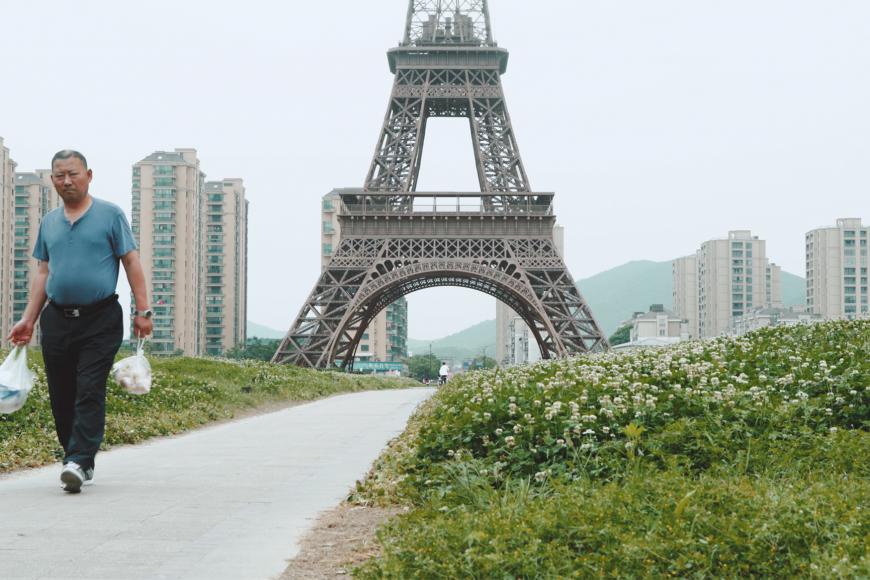
Impressions of an imaginary city, filmed on the background of the Chinese zeal for globalization: Contexts of meaning and geographical borders blur and reconstitute themselves.
The account of a journey through an imaginary city, filmed along China’s new trade routes. Like the fictionalized Marco Polo from Italo Calvino’s “Invisible Cities”, the traveller in this film talks of worlds that resemble familiar places but follow their own, sometimes seemingly incredible rules. The observations condense into a meditation about the nature of cities and the transformation of the concept of globalization.
The foreign visitor’s voice sounds muffled, as if it were coming out of the cave whose interior views open the film. Time and again, the eye returns there – but the fluorescent rock faces soon turn into the sparkle of distant galaxies, the narrow confines of the cave indistinguishable from the vastness of space. It is a symbol of the decoupling of sign and meaning, of “real” and “false”, of sensual impressions and their positive geographical allocation that pervades the film: Daft Punk perform in front of a Chinese shopping mall; the Eiffel Tower stands first in a housing estate, then, folded up to a fraction of its size, in view of Big Ben and Tower Bridge.
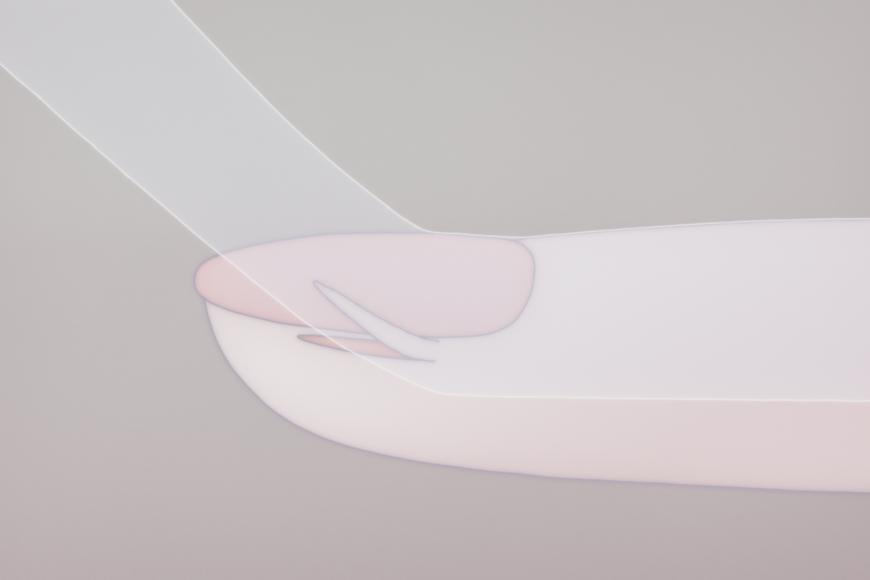
Tszzzzidd – skin and adhesive tape separate slowly, almost lasciviously. Sensual variations on pain and pleasure in a calm but scalpel-sharp drawn animation.
Tszzzzidd – skin and adhesive tape separate slowly, almost lasciviously. From a sober physical point of view, forces between molecular bonds are being overcome. Yoriko Mizushiri composes brief, highly sensual variations on pain and pleasure based on this phenomenon. Restrained, calm and scalpel-sharp, she creates two-dimensional drawn animations in subdued colours, accompanied by cool electronic sounds that explode in one’s head only to scatter into the anxious but curious body.
André Eckardt
Credits
Director
Yoriko Mizushiri
Producer
Emmanuel-Alain Raynal, Pierre Baussaron, Nobuaki Doi / New Deer
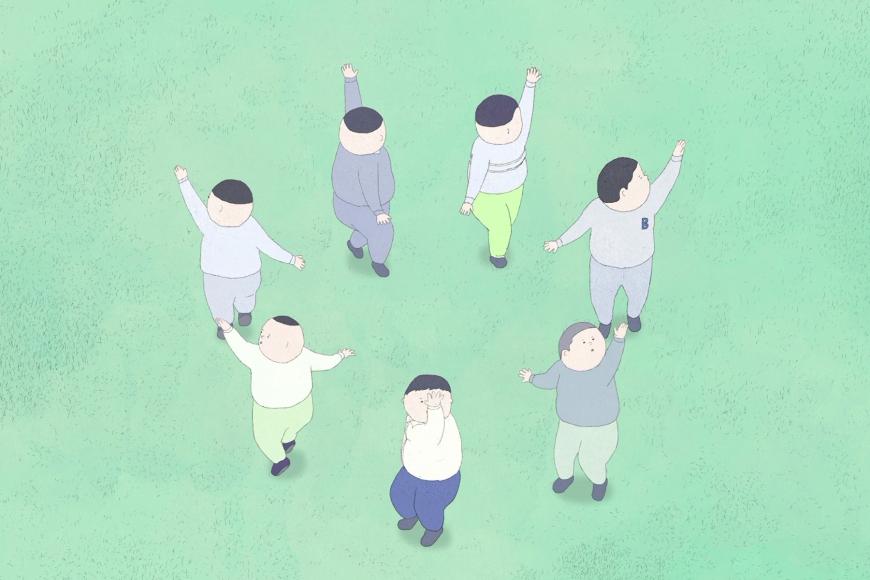
A boy, a girl, a bird with a swan’s neck nestling in hands, a gently wooded peninsula of longing: Atsushi Wada’s almost speechless animation, mapped out in uniform and unicoloured chains of motifs and events, follows the dream and shame logic of a sexual awakening. There’s a sadness about the rounded and infantile figures, perhaps that of a first “little death”.
Sylvia Görke
Credits
Director
Atsushi Wada
Editor
Atsushi Wada
Producer
Emmanuel-Alain Raynal, Pierre Baussaron, Nobuaki Doi
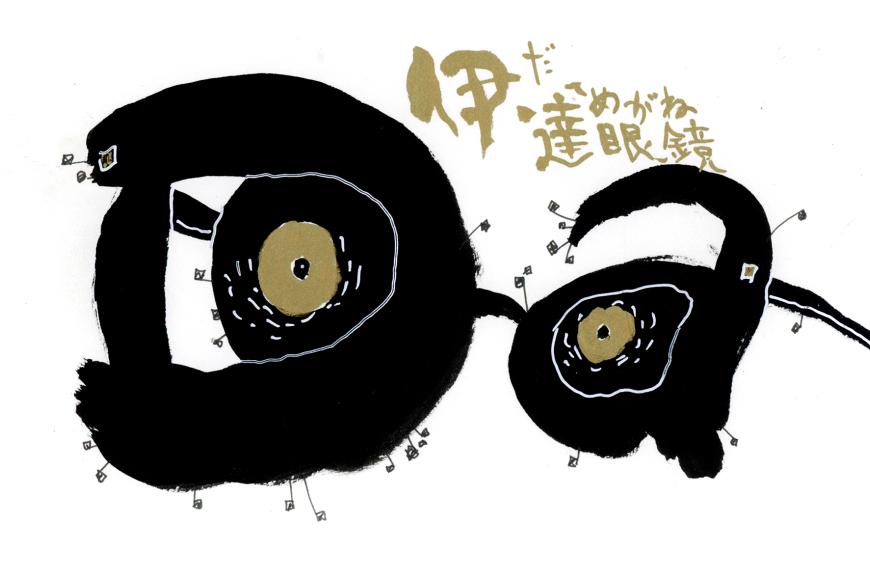
The last syllable on the lips of a dying man is “da”. Koji Yamamura translates a short story by author Hideo Furukawa into a thrilling and highly dynamic film.
Life is short, extremely short. The time between birth and death seems to fly by. Snip your finger – and it’s all over. The last seconds are just long enough to pronounce the syllable “da”. It is precisely this syllable, spoken with someone’s last dying breath, that is picked up by a man who looks for the shortest of all things in the streets of Tokyo. The syllable whirls through his thoughts, triggering a torrent of reflections on the Japanese language that he gets more and more worked up about. In a dadaist manner, the “da” words hurtle at us like notes in jazz. Bold ink drawings move across the white background, sometimes fluidly, sometimes explosively. A last “da” completes the extemporisation and brings to a standstill all the energetic circling and vibrating that dominated the image before. The dying man closes his eyes. But the end is followed by a new beginning. “Extremely Short” marks the start of the series “Bungaku Bideo” – literature videos – which, commissioned by the Yanai Initiative, makes innovative accomplices of contemporary Japanese literature and international animation. In this case, Koji Yamamura encounters a piece of prose by Hideo Furukawa, listens to the monologue recited by the author himself and translates his linguistic furor into an exciting visual form.
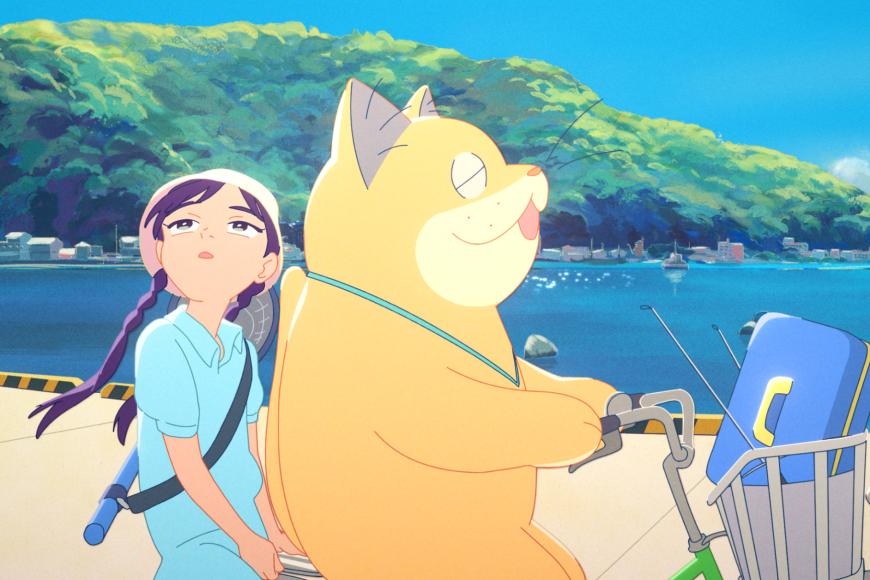
Left alone by her father, eleven-year-old Karin makes friends with a talking monster cat. This launches a wild and fantastic tour de force through fabulous and hellish worlds.
Eleven-year-old Karin is spending the summer in the country, where she makes friends with a giant talking cat. So far, so cute. But there is more to come. Her father has run up debts with gangsters who will beat him half to death. The god of poverty stalks Karin. He will take her to hell, where her deceased mother is spending eternity as a cleaning lady. Does this still sound cute? If “Ghost Cat Anzu” is meant to be a children’s film, it is the most merciless one you can imagine. The cat demon, or Bakeneko, is a well-known character in Japanese mythology. And there are other familiar patterns in Takashi Imashiro’s manga on which this film is based: the portal to a parallel world, the mythical creatures in the forest … But the devil is in the details, for comic and adaptation handle the traditions with an astonishing degree of irreverence; humans and ghosts often behave like unmitigated louts, and the entrance to hell is through a toilet bowl. First-time director Yôko Kuno and the renowned Nobuhiro Yamashita, who has co-directed an animated film for the first time here, work with rotoscoping. The quirky, cartoon-like figures and painterly backgrounds contrast so harmoniously, the highlights are so lovingly placed that one can feel, taste, smell and grasp the sultry summer atmosphere.
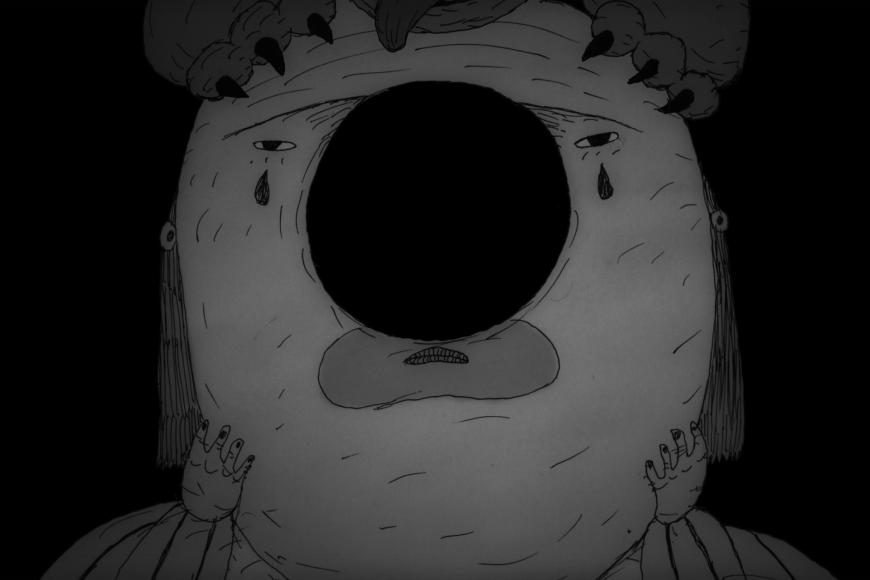
The life of a nameless orphan, from reluctant J-Pop idol to futuristic god figure. A hellish ride through the depths of human depravity, visualized with imagination and love.
The original title of this film can be roughly translated as “A Nameless Life” and there is really no other way to sum up the story. We will never learn the protagonist’s real name, but in the one hundred lonely years that we accompany him for 90 minutes of cinema, we see ever new facets of him. The film opens with a seemingly innocent montage of taxi rides in 1994. But as nonchalantly as the scenes are strung together here, it is important to pay attention to the subtleties if you want to stay on top of things during the ensuing century-long trip. The journey begins in the northern Japanese province and takes us through the J-pop world of Tokyo’s hip Harajuku district to a post-apocalyptic future where Fernand Léger and Stanley Kubrick shake hands. Ryuya Suzuki is considered an outsider in contemporary Japanese animation. He is the sole author, director, animator, editor, and musician here. “Jinsei” is entirely his vision, a film about life and death, fate and rebellion, about power and powerlessness, unsparing and emotional. The 2D animation is imaginative, surprising, usually minimalist, always irritating, occasionally contemplative and then explosive. A hellish ride through human abysses, produced with so much attention to detail that new spaces open up every time you watch it.
The mocking transvestite, the raging dog, the prophetic clown and the little girl, all united inside the desperate protagonist. A crisis full of poetic dignity.
The mocking transvestite, the raging dog, the prophetic clown and the little girl are united inside the desperate protagonist. The longing to break free rises forcefully – like a pistol pressed against his chest. In humorous metaphors, Hakhyun Kim takes a crisis of disorientation to extremes, while his extraordinary stylistics lend it poetic dignity.
Over three decades, Uwe Walter from Gelsenkirchen has become part of the Japanese village community of Miyama. This moves him at last to say goodbye to the past.
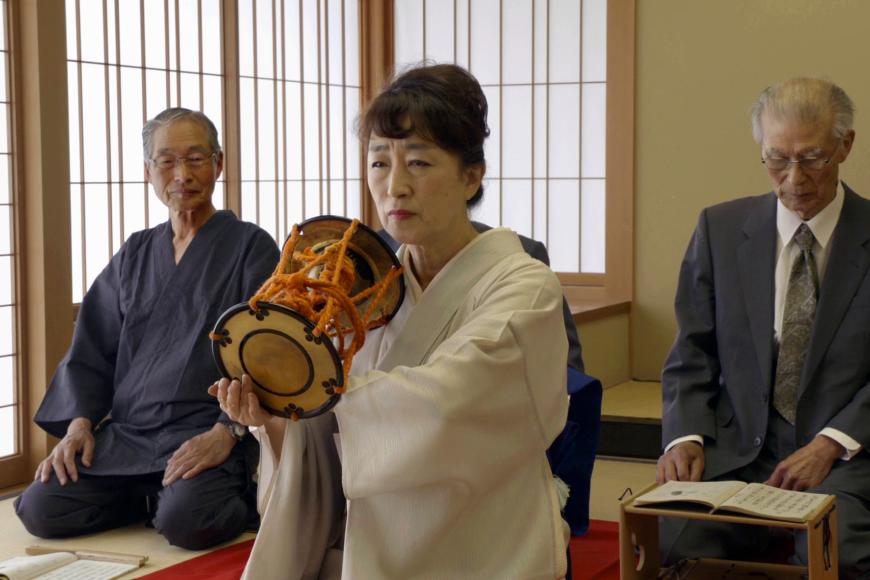
There’s probably no other citizen of Gelsenkirchen who has ever mastered Nō singing and playing the Shakuhachi flute as authentically as Uwe Walter. He has lived in the mountain village of Miyama north of Kyoto for three decades and emulates the local residents, whether they earn their living on the fields, breeding cattle or hunting. People tend their gardens, repair fences to keep away the macaques and grow their own rice. Uwe has become perfectly Japanese, at one with his environment.
However well-suited his Ruhr area wit makes him as a figure of identification, the camera keeps a respectful distance, more reserved than Uwe himself. Only at one point does it come touchingly close: When he is forced to say goodbye to an essential part of his past in the interest of the village community. But the real subject of this film is not the German with his greyish blonde curls but rather that very community, portrayed by Rainer Komers in bittersweet polyphony. It emerges in the children’s games, the adults’ pursuits and the old people’s tales, in the summer downpours of the rainy season, the white moon over the nocturnal village and the blood-red leaves of autumn.
Christoph Terhechte
Credits
Director
Rainer Komers
Script
Gregor Bartsch
Cinematographer
Rainer Komers
Editor
Gregor Bartsch
Producer
Rainer Komers
Sound
Uwe Walter, Yuki Morimoto, Michel Klöfkorn, Oscar Stiebitz
Score
Uwe Walter, Yuki Morimoto
World Sales
Joachim Kühn
Broadcaster
Doris Hepp
Key Collaborator
Hiroko Inoue
Nominated for:
VER.DI Prize for Solidarity, Humanity and Fairness
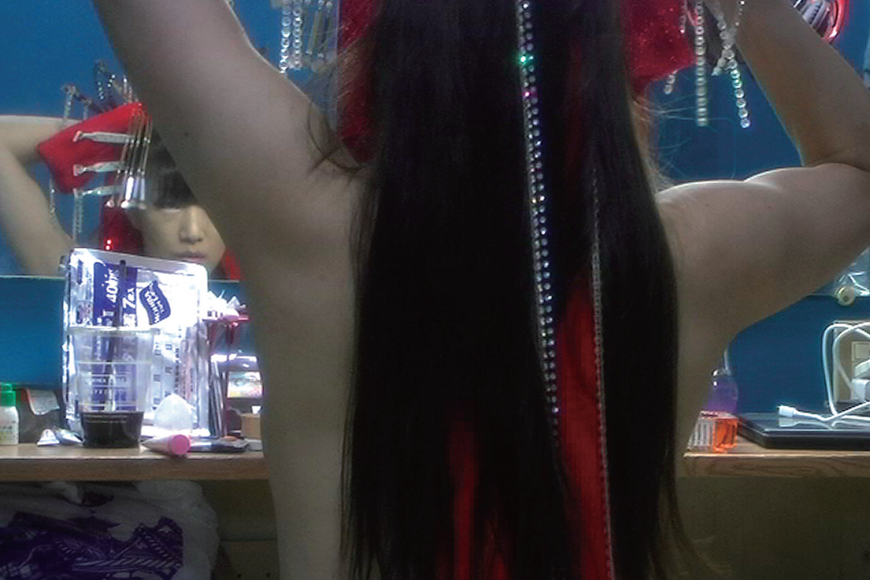
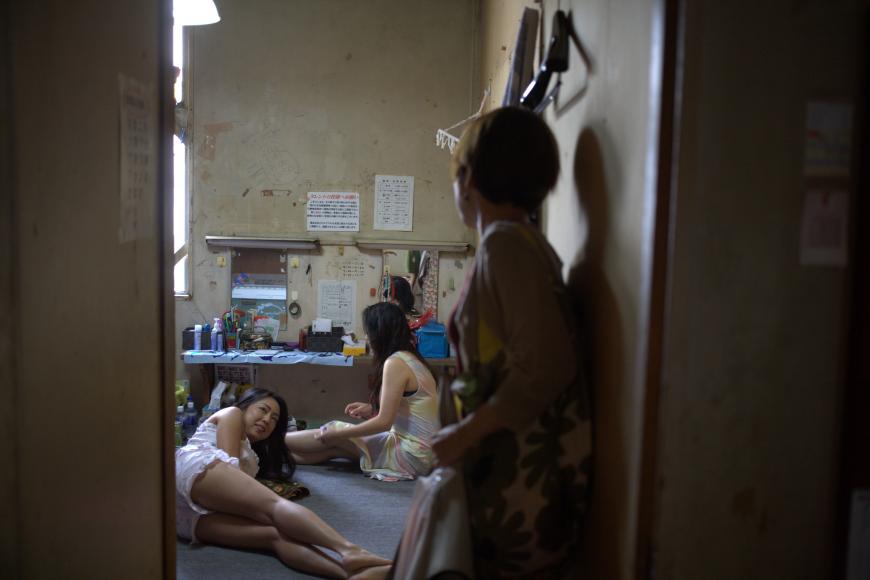
A background study of a dying amusement culture, filmed in slovenly dressing rooms in front of badly polished make-up mirrors. – That’s how far editor Mary Stephen follows director Yoichiro Okutani’s montage interpretation of his own footage about the Japanese strippers called Odoriko. But Stephen’s editor’s cut begins fully dressed: a tastefully lit stage overture in costume, starting from which she rearranges or rather sheds the material, reintegrating image and sound sequences originally discarded by Okutani, for example the titular statement of an Odoriko explaining her choice of profession: “It was about being nude at heart.”
A background study of a dying amusement culture, filmed in slovenly dressing rooms in front of badly polished make-up mirrors. – Director Yoichiro Okutani follows the Odoriko, the Japanese strippers, through their daily routine between dressing and undressing, between pragmatic approaches to life and eroticism made fit for the stage. Okutani’s cut begins naked: A nude woman descends a staircase, filmed not to advantage but with the brutal ordinariness of routine. One production year and five minutes lie between this – Okutani’s – director’s cut and Mary Stephen’s editor’s cut “Nude at Heart”. But how much more?
Sylvia Görke
Credits
Director
Yoichiro Okutani
Script
Yoichiro Okutani
Cinematographer
Yoichiro Okutani
Editor
Yoichiro Okutani, Keiko Okawa
Producer
Asako Fujioka, Eric Nyari, Yoichiro Okutani, Annie Ohayon-Dekel
Paper and colour pigments lead a life of their own. The material awakens and opens its mouth. The colours begin a subtle dialogue about the difficulties of human interaction.
Paper and colour pigments lead a life of their own. The material awakens and begins to talk, opening its mouth. The colours speak to each other, their substances add up to form a multi-layered tale about the strains of dialogue and interaction. The texture of the hand-painted individual frames is closely interwoven with a sonic tapestry of human sounds and minimalist electronic resonances.
A consensual union becomes a brutal assimilation that ends in death and a new beginning. Powerfully moving colours and fascinating sounds transport irritating emotions.
The two main characters of this film seem made for each other. They literally fit together, merge into each other, melt into a colourful, psychedelic, swirling whole. They function together, until one of them disconnects. The madness of this riot of colours turns into a dark nightmare when the one left behind re-absorbs the other by force. Against her will, the renegade must now be sewn to her partner. The once flourishing relationship degenerates into an irritating visual and audio chaos of aggressively twitching drawings and shattered sounds. Impaled on a gnarly tree, the couple’s bodies decay. As they are dying away, darkness turns into light and fresh blossoms open on the pale bones.
Franka Sachse
Credits
Director
Xu Yuan
Producer
Tomokazu Nomura
Sound Design
Nanami Sato
Animation
Xu Yuan
Nominated for:
Gedanken Aufschluss Prize,
mephisto 97.6 Audience Award