Film Archive

Sections (Film Archive)

Media Name: a5d40ef7-ec19-4c7c-ac61-17a584683d48.jpg

Abyssal

Abisal
Alejandro Alonso
International Competition Short Film 2021
Documentary Film
Cuba,
France
2021
30 minutes
Spanish
Subtitles: 
French, English
A ship scrapyard in western Cuba. The observing camera follows Raudel and his colleagues who work in what seems like a hermetically sealed microcosm. A homing pigeon strays into the place; the workers contemplate it silently as they smoke. Sometimes they talk about their dreams. Shots are focussed in turns on their bodies and their surroundings. Rhythmic, artfully crafted and authentically produced sounds accompany precise and lucid images, without aestheticizing the harshness of their work.
Borjana Gaković

Credits DOK Leipzig Logo

Director
Alejandro Alonso
Script
Lisandra López Fabé, Alejandro Alonso
Cinematographer
Alejandro Alonso
Editor
Emmanuel Peña
Producer
Boris Prieto, Alejandro Alonso, Oderay Ponce de León
Sound
Glenda Martínez Cabrera, Velia Díaz de Villalvilla, Alejandro Pérez
Score
Pepe Gavilondo
World Sales
Boris Prieto
Funder
Norwegian Fund for Cuban Cinema, CNC / Aide aux cinémas du monde
Winner of: Golden Dove Short Documentary (International Competition Short Film)
Retrospective 2024

Hello Cubans

Agnès Varda
The grande dame of French Nouvelle Vague spent the turn of the year 1961/62 in Cuba. She came back to Europe with a photo film full of cha-cha-cha and cheerful socialism.
Filmstill Hello Cubans

Hello Cubans

Salut les Cubains
Agnès Varda
Retrospective 2024
Documentary Film
France,
Cuba
1963
30 minutes
French
Subtitles: 
English
At the turn of 1961/62, Agnès Varda travelled to Cuba and saw a country that integrated Marx and Lenin into the everyday life of the Caribbean. Cha-cha-cha was part of it, but also cars à l’américaine. At her Parisian animation stand, Varda animated the black and white photos she had brought back home in an almost jaunty photo film. Chris Marker, her close friend from the Rive Gauche circle of the French Nouvelle Vague, had just paved the way for this cinematic form. They also shared an enthusiasm for the Cuban Revolution – and finally even a bit of Leipzig festival experience: In 1964, Varda’s moving photo montage won the Silver Dove. Despite or because of the subtle irony with which she looks at this somewhat improvised socialism?
Sylvia Görke

Credits DOK Leipzig Logo

Director
Agnès Varda
Editor
Janine Verneau
Producer
Société Nouvelle Pathé-Cinéma, Ciné-Tamaris
Narrator
Agnès Varda, Michel Piccoli
Retrospective 2023

Noticiero ICAIC Latinoamericano, No. 422

Santiago Álvarez
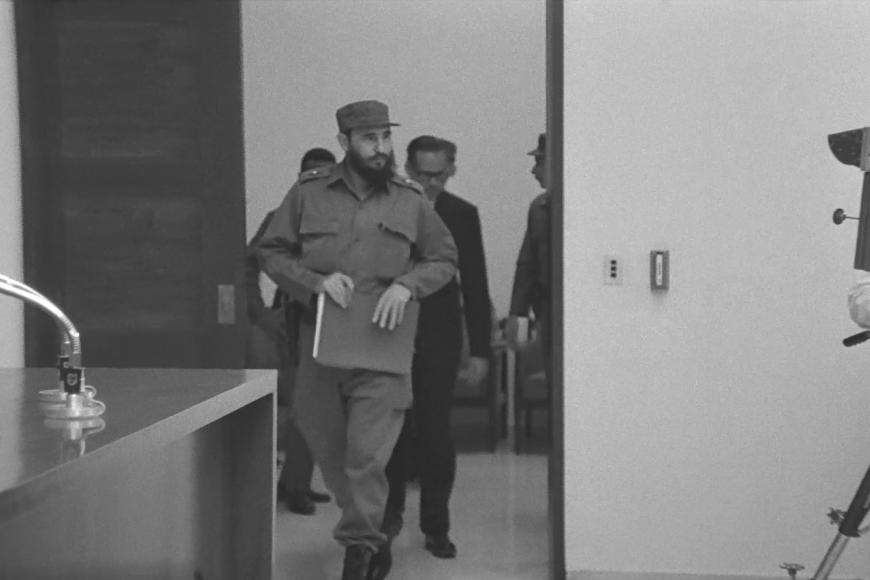
Fidel Castro comments on the events of the Prague Spring – in surprisingly critical terms. This newsreel report was withdrawn from the Leipzig festival programme in 1968.
Filmstill Noticiero ICAIC Latinoamericano, No. 422

Noticiero ICAIC Latinoamericano, No. 422

Noticiero ICAIC Latinoamericano, No. 422
Santiago Álvarez
Retrospective 2023
Documentary Film
Cuba
1968
14 minutes
Spanish
Subtitles: 
English
In September 1968, Fidel Castro comments on the suppression of the Prague Spring in surprisingly critical terms. He opens his thunderous speech with the statement that it could endanger Cuba’s safety. Although Santiago Álvarez was the guest of honour at the Leipzig festival, this newsreel report was withdrawn from the programme. After long research it will be shown for the first time in Leipzig in this Retrospective.
Katharina Franck, Andreas Kötzing

Credits DOK Leipzig Logo

Director
Santiago Álvarez
Producer
Instituto Cubano de Arte e Industria Cinematográficos ICAIC
Retrospective 2024

People at the Beach

Néstor Almendros
A poetic evocation of the beaches of Havana: people in the sun, in the water, in cafés, in embraces. Unofficial images and sounds of post-revolutionary Cuban relaxation.
Filmstill People at the Beach

People at the Beach

Gente en la playa
Néstor Almendros
Retrospective 2024
Documentary Film
Cuba
1960
12 minutes
without dialogue
Subtitles: 
None
The beaches of Havana, splashing around, tender gestures between lovers, the sun glistening on the water, hips swaying to music. With this light-handed etude, Néstor Almendros delivers a shimmering testimony of post-revolutionary relaxation – and an early proof of his virtuosity as a cinematographer.
The film was made at ICAIC – and disappeared there, too. The national film art institute founded in 1959 by order of the new government saw no place for such neorealistic extravaganzas in the new Cuban cinema and issued a screening ban. Néstor Almendros left Cuba in 1961 to become a world-renowned cinematographer in the US and Europe. His name was expunged from the ICAIC filmography published in the book accompanying the 1974 Cuban retrospective in Leipzig.
Sylvia Görke

Credits DOK Leipzig Logo

Director
Néstor Almendros
Script
Néstor Almendros
Cinematographer
Néstor Almendros
Editor
Néstor Almendros
Sound
Néstor Almendros
Retrospective 2024

The Truth About Fidel Castro Revolution

Victor Pahlen
Hollywood star Errol Flynn loves Havana, its casinos and its cocktails. As an eyewitness to the Cuban Revolution, he also learns to love Fidel Castro, the “Cuban Robin Hood.”
Filmstill The Truth About Fidel Castro Revolution

The Truth About Fidel Castro Revolution

The Truth About Fidel Castro Revolution
Victor Pahlen
Retrospective 2024
Documentary Film
USA,
Cuba
1959
51 minutes
English
Subtitles: 
None
When Hollywood star Errol Flynn appeared on the Leipzig festival screen in 1960, he had been dead for a year. The audience saw him in his last role: as an aged lover – of Havana, casinos and cocktails, as the nemesis of the Cuban liberation movement, which had declared war on corrupt bon vivants like him. The movie swashbuckler rhapsodises about his Cuban counterpart Fidel Castro and nonchalantly moderates the history of the dictatorship and liberation of the island state, cigarette holder in hand.
Did Hollywood call Leipzig to recommend this film? It was probably Moscow, because its world premiere is said to have taken place there in 1959. But how did the self-confessed anti-communist Errol Flynn come to make this declaration of love? Maybe his new friend Fidel did not tell him the whole truth?
Sylvia Görke

Credits DOK Leipzig Logo

Director
Victor Pahlen
Script
Victor Pahlen
Producer
Victor Pahlen
Narrator
Errol Flynn