The portrait of a young, queer generation in a Colombia marked by violence and repression, told as a real-life ghost story in atmospheric and morbid images.
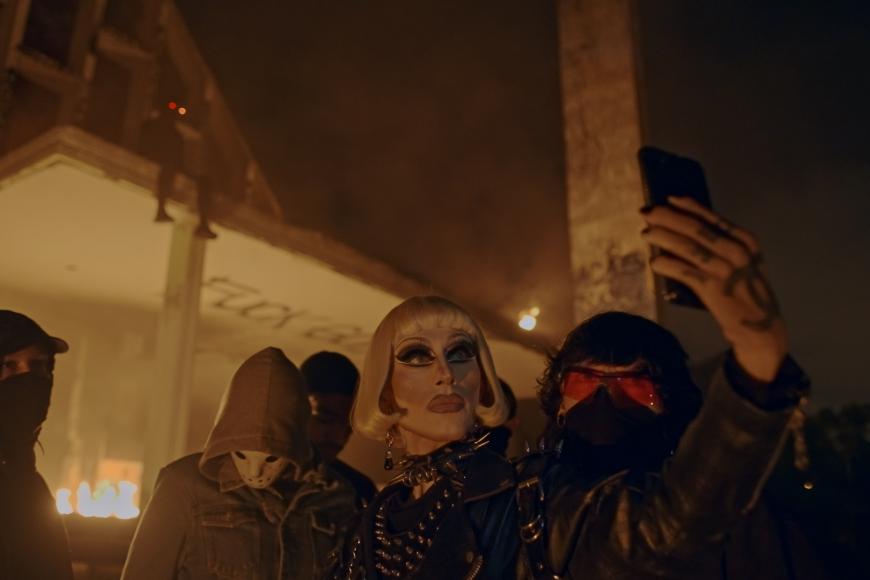
Theo Montoya draws on casting outtakes, melancholy observations of daily life and decadent party impressions from his friends to create a morbid and yet tender portrait of a young, queer generation in Colombia. In a country marked by violence and repression they can hardly imagine their future, but maintain a close, almost loving relationship with death.
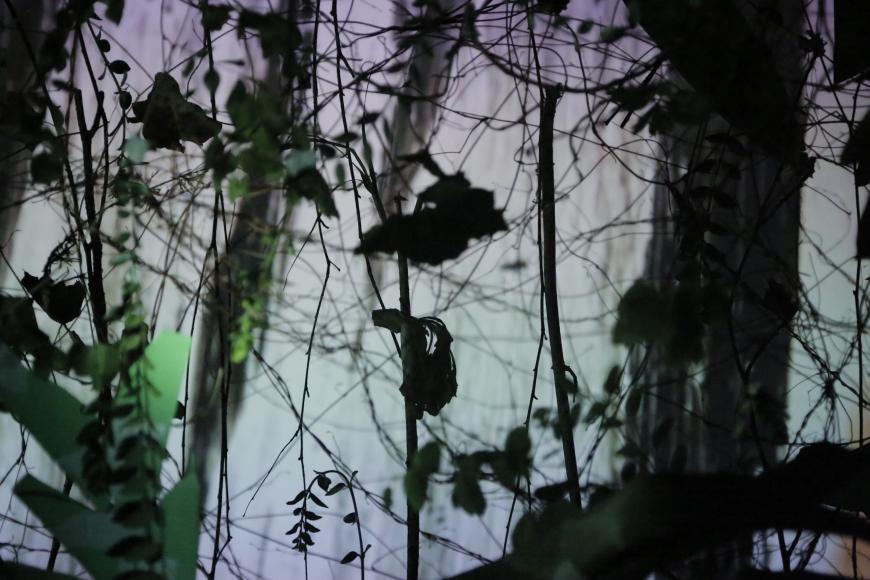
This was meant to be a fiction film: a ghost story in which the dead no longer find cemetery space and consequently coexist with the living, including having sexual relationships – which the state rigorously forbids and persecutes. A clandestine nocturnal subculture emerges where erotic desires for which daylight means annihilation can be acted out. A week after Montoya found his leading actor for the project, the latter died of a heroin overdose. More deaths among his friends follow. They are the ghosts haunting the film that was ultimately made. It retains its dystopian character, but the dangers it portrays are quite real: For these young people, they are part of everyday life in Medellín, which is still deep in the shadow of Pablo Escobar and where the search for pleasure and human warmth takes one through labyrinthine abysses.
Carolin Weidner
Credits
Director
Theo Montoya
Script
Theo Montoya
Cinematographer
Theo Montoya
Editor
Matthieu Taponier, Delia Oniga, Theo Montoya
Producer
Theo Montoya, Juan Pablo Castrillón, Bianca Oana, David Hurst
Co-Producer
Balthasar Busmann, Maximilian Haslberger
Sound
Eloisa Arcila Fernandez, Estephany Cano
Sound Design
Marius Leftărache, Victor Miu
Score
Vlad Feneșan, Marius Leftărache
Winner of:
Golden Dove (International Competition)
Katrin Hauser, Lenia Friedrich, Arjun Patel, Milan Haupt, Dexin Yin, Quingqi Ren, Tianyi Zhang, Diego Herguera, Raquel Gálvez Soto, Toni Planas Portas, César García Villafaina, Inés Gonzáles, Candela Carroceda, Agata Tracevič, Justinas Erminas, Eva Rodz, Žilvinas Baranauskas, Margarita Valionytė
Hommage: Isabel Herguera 2024
Animated Film
Germany,
Switzerland,
China,
India,
Mexico,
Colombia
2020
16 minutes
English,
Hindi,
Chinese,
Italian,
Spanish,
Albanian,
Portuguese (Portugal)
Subtitles:
English
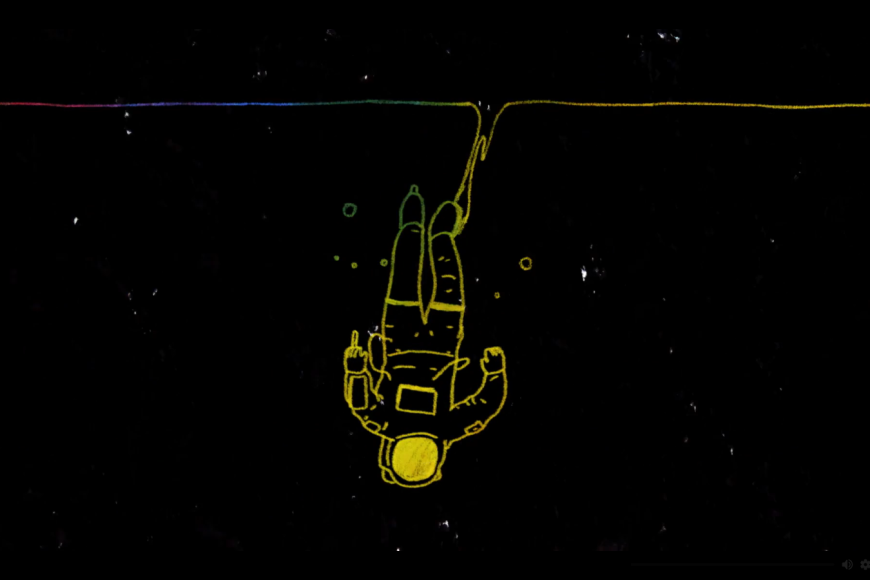
In early 2020, the lockdown has brought the world to a halt. Homes become space stations, hermetically sealed off from the outside world. Nobody goes out, only the thoughts go wandering. Students of seven international universities exchange personal impressions of and reflections on this forced isolation online and get to know each other through this joint project.
Franka Sachse
Credits
Director
Katrin Hauser, Lenia Friedrich, Arjun Patel, Milan Haupt, Dexin Yin, Quingqi Ren, Tianyi Zhang, Diego Herguera, Raquel Gálvez Soto, Toni Planas Portas, César García Villafaina, Inés Gonzáles, Candela Carroceda, Agata Tracevič, Justinas Erminas, Eva Rodz, Žilvinas Baranauskas, Margarita Valionytė
In the global North, the DC-3 is regarded as a vintage plane and tourist attraction. In Colombia, however, it is still used as an airliner and serves as the only link to the outside world for remote villages in the Amazon region. The history of the former “Raisin Bomber” reflects economic and hegemonic conditions. Now the DC-3 raises its voice in an entranced cinematic journey through time and space to talk of dangers, sensual experiences – and a mystic passenger.
Picture by picture a daughter looks through the family album, encountering parents, siblings, parties and excursions. In her commentary one can taste the salt and poison behind that normalcy.
Competition for the Audience Award Short Film 2020
Animated Film
Colombia
2020
10 minutes
Spanish
Subtitles:
English
Click, frame change, click, frame change. The narrator presents her family in snapshots: the father in his youth, the mother posing in an armchair, siblings, birthdays, excursions, the usual. But the commentary by the daughter looking back adds something profoundly salty, perhaps even poisoned, to the unfolded normalcy. Tiny insults accumulate into sadness. It (almost) doesn’t matter that the family members in question are sloths.
The breasts are in place, the feathers are smoothed, off to the date! Her daughter does not comprehend the ritual of desire yet … Erotically crude, with pointed beaks in the conflicts.
Breasts lifted, bottom tight, feathers smoothed. She is ready for her date. But her daughter clings and refuses to let her go to this as yet incomprehensible, repulsive ritual of desire. Very soon the fully-fledged adolescent will indulge in sexual lust herself … and experience disappointments. In the conflicted world of the two women, men evade partnership and fatherhood. The faithful bitch offers the only support.
As in her previous film, Carla Melo Gampert transfers her impressive but uncompromising analysis of family relationships to the lives of wading birds. Human traits show through in the anatomy, but the bird’s bodies including their feathers and sounds lend themselves perfectly to the apt exaggeration of emotions. Delicate strokes turn into cuttingly sharp movement lines of the animal characters, both in their erotically crude acts of love and their “hands-on” disputes. Soft splashes of watercolour glow incandescently in the heat of lust and warningly in the hopeless fury.
The letters of former FARC guerrilleros from Colombia supply the basis of these personal memories. – A touching film with an impressive joy of visual experimentation.
Former fighters of the Colombian FARC guerilla report in letters on their most formative experiences from their time in the armed underground. University students from three continents adapt these personal memories in a parallel collective process to develop a touching film whose visual joy of experimentation is impressive.
Franka Sachse
Credits
Director
collective
Producer
Kunsthochschule für Medien Köln, National Institute of Design, Universidad Nacional Autónoma de México, Universidad Nacional de Colombia en Bogotá, Pontificia Universidad Javeriana, China Central Academy of Fine Arts
A fictitious explorer reports on gold-mining and its commercialization in Venezuela. Paradoxically, the gold diggers live off nature – and destroy it at the same time.
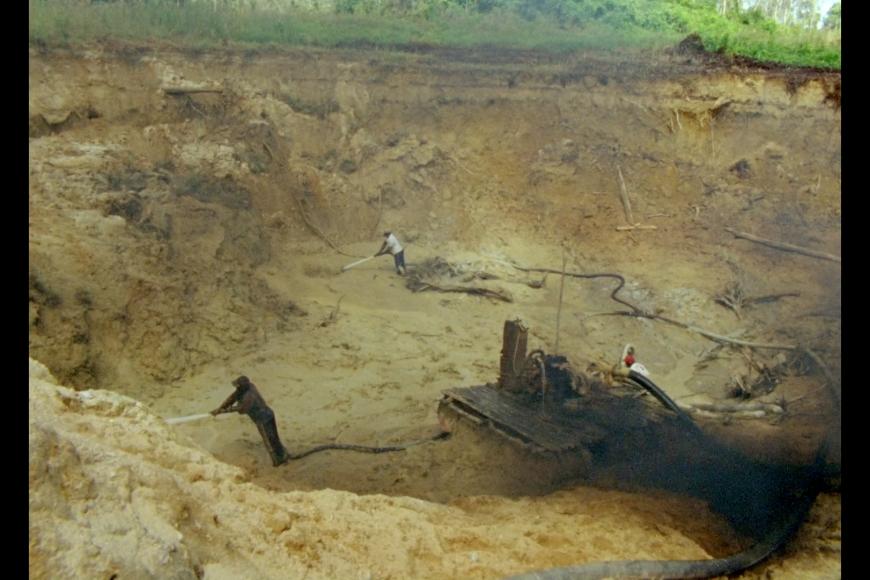
In the deliberately chosen style of an old-fashioned field report, a fictional explorer describes his observations on gold-mining in Venezuela. His mission takes him along the Orinoco, from remote jungle mines to industrial zones. His focus stays on the workers and their environment. The titular Moriche palm tree, an edible and crop plant growing along the river, serves as an example for the relationship between humans and nature and their use of raw materials. Paradoxically, the gold-diggers live in harmony with Mother Earth as their nourisher and healer, but at the same time destroy her. As in so many other places in the world, their very survival depends on an economic system inherited from colonialism. The rapid pace of capitalism is in glaring contradiction to the arduous extraction of the gold dust, produced only by slow processes of erosion. As the narrator drifts along the river and meditates on different contexts, the images work their way through the layers of the complex subject. The immersive poetic journey alternates between observational Bolex shots, hand-drawn illustrations and abstract visualisations of photochemical reactions. Accompanied by a sound design both distinct and elaborate, the lustre of the gold literally glitters from the screen.
Annina Wettstein
Credits
Director
Chris Gude
Script
Chris Gude
Cinematographer
Chris Gude
Editor
Felipe Guerrero, Chris Gude
Producer
Chris Gude, Felipe Guerrero, Maite Bermúdez, Adriana Agudelo
Sound Design
Felipe Guerrero, Chris Gude
Score
Maximilian Gude
World Sales
Michaela Čajková
Narrator
Jorge Gaviria
Nominated for:
Prize of the Interreligious Jury,
FIPRESCI Prize,
Silver Dove
In northern Colombia Dolly takes the railway to drive people from village to village every day – with a “Motorrodillo”, a surrogate train equally ingenious and improvised.
In rural northern Colombia, where the railway has long been discontinued, people help themselves with a fleet of “Motorrodillos” – motorcycle-driven miniature trains. Every day, Dolly and her colleagues take school kids, goods and travellers on rugged routes from village to village. If you meet oncoming traffic on the way, you get off the rails. If you find holes in the rails, you mend them yourself. The affectionate portrait of a self-organised transport system.
Marie Kloos
Credits
Director
Alba Jaramillo
Cinematographer
David Horacio Montoya
Editor
Francine Lemaître
Producer
Qutaiba Barhamji, Marie-Odile Gazin, Alba Jaramillo
This alien body that does not seem to be yours. It is too conspicuous, too tall, and then again too insignificant. A cinematic reconciliation with being different.
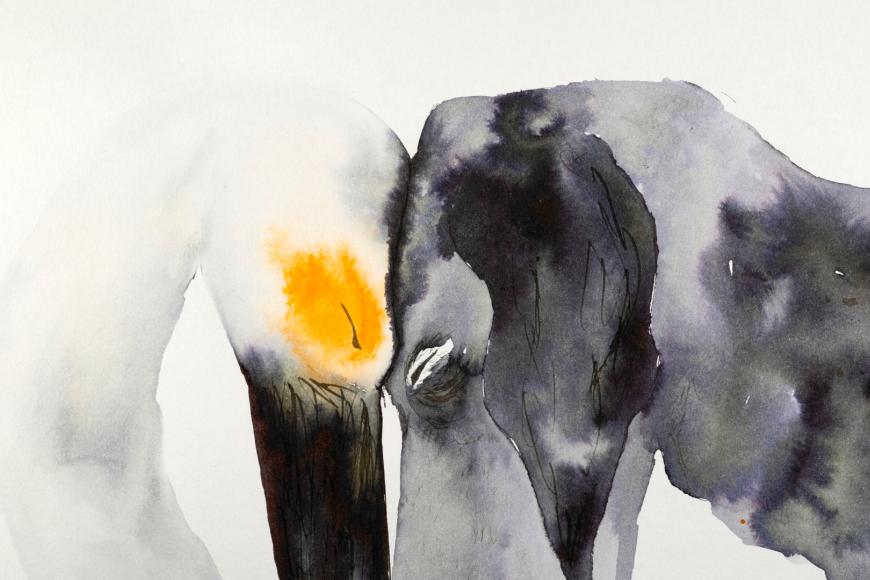
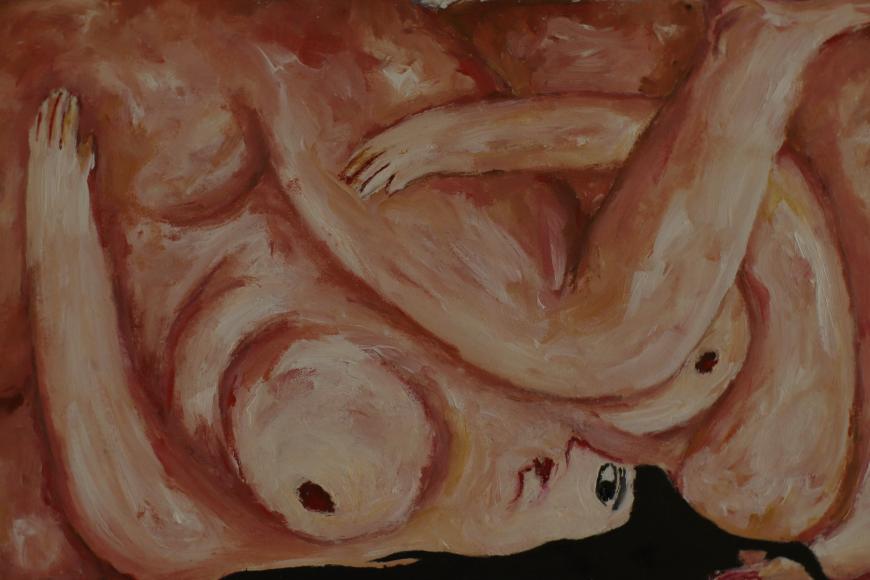
“There was a body that didn’t want to be human. It didn’t know it belonged to someone. To me.” María Cristina Pérez González opens her film with these poetic and cryptic words, diving deep into the visually powerful, hand-painted animation. Associative rather than narrative, the sad voice pulls us into a maelstrom of remembered fragments that all revolve around the protagonist’s body: A voluminous shape that sometimes eats itself with loathing, stretches until it fills the frame or cowers like a pea – in the blackness of the fluid, generous brushstrokes, but above all in its own fleshy self. There is the estranged sister who once called the feet of this body ugly. The good friend who disappeared without a farewell. The father who once said that all unhappy women grow fat. And most of all there is this nameless figure that lives in her belly and feeds her depression with a cute grin. As so often in life, the only path to contentment is reconciliation. With the sister, of course, but above all with her own body which does not fit into narrow social norms – but is the only one she has. And with which she can dance, jump, and even laugh quite splendidly once she understands that it is not a monster to be fought.
Marie Ketzscher
Credits
Director
María Cristina Pérez
Script
María Cristina Pérez
Editor
Mauricio Cuervo Rincón
Producer
Mauricio Cuervo Rincón
Co-Producer
Mireia Vilanova, James Belfer, Adam Belfer
Score
Daniel Gwilym Jones Cozzarelli
Animation
Laura Alcina, Natalia Rojas Noy, Megumi Cardona, Gizenth Barreto, Fabián Llantén, Anamaría Sáenz Peñas, Julián Arias Garzón, Juan Pablo Figueroa, Daniel Bonza
Vuk Jevremović, Juan Camilo González, Cecilia Traslaviña, Isabel Herguera, José Belmonte, Carlos Santa, Richard Reeves, Kemei Cheng, Liming Wang, Koldo Almandoz
A shipwreck, the fog bells of a lighthouse, the changing tides. A film as the result of an inter-oceanic workshop: an intuitive narrative, generated by a collective act of creation.
Vuk Jevremović, Juan Camilo González, Cecilia Traslaviña, Isabel Herguera, José Belmonte, Carlos Santa, Richard Reeves, Kemei Cheng, Liming Wang, Koldo Almandoz
Hommage: Isabel Herguera 2024
Animated Film
Spain,
Colombia,
China,
Oman,
USA,
Singapore
2013
6 minutes
English
Subtitles:
None
Tattooed skin, harbour music, the horror of a shipwreck, the fog bells of a lighthouse, the changing of the tides. This film about the glorious and deadly ocean, which pulls you down into the depths of the sea, is the result of an interoceanic workshop that uses the creative mechanisms of the cadavre exquis technique. An intuitive tale arises from a collective act of creation.
Franka Sachse
Credits
Director
Vuk Jevremović, Juan Camilo González, Cecilia Traslaviña, Isabel Herguera, José Belmonte, Carlos Santa, Richard Reeves, Kemei Cheng, Liming Wang, Koldo Almandoz