Along the river Oder: Virulent questions about homeland and community, everyday life and politics, asked with confident casualness, provide an account of the present.
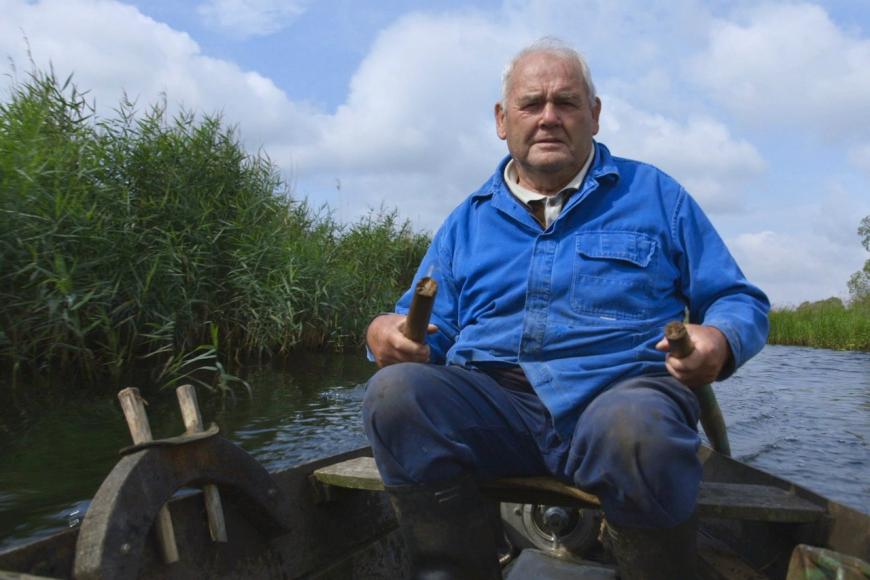
The river Oder: A historical and cultural landscape churned again and again by the tide of events of the past century. A tale told in concentric circles about a region which was and still is the scene of the beginning, end and open middle of voluntary and involuntary migrations. Virulent issues of daily life and politics that, asked with confident casualness, provide a robust account of the present.
Movements and stories in the border region between Poland and Germany – Andreas Voigt’s new film takes up the themes of his 1992 work “Borderland – A Journey”. The charged term “homeland” stirs up (trouble in) the minds and hearts of the people: What it once was and what has become of it! Sure, that’s not the top priority in their daily agenda. But how people appropriate this term and how that in turn structures their attitudes also determines how they figure out the taste of life in the here and now of Europe. The search for closeness is confronted with the insistence on distance. Communication about belonging becomes flimsy because the body language says something different than the spoken word. As a film that’s not about administering a politically correct separation diet, “Borderland” provokes experiences and enables encounters.
In this existentialist animated folly, figures suffering from the absurd wander through a good dozen laconic momentary miniatures, looking for what can’t be found: meaning.
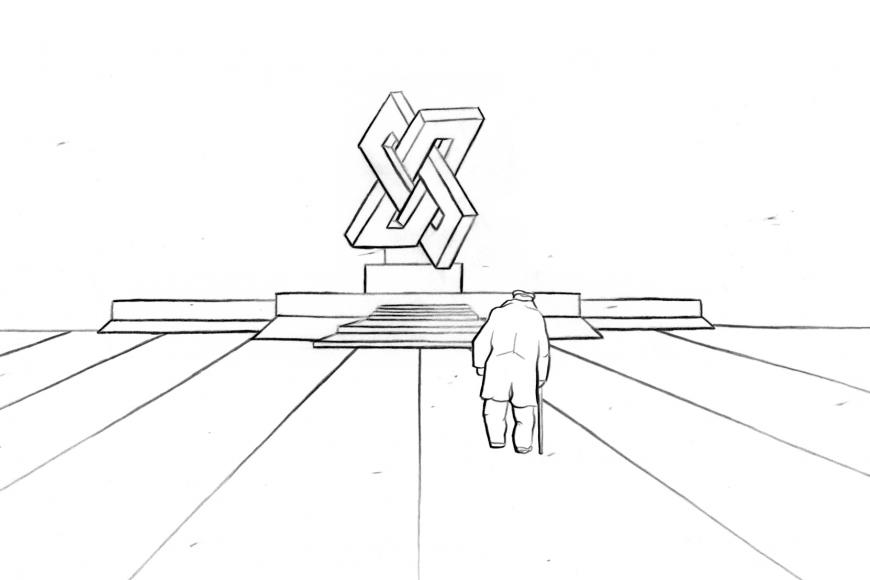
A man in socks takes a shower and melts. A claw machine in which nothing can be grabbed is fed coins. A mermaid makes sculptures of feet. A woman packs a banana into a plastic bag, then into another and another and … Figures suffering from the absurd wander through a good dozen laconically drawn momentary miniatures, ceaselessly looking for what can’t be found: meaning. Katarzyna Miechowicz’s animated folly prickles, even existentially.
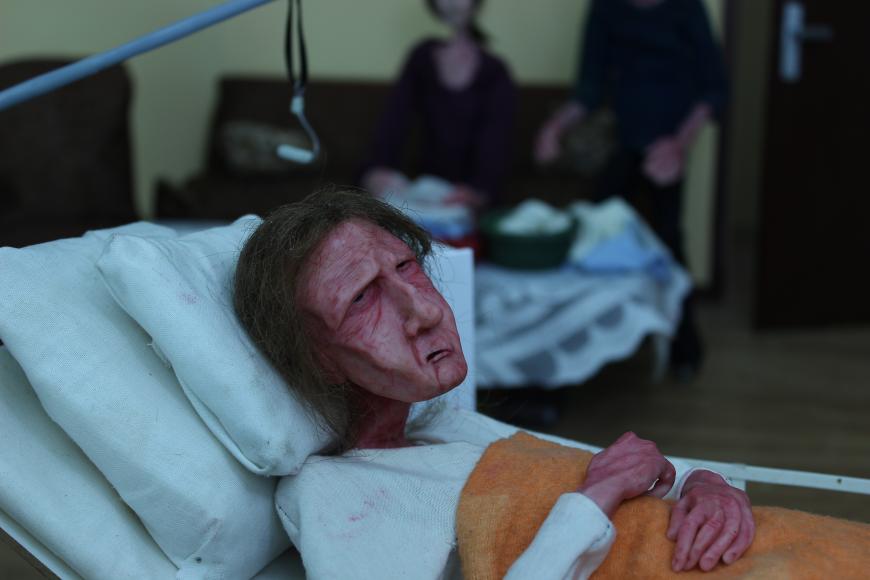
An old woman in her final days is the centre of attention within her family. But her selfhood fades away amid being cared for by her husband and daughter, who have problems of their own.
She is the centre of attention, but exhausted by life. An old woman in her final days, bedridden and too weak to speak to her husband and daughter. Her selfhood fades away while in the care of her relatives, who have problems of their own. But Julia Orlik brings the woman back into the foreground with her minimalist concept and touching puppet design.
André Eckardt
Credits
Director
Julia Orlik
Script
Julia Orlik
Cinematographer
Julia Orlik
Editor
Aleksandra Rosset
Producer
Agata Golanska
Sound
Bogdan Klat
Animation
Julia Orlik
World Sales
Marta Swietek
Winner of:
Golden Dove Short Animated Film (International Competition Short Film)
A complex exploration of transience, life and death, created by minimalist means and in animated form. Atmospheric, subtle and at the same time apocalyptic.
Marta Pajek (digitally) created a complex, atmospheric universe – with minimalist means and yet rich in detail. References to contemporary history meet visions of an intuited, dystopian future. We are made aware of (our own) transience in subtle, but almost brutal ways. Ageing bodies, ageing ideas. In the end, the grande dame of Polish cinema, actor Anna Polony, sings: “… when will we ever learn?”
Borjana Gaković
Credits
Director
Marta Pajek
Script
Marta Pajek
Editor
Marta Pajek
Producer
Piotr Szczepanowicz, Grzegorz Wacławek
Co-Producer
Maral Mohammadian
Sound
Michał Jankowski, Piotr Knop
Score
Aleksandra Gryka
Animation
Marta Pajek, Alex Boya
World Sales
Luce Grosjean
Winner of:
Golden Dove Short Animated Film (International Competition Short Film)
Ukraine, February 2022. The filmmaker flees to her parents’ house on the outskirts of Kyiv, where they live in an unbearable and inherently self-destructive limbo.
February 2022, the beginning of the Russian war of aggression on Ukraine. When the fighting comes closer, director Alina Maksimenko flees from the district capital of Irpin north-west of Kyiv to her parents’ home in the countryside, where she gets stranded with her cat and her camera. It would be better to move even farther away, beyond the border, to be really safe, the daughter urges. Nonetheless, they decide to stay – hoping for the situation to get calmer on the one hand, trusting in the remoteness of their village refuge on the other. The three of them hold out in an increasingly empty village. Fear spreads, tiredness. The parents refuse to change anything about their usual routines. It is an unbearable limbo that is inherently self-destructive. They try to hold on to their everyday life as best they can. Father Tolya takes care of the animals in the neighbourhood; dozens of abandoned cats gather at the front door every day. Meanwhile, mother Tetyana gives piano lessons over the phone, unless the mains is down again. And Alina, the daughter, makes a film. She is not interested in the fighting. Rather, her documentary of those first weeks of war is a minutely detailed portrait of waiting. The eye is on a microcosm where survival is in question, which makes it universal.
Witali and Łukasz have graduated from the Orthodox seminary. To become priests, they must get married. But they prefer to live for the moment in their unorthodox flat share.
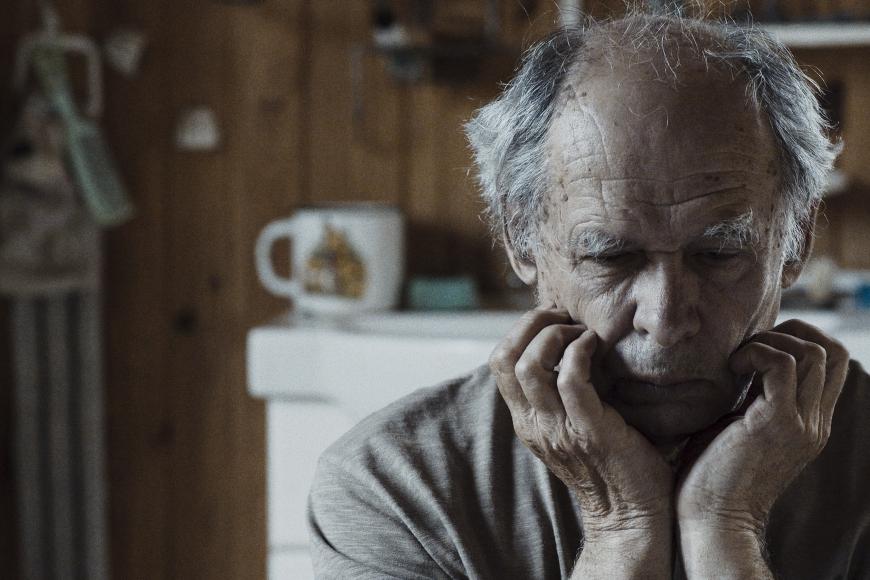
Witali and Łukasz have graduated from the Orthodox seminary. To take up priesthood, they must either start a family or become monks. But the two friends prefer to live for the moment, to muse, philosophize and sing. The camera looks on, full of empathy, giving the two men space and time to face their situation. A documentary observation turns into a thriller: Can their tender friendship withstand religious obligations and family expectations?
Anke Leweke
Credits
Director
Monika Proba
Script
Monika Proba
Cinematographer
Zvika Gregory Portnoy
Editor
Adriana Fernández Castellanos, Monika Proba
Producer
Ewa Jastrzebska, Jerzy Kapuscinski, Magdalena Borowiec, Tatiana Matysiak, Daria Zienowicz
Loosely based on Raymond Roussel’s novel “Locus Solus”, we explore the world of the inventor Martial Canterel. His estate is a place of innovation but completely without morals.
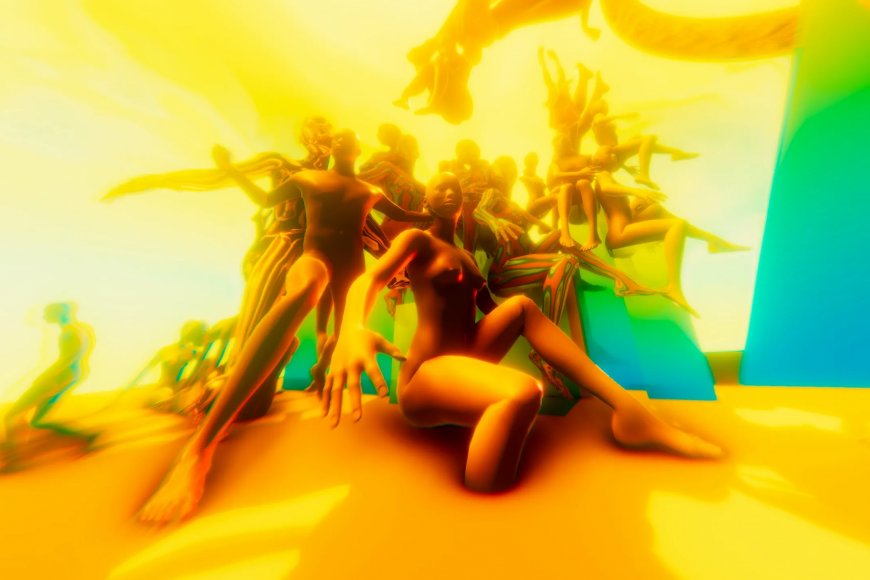
Loosely based on Raymond Roussel’s novel “Locus Solus”, we explore the world of the inventor Martial Canterel. His estate is a place of innovation, a space for experiments that elude ethical responsibility. All its guests become objects of research – and must ask themselves whether scientific progress justifies every sacrifice.
See the Sphinx, Ancient Rome and the Eiffel Tower all in one day. This 360° film plays with scaling and engages with our ideas of world-building and virtual reality as a medium.
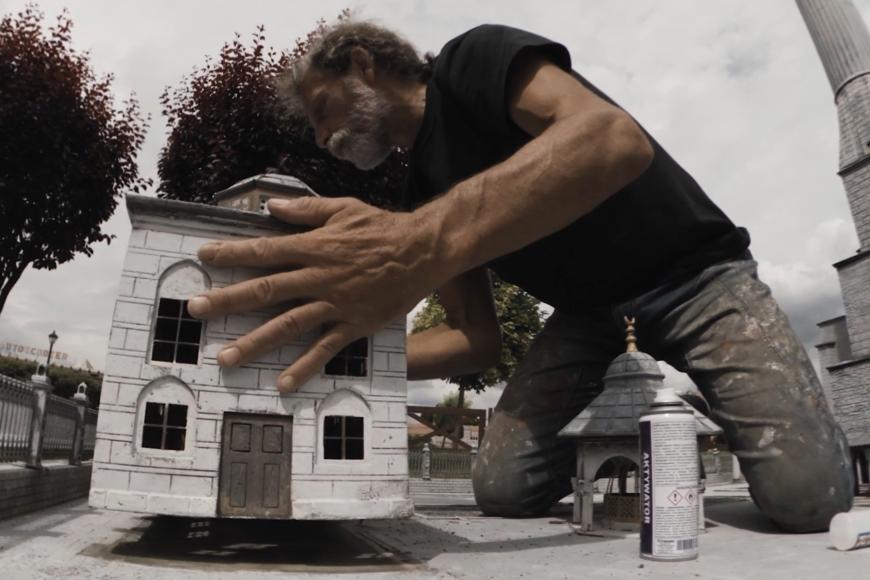
See the Sphinx, Ancient Rome and the Eiffel Tower – all in one day! This 360° film is a visit to a miniature park and to the work of the Creator who builds it. By toying with our sense of scale, “Minitourism” engages with ideas of world-building and virtual reality as a medium. Both playful and contemplative, it invites us to consider the ways we build our world.
Scenes of a marriage as a minimalist, vibrating black and white animation: A woman and a man in a room. A fly rotates around the lightbulb and the couple around themselves.
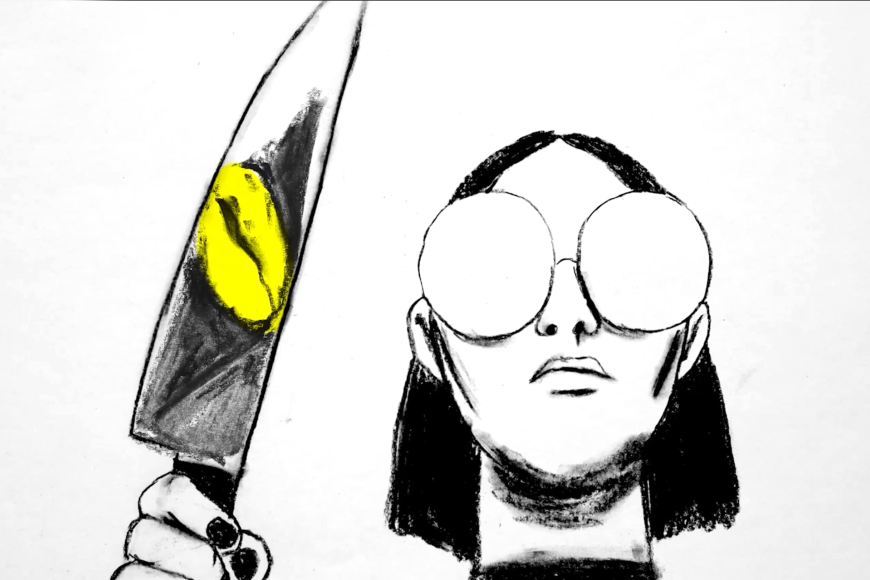
A fly rotates around a lightbulb, a spoon turns in a cup. Everything moves in circles here, including the life of the couple. He looks at his mobile phone, she does the sun salutation. Even her somersaults don’t make him look up. The minimalist black and white animation begins to vibrate. The monotony gets out of rhythm. She imagines him as a fly and chases him. Scenes of a marriage, reflected in the yellow eyes of a gecko.
Anke Leweke
Credits
Director
Marta Magnuska
Script
Marta Magnuska
Editor
Ewa Golis, Marta Magnuska
Producer
Piotr Szczepanowicz, Grzegorz Wacławek
Co-Producer
Sabine Andersone
Sound
Michał Fojcik
Animation
Marta Magnuska, Kristīne Zvirbule, Mārtiņš Dūmiņš
Winner of:
Golden Dove Short Animated Film (International Competition Short Film)
Even in death, you can’t get rid of bureaucracy! In the day-to-day business of a Warsaw funeral parlour, mourning is mired in paperwork, routine and triviality.
It is said of Krzysztof Kieślowski that he did not see himself as a political filmmaker. At least this early documentary casts doubt on this, for it depicts the cold stranglehold of bureaucracy. The setting is a municipal funeral home in Warsaw. Phone calls are made, documents checked and stamped. Business runs like clockwork, from the cradle to the grave. Leipzig naturally maintained ties with older Polish documentarists like Jerzy Bossak, even after he relocated to Denmark. The fact that Kieślowski and other notable Polish film artists of his generation did not appear in the programmes before 1990 fits into the image of a life consumed by pettiness painted here. The real issue was probably animosities with the festival in Cracow.
Via joyfully spacy performances and intellectual controversies, the Teatr 21, which consists of acting enthusiasts with Down’s syndrome, develops an idea of the autonomy they long for.
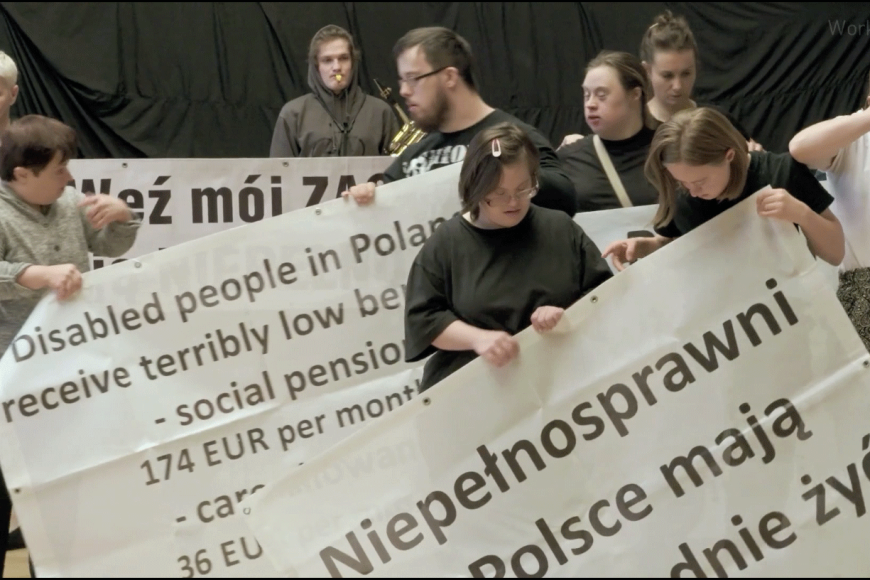
Inspired by a political protest movement, the Teatr 21 – a theatre company of acting enthusiasts with Down’s syndrome – develops a play in which the participants articulate their wishes and demands and at the same time get to abandon themselves with great joy to creative development. Martyna Peszko attentively follows the creation process as it unfolds in a productively bustling rehearsal atmosphere, with musical accents provided by the improvisations of a free jazz trio.
In 2018, people with handicaps occupied the government building in Warsaw for forty days to demonstrate for more support and recognition. The protest had almost no political consequences, and yet: The revolutionary spark ignited the public. The Teatr 21 project takes up the events, draws strength from the disappointment about the failed insurgence. That leads to discussions about their artistic craft: What does professional acting mean? What has nudity to do with revolution? And why do you always have to understand the lyrics to songs? In exploring the relationship between performance and politics, they reclaim an autonomy they are often denied in life: over their own body, their own stories. The stage direction and dramaturgy provide an unobtrusive and intelligent framework, which is extended by Peszko’s judiciously observant workshop report.
Carolin Weidner
Credits
Director
Martyna Peszko
Script
Martyna Peszko
Cinematographer
Magda Mosiewicz
Editor
Olga Kalagate
Producer
Justyna Sobczyk
Co-Producer
Katarzyna Tymusz
Sound
Adam Buka, Martyna Peszko, Konrad Wosik
Score
Zespol Pokusa
World Sales
Katarzyna Wilk
Nominated for:
Young Eyes Film Award,
MDR Film Prize,
Leipziger Ring
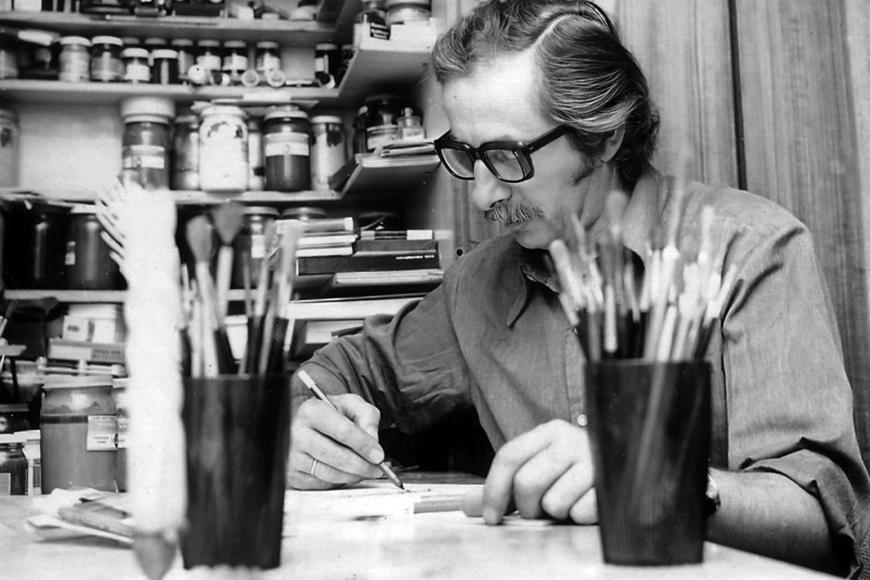
Karol Śliwka’s design has made graphic design history. But who was the person behind the iconic lines and shapes? An agile, thoroughly accessible portrait.
When Karol Śliwka (1932–2018) opens his drawer, dozens of tools jump out: scissors, compasses, rulers, and knives. For Śliwka’s equally famous and elegant graphic designs are purely handmade. They are displayed on consumer goods and advertising posters, even became iconic symbols of the United Nations. His career was far from predestined: Having suffered a serious eye injury in a childhood accident and bound to take over his parents’ farm, Karol Śliwka’s turn to art could be seen as an act of rebellion. It has paid off, as proved not only by the numerous awards he won during his long career. Via home videos, “Signs of Mr. Plum” also gives us insights into his joyful marriage to an opera singer. Bartosz Mikołajczyk and Urszula Morga skilfully connect Karol Śliwka’s designs with contemporary history, capturing the mood of the 1960s and 1970s with a light hand and quick editing. Graphic design and biography merge into an accessible and highly amusing mixture.
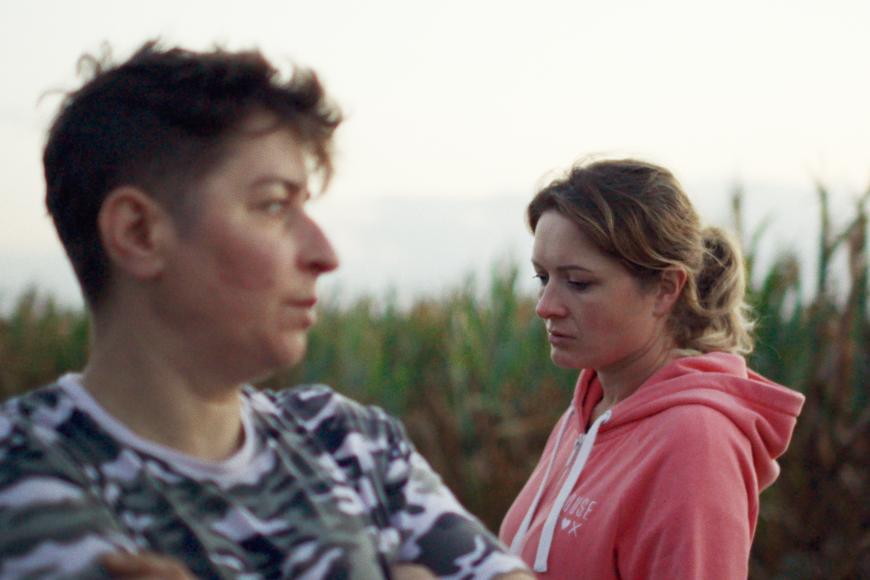
Father, mother, child – there are practically no exceptions to the ideal model family in the conservative part of Poland, and certainly no queer ones. Agnieszka hazards it anyway and takes the risk.
The rules in rural Poland are clear: Every man must have a woman; every dancer must have a female dancer. The pubescent Miłosz feels safe here, especially after his mother’s death. His sister Agnieszka, who is in a long-distance relationship with her friend Majka, does everything to obtain custody of her little brother. Gradually, a new family model is revealed, documented by Marek Kozakiewicz as an attempt that is as restrained as it is determined.
The windmills behind the houses rotate steadily, standing in place, signalling stability. But the lives of Miłosz and his 35-year-old sister are in turmoil. They are facing a red-tape marathon to make Agnieska his legal guardian: Both have been orphans for a few months. Director Marek Kozakiewicz depicts the establishment of a new family no one expects much applause for in conservative Poland. Because for Agnieszka and her partner, who is ten years older, the determination to try living together manifests tentatively. Without kisses, without celebrations, the decision almost casually becomes reality – the women are exploring the boundary between platonic tenderness and enforced secrecy. And Miłosz, too, seems to realise only slowly what the relationship between Majka and Agnieszka really is.
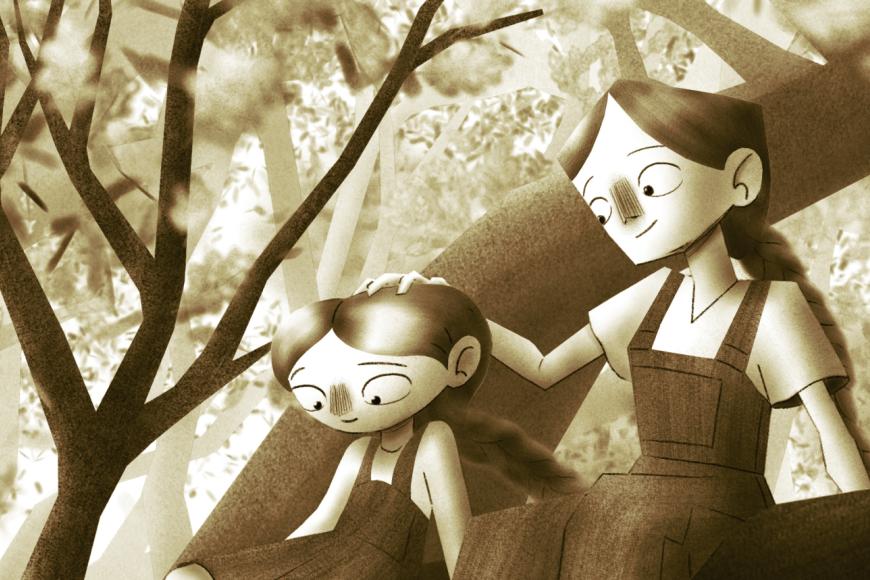
Two sisters travel to the realm of clouds on a paper plane, in search of the big tree with the golden leaf. Slowly they get closer to each other and their goal.
Two sisters travel to the realm of clouds on a paper plane. They are looking for the big tree with the golden leaf. Their plane has to be mended again and again, and the big sister is worried. When she falls ill, the little sister takes control. Slowly they get closer to each other and their goal on this arduous journey.
Lina Dinkla
Credits
Director
Kasia K. Pieróg
Editor
Kasia K. Pieróg
Producer
Marcin Podolec
Sound
Kacper Zamar
Score
Hubert Zemler
Animation
Kasia K. Pieróg, Jakub Baniak, Agnieszka Czachór, Przemysław Świdada, Dudek Pulit, Michalina Musialik, Adrianna Matwiejczuk, Karolina Kajetanowicz, Alicja Grotuz
Born blind, the tragic hero of this film sees his surroundings with a delay of seven years. The images from the past become a curse that’s irreconcilable with his present life.
Competition for the Audience Award Short Film 2022
Animated Film
Poland,
Portugal
2022
11 minutes
English
Subtitles:
None
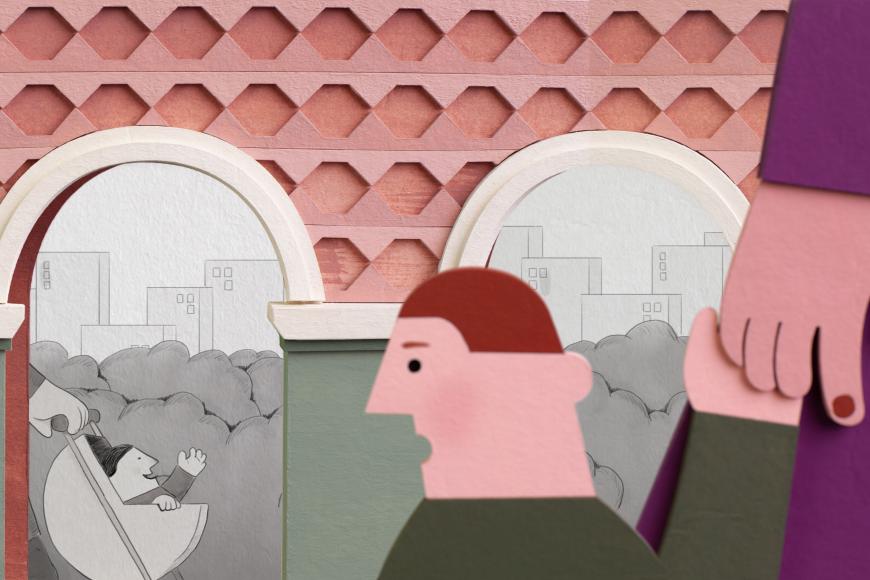
Born blind, the hero of this film turns seven before he begins to see images from the past that soon follow him like a curse. Like the stars in the night sky, what he sees has often long since passed away and gone out. In this tragic masterpiece by the directing duo Kijek/Adamski, the almost tangible pastel-coloured cut-out technique of the present-day narrative contrasts with delicate black and white 2D animations that represent the shadows of what is lost.
Christoph Terhechte
Credits
Director
Katarzyna Kijek, Przemysław Adamski
Script
Katarzyna Kijek, Przemysław Adamski
Cinematographer
Katarzyna Kijek, Przemysław Adamski
Editor
Katarzyna Kijek, Przemysław Adamski
Producer
Piotr Szczepanowicz, Grzegorz Wacławek
Co-Producer
Przemysław Adamski, Katarzyna Kijek, Bruno Caetano
Sound
Philip Lenkowsky, Carlos Abreu, Miguel Gonçlaves
Score
Piotr Kaliński
Animation
Katarzyna Kijek, Przemysław Adamski, Ala Nunu, João Gonzalez, Jakub Kaczmarek, Bartosz Stępnik, Hugo Sequeria
The daily routine in the life of a young couple: getting up, eating soup, daydreaming … Surreal animated photo collages and electro-acoustic sounds turn the inside out.
The daily routine in the life of a young couple: getting up, squeezing blackheads, eating soup, daydreaming … Zbigniew Rybczyński reworks real-life images to create surreal collages in order to visually turn the inside out. He is supported by the Polish composer Eugeniusz Rudnik, whose great electro-acoustic inventiveness shifts playfully back and forth between naturalism and alienation.