During a brief encounter, a real connection seems to develop between a whale and a diver. But then the whale disappears again in the depths of the ocean.
A diver encounters an injured whale. He decides to help the animal and gets a friendly look of thanks. For the space of a few seconds, the border between the two species seems permeable. The whale disappears in the depths of the ocean and leaves the diver wondering whether this was all just a projection of human hopes.
Franka Sachse
Credits
Director
Tess Martin
Score
Spencer Thun
Animation
Tess Martin, Webster Crowell, Stefan Gruber, Britta Johnson, Amanda Moore
A high-rise in Kyiv, an apartment on the 15th floor. A zoom out of a still image. On the telephone, Mariia shares her memories of this place, of coming-of-age and community – before the war.
In 2002, the filmmaker moved into an apartment on the 15th floor of a Kyiv high-rise. She was twelve at the time. Today, from the safe distance of another country, she talks to people who remember the flat and the time spent together. Coming-of-Age, the love of cinema, a sense of community and the erotic charge of individual moments combine to create an image of missing home and intimacy. With every memory, we zoom a little out of the still image on screen: three windows facing southwest, a balcony facing southeast, a rooftop protected from view, a high-rise panorama. The warm and personal gaze at the sky and houses of Kyiv is mirrored in the cold attentiveness of international war reporting.
Mahardika Yudha, Robin Hartanto Honggare, Perdana Roswaldy
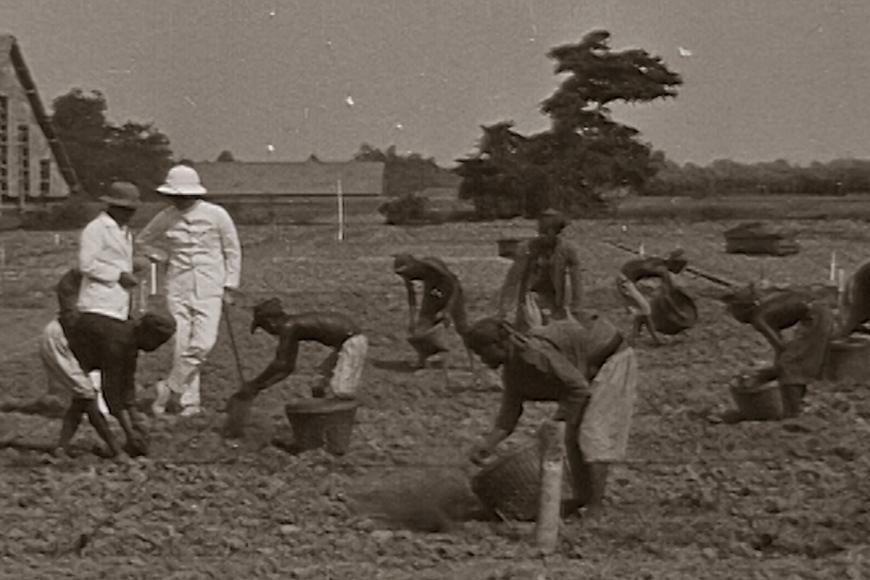
This comprehensive essay, impressively edited from images of the former Dutch colonial power in Indonesia, investigates the plantation as the foundation of colonialism.
Mahardika Yudha, Robin Hartanto Honggare, Perdana Roswaldy
International Competition 2022
Documentary Film
Indonesia,
Netherlands
2022
59 minutes
English
Subtitles:
English
The semi-autobiographical account of a European plantation manager on Sumatra during Dutch colonial rule becomes a starting point for reflections on the structure of the plantation itself. An essay about local tobacco and rubber cultivation, the construction of skin colour as a social category and the "tropic fever” which rises slowly but inexorably, edited from archive material dating from 1890 to 1930.
Very few films have made use of the extensive material shot by the colonists in the Dutch East Indies, now Indonesia. Those who took up the task, like “Mother Dao” or recently “They Call Me Babu”, did so from a Dutch perspective. “Tropic Fever” is the first feature-length film from Indonesia that appropriates that stock, using photos, documentary silent film footage, home movies and feature films as well as development plans from the archives of the former colonial power, along with the report of a Hungarian who managed a plantation on Sumatra in the 1920s. Mahardika Yudha, Robin Hartanto Honggare and Perdana Roswaldy impressively demonstrate how forests and swamps turned into rigidly organised agricultural areas and how the plantation and its structure became the foundation of the colonial project as such. Suddenly the assumption that “tropic fever” arises from the heat seems doubtful.
Marie Kloos
Credits
Director
Mahardika Yudha, Robin Hartanto Honggare, Perdana Roswaldy
Script
Perdana Roswaldy, Robin Hartanto Honggare
Cinematographer
Mahardika Yudha, Syaiful Anwar
Editor
Mahardika Yudha
Producer
Robin Hartanto Honggare
Sound
Mahardika Yudha
Score
Mahardika Yudha
Key Collaborator
Het Nieuwe Instituut, EYE Filmmuseum, Marinus Plantema Foundation
Nominated for:
Prize of the Interreligious Jury,
FIPRESCI Prize
A dull underwater world floods a bright white hospital corridor. In this scenario, the main character tells the story of her rape and how she lost her voice.
A dull underwater world filled with eerie creatures floods a bright white hospital corridor. This scenario sets the stage for a tale about an abused woman. After the rape, she finds herself not only confronted with the standardised examinations, her boyfriend’s horror and the alienation from herself: She has also lost her voice.
A mother, a daughter, their close relationship and the question why sex does strange things to people. The cinematic reappraisal of a trauma, complete with a few show numbers.
“Sex does strange things to people!” This sentence reverberates from her childhood. What did her mother mean? What fears did she pass on to Emma? The budding filmmaker sets up the camera in her mother’s apartment, invites mum’s friends, creates an open atmosphere. Coby opens up more and more, talks about a repressed topic. At the same time, she gets to show a wholly different side of herself, performing song and dance numbers in front of her daughter’s lens.