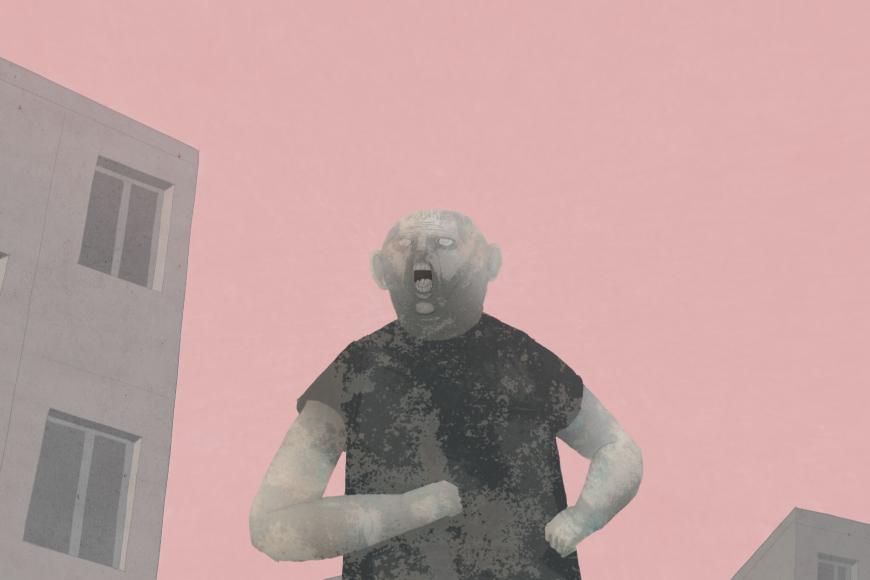
The small creature seems in need of love, until it comes snarling round the corner, chasing you on its short legs through the empty suburb. Unease starts to spread.
Small and cu… No, not cute. This knee-high creature seems shy and in need of love instead. Until it comes snarling round the corner, chasing you on its short legs through the empty suburb. An uncomfortable lurking feeling spreads. With sparse drawing, mean sound bites and not-so-friendly characters, Malte Stein lays out the surgical instruments for a head game.
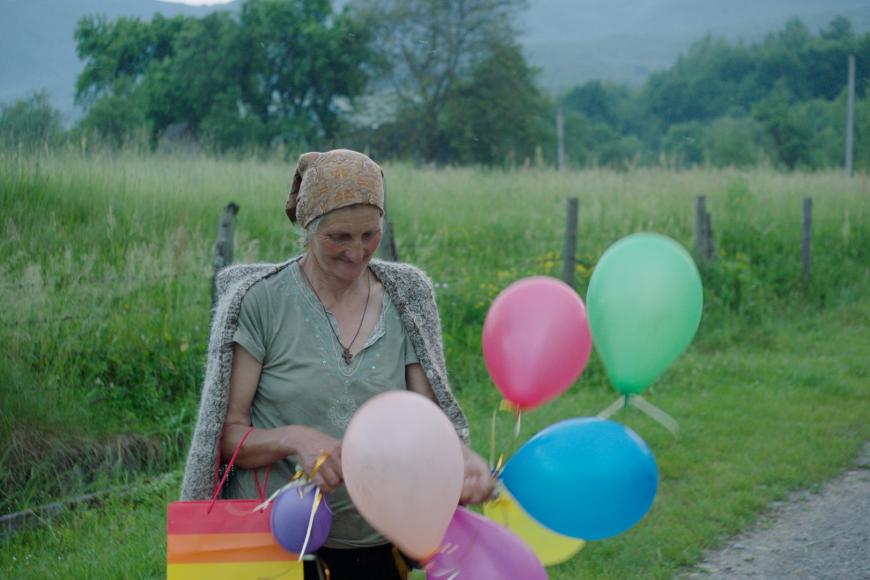
The portrait of a Carpathian village: In encounters with three independent women, Maksym Melnyk documents rural life in the Ukrainian village of Stuzhytsya near the EU border.
In a remote village, whose name roughly means “a cold place”, this film looks for warmth in encounters. The Ukrainian village of Stuzhytsya is situated in the Carpathian Mountains in the border triangle between Poland and Slovakia. The three elderly female protagonists – a farmer, a post office clerk and a biologist – are firmly rooted in a place where hardly any young people are left in 2019, the year of Zelensky’s election victory. Over time, the film crew also becomes, at least temporarily, a valued part of the village community.
Between horoscope readings at the post office, farm work with pitchforks and church blessings of cars in need of repair, Maksym Melnyk, also a native of Zakarpatska Oblast, establishes a growing intimacy with the three women. His documentary style arises from the interaction: In the beginning, he asks off camera questions like a reporter, but as he gets closer to the people, he enters the frame himself. Very few documentary filmmakers today see themselves as a “fly on the wall”. But gifting a pig to a protagonist in front of the camera or letting her cut the camerman’s hair? That’s rather unusual. Taking the single farmer Hanna, who treats Melnyk and his cinematographer Florian Baumgarten – whom she calls “the German” – like sons, as an example, the film portrays a rural lifestyle full of privation that seems to be in decline in the mountain region near the EU border.
Jan-Philipp Kohlmann
Credits
Director
Maksym Melnyk
Cinematographer
Florian Baumgarten, Meret Madörin
Editor
Jannik Eckenstaler
Producer
Maksym Melnyk, Andrea Wohlfeil
Sound
Roman Pogorzelski
Score
Maksym Melnyk
Winner of:
DEFA Sponsoring Prize,
Golden Dove (Audience Competition)
A representative of the Volgograd Section of the German-Soviet Friendship Society recalls German “comrades who fought against Hitler here […] and at other front sectors.” Equalisation with the people in the Soviet Union is completed at the Mamayev Kurgan memorial: The (German) visitors merge with the survivors who mourn their fallen.
Konstantin Wiesinger
Credits
Director
Volker Kastius
Cinematographer
Willy Reitze
Producer
Amateurfilmstudio VEB Elektromotorenwerk Wernigerode
A virtuoso filmic reflection on automatisms in art and an encounter with Margaret Raspé on a Greek island, where the artist and filmmaker spends part of the year. Considered to be a pioneer of feminist German film, “I know where I am” is how she sums up her feeling on the island. Orientation in space, control and letting go are all central categories in her artistic practice.
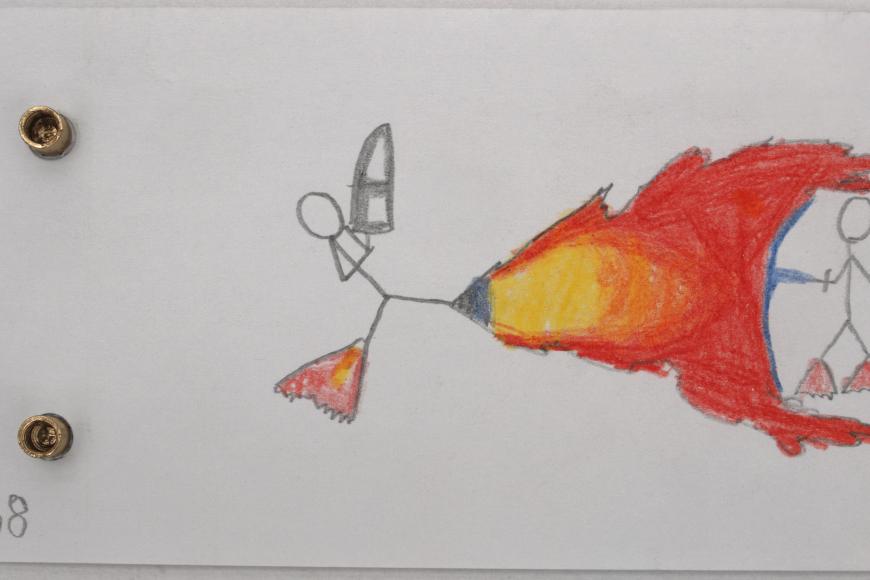
The filmmaker’s son was killed in an accident. He was working on a flip book that his father finishes. The proximity of happiness and loss in the most succinct form.
Competition for the Audience Award Short Film 2021
Animated Film
Austria
2021
2 minutes
German
Subtitles:
English
A very short film, infinitely sad and at the same time mischievous and playful. The opening credits tell us the devastating news: The filmmaker’s son was killed in an accident and left behind an unfinished flip book. The father resumes work on it and continues drawing the superhero tale, creating an animated film between deep mourning and carefree children’s logic. Capturing the proximity of happiness and loss in the most succinct form.
A belligerent documentary polemic about Führer tourism at Obersalzberg. The Federal German authorities have prohibited the iniquitous practice but are still cashing in big time.
Walter Krüttner is considered the only satirist among the signatories of the Oberhausen Manifesto, which was announced at the West German Short Film Festival in 1962. His film begins like those that the Oberhausen group wanted to put a stop to: with ländler music and a quote by regional poet Ganghofer. “Lord, the ones you love you let fall into this land.” Krüttner observes the tourist hustle and bustle at Obersalzberg: tour guides leading Führer travellers through the Nazi buildings. And Krüttner counts the profits West German authorities make by this. He himself profited by winning the “Silberne Lorbeer” (Silver Laurel) of Deutscher Fernsehfunk (German Television Broadcasting), awarded at the International Leipzig Documentary and Short Film Week 1963.
A narrator explains surviving evidence of the events on the grounds of the Langenstein-Zwieberge subcamp. The film ends with a formulaic ritual of remembrance.
A male voice, accompanied by the eponymous instrumental piece by Reinhard Lakomy, comments on photographic and material evidence of the events on the grounds of the Langenstein-Zwieberge subcamp. The audiovisual tour concludes with a visit by an FDJ (Free German Youth) group who lay down wreaths at the memorial site built in 1949. The speaker unequivocally classes this ritual of remembrance as part of the raison d’état.
Konstantin Wiesinger
Credits
Director
F. Faust
Script
A. Faust
Cinematographer
R. Muschke
Editor
F. Faust
Producer
Technische Hochschule Magdeburg, Bezirkskabinett für Kulturarbeit Magdeburg
The company and details of its machinery are presented. A montage from two different sources on the title, one of them tinted fragments, the other well-preserved black-and-white footage.
A tinted nitrate fragment of the company film “A. Gutberlet & Co., Leipzig-Mölkau, Spezialfabrik für Falzmaschinen und Faden-Buchheftmaschinen, gegründet 1901“ (specialist in the manufacture of folding machines and thread book stitching machines, established 1901) was an exceptional find. It could be restored in its original colour tones by analogue methods in 2024 and then digitised. Combined with the dupe negative of another version, it now offers insights into the factory halls and the work on the machines.
An entertaining vision for International Women’s Day as an admonition, inspiration and commentary about gender relations in GDR everyday life, in the form of a puppet animation.
The married couple Angelika and Horst Butter sum up successes and setbacks of their joint amateur filmmaking. They now produce elaborate puppet animations in their private rooms, under sometimes adverse conditions. They adapt fairy tale and fantasy sources, but also take up topical social issues, for example in an entertaining vision for International Women’s Day.
Competition for the Audience Award Short Film 2020
Animated Film
Germany
2019
4 minutes
English,
German
Subtitles:
English
A cosy family picnic at the place they have been visiting since the Cretaceous period is what Mom, Dad and Go Zilla want. But first the big city that has annoyingly sprung up there must be flattened. In the father’s opinion, the performance of his offspring unfortunately leaves a lot to be desired: Too dreamy and still sucking on a pacifier, the little one just doesn’t wreak enough havoc. It’s an entertaining story in the almost normal everyday life of a family.
With the participation of several company and amateur film associations, the film accompanies a trip to Leipzig by delegations from 40 countries on the occasion of the 10thWorld Youth Games in Berlin.
East Berlin plays host to the world at the 10th World Youth Festival. The secret capital of the GDR, Leipzig, also gets some reflected glory. On 3 August 1973, festival delegations from forty countries take a special train to the trade fair city. Between the official events there is room for ambiguous side glances, captured in this report of the day made by several Leipzig company and amateur film groups.
Konstantin Wiesinger
Credits
Director
collective
Producer
Pionierfilmstudio Haus der Jungen Pioniere “Georg Schwarz” Leipzig, Ensemble “Deutsch-Sowjetische Freundschaft” Leipzig, Club Leipziger Filmamateure, VEB Verlade- und Transportanlagen Leipzig, VEB Spezialbaukombinat Leipzig
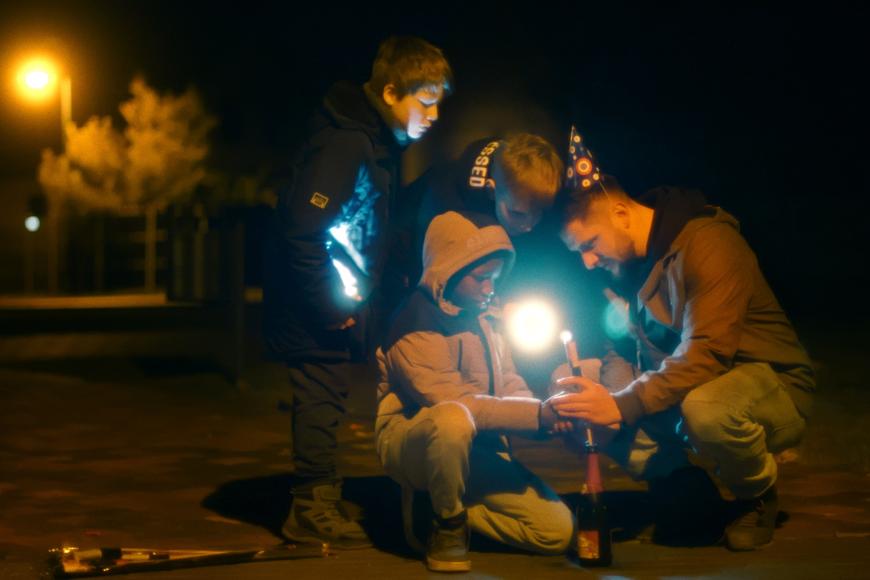
Touching insights into the daily workings of the youth welfare system. Five boys in a rural residential group who long for a home. And the people who try to give it to them.
When parents can no longer fulfil their duty of care, the children’s world often falls apart. Nothing stays as it was. Suddenly it is no longer mum or dad who are in charge but the youth welfare system. Daniel Abma followed a youth housing group in a rural area over several years, showing professional educators who want to give five boys between the ages of seven and fourteen what they need most urgently, day by day: security, orientation, a home. The documentary focus is not on the children but on those who take the parents’ place. They sometimes remind us of Don Quixote tilting at the windmills, for there is a diffusion of responsibility between school, youth welfare services, and absent mothers and fathers. Words fail when adults do not keep appointments, when those in charge capitulate in the face of racist bullying and propose some “time out” – for the bullied boy – in a psychiatric facility. It would be easy to denounce these mechanisms, but that is not the point Daniel Abma wants to make. His observation, both emphatic and reserved, looks questioningly into the gaps in the system – with those who are in danger of falling through and those who try to fill them with affection. He makes us suspect that the answer is not to close all the system’s gaps. It is people who are there for other people and take responsibility.
Luc-Carolin Ziemann
Credits
Director
Daniel Abma
Script
Daniel Abma
Cinematographer
Johannes Praus
Editor
Jana Dugnus
Producer
Britta Strampe, Laura Klippel
Sound
Alexandra Praet, Christoph Walter
Sound Design
Alexandra Praet, Roman Pogorzelski
Score
Henning Fuchs
German Distributor
Camino Film
Broadcaster
Rolf Bergmann, Dagmar Mielke
Commissioning Editor
Rolf Bergmann, Dagmar Mielke
Funder
Medienboard Berlin-Brandenburg GmbH, Deutscher Filmförderfond, BKM - Die Beauftragte der Bundesregierung für Kultur und Medien, FFA Filmförderungsanstalt
Nominated for:
VER.DI Prize for Solidarity, Humanity and Fairness,
DEFA Sponsoring Prize,
Gedanken Aufschluss Prize
Winner of:
Gedanken Aufschluss Prize,
ver.di Prize for Solidarity, Humanity and Fairness
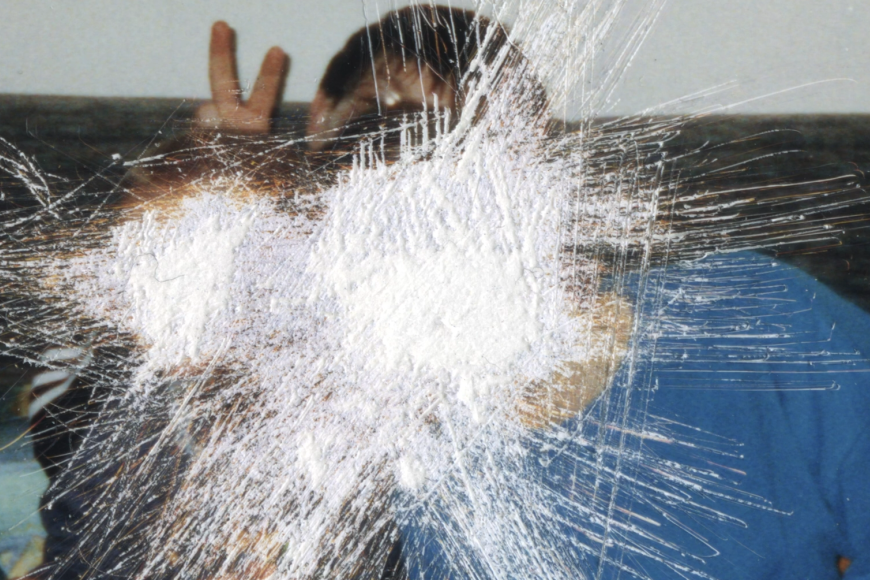
Family photos. A woman’s face is scratched out or overpainted. Fragmentary descriptions of the mother’s sudden outbursts are added. Approaching the trauma of an experience of violence.
We all know photos with painted-over or cut-out faces. The repeatedly inserted hand that works on family pictures with pens and other utensils seems like a refrain. The attempts at eradication are audible. They are a dissonance transferred to the body. Scratch, distort, remove. Usually a woman’s head. Even if the narrator speaks in the third person, even if the hand may not be his hand, these could be his own experiences. The fragmentary descriptions revolve around a mother who beats and tortures her children. It is a childhood in permanent fear. How do you deal with the memories and scars in adulthood? Can the experience be put into words at all? Why do you feel strangely alienated from your siblings who suffered the same? David Kind’s essayistic approach to the trauma of violence is questioning. The doors of the title are opened with extreme caution.
Despite ideological shortcomings, the Stralsund People’s Dockyard youth brigade do excellent work. Nevertheless, the city becomes the focal point of socialist conditions of value creation.
High up north, in the Stralsund People’s Dockyard, Gitta Nickel encounters a youth brigade whose members speak frankly: “I’m 27 now. Judging from my own example I can say: it’s been nothing but work, really nothing. I can really say that about me, stark and stiff.” Stralsund as the focal point of socialist conditions of value creation: A ship may be completed every two weeks, but housing, let alone leisure facilities aren’t. The diagnosis: The quality-of-life to performance ratio is less than ideal. The brigade’s team spirit, though, is still strong, even if, as some think, there are some shortcomings on the “ideological side”.
What does it mean to lead a nomadic life in Germany today? This film explores the potentials of a vagabond existence in a world of settlement permits and garden fences.
What does it mean to live a nomadic life in Germany today? How do people see you when to keep moving is more important to you than possessions and social status? What are the prejudices faced by people who work outside the 40-hours-per-week regular job model and want to be fulfilled? To get some answers to these questions, Anna Friedrich walks part of the way with four women who prefer travelling to settling. The journeywoman Magdalena loves the intensity of permanent new beginnings, but travelling also keeps her from working in her dream job as a qualified farmer. As an activist, Johanna lives in her refurbished van, which she has parked at various spots for years, and frequently takes part in political protests like forest occupations. Elwera, a former tightrope artist, and her granddaughter Ghislaine belong to the Yenish community who move from market to market, continuing a generations-old tradition. Director Anna Friedrich uses the conversations to shed light on her own longing for being on the road, but also for a critical reflection of the settled world in the eyes of these women. The potentials of a nomadic existence thus emerge – and how they are in danger of wasting away between settlement permits and garden fences. Stepping to the other side of the fence opens possibilities.
Luc-Carolin Ziemann
Credits
Director
Anna Friedrich
Cinematographer
Robin Angst, Ray Peter Maletzki, Leonard Schmidt, Anna Friedrich
Editor
Federico Neri, Miro Schawalder
Producer
Stephan Helmut Beier, Ray Peter Maletzki
Co-Producer
Thomas Beyer, Andrea Wohlfeil, Filmuniversität Babelsberg KONRAD WOLF
Sound
Alejandro Weyler, Anna Friedrich, Elisa Malter
Sound Design
Irma Heinig
Score
Max van Dusen
Broadcaster
Thomas Beyer
Nominated for:
VER.DI Prize for Solidarity, Humanity and Fairness,
DEFA Sponsoring Prize
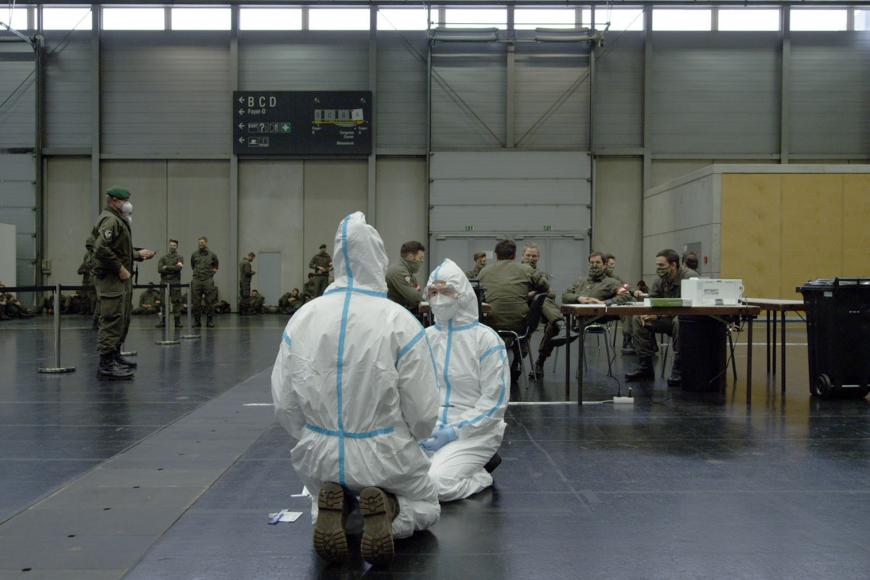
Lockdown, easing, lockdown: Vienna in the Covid-19 pandemic from March 2020 to December 2021. Generous tableaus document paralysis, fear, learning, anger – and incipient repression.
The film opens with the image of an elderly individual in a hospital, hooked to a machine: assistance is needed to slowly breathe in and out. This existential moment of physical precariousness is followed by Nikolaus Geyrhalter’s typical long shots, though in this case they do not document work processes but look like a prequel to his fantastic science fiction documentary “Homo Sapiens” (2016): deserted airports, swimming pools, playgrounds.
The filmmaker sets out with his identifiable aesthetic tools to tackle the documentation of the first three waves of the Covid-19 pandemic, from March 2020 to December 2021. In Vienna, a major city with a relatively well-functioning health system, he looks at institutions that are in a “flexible learning mode”: intensive care units, emergency shelters, schools, cinemas. Time and again he visits a flower shop that is not system-relevant but, by its own definition, sells food. Lockdown followed by eased restrictions followed by lockdown. The camera registers how paralysis in the face of a natural disaster is superseded in some people by anger at the restrictions. Meanwhile, cases of Long Covid are being treated in the hospitals. Topical, only a little later, these images cut across the repression of what has been experienced.
Jan Künemund
Credits
Director
Nikolaus Geyrhalter
Cinematographer
Nikolaus Geyrhalter
Editor
Gernot Grassl
Producer
Nikolaus Geyrhalter, Michael Kitzberger, Wolfgang Widerhofer, Markus Glaser
Sound
Sergey Martynyuk, Lenka Mikulova
Sound Design
Nora Czamler, Manuel Meichsner
World Sales
Andrea Hock
Nominated for:
FIPRESCI Prize,
Prize of the Interreligious Jury









![Filmstill Fa. Gutberlet & Co. [Ausschnitt]](/sites/default/files/styles/stepped_teaser_/public/fiona/films/stills/94a765f0-53ce-4935-bc20-309db0abbb7f.jpg?h=346bc062&itok=5n_TqdCp)








![Filmstill Fa. Gutberlet & Co. [Ausschnitt]](/sites/default/files/styles/film_stills_full_content_view/public/fiona/films/stills/94a765f0-53ce-4935-bc20-309db0abbb7f.jpg?h=346bc062&itok=0mNa-FNw)


