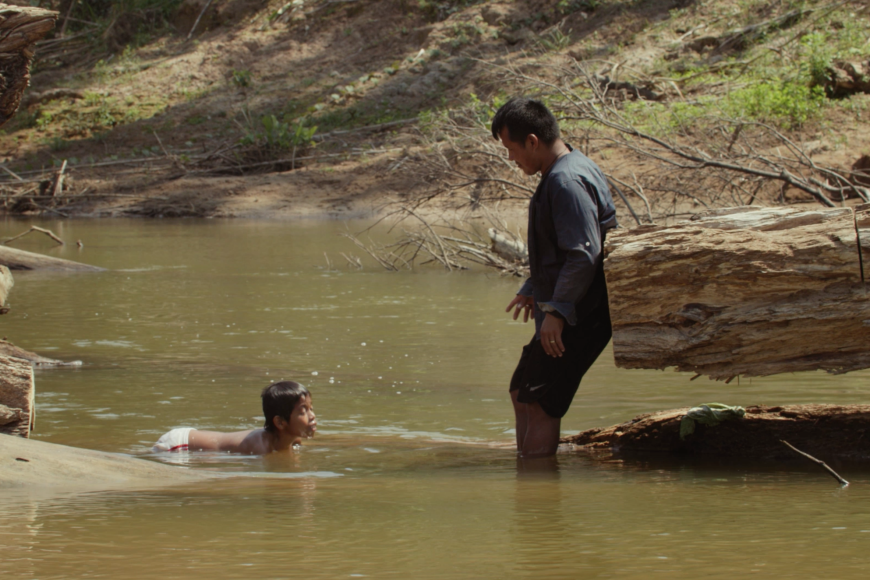
Hanan thinks her little brother should know how to swim. When she came to Europe in a rubber dinghy she was terrified of water. Today she is a swimming instructor.
“Guess what we’re doing! We’re going to practice swimming.” Hanan accompanies her brother to classes in the public pool. The first swimming badge is called the Seahorse, their instructor explains, because it “stands” in the water and doesn’t drown. When Hanan’s family came to Europe in a rubber dinghy, she couldn’t swim. To forget this experience, she learned not to go under in the water – like a seahorse.
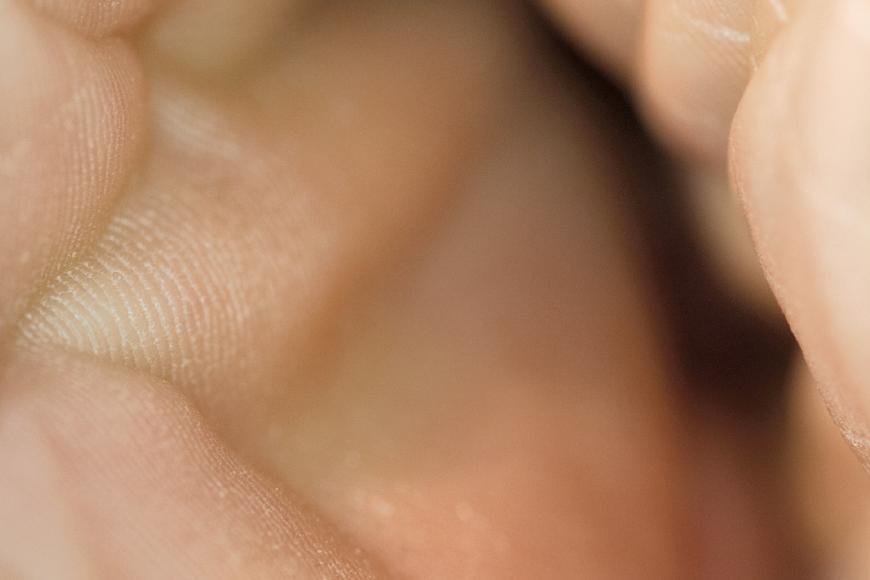
Nothing is closer to us than our skin. Its beautiful and less beautiful parts envelop the self, separate it from all else. A foray along naked parts of the body takes us from a shiny ridge via a rounded protuberance to a shady gorge. A neck. A belly…ear. A fellybear? Photos, videoclips and sounds form an irritating body collage.
Abkhazia, a place of memory and at the same time a blind spot for the director. Almost impossible to enter from Georgia, she chooses an associative and personal approach to the split-off territory.
Parts of the house director Anna Dziapshipa traces in her autobiographical roamings through the past look like straight out of a horror film: cobwebbed, dark, derelict. It is located in Abkhazia, the region officially off-limits to Georgians, protected by Russia and not recognised as an autonomous republic by the international community.
One half of Dziapshipa’s family comes from here, including a football player who once was a key player for Dinamo Tbilisi. The filmmaker edits footage of his sports activities into “Self-Portrait Along the Borderline,” but also shows the splendour of the former Soviet holiday paradise. It is a personal, associative approach in which Dziapshipa analyses and reflects on her own experiences as a child with both Georgian and Abkhazian family backgrounds. Discrimination plays a role, as do solemn and disturbing things. Time and again, spiders crawl through the frame, weaving their webs and thus connections.
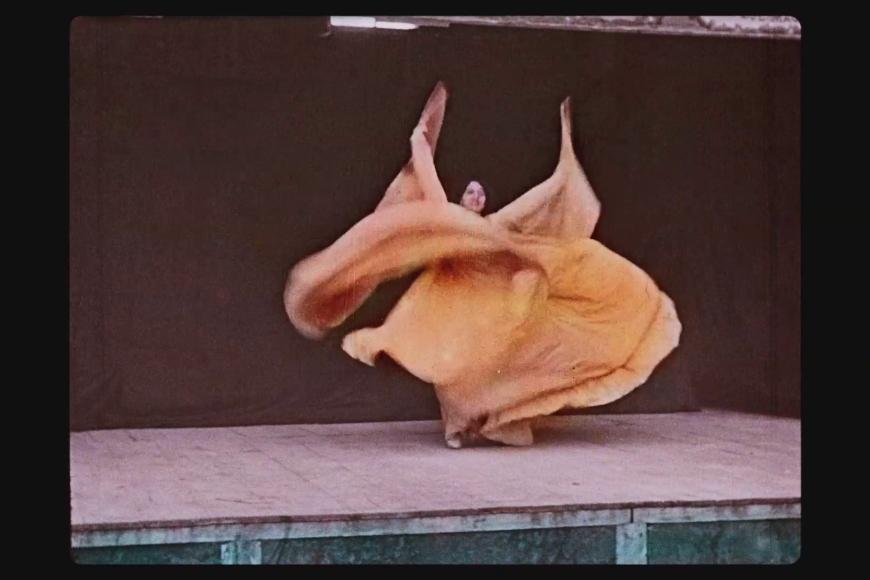
In the early days of cinema, audiences were hungry for pictures bursting with vitality. The serpentine dance with its graceful shifting patterns, and in colour, satisfied their wish.
Movement, movement: In the early days of cinema, audiences were hungry for pictures bursting with vitality. For many film pioneers, the subject par excellence was the serpentine dance, which produced graceful shifting patterns by means of ample veils. The Lumière brothers additionally had the film hand-coloured, frame by frame, reinforcing the vivid expression of the dynamic body geometries.
Our everyday digital life is unthinkable without mobile phones. But what natural and human resources does the tech industry require for this innovation?
Our everyday digital life is unthinkable without smartphones. Across the world, more than five billion such devices are in circulation. Each one of those is even touched more than 2,600 times per day. This AR experience takes us through the hidden history of this technology and thus into the Democratic Republic of the Congo. What natural and human resources does the tech industry require for its innovations?
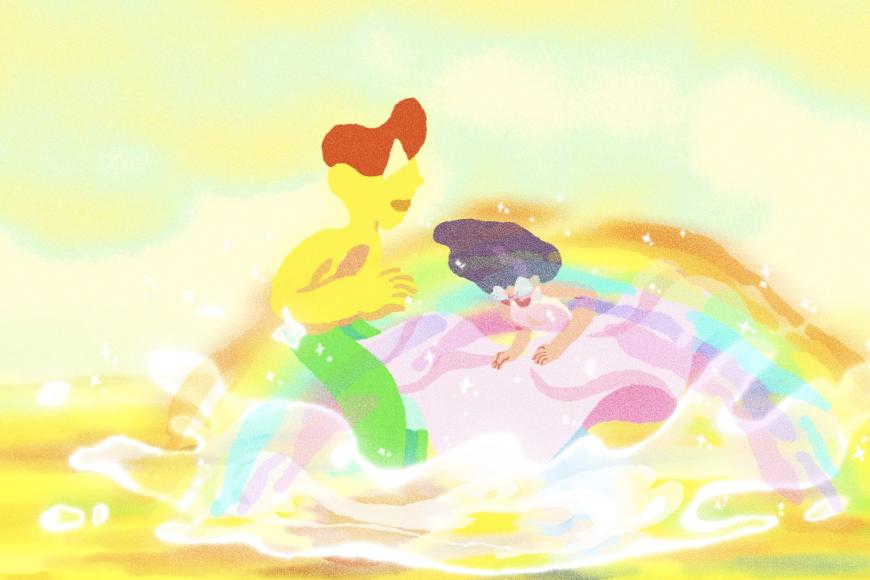
A consensual union becomes a brutal assimilation that ends in death and a new beginning. Powerfully moving colours and fascinating sounds transport irritating emotions.
The two main characters of this film seem made for each other. They literally fit together, merge into each other, melt into a colourful, psychedelic, swirling whole. They function together, until one of them disconnects. The madness of this riot of colours turns into a dark nightmare when the one left behind re-absorbs the other by force. Against her will, the renegade must now be sewn to her partner. The once flourishing relationship degenerates into an irritating visual and audio chaos of aggressively twitching drawings and shattered sounds. Impaled on a gnarly tree, the couple’s bodies decay. As they are dying away, darkness turns into light and fresh blossoms open on the pale bones.
Franka Sachse
Credits
Director
Xu Yuan
Producer
Tomokazu Nomura
Sound Design
Nanami Sato
Animation
Xu Yuan
Nominated for:
Gedanken Aufschluss Prize,
mephisto 97.6 Audience Award
Magnificent works of art made of fruit once lent the Chinese restaurant business a radiant glamour. Today they are overshadowed by a heavily economised food culture.
A giant ginger mountain landscape that five cooks spent a week to make: Once magnificent culinary works of art were created in Chinese restaurants. Food was associated with a wealth of money and time. The world today is short-lived, customers have become few and far between. Chefs talk about the connection between food culture and socio-economic change in China.
Ricky is a boy from the Ashéninka tribe who lives with his family in the Peruvian Amazon Forest. He wants to overcome his fears and goes hunting for a huge catfish.
Ricky is a boy from the Ashéninka tribe who lives with his family deep in the Peruvian Amazon Forest. But even here, the children’s favourite pastime is watching videos on their mobile phones. One day, Ricky is faced with the task of overcoming his fears and going hunting for a huge catfish that can only be caught by hook. This is where his journey to adulthood begins.
Is ADHS the fashionable diagnosis of a society geared towards efficiency and Ritalin the perfect doping agent? A personal journey to the heart of chaos and back – from a deliberately female perspective.
In recent years, the number of diagnoses of attention-deficit hyperactivity disorder has skyrocketed. What are the reasons? Does a society geared towards efficiency use the label ADHS to weed out anyone who does not fit its frames? What are the consequences of the fact that medication treatment has become almost ubiquitous? Could Ritalin and the like have become the doping of the performance society?
In their very personal documentary, Gitti Grüter, diagnosed with ADHS since puberty, sets out to find answers. Grüter talks to five women who have been officially diagnosed with this disorder about lack of concentration, impulsive behaviour, overstimulation, relationship problems, depression and insomnia. The open conversations gradually reveal how hard life can be for women with ADHS, because social stereotypes of femininity often prevent or delay the right diagnosis. Through the calculated use of filmic means, Grüter manages to convey to the audience a sense of the permanent and overpowering inner and outer chaos. Skilfully and with a generous dose of irony, they focus on how people suffering from ADHS are stigmatised – and not least on the role of gender stereotypes in this process. The conclusion is surprising and encouraging.
Luc-Carolin Ziemann
Credits
Director
Gitti Grüter
Script
Gitti Grüter
Cinematographer
Lenn Lamster
Editor
Dan Gatzmaga
Producer
Christoph Holthof, Daniel Reich, Norman Bernien
Co-Producer
Sara Günter, ZDF Das kleine Fernsehspiel, Filmuniversität Babelsberg KONRAD WOLF
Sound
Simon Ferber
Sound Design
Larissa Kischk, Eva Perhácová, Simon Schüler
Score
Valeriia Khazan, Felix Römer
German Distributor
Luna Selle
Nominated for:
Goethe-Institut Documentary Film Prize,
Gedanken Aufschluss Prize,
DEFA Sponsoring Prize,
VER.DI Prize for Solidarity, Humanity and Fairness
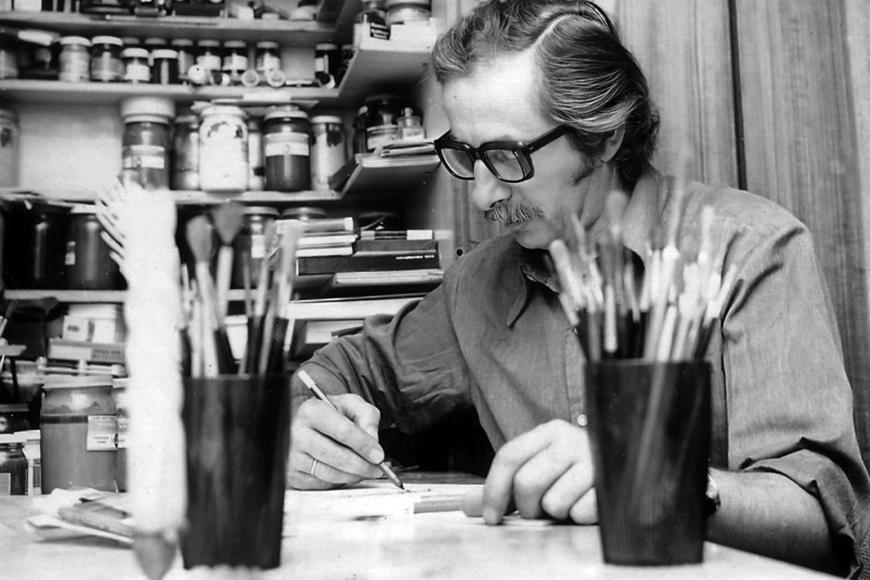
Karol Śliwka’s design has made graphic design history. But who was the person behind the iconic lines and shapes? An agile, thoroughly accessible portrait.
When Karol Śliwka (1932–2018) opens his drawer, dozens of tools jump out: scissors, compasses, rulers, and knives. For Śliwka’s equally famous and elegant graphic designs are purely handmade. They are displayed on consumer goods and advertising posters, even became iconic symbols of the United Nations. His career was far from predestined: Having suffered a serious eye injury in a childhood accident and bound to take over his parents’ farm, Karol Śliwka’s turn to art could be seen as an act of rebellion. It has paid off, as proved not only by the numerous awards he won during his long career. Via home videos, “Signs of Mr. Plum” also gives us insights into his joyful marriage to an opera singer. Bartosz Mikołajczyk and Urszula Morga skilfully connect Karol Śliwka’s designs with contemporary history, capturing the mood of the 1960s and 1970s with a light hand and quick editing. Graphic design and biography merge into an accessible and highly amusing mixture.
Father, mother, child – there are practically no exceptions to the ideal model family in the conservative part of Poland, and certainly no queer ones. Agnieszka hazards it anyway and takes the risk.
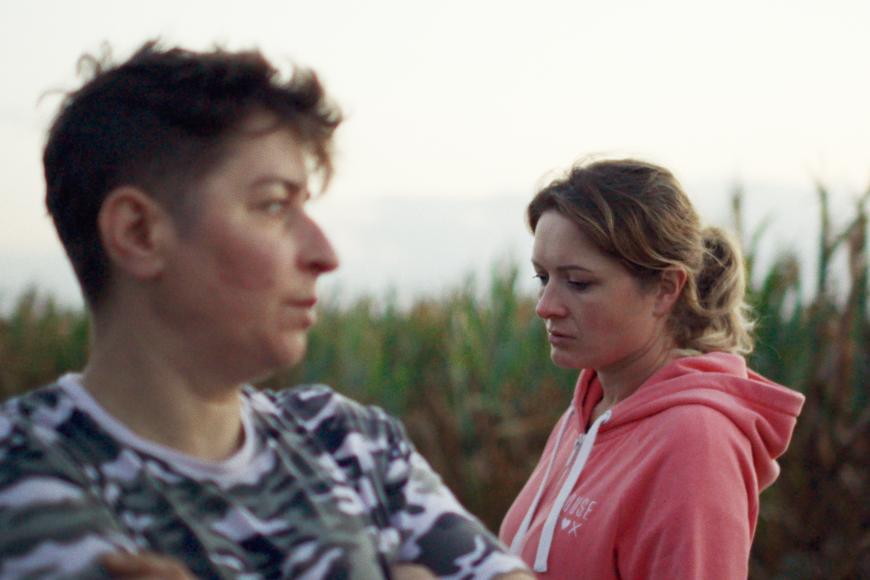
The rules in rural Poland are clear: Every man must have a woman; every dancer must have a female dancer. The pubescent Miłosz feels safe here, especially after his mother’s death. His sister Agnieszka, who is in a long-distance relationship with her friend Majka, does everything to obtain custody of her little brother. Gradually, a new family model is revealed, documented by Marek Kozakiewicz as an attempt that is as restrained as it is determined.
The windmills behind the houses rotate steadily, standing in place, signalling stability. But the lives of Miłosz and his 35-year-old sister are in turmoil. They are facing a red-tape marathon to make Agnieska his legal guardian: Both have been orphans for a few months. Director Marek Kozakiewicz depicts the establishment of a new family no one expects much applause for in conservative Poland. Because for Agnieszka and her partner, who is ten years older, the determination to try living together manifests tentatively. Without kisses, without celebrations, the decision almost casually becomes reality – the women are exploring the boundary between platonic tenderness and enforced secrecy. And Miłosz, too, seems to realise only slowly what the relationship between Majka and Agnieszka really is.
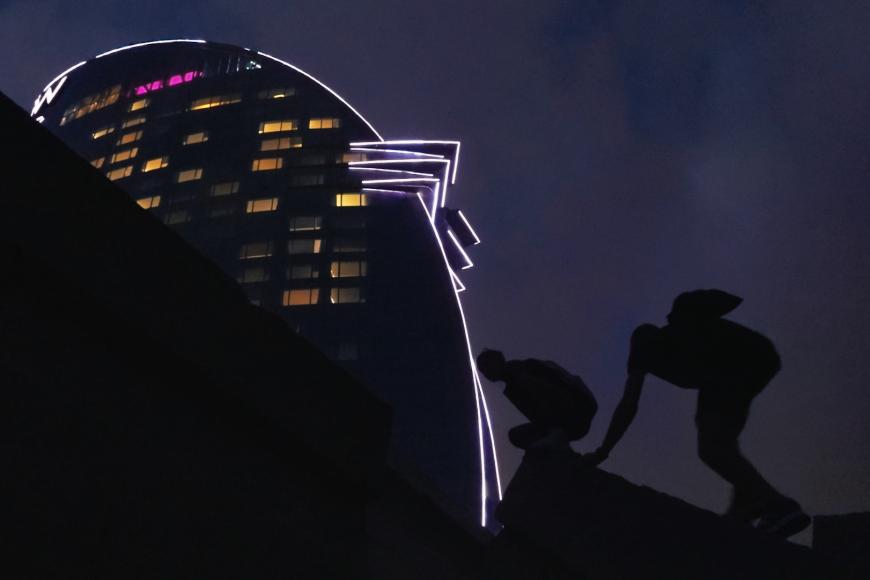
The film follows three young Russian women after the attack on Ukraine. Stay or leave? A haunting look at a generation in today’s Russia and their lives on the go.
Alyona, Alik and Katya belong to a generation of young Russian women who demand what they are not allowed. They are part of a global youth that dreams of self-determination and freedom. Sybilla Tuxen followed her protagonists between 2018 and 2022, up to the time of Russia’s invasion of Ukraine, when the three young women find themselves in a new reality. Now more than ever, they are rebelling against Putin’s state and have since lived life on the go.
One of them has made it to Georgia, another goes to Spain, while the third stays at home. They keep in touch by smartphone and social media. One hears from their conversations that they, like many others, don’t believe that political engagement can change anything. Their resistance rather consists in leading modern and western lives in which gender, sexuality, pop music and identity issues play important roles. Tuxen’s darkly poetic debut film is set in nocturnal cars, flats and backyards. The transit in which the three find themselves becomes physically tangible. Their stories allow us rare glimpses into an almost invisible side of today’s Russia and the complexity of lived contradiction.
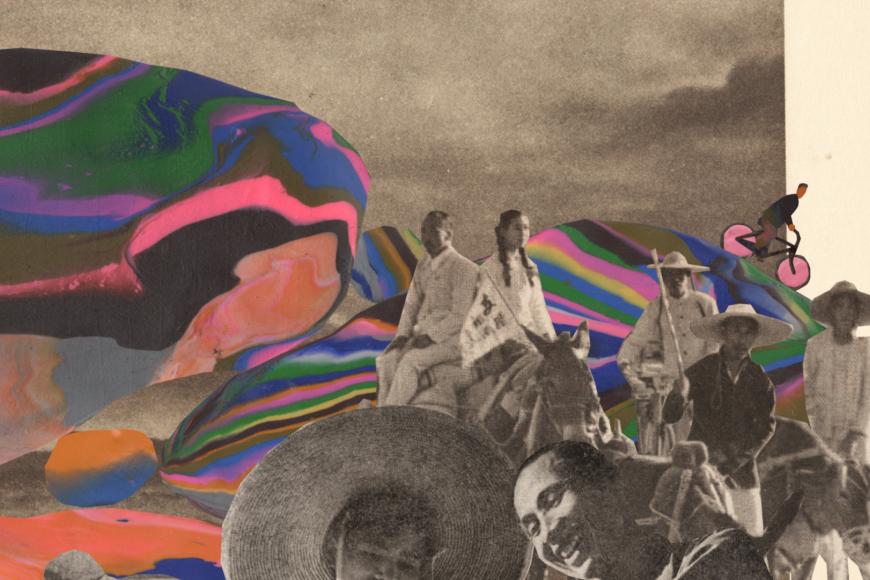
The tumultuous 1960s in China as a collage of archival images, clay figures and interviews. Lei Lei lets his father and his grandfather talk, about bicycles and bank clerks, about life in the countryside, re-education and class enemies. Their memories generate a multicoloured surreal world that is an enchanting fantasy of the time before and during the Cultural Revolution.
In his second feature-length film, artist and animation filmmaker Lei Lei once more takes up experiences of family members and uncovers a piece of national history via private stories. For more than six years, he collected family photos, postcards, propaganda images and old films. On this backdrop he forms and moves his characters made of gum-like pastel modelling clay, whose colourful, almost childlike appearance supports the impression that this is where a grandson imagines the anecdotal memoirs of his ancestors. But this imaginative animation is anything but naïve: It takes the time to accommodate the detours and pauses in the narrative and takes us – by means of a restrained soundscape, too – deep into a universe where one can lose oneself.
Marie Kloos
Credits
Director
Lei Lei
Script
Lei Lei
Cinematographer
Lei Lei
Editor
Lei Lei, Patrick Minks
Producer
Isabelle Glachant, Lei Lei
Co-Producer
Bruno Felix, Janneke van de Kerkhof, Femke Wolting
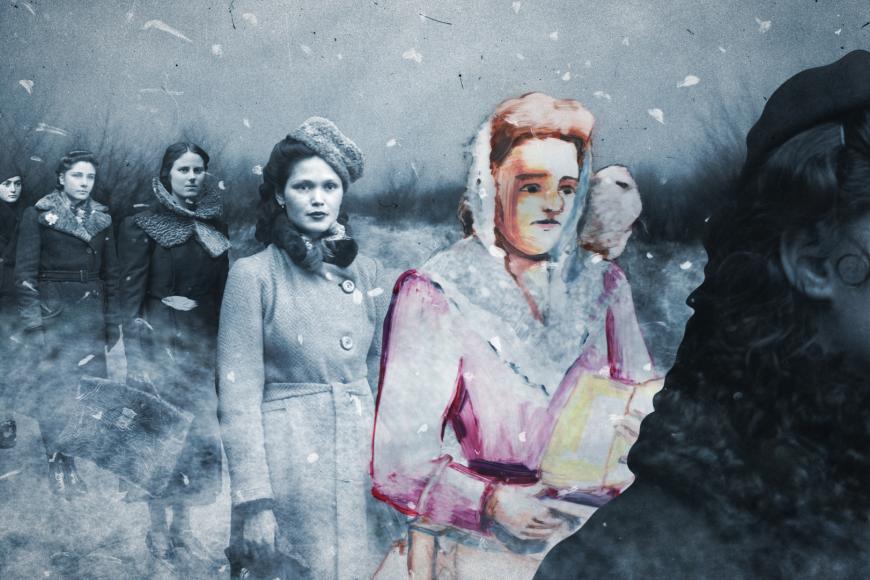
Inspired by the estate of a Romanian photographer in which 5,000 glass plate negatives from the 1930s to the 1950s survived undiscovered for a long time, a touching love story evolves. In 1939, Anna Florea meets the young soldier Jean Mihail in her home village in Bukovina. A moonshine kiss seals their affection. But all too soon, Jean is ordered to the frontline. His passionate letters keep the connection alive. But when Anna must flee the site, the contact breaks off. Their great love is fragile, damaged by war and time – just like the old studio and everyday photographs this animated documentary uses to illustrate optimism and impending loss. Anna Florea herself narrates the film: in retrospect, at the age of 91. Her warm and gentle voice reanimates the memories seemingly stored in these pictures. Those “frozen” on the photographic plates begin to move, are made to glow in oil-on-glass overpaintings, blossom and take us with them into the past.
Franka Sachse
Credits
Director
Mélody Boulissière, Bogdan Stamatin
Editor
Billie Belin, Annabelle Basurko, Nina Gerolt
Producer
Marc Faye
Co-Producer
Mathieu Rolin, Mihai Mitrică
Sound
Yan Volsy
Animation
Mélody Boulissière, Charlotte Arene, Andrei Berculescu, Dorel Mărgărit, Cosmin Tudor Sîrbulescu
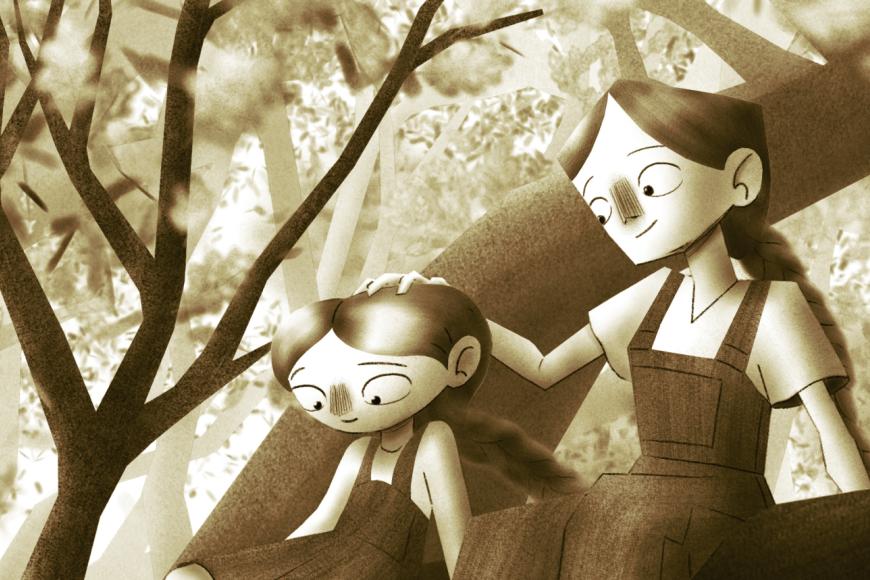
Two sisters travel to the realm of clouds on a paper plane, in search of the big tree with the golden leaf. Slowly they get closer to each other and their goal.
Two sisters travel to the realm of clouds on a paper plane. They are looking for the big tree with the golden leaf. Their plane has to be mended again and again, and the big sister is worried. When she falls ill, the little sister takes control. Slowly they get closer to each other and their goal on this arduous journey.
Lina Dinkla
Credits
Director
Kasia K. Pieróg
Editor
Kasia K. Pieróg
Producer
Marcin Podolec
Sound
Kacper Zamar
Score
Hubert Zemler
Animation
Kasia K. Pieróg, Jakub Baniak, Agnieszka Czachór, Przemysław Świdada, Dudek Pulit, Michalina Musialik, Adrianna Matwiejczuk, Karolina Kajetanowicz, Alicja Grotuz
Jamila, Rachel and Faseeha – aged 9, 11 and 12 – belong to the Sisterqueens rap crew. In their rhymes, the friends raise poignant questions about self-determination and identity.
Jamila is nine, Rachel eleven and Faseeha twelve when they take their first steps into a new hip-hop culture. The Berlin girls meet at a rap project, become friends and take off with their Sisterqueens crew. This documentary follows them over four years through their daily life with parents, siblings and their unusual chosen hip-hop family, where they learn a lot about hook lines and even more about self-respect. We watch the three at rehearsals, studio recordings and stage performances, where they counter the well-known gender clichés of rap with their own songs. They also discuss their experiences with racism and exclusion and turn what happens to them into rhymes. Faseeha tests the boundaries with other artistic forms of expression, Rachel thinks about what self-determination means to her, and Jamila witnesses a frightening incident that makes her doubt the sanity of the police. They formulate their ideas and questions about what it means to be themselves, always with humour and to the point.






![Filmstill Shape of Appetite [excerpt]](/sites/default/files/styles/stepped_teaser_/public/fiona/films/stills/f9f67d36-b422-4576-91f4-91836e42e5ee.jpg?h=d1cb525d&itok=0hB_0_H1)




![Filmstill Shape of Appetite [excerpt]](/sites/default/files/styles/film_stills_full_content_view/public/fiona/films/stills/f9f67d36-b422-4576-91f4-91836e42e5ee.jpg?h=d1cb525d&itok=W9TnQAfW)


