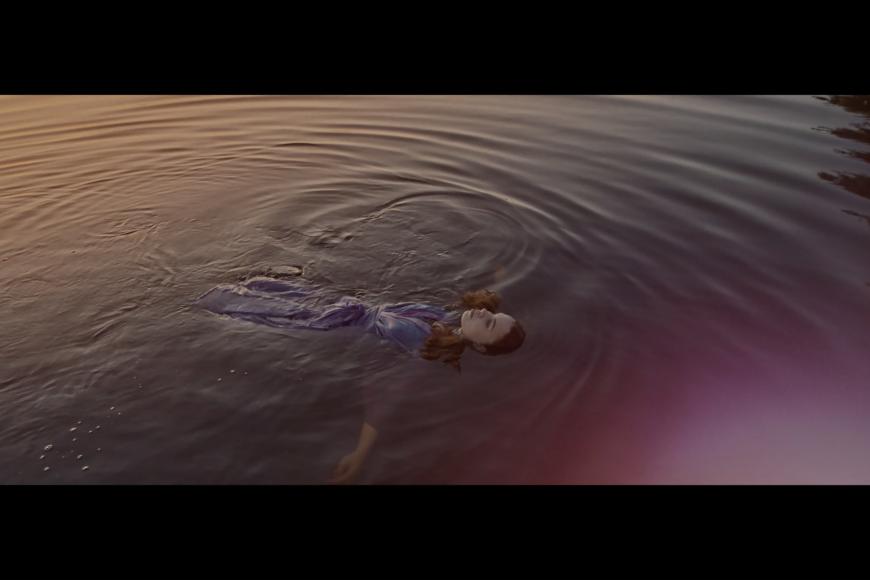
The film follows Vilma on her last weekend in her hometown of Tornio, a small place in Lapland. Very soon she will move far away to the big city of Helsinki.
The film follows Vilma on her last weekend in her hometown of Tornio, a small place in Lapland. She celebrates her graduation, has a great time with her family and friends in the lightheartedness of summer and says goodbye to her old life. Very soon she will be far away. Her new home is the big city of Helsinki, a ten-hour drive from Tornio.
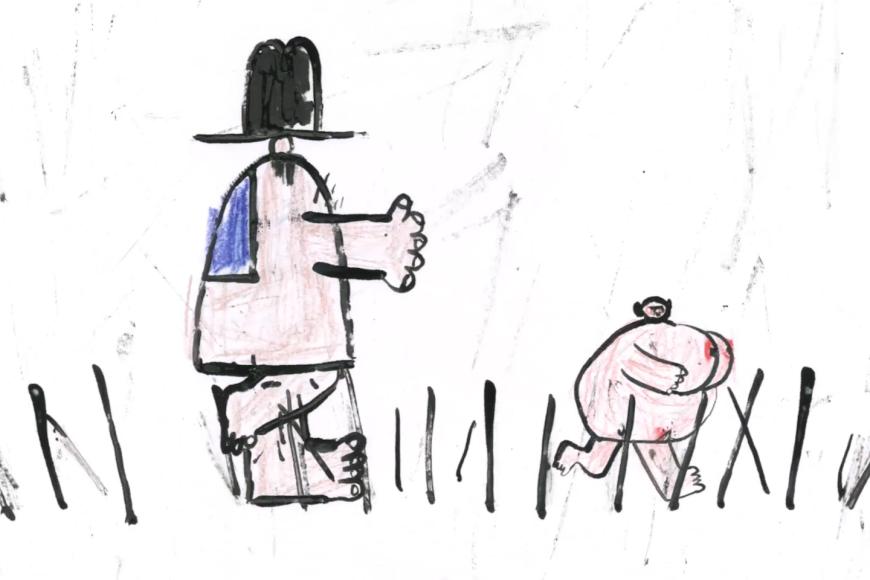
An animation-documentary hybrid in which four older women reflect on their memories of times when the relations between the sexes were completely different.
In this animation-documentary hybrid, four older women reflect on their memories of the old times when they were young and relations between the sexes were completely different. Their many voices merge into one: Grandmother Vera speaks. She tells her story in precise detail, gives insight into the turbulence of her youth and shares memories of her intimate life. She speaks as a representative of Slovenian women in the first half of the 20th century and illustrates their status in the gender and social hierarchies of that era.
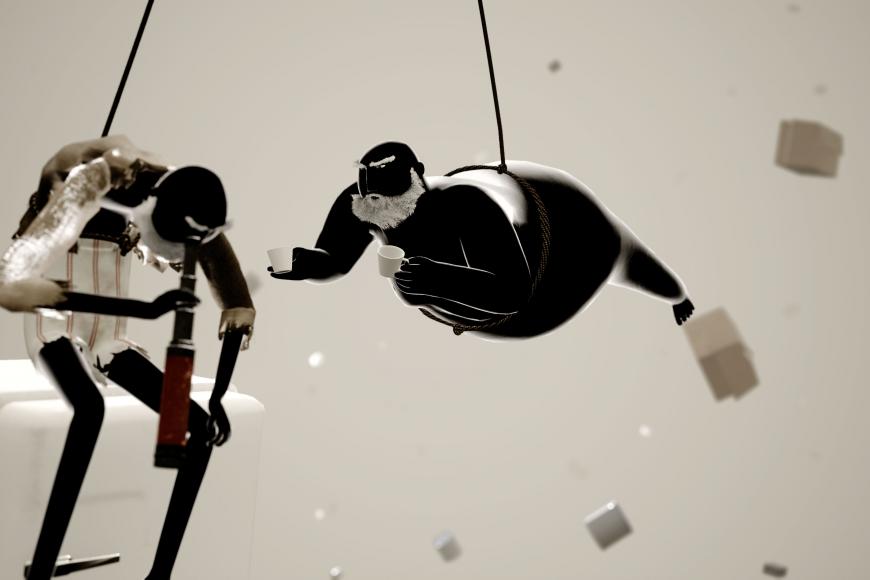
Osario and Benedito live in a space where gravity doesn’t seem to exist. Their cosmos knows neither up nor down. But is all this lightness just an illusion after all?
Osario and Benedito, two brothers, lead a quiet and isolated life. Gravity doesn’t seem to exist in their cosmos. Objects float around – no up, no down, no points of orientation. The two have never known anything else than this floating in space. We float along and are irritated: is all this lightness just an illusion?
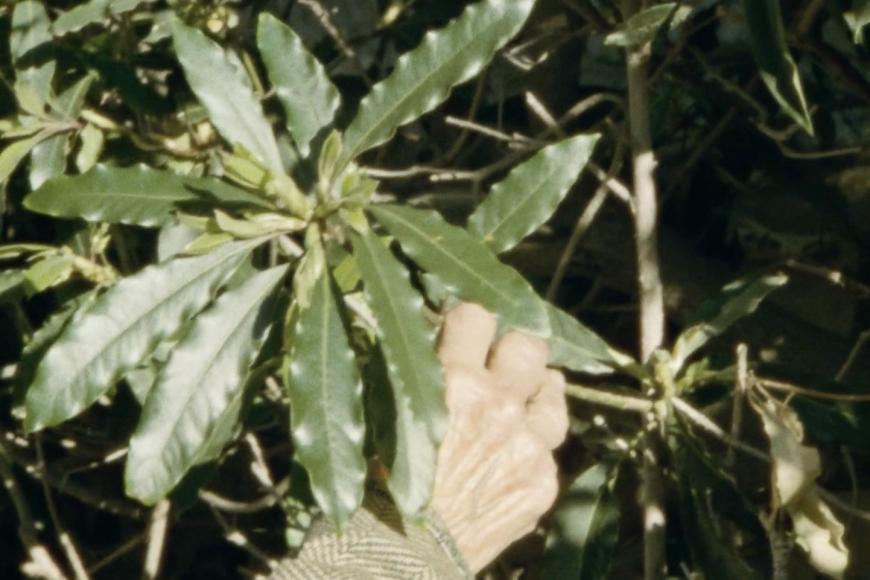
A minimalist eulogy to the painter Luchita Hurtado, who only experienced her breakthrough at the age of 97. A film in autumn colours about a woman in tune with nature.
A visual artist all her life, Luchita Hurtado only reluctantly experienced her breakthrough at the age of 97. “Green Turns Brown” is a minimalist eulogy to the publicity-shy painter. Shot on Super 8 film stock during the last months of her life, this film, which revels in autumn colours, paints the portrait of a woman in tune with nature who sees death not as the end but as the crossing of a border. “Life goes on.”
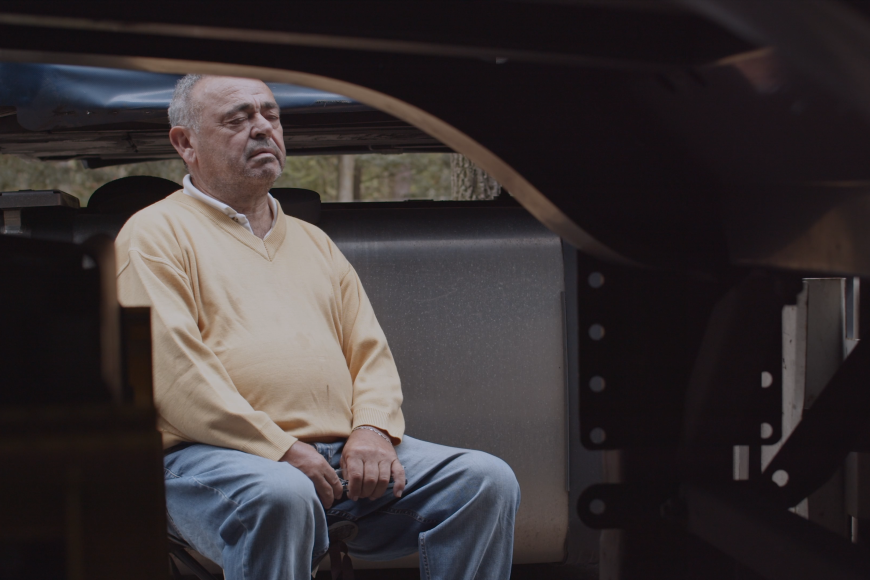
A summer Sunday at a motorway service area. The trucks stand still. The drivers doze, cook, stare into space. A phone call with the family provides inner and outer movement.
The motorway roars in the background, darkness lies over the service area. One truck driver smokes; another turns on the light in his sleeper cab. A summer Sunday is dawning, everything is standing still. Precisely designed detail shots induce in us a state of waiting. This is what life on the road can also look like. Cooking, dozing, staring into space. Hair is shorn short, words are exchanged. Polish pop songs resound from one of the cabs.
Life seems to have been tuned out. And yet it is happening. One of the men roams the forest, calls home. Suddenly a family is present in the images: The man remembers a swimming trip when the children were small. A strangely beautiful sight. He holds his mobile up in the air so the person on the other end of the line can hear the woodpecker.
Do you think of what a memorial is meant to remind you of? An enlightening tour of Leipzig, “City of Heroes” of the Peaceful Revolution, and the grey areas of a contemporary culture of remembrance.
In autumn 1989, many Leipzig citizens lost patience with the GDR. Within weeks, they brought down a forty-year-old state apparatus resistant to change by rallies. Now their patience is tested again: In 2008, the German Bundestag promised the “City of Heroes” of the Peaceful Revolution a monument. Planning has been going on and on … Leipzig bears the waiting with equanimity; after all, it was not idle in the meantime. Right after reunification, the citizenry took charge of its culture of remembrance with such vigour that the monuments are piling up today. Looking up to the crown of the palm tree of the Nikolai Column, one had better take care not to step on a commemorative plaque, fall into a commemorative fountain or bump into a commemorative bell. Classicist? Figurative? Abstract? What is the formal language a city chooses to tell itself its own history while it is practically still happening? Locals and newcomers roam the current Leipzig collection of monuments, a man ties his shoelaces on the big toe of the bronze sculpture “Step of the Century”. Do people think about what monuments give them to think about? The subtly framed and laconically presented impressions of the city are intermingled not only with the trademarks and emblems of lived urbanity, but also with the voices of local cultural delegates. They are thinking: about the pros and cons of accelerated remembrance.
A historical trade show film on various folding and stapling machines which are shown in action and explained in abundant detail, featuring exterior views of the factory in Plagwitz.
The Gebrüder Brehmer company produced wire stitching and folding machines and was one of the largest of its kind in Germany with up to 1,000 employees. Even in the early days of the medium, the company used film to promote its goods and cultivate its reputation. This image film presents the factory in Plagwitz and special folding machines, for example the “¾-Automatic Sheet Feeder”.
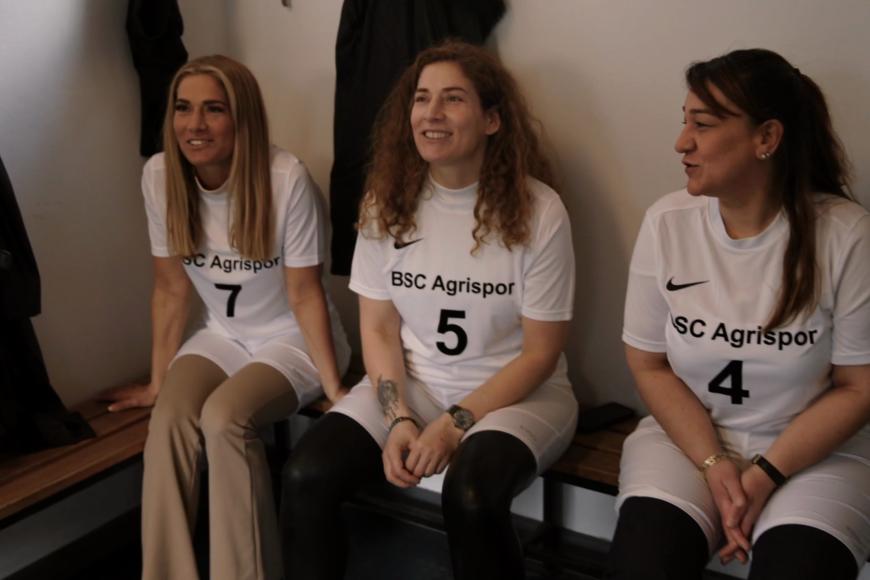
After thirty years, Bademsoy returns to the former players of the first Turkish girls’ football team in Berlin. Many questions are still open, including the old ones about being German.
“You got to try to live your own life,” Arzu, one of the football players from the Turkish-Kreuzberg girls’ team Ağrı Spor, demanded in a 1995 film by Aysun Bademsoy. Today she is in her late forties and leads her own life, like her former teammates Türkan, Nalan and Nazan. Bademsoy visited the four of them for the fourth time, following their lives, recalling their visions for the future from back then. And this time she also talked to their daughters, some of whom on the brink of adulthood, who also think about adaptation, tradition, religion and culture. Little has changed between then and now, being German remains a difficult question to answer for every generation. Aysun Bademsoy has produced a delicately layered work of German-Turkish perspectives in which female concepts of identity are reflected back at a society where integration is formulated only as expectation. “If others don’t accept that we are Germans, how are we supposed to accept that?” Selin, Türkan’s daughter, asks. You don’t need to know the other three films to understand “Game Changers” – and to appreciate the significance of this project which now spans almost thirty years. The best thing about it: Football is being played again!
Jan Künemund
Credits
Director
Aysun Bademsoy
Cinematographer
Ines Thomsen, Isabelle Casez
Editor
Maja Tennstedt
Producer
Alex Gerbaulet
Sound
Ivonne Gärber, Camilo Garcia Castro
Sound Design
Titus Maderlechner
Nominated for:
VER.DI Prize for Solidarity, Humanity and Fairness,
Gedanken Aufschluss Prize






![Filmstill Messefilm der Fa. Gebrüder Brehmer [Ausschnitt]](/sites/default/files/styles/stepped_teaser_/public/fiona/films/stills/9a4bd28d-d399-49b5-aa0c-02a279d358df.jpg?h=346bc062&itok=L3e-BX-j)



![Filmstill Messefilm der Fa. Gebrüder Brehmer [Ausschnitt]](/sites/default/files/styles/film_stills_full_content_view/public/fiona/films/stills/9a4bd28d-d399-49b5-aa0c-02a279d358df.jpg?h=346bc062&itok=ND0OPpZr)
