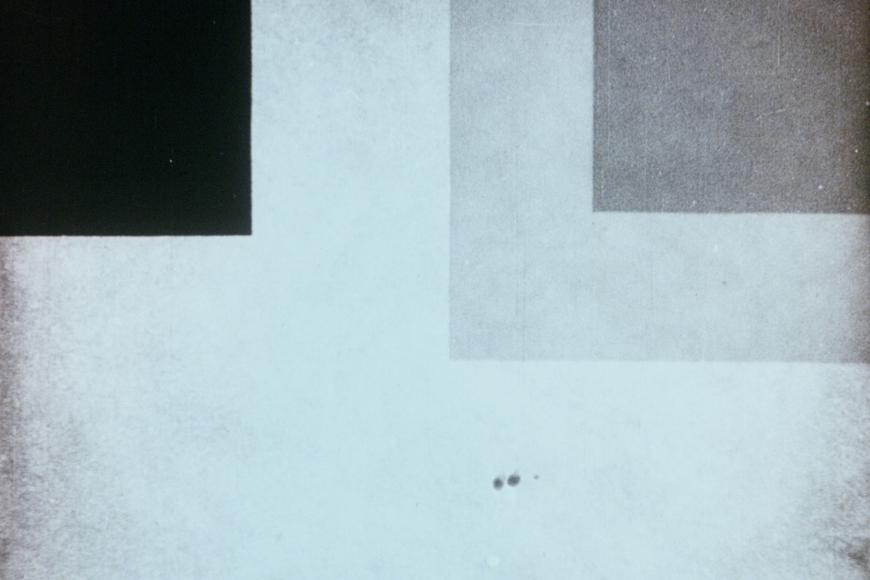
The image as an optical soundtrack: Movements become sounds, what you hear is what you see. – A tribute to the European avant-garde of the 20th century.
A contemporary answer to the avant-garde experiments of the 20th century. Once, artists like Oskar Fischinger drew graphic elements on the optical soundtrack of film strips to produce unexpected tones. Max Hattler turns the whole image into an optical soundtrack that directly translates into audio. Abstract movement becomes noise. What you hear is what you see.
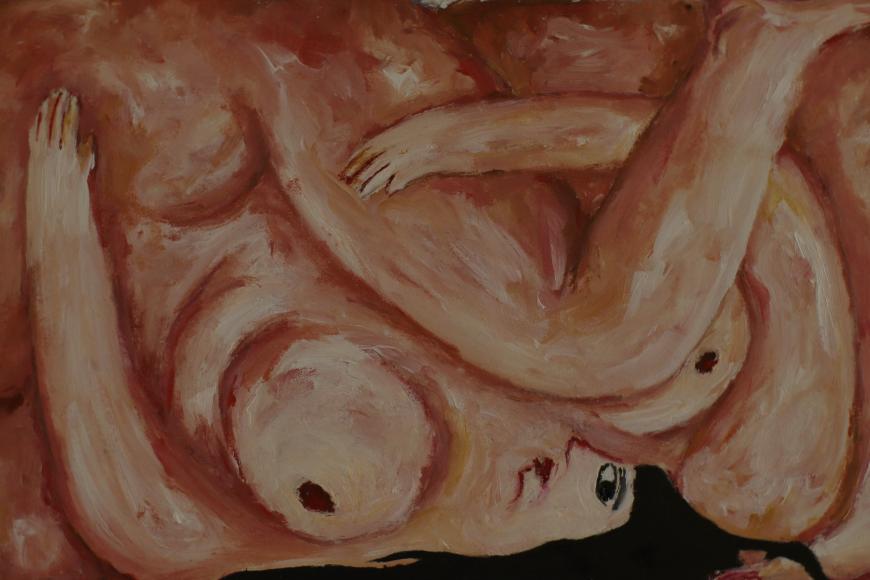
This alien body that does not seem to be yours. It is too conspicuous, too tall, and then again too insignificant. A cinematic reconciliation with being different.
“There was a body that didn’t want to be human. It didn’t know it belonged to someone. To me.” María Cristina Pérez González opens her film with these poetic and cryptic words, diving deep into the visually powerful, hand-painted animation. Associative rather than narrative, the sad voice pulls us into a maelstrom of remembered fragments that all revolve around the protagonist’s body: A voluminous shape that sometimes eats itself with loathing, stretches until it fills the frame or cowers like a pea – in the blackness of the fluid, generous brushstrokes, but above all in its own fleshy self. There is the estranged sister who once called the feet of this body ugly. The good friend who disappeared without a farewell. The father who once said that all unhappy women grow fat. And most of all there is this nameless figure that lives in her belly and feeds her depression with a cute grin. As so often in life, the only path to contentment is reconciliation. With the sister, of course, but above all with her own body which does not fit into narrow social norms – but is the only one she has. And with which she can dance, jump, and even laugh quite splendidly once she understands that it is not a monster to be fought.
Marie Ketzscher
Credits
Director
María Cristina Pérez
Script
María Cristina Pérez
Editor
Mauricio Cuervo Rincón
Producer
Mauricio Cuervo Rincón
Co-Producer
Mireia Vilanova, James Belfer, Adam Belfer
Score
Daniel Gwilym Jones Cozzarelli
Animation
Laura Alcina, Natalia Rojas Noy, Megumi Cardona, Gizenth Barreto, Fabián Llantén, Anamaría Sáenz Peñas, Julián Arias Garzón, Juan Pablo Figueroa, Daniel Bonza
The painter Ruttmann takes out a patent for a process to produce moving image: glass sheets mounted on top of each other are painted with oil paints and photographed from above with a camera.
Like many artists of his time, Walter Ruttmann discovered film as a medium of experimentation with revolutionary forms of expression. He gave up easel painting in 1918 and acquired the first German patent for an animation stand in 1920, thus creating the technical prerequisites for his “Opus” series: abstract elements of painterly gestures and cardboard moved by stop-motion.
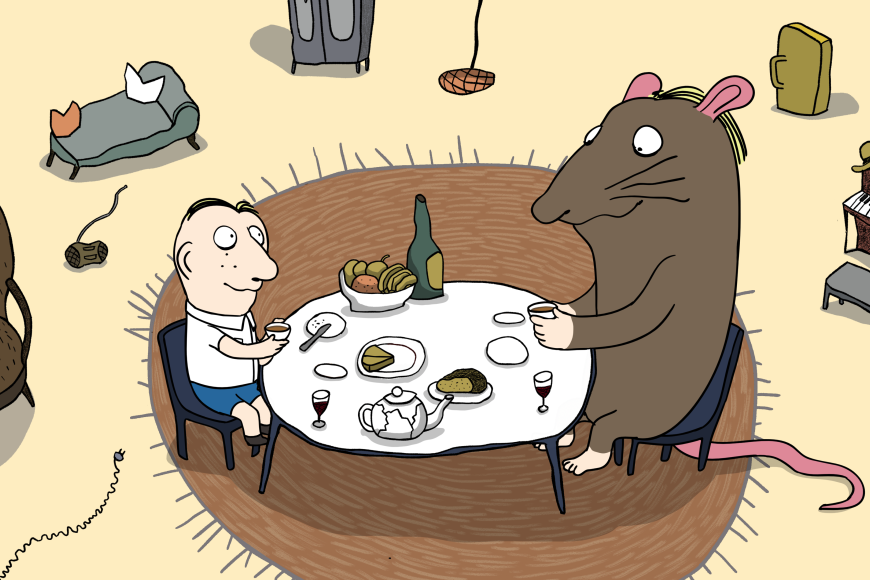
A huge, cheeky rat has moved in with the little man and makes itself at home. One day he angrily throws it out. But then he realises how empty and lonely everything is without it.
A huge, cheeky rat has moved in with the little man. It whistles to the music from the radio, helps itself from the fridge without asking, splashes in the bathtub and is simply everywhere – loud, annoying, just too much. When it suddenly disappears, the little man realises that the apartment has never been so quiet – and so empty. A heart-warming adaptation of Nadia Budde’s eponymous picture book.