This film examines the question of the boundaries between analogue and digital images in a haunting, sometimes challenging way. Aesthetical elements of techno culture are reflected here.
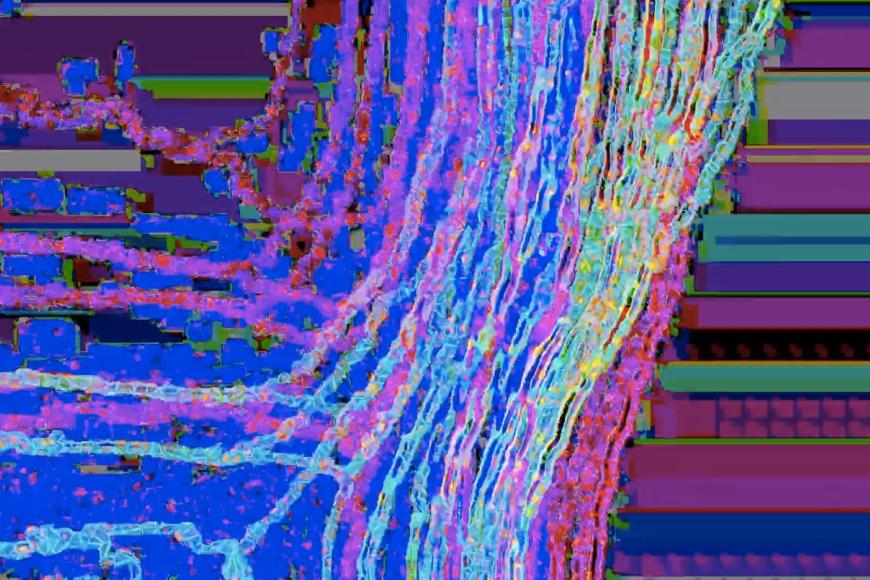
Coarse pixelated lines burst into our field of vision. They seem to communicate, but in a strange language. A little later they explode in a blaze of colours, while old-fashioned test patterns sneak into the background. Memories of a not-too-distant era come to mind, when everything was analogue and pixels could only dream of their big future.
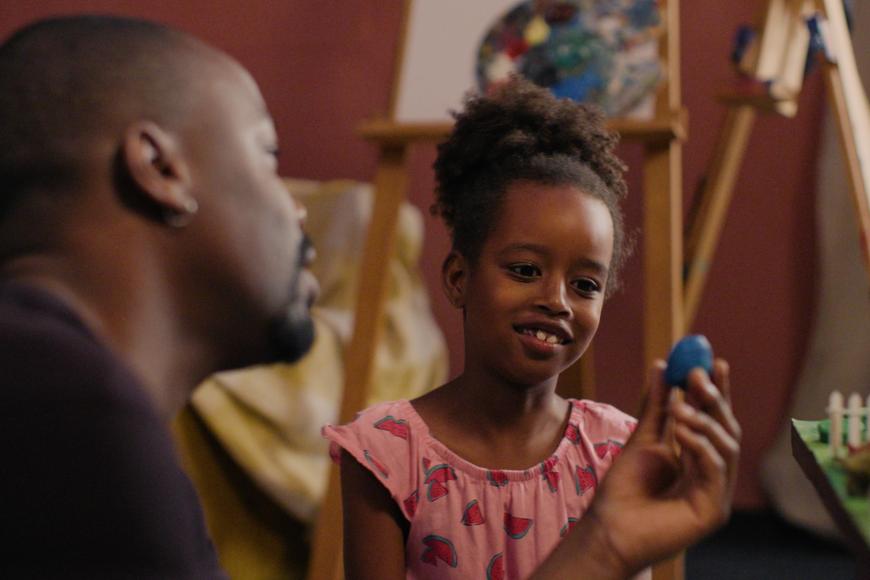
All creatures in Greenland are green, except Bluekid. In this partly animated handicraft world, Mwita Mataro reflects on experiences of racism in Austria with children and experts.
In his early twenties, Mwita Mataro set himself three big goals: become a rock star, make a film, and then found an art school in Tanzania. He has already accomplished the rock star part – he is the frontman of a band. And this film is his directorial debut. There was a choice of many subjects, something beautiful like friendship, for example. But there is one thing that bothers him more than his white film colleagues, and that is the colour of his skin. So what does it mean to grow up as a Salzburg native with Tanzanian roots, as a Black Person of Colour in predominantly white Austria? To investigate this, he has teamed up with young BPoCs to create the animated fantasy world Greenland: a place where all the potato creatures are green except Bluekid and his blue family. They paint themselves green to be less conspicuous, but since this does not always work out, Bluekid experiences rejection and marginalisation.
In his documentary essay, Mataro reflects on a daily reality based on colours: racism, alien attributions, otherness, blues experiences in Greenland. He listens to children and adults, lets the audience participate in talks with pedagogues, psychologists and politicians and opens up in front of the camera at home. With “Austroschwarz”, Mataro also comes one step closer to his third goal.
Tina Jany
Credits
Director
Mwita Mataro, Helmut Karner
Script
Mwita Mataro, Helmut Karner
Cinematographer
Jasmin Schwendinger
Editor
Christin Veith
Producer
Stephan Herzog, Andrea Elaiza Arnold
Sound
Cristi Iorga
Sound Design
Eli Frauscher
Score
Nicola Mpunga
Animation
Vladimir Savić
Nominated for:
Gedanken Aufschluss Prize,
Young Eyes Film Award,
Leipziger Ring
Children who are stillborn or die too young – not an uncommon fate. But society hardly ever talks about it. This film gives parents a space to grieve and break the silence.
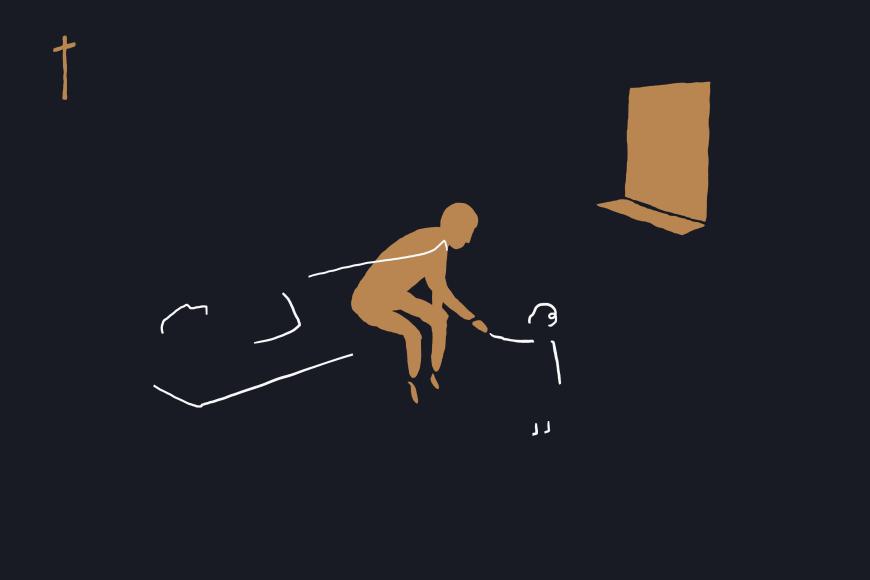
“Apparently, it had to happen to me before I learned it was ‘normal’.” This statement by a protagonist sums up how our society deals with stillborn children or children who die young: Star children are omnipresent (one in four mothers has lost a child) and yet absent. We lack the vocabulary, the sensitivity, and the tranquillity to enable parents to mourn. Remo Rauscher’s animated documentary confronts us with this inability, letting twenty people in mourning or who deal with mourning speak: Thinking out loud, struggling for words, regarding the pain from different perspectives, discovering dignity and strength in it and helping us to overcome the taboo. They object to being an “error in the system”, to accepting the speechlessness. In Rauscher’s film, the darkness is ambivalent and palpable on all levels: It is absorbing and caring. It is generous and gives us moments of beauty, humility, and hope. The 2D animations in muted colours on a dark background are always abstract, sketchy, and restrained – an expression of tact and respect. They draw attention to themselves only once in a while, while the voices are given a lot of space and can unfold without fear. This film opens a space to mourn that society is unable to offer yet.