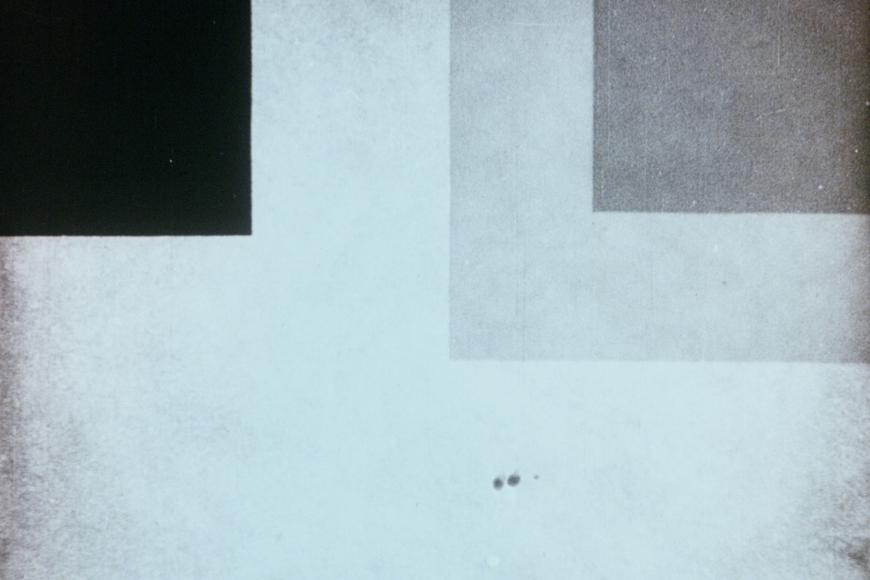
The image as an optical soundtrack: Movements become sounds, what you hear is what you see. – A tribute to the European avant-garde of the 20th century.
A contemporary answer to the avant-garde experiments of the 20th century. Once, artists like Oskar Fischinger drew graphic elements on the optical soundtrack of film strips to produce unexpected tones. Max Hattler turns the whole image into an optical soundtrack that directly translates into audio. Abstract movement becomes noise. What you hear is what you see.
The painter Ruttmann takes out a patent for a process to produce moving image: glass sheets mounted on top of each other are painted with oil paints and photographed from above with a camera.
Like many artists of his time, Walter Ruttmann discovered film as a medium of experimentation with revolutionary forms of expression. He gave up easel painting in 1918 and acquired the first German patent for an animation stand in 1920, thus creating the technical prerequisites for his “Opus” series: abstract elements of painterly gestures and cardboard moved by stop-motion.