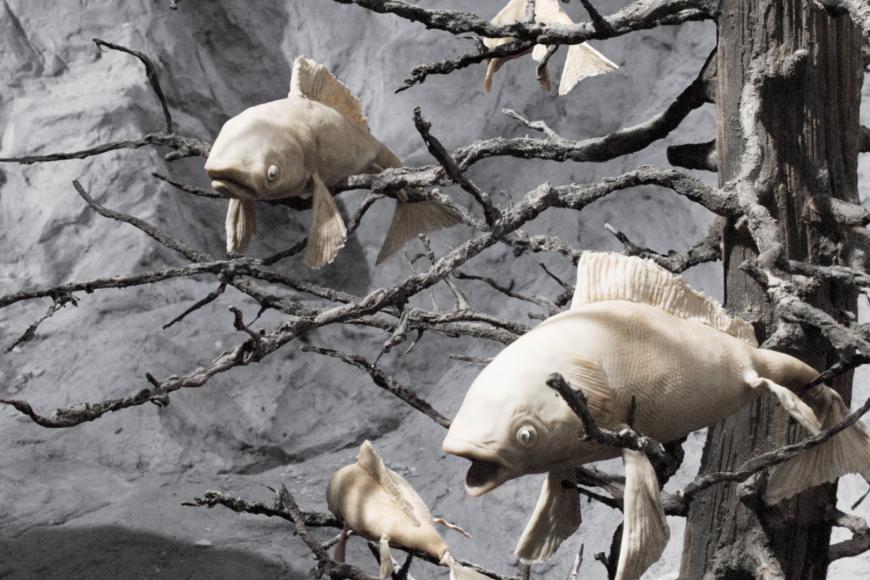
A demonstration set in an apocalyptic fantasy world with parable-like references to reality of how creatures (can) react when they are confronted with existential misery.
With his multiple award-winning animation, Jonatan Schwenk has created a haunting parable about compassion and solidarity. Mute creatures with burning eyes suddenly find themselves confronted with the distress of another species. At first their reaction is hesitant and stoic. But when the other species’ misery begins to disturb their peace of mind, they take action … “Sog” captivates with many creative ideas on the level of animation, succeeding in creating archaic images that look both abstract and realistic. Without a single word, the film makes us experience what a lack of empathy can lead to and that there are always at least two options for action.
In search of the cat Leo a boy roams through sunny, crayon coloured fields. Drifting without a care is part of the last throes of childhood before it ends.
In search of the cat Leo a boy roams through sunny fields. Drifting without a care and digging up treasures in the mysterious darkness of the barn are the last throes of childhood before it ends. The crayon colours of this summer are overlaid with the whispering and rustling of shelter – and a premonition. Mara Cerri and Magda Guidi sharpen our senses for the impressions of a confusing age.
In the Israeli-Palestinian conflict, the GDR explicitly supported the UN Partition Plan at first, only to adopt an increasingly one-sided position from 1965 onwards.
Under the banner of international solidarity, Arab children from refugee camps in Jordan are spending a holiday in the GDR in 1970. This political gesture ties in with the recently redefined position of the GDR in the Israeli-Palestinian conflict. At the World Youth Festival in 1973, Yasser Arafat was already seen standing next to Erich Honecker on camera.
Life instructions from nowhere: “Take a deep breath, say YEEES!” But the anonymous guru becomes a chattering flâneur through his own psychedelic universe of problems.
A voice from nowhere proclaims life instructions: “Take a deep breath, say YEEES! … and stop being boring!” But rules and authority gradually elude the anonymous instructor. He becomes a chattering, contradictory flâneur through the universe of his problem-fraught private affairs. Those therapy units have a really sneaky design.
André Eckardt
Credits
Director
Patrick Buhr
Script
Patrick Buhr
Editor
Patrick Buhr
Producer
Ute Dilger
Sound
Marvin Horsch, Donghee Nam, Jonathan Kastl
Animation
Patrick Buhr
Narrator
Erik Hansen
Performer
Vanja Smiljanić, Sina Seifee, Lia Sudermann, Matthias Conrady
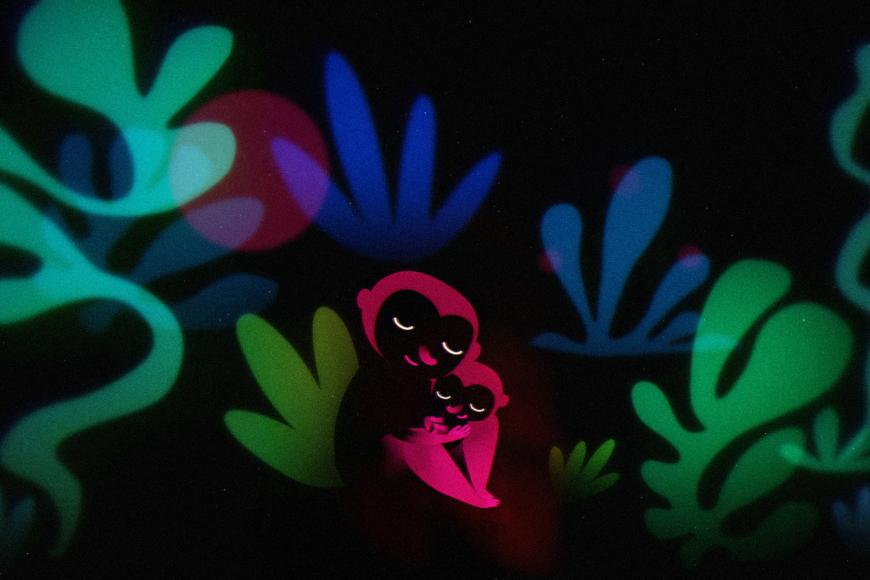
The sun is setting in the jungle. The little monkey rocks from leaf to leaf. His dreams are wild and colourful … A filmic lullaby that definitely won’t make anyone fall asleep.
The sun is slowly setting in the jungle. The little monkey closes his eyes. He rocks and glides from one green leaf to the next, gently drifting off into sleep. But what is this? Suddenly the world of dreams becomes darker, more colourful and wilder. Mysterious plants, creatures and shapes are lining the path through the night … “Somni” is a filmic lullaby, though no one is likely to fall asleep here.
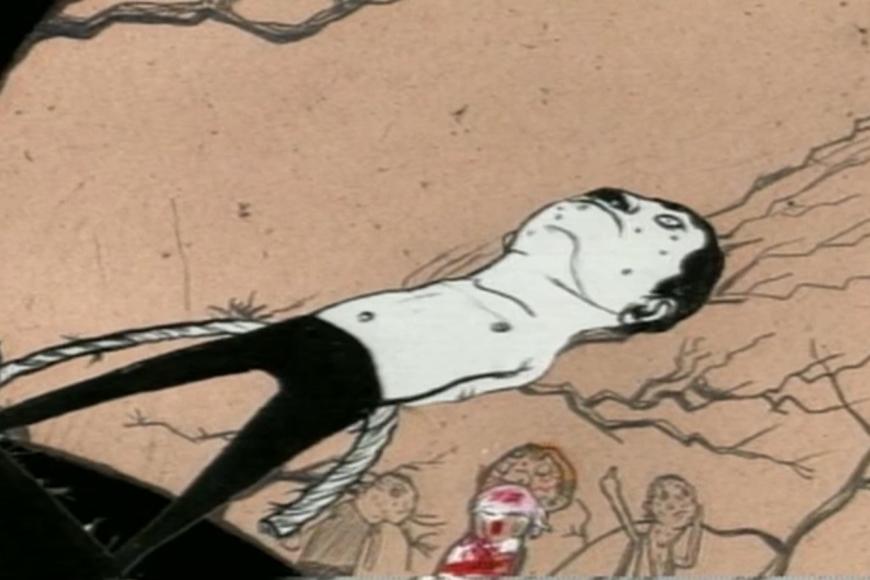
Children who play judges teach the neighbour’s boy a lesson. A scenario of bullying, based on Charles Bukowski, shows murderous group dynamics in rough comic book style.
A harrowing scenario of bullying based on a short story by Charles Bukowski, whose language is translated authentically into a rough comic book style. A children’s gang teach the neighbour’s boy a lesson. It’s their duty, the self-styled righteous ones tell themselves. What starts out like a game in a framework of dominance and banal irrationality escalates into murderous group dynamics.
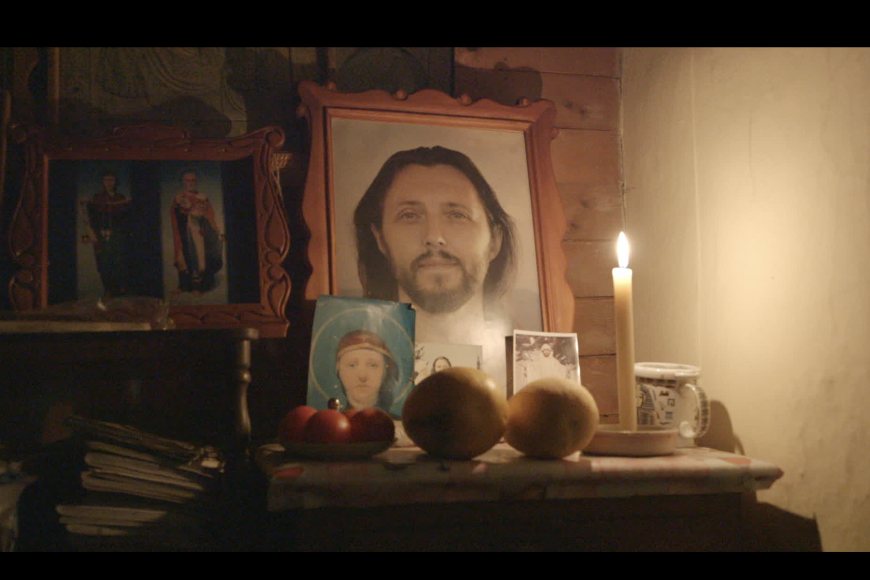
A religious community have created their model town in the Siberian wasteland. A long-term study and post-Soviet narrative, while the
militarisation of the country draws closer.
The winters in the Siberian taiga may be long, but at least Moscow is far away. In the early 1990s, a religious community lead by former traffic cop Sergei Torop settled in the endless landscape at the foot of the eastern Sayan Mountains. After a religious revival he calls himself Vissarion, wears flowing robes, long hair and acts as the Son of God on earth. Misty-coloured portraits on which “the Teacher” gazes obliviously into the distance hang in the homes of his followers. Together they have created the model town of “Abode of Dawn”, also called “Sun City” by the locals, to build a new society. Director Kristina Shtubert travelled to Siberia five times between 2013 and 2022. Her gaze is observational, less concerned with the search of faith and meaning than with the question whether the Sun City dwellers are happier here than in their discarded lives. And what would their alternatives be? More and more, the long-term observation turns into a post-Soviet narrative of a faded-out state. Meanwhile, the militarisation of the country progresses. Moscow is coming closer.
Anke Leweke
Credits
Director
Kristina Shtubert
Cinematographer
Hanna Mayser
Editor
Dietmar Kraus, Calle Overweg, Adrienne Hudson
Producer
DFFB Deutsche Film- und Fernsehakademie Berlin
Co-Producer
Kristina Shtubert, Rolf Bergmann
Sound Design
Sasha Valent
Production Company
DFFB Deutsche Film- und Fernsehakademie Berlin
-
Andreas Louis, Margarita Amineva-Jester
Nominated for:
Leipziger Ring,
DEFA Sponsoring Prize,
VER.DI Prize for Solidarity, Humanity and Fairness,
MDR Film Prize
The daily routine in the life of a young couple: getting up, eating soup, daydreaming … Surreal animated photo collages and electro-acoustic sounds turn the inside out.
The daily routine in the life of a young couple: getting up, squeezing blackheads, eating soup, daydreaming … Zbigniew Rybczyński reworks real-life images to create surreal collages in order to visually turn the inside out. He is supported by the Polish composer Eugeniusz Rudnik, whose great electro-acoustic inventiveness shifts playfully back and forth between naturalism and alienation.
The day begins for father and daughter. They climb beyond their treehouse, glide over and under water, cross blooming landscapes, travel through the air and fly on into space. By ship, bicycle, balloon or on foot. A film about travelling, collecting souvenirs in passing and the question of what’s left at the end of a life.
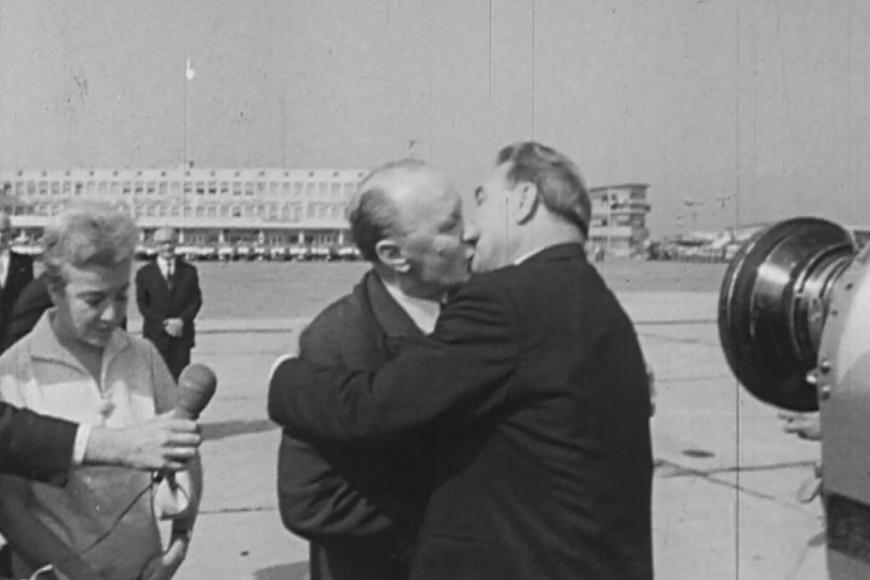
Soviet Troops in Prague and Budapest (Panorama, 29.7.1968)
anonymous
A curious look at the socialist reform experiment in Prague, with sceptical undertones: Will everything end like it did in Hungary in 1956? Soviet tanks are already being deployed along the border of the ČSSR.
Soviet Troops in Prague and Budapest (Panorama, 29.7.1968)
Sowjetische Truppen in Prag und Budapest (Panorama, 29.7.1968)
anonymous
Retrospective 2023
Documentary Film
FRG
1968
15 minutes
German
Subtitles:
None
Prague in July 1968. The West German television magazine Panorama reports on the situation in the ČSSR, drawing parallels to the developments in Budapest in 1956. Curious and sceptical at the same time, the feature explores the possibilities of an independent reform movement, but also soberly concludes that the Soviet Union will not tolerate this. The tanks are already waiting at the border.
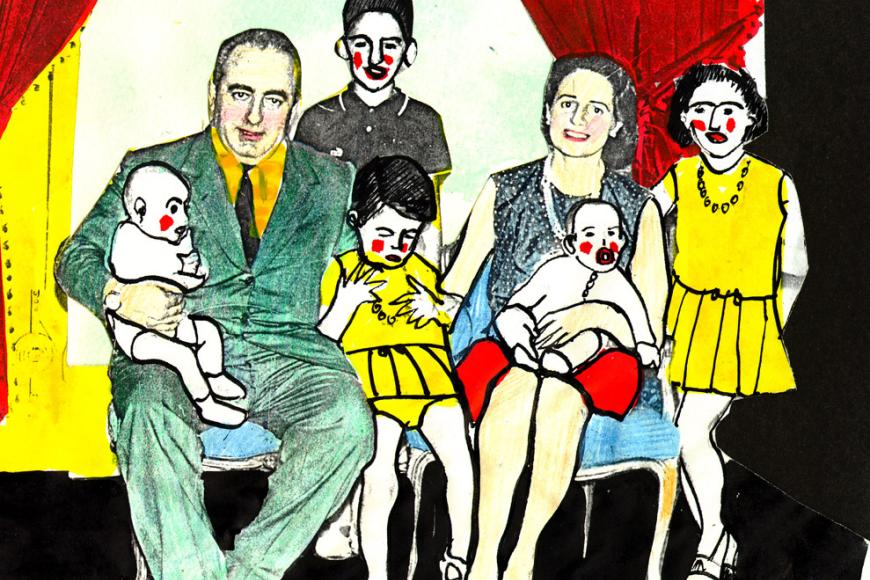
Isabel Herguera herself welcomes us in the title sequence of this autobiographical short film and gives us a brief glimpse behind the scenes of her work as an artist. Right after that, we join her on a fast-paced trip through the part of her family history that begins with the birth of her brothers in 1965 and ends with the death of General Franco in 1975.
After thirty years, Bademsoy returns to the former players of the first Turkish girls’ football team in Berlin. Many questions are still open, including the old ones about being German.
“You got to try to live your own life,” Arzu, one of the football players from the Turkish-Kreuzberg girls’ team Ağrı Spor, demanded in a 1995 film by Aysun Bademsoy. Today she is in her late forties and leads her own life, like her former teammates Türkan, Nalan and Nazan. Bademsoy visited the four of them for the fourth time, following their lives, recalling their visions for the future from back then. And this time she also talked to their daughters, some of whom on the brink of adulthood, who also think about adaptation, tradition, religion and culture. Little has changed between then and now, being German remains a difficult question to answer for every generation. Aysun Bademsoy has produced a delicately layered work of German-Turkish perspectives in which female concepts of identity are reflected back at a society where integration is formulated only as expectation. “If others don’t accept that we are Germans, how are we supposed to accept that?” Selin, Türkan’s daughter, asks. You don’t need to know the other three films to understand “Game Changers” – and to appreciate the significance of this project which now spans almost thirty years. The best thing about it: Football is being played again!
Jan Künemund
Credits
Director
Aysun Bademsoy
Cinematographer
Ines Thomsen, Isabelle Casez
Editor
Maja Tennstedt
Producer
Alex Gerbaulet
Sound
Ivonne Gärber, Camilo Garcia Castro
Sound Design
Titus Maderlechner
Nominated for:
VER.DI Prize for Solidarity, Humanity and Fairness,
Gedanken Aufschluss Prize
In short sequences of images pointedly set to music by Louis Armstrong, we follow the pleasurable triumph of young life over the obstacles of setting out into the world.
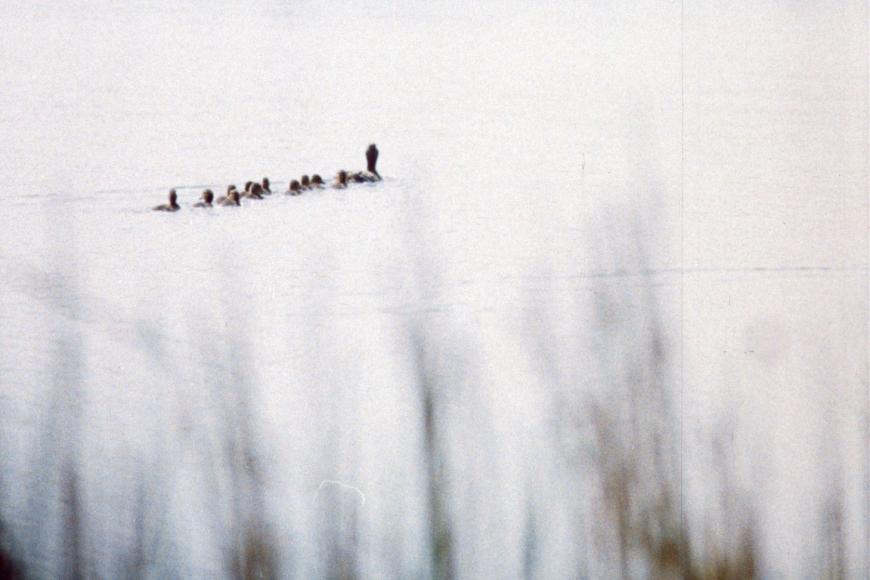
In short sequences of images pointedly set to music by Louis Armstrong, the film follows the pleasurable triumph of young life over the obstacles of setting out into the world. As short as the film is and as curious its contents, the chequered story of its working and release titles is just as interesting. In 1987, the industry magazine “Film und Fernsehen” presented it simply as “A DEFA film by”. The text printed there ends with a sentence in brackets: (And many a viewer may marvel at the courage of the little ducklings and feel encouraged themselves.)
A gaudily coloured twisty slide takes us into emotional shallows. A squeaky voice complains about its inadequacies. It belongs to an animated figure which serves as a catch bowl for a soul that’s not doing well. Its creator has pieced it together, but something holistic does not pop out of the demiurgic mush. Tulapop Saenjaroen uncovers the beginnings of Thai animation and takes a critical look at the future promise of media placebos.
“Communism is Soviet power plus the electrification of the whole country,” Lenin said. The biggest country on earth, presented in stupendous images intended to awe and amaze.
Saint Petersburg as the cradle of the 1917 October Revolution, Moscow as the birthplace of the Soviet Union in 1922: According to Lenin’s dictum “Communism is Soviet power plus the electrification of the whole country,” the mastery of the forces of nature and the exploitation of natural resources are demonstrated in impressive images – emphasising the independence and fraternity of all Soviet Republics.
A wild ironization and deconstruction of the old Soviet pathos of the victory of technical progress – like the accelerated pulse just before a heart attack.
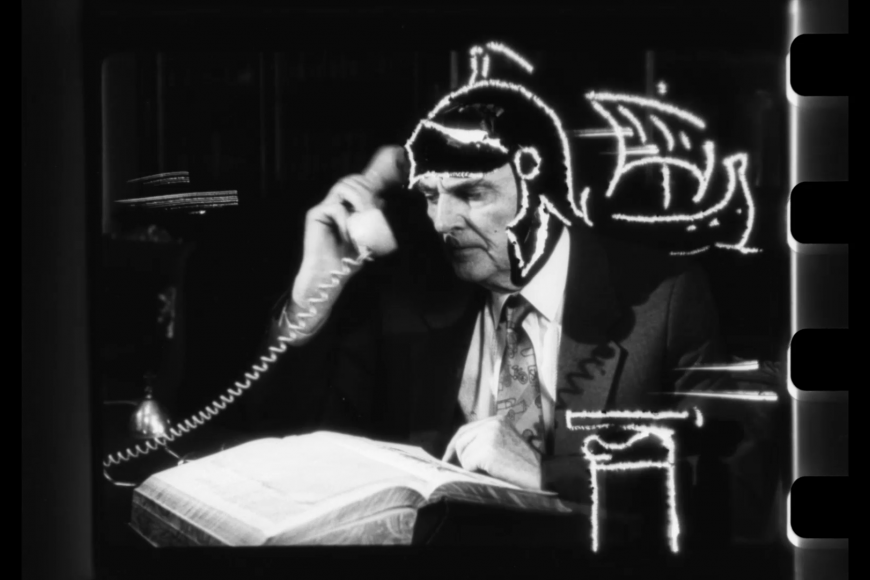
Overpaintings and scratchings in scenes from the Russian science fiction film “Silver Heads” by Yevgeniy Yufit. Considering that this work is already an outrageous deconstruction of the old Soviet pathos of the inevitable victory of scientific and technical progress, “Stakes” must be regarded as its drug-fuelled exaggeration into the unsurpassable.
Ralph Eue
Credits
Director
Boris Kazakov
Script
Boris Kazakov
Cinematographer
Boris Kazakov
Editor
Boris Kazakov
Producer
Saint Petersburg International Film Festival of Festivals









![Filmstill SSSR. 50 Let – 50 Years USSR [fragment]](/sites/default/files/styles/stepped_teaser_/public/fiona/films/stills/155894af-d436-43aa-adaa-595a2c83d4f5.jpg?h=8cd0f387&itok=7HRK46Ve)



![Filmstill SSSR. 50 Let – 50 Years USSR [fragment]](/sites/default/files/styles/film_stills_full_content_view/public/fiona/films/stills/155894af-d436-43aa-adaa-595a2c83d4f5.jpg?h=8cd0f387&itok=ERwnJ4cE)
