Examples from a DIY book about Op Art patterns form the basis of this hypnotic film. The images seem to move by themselves in front of our eyes. Their flowing and shimmering is driven by colour changes and cross-fades until the boundaries between actual and imagined movement become blurred. It is not only the soundtrack and title that herald the mischievous spirit of this work.
Mary is a 12-year-old girl living in the 19th century: inquisitive, persistent and fascinated by fossils. An entertaining and warm-hearted biopic about one of the first female palaeontologists.
We are travelling back in time to the early 19th century on the south coast of England. This is where Mary Anning lives, a 12-year-old girl who is inquisitive, persistent and fascinated by fossils. She spends every free minute at the beach to look for the fossilised remains of long extinct animal species in the strata of her hometown’s coastal cliffs. Her father, too, is an enthusiast and earns a little extra for his family by selling fossils. When he disappears after the collapse of a cliff, Mary’s life is shaken. All that her father leaves behind is a mysterious drawing whose meaning Mary only gradually makes out. She is determined to uncover the secret together with unexpected allies. An entertaining and warm-hearted biopic about one of the first female palaeontologists.
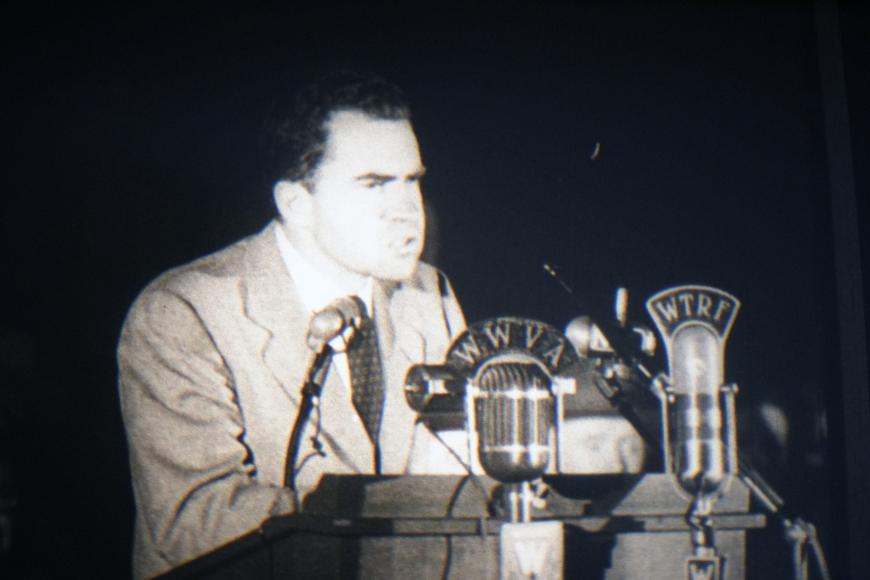
Three years before the Watergate affair brought down Richard Nixon, de Antonio proved with this gruesomely funny found footage montage that the president was a charlatan.
Three years before the Watergate affair brought down Richard Nixon, de Antonio exposed the President as a charlatan in this cruel and funny material montage. From an interview in the “Minutes” of the 1972 Leipzig Dokumentarfilmwoche: Question – “In each of your films, you expose a major American institution […]. Which did you choose for ‘Millhouse’?” De Antonio’s answer – “Nothing less than the traditional political process as a whole. The film is by no means a personal attack on Nixon. To expose a political opponent, all you need to do is rent a hall for him. The film attacks the American system, the credibility of this system, by turning on the perfect symbol of this system, the President.”
Tobias Hering, Tilman Schumacher
Credits
Director
Emile de Antonio
Cinematographer
Ed Emshwiller, Richard Kletter, Bruce Shaw, Mike Gray, Dan O’Reilly
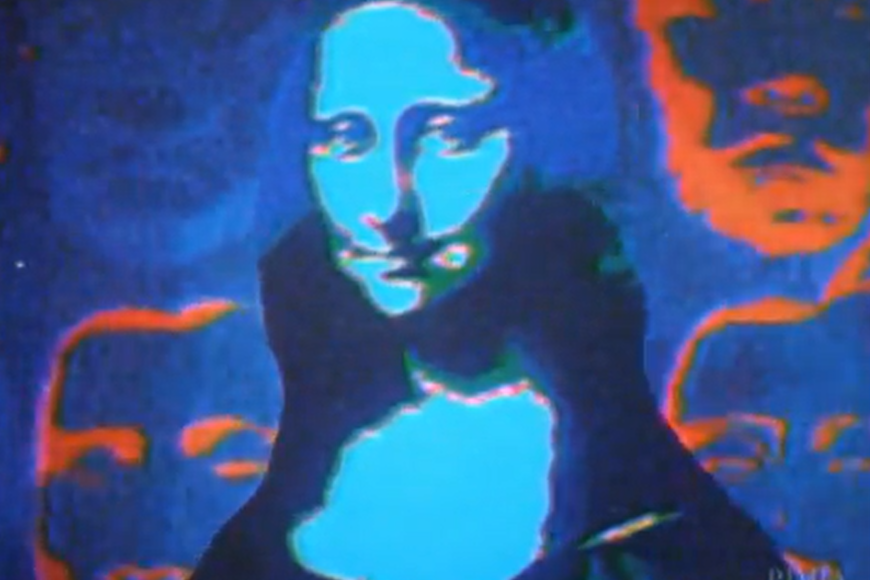
In the first ever use of the Scanimate video synth in Japan, Matsumoto takes the Mona Lisa on a journey through surreal landscapes, animating her into a shimmering psychedelic vision.
Using the Scanimate video synthesizer, da Vinci’s portrait of Lisa del Giocondo embarks on a surreal journey through real and artificial landscapes. In doing so, Toshio Matsumoto projects a kind of fantasy world of electronic images, exploding colour and movement onto his subject, animating Mona Lisa into a shimmering psychedelic vision accompanied by an abstract electronic soundtrack.
A gorgeous collection of tiny moving image moments full of wisdom, wit, and poetry. Viewed through a magnifying glass, the small things offer room for surprises – and great insights.
A brilliant and highly poetic collection of tiny moving image moments which offers aesthetic delights through cleverly chosen camera angles, framing, lighting, montage and the materials used. This archive of trifles remains silent. The eyes begin to hear, the sound is generated in the mind. Simply enchanting.
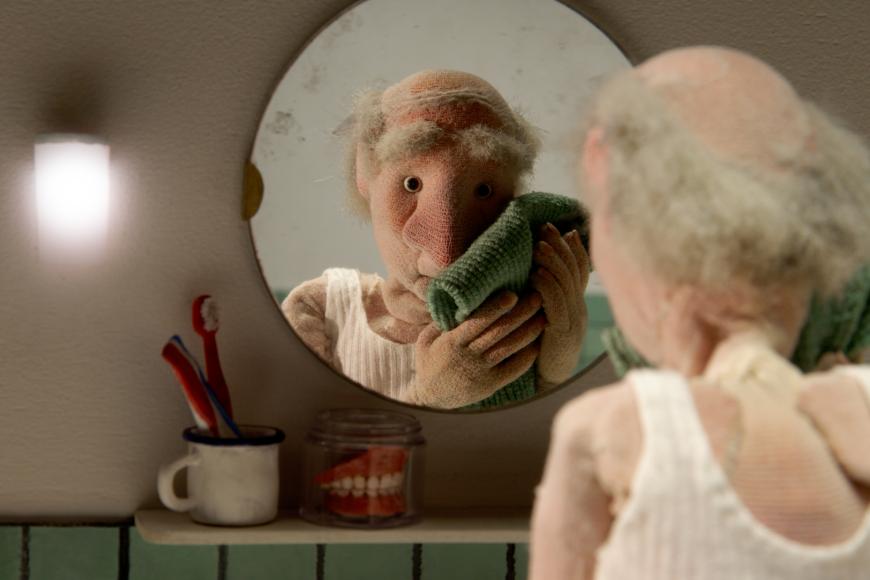
Starlings circle in flocks above the retirement home. What does the end of life feel like? A man grows the first feathers and senses that he is gradually drifting from this world.
Flocks of starlings are circling above the retirement home. These impressive natural spectacles are called murmurations because from a distance they sound like collective murmuring. Not everyone hears or sees them, but the old man notices. Sometimes the starlings send a single twittering messenger to his window. Often, the birds are more present to him than his fellow humans, more present than the old demented fellow resident who regularly waters a still life of flowers, more present than his neighbours in the amateur choir. And then it happens: The old man finds a first feather in his hair, then a second, then several. Soon he grows a beak so that instead of singing he can only caw. The last phase of life we witness here is lovingly animated: The puppet animation was created with gauze bandages, a beautiful approach to the vulnerability that comes with aging. The farewell to life shown here is devoid of pathos, not even that over-produced grief we know from many narratives of dying. Even the retirement home is a completely mundane place, neutrally portrayed. Instead, we follow this feathered farewell as a quiet but growing alienation from the world, a no-longer-belonging. And one day we will all grow the wings that go with it.
Marie Ketzscher
Credits
Director
Janneke Swinkels, Tim Frijsinger
Script
Janneke Swinkels, Tim Frijsinger
Cinematographer
Janneke Swinkels, Tim Frijsinger
Editor
Janneke Swinkels, Tim Frijsinger
Producer
Peter Lindhout
Co-Producer
Annemie Degryse, Janneke Swinkels, Tim Frijsinger, Ben Tesseur
Sound
Corinne Dubien
Sound Design
Corinne Dubien
Score
Roos Rebergen, Sjoerd Bruil
Animation
Rosanne Janssens, Mirjam Plettinx, Geertrui de Vijlder
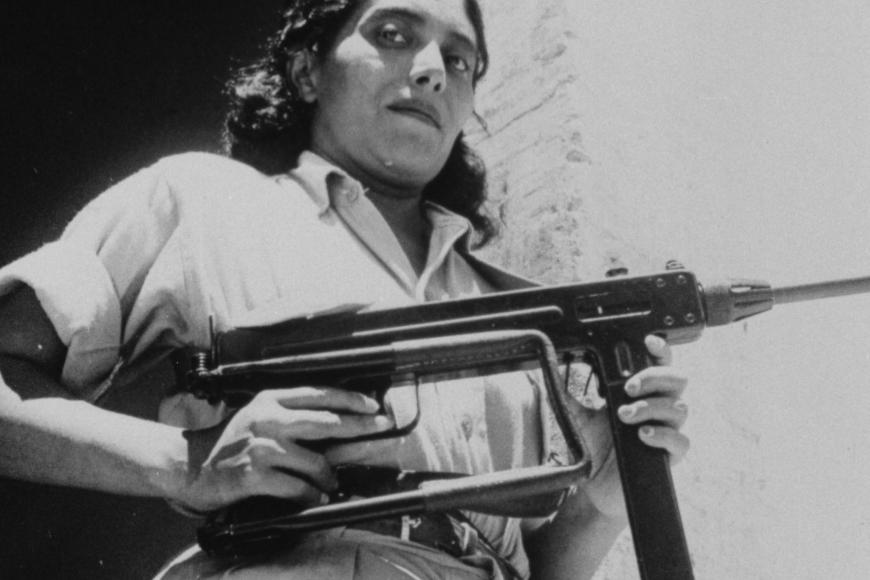
The female first-person narrator recalls her political awakening – from exploited day labourer to guerillera – and the fight against the United Fruit Company’s influence on her country.
Set to high-contrast series of images in black and white that sometimes come to a standstill, the female first-person narrator recites an emphatic speech about her political awakening: her development from an exploited day-worker to a guerrillera fighting against the political and economic influence of the USA on Latin American states, in this case the globally active United Fruit Company and its dominance in Guatemala. “My Country Occupied” is a film in search of a political form, oscillating between rapidly edited agitprop in the spirit of Latin-American Third Cinema, polemically used found footage and rather catchy, folkloristic-looking passages about the country and its people.