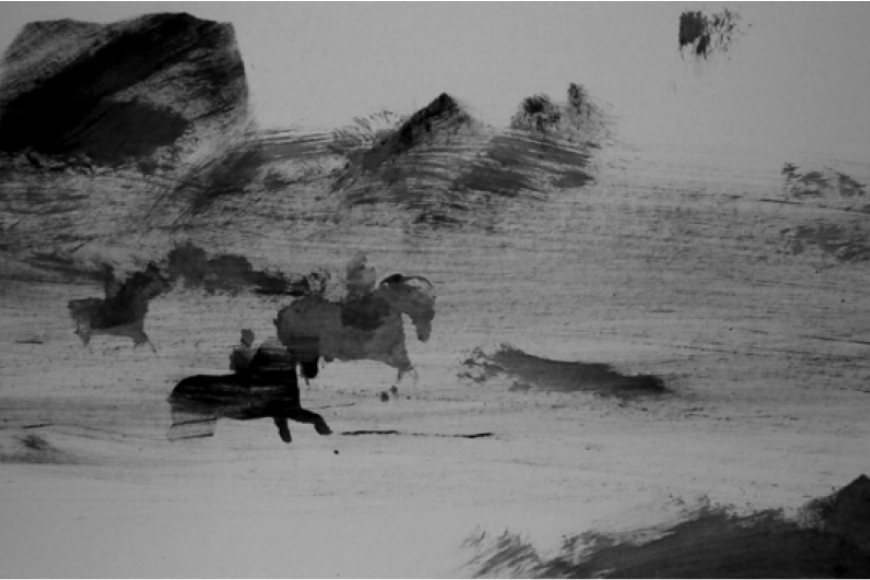
In 1940, two friends who grow up like brothers rescue horses destined for war in Sardinia. Only one of them will survive. An equally dark and poetic animation.
Sardinia, 1940. The harmless term “horsing around” takes on a very serious and ultimately tragic meaning for 14-year-old Michele and his 11-year-old friend Ventura. When they learn that the peasants have sold their best horses for serious money to the state and thus to the military for the approaching war, the two boys take a decision that is as naïve as it is intuitive: They free the herd in a daring nighttime operation. Their happiness is short-lived. Betrayed by a villager, they are caught on the way home and Ventura is shot dead. A senseless death? Or a sign of special bravery, as the ambiguous Sardinian film title suggests? Director Giovanni Columbu, a Sardinian himself, has dedicated his late animation debut to his grandmother who once told him the story. He took the liberty of adapting it with brushstrokes on paper, his style drawing primarily on the charms of historical painting schools, animation techniques and cinema genres. Columbu’s associative visual language, marked by shades of black, white, and grey, is animated by impulsive hatchings, countless dots, and generous elisions. The soundtrack, too, sets rather sparse nuances – subtle illustrations that draw on Sardinian cultural traditions while opening a space for universal metaphors.
Andreas Körner
Credits
Director
Giovanni Columbu
Script
Giovanni Columbu
Editor
Giovanni Columbu
Producer
Giovanni Columbu
Co-Producer
Flavia Oertwig
Score
André Feldhaus, Filippo Ripamonti, Alessandro Olla, Hans Zeller, Pietro Mascagni
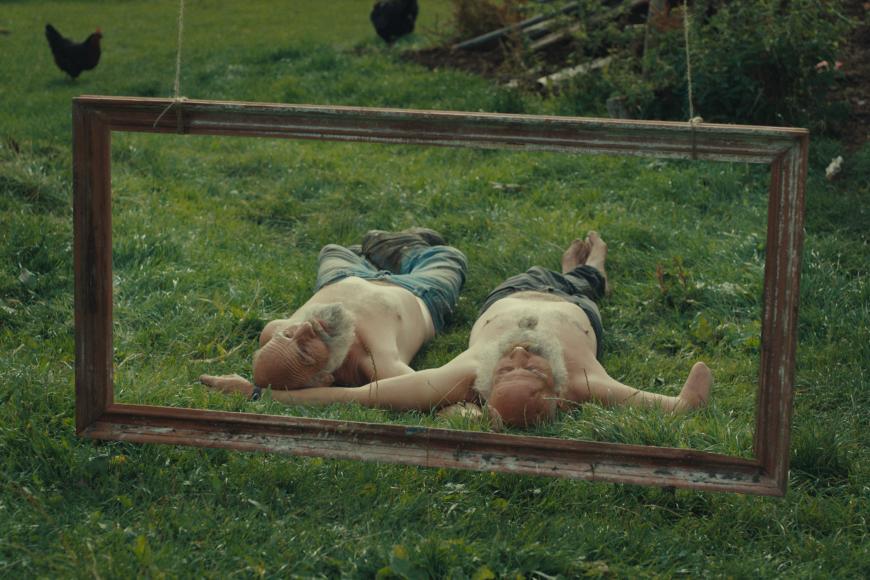
Brothers in the Bohemian Forest: Franta and Ondra, twins with impressive full beards, in their early 60s, live in quarrelsome harmony on a remote farm in a rugged landscape.
Two quarrelsome brothers with impressively full beards live on a remote farm in the Bohemian Forest, surrounded by a rugged landscape: At one point, Franta and Ondra themselves become aware that this setting has an almost Old Testament feel to it, but cannot agree on who might be Cain and who Abel in this scenario. They rarely agree in any case: Daily squabbles are the big constant in the life of the identical but otherwise dissimilar twins. When Franta embarks on another breakneck adventure, Ondra wants nothing more than to smoke in peace. Nonetheless, they occasionally exchange hugs and nose kisses. In their early 60s, Franta and Ondra spend their time working in the fields, playing jokes with the animals, or competing in left-hand arm-wrestling duels. The facts that Franta lost his lower right arm in an accident or that the twins took part in the 1989 revolution in Czechoslovakia belong to an apparently distant past. With a domestic cow as narrator, the leitmotif of a huge mirror, and a classical soundtrack, Miro Remo finds a wonderful form for the portrait of these idiosyncratic people.
Jan-Philipp Kohlmann
Credits
Director
Miro Remo
Script
Aleš Palán, Miro Remo
Cinematographer
Dušan Husár, Miro Remo
Editor
Máté Csupor, Šimon Hájek
Producer
Tomáš Hrubý, Tomáš Hrubý, Miro Remo, Pavla Janoušková Kubečková
Shimmering lines interweave again and again to become a digital cloth. A 3D model of Kunsthaus Baselland disentangles itself from the lines only to disappear again in a moment.
Shimmering lines intertwine constantly to create ever new digital webs. The third dimension is added by diagonals. A moving camera allows us to finally recognise the secret that the visual elements have kept hidden so far: A 3D model of the Kunsthaus Basel creative centre disentangles itself – only to fade back into the luminous void.
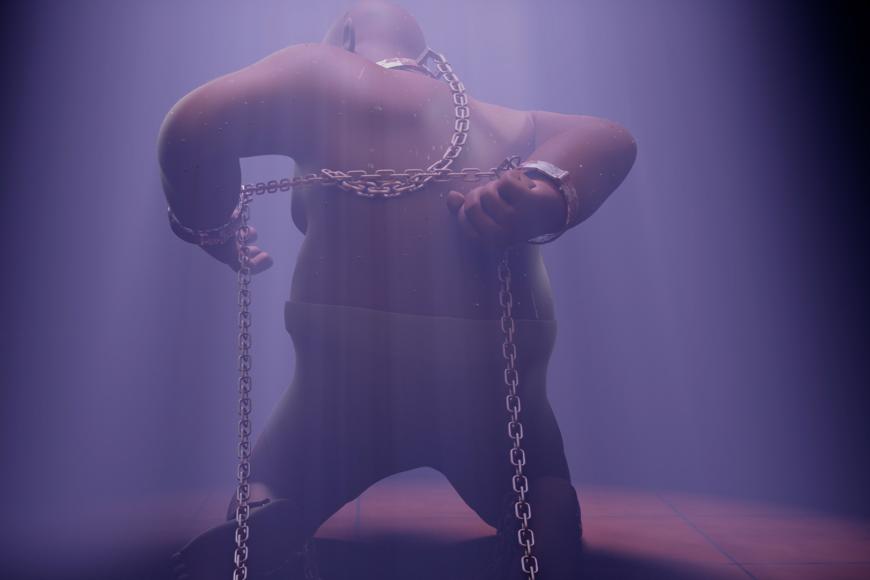
A man throws off the shackles of slavery, lays the traditional Kente cloth aside, puts on a business suit – and starts to walk towards the future. Or towards what he thinks is the future, because this is not a pleasant walk: To the cheers of the people, the man pushes into the backroom of an Asian restaurant where he flogs plots of land, moves to the next backroom, money case in hand, to bribe the pastor and ultimately ends up on stage to give a state-supporting speech as President – against corruption, of course. The career of our nameless protagonist – whose sunglasses-covered face, interestingly, we get to see only in the limelight – takes him right through the streets of an African metropolis, past protests being suppressed, through a dilapidated infrastructure, criminal gangs, and even natural disasters. Nobody has thrown off the shackles of slavery in Francis Yushau Brown’s relentlessly critical film. Instead, a few individuals have chained themselves to nepotism and keep the rest of the population poor and backwards. His film is a 3D indictment brimming with rage, including of the Western and Far Eastern (neo) colonizers. And far above hover the enraged gods, waiting for the people to put an end to this situation at last.
Marie Ketzscher
Credits
Director
Francis Yushau Brown
Script
Francis Yushau Brown
Editor
Charles Sam
Producer
Ruth Ojougboh
Sound
Gomez Beatx
Sound Design
Gomez Beatx
Score
Gomez Beatx
Animation
Francis Yushau Brown, Charles Seyi Kilanko, Kingsford Appiah, Jason Bonsu Sarpong
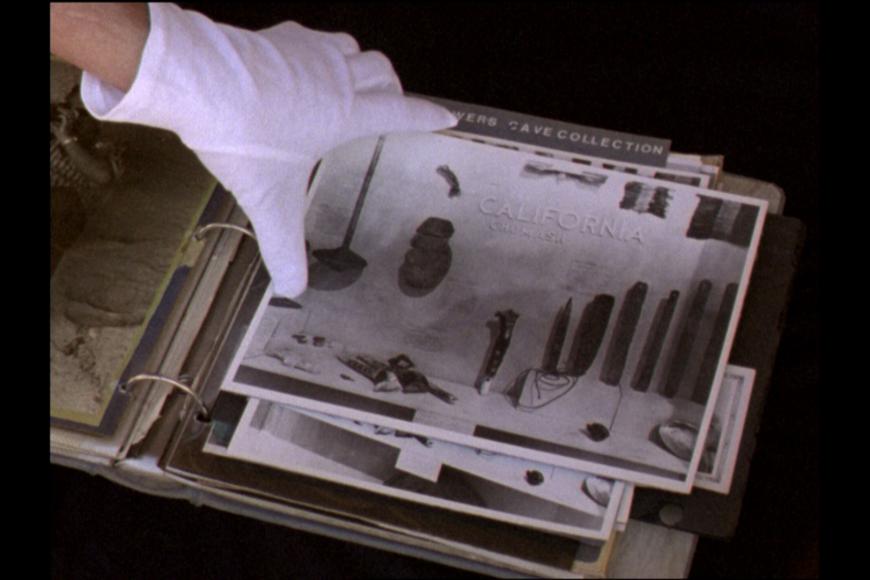
This graceful, protean short explores the past and present of Bower’s Cave in California, where a large collection of Chumash Indian religious artefacts were found in 1886.
In 1885, two boys came across a large collection of Chumash Indian religious artefacts in a cave in California’s San Martin Mountains. Later named Bowers Cave, it is now located on a landfill site. Lee Lynch and Lee Anne Schmitt’s graceful, protean short braids together a panoply of different texts and images to unearth the different layers to this all-too American story and allow its wider implications to resonate: photos of museum exhibits given their Chumashan names in voice-over, historical quotes that move across views of contemporary industrial activity, Indigenous figures rendered as bright plastic toys, the mouth of the cave and the markings carved into its walls.
Self-organized solidarity communities: The New York squatter movement fights to prevent the poorer population sections from being driven out of the lucrative areas in Manhattan.
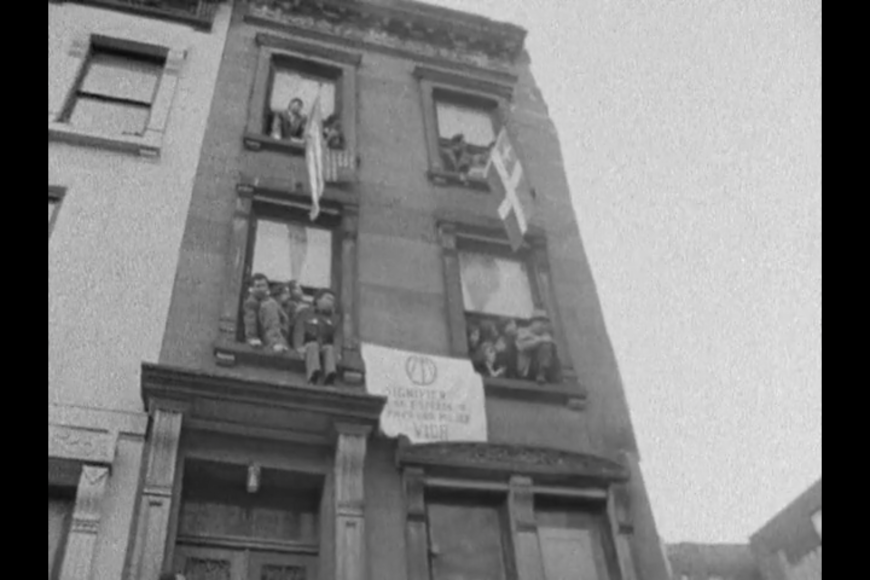
“Why should I move? I was born here.” While a senseless war is waged in Vietnam and million-dollar rockets are shot to the moon, there is not enough decent housing in New York – and worse, the poor are being forcibly evicted from their homes, says an angry protagonist of this activist film which introduces the New York squatter movement. Latin Americans in particular are forced to leave the lucrative Manhattan housing market, but the protesters do not accept this without putting up a fight. “Break & Enter” is a spontaneous and encouraging film document about self-organised communities based on solidarity.
Books Are Bread and Human Beings Need Them [excerpt]
Peter Rocha
Modern sound, image composition and montage show the spectrum of the 1982 Book Fair, combined with colour and black-and-white footage of its venue, Leipzig.
Books Are Bread and Human Beings Need Them [excerpt]
Bücher sind Brot, dessen der Mensch bedarf [Ausschnitt]
Peter Rocha
Matinee Saxon State Archive 2025
Documentary Film
GDR
1982
6 minutes
German
Subtitles:
None
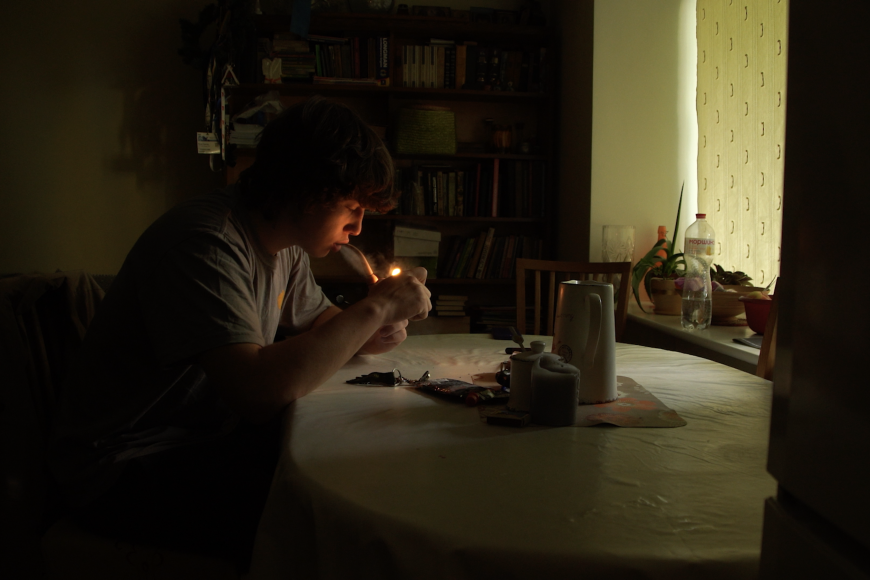
A quote by literary figure Johannes R. Becher, first Minister of Culture of the GDR, supplies the title of this film about the 1982 International Book Art Exhibition. Sensitively composed images embed the IBA in the hustle and bustle of Leipzig. Old and new shots of the city, in black and white and in colour, take us to some of the 82 national booths of this book art contest, accompanied by atmospheric piano music.
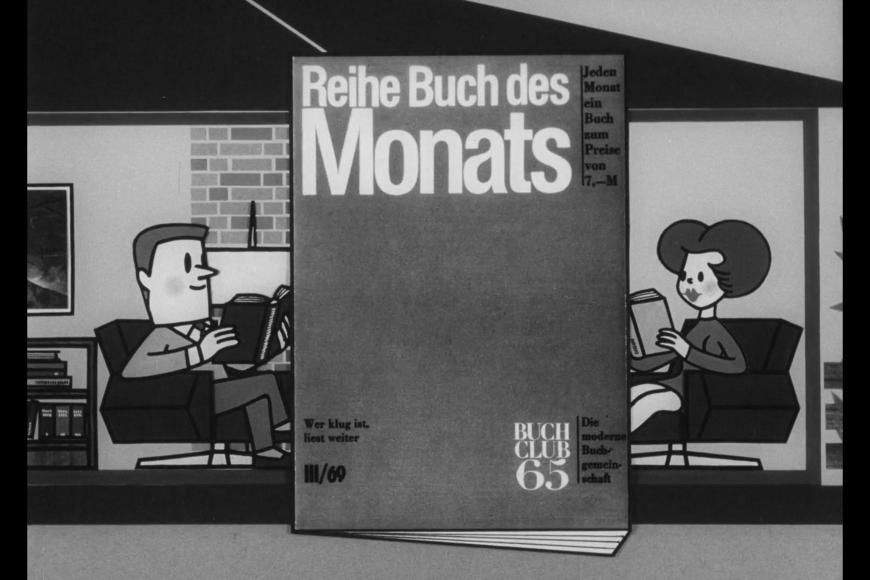
Order more than the occasional book and even join the “Buchclub 65”, and you will be rewarded with the club magazine and the main recommendation book. Promoting customer loyalty in the analogue age.
This animated film advertises the advantages of the “Buchclub 65” (Book Club 65), a book community founded in 1965. Membership in the community, which existed until 1990, entitled you to regularly buy books at discount prices. The nationwide supply of reading matter to the population of the GDR is emphasised, the club magazine is introduced. And once a year, there is a gift: the main recommendation book.
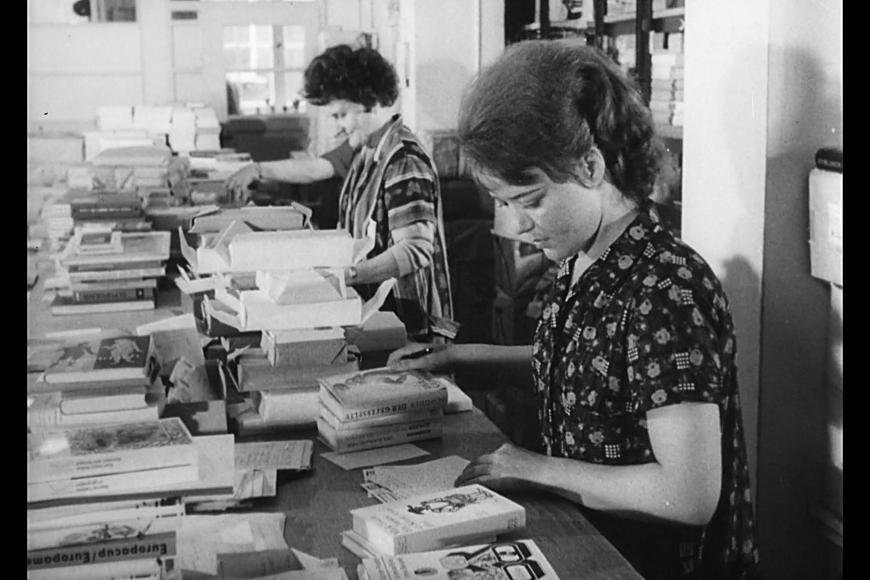
The GDR’s self-image as a land of books is presented in the style of a reportage, backed by figures and comparisons. Buchhaus Leipzig, the institutional operator of the central mail-order book trade, supplies the Republic with a wide variety of books and also scores with excellent organisation. An insight into distribution logistics, long before the invention of online stores.
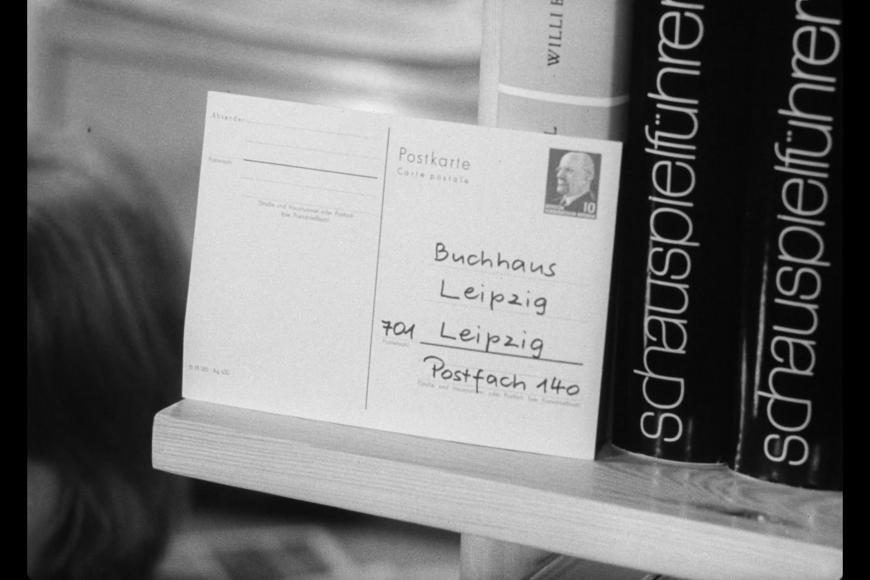
According to this black-and-white advertising spot, Buchhaus Leipzig delivers the latest books of every kind quickly and at any time to young people living in rural areas. Guaranteed!
Accompanied by fast-paced editing and pop music, a young GDR citizen explains that even in rural areas the latest in literature can be enjoyed without a problem. Shipping is quick and easy, everything can be found in the extensive catalogues of Buchhaus Leipzig! All you need to do is send a postcard … This spot is one of seven films in the “Buchhaus Leipzig” collection at the Leipzig State Archive.
On 9 February 2022, four friends in Kyiv discuss the situation: There are 120,000 Russian soldiers at the borders – what will happen? An equally historical and private moment.
In the evening of 9 February 2022, four young men sit around a table in Kyiv. The friends are discussing the situation: 120,000 Russian soldiers are stationed right at the Ukrainian border. What is going to happen? In “The Birds Are Silent”, director and cinematographer Leo Dzhyshyashvili captures an equally private and historical moment. What is striking is the clarity with which Andriy, Olexandr, Ivan and Sasha assess the consequences of the imminent attack: Potential decisions about their own future are mixed with concerns about relatives and the bewilderment at being thrown into a situation that provokes both helplessness and disgust. But there is a glimmer of hope – perhaps the imagined horror scenarios are nothing but a waste of energy? Cut. Some of the debaters have become soldiers; one has barricaded himself in the bathroom with a narrow mattress and a meal. Within eight minutes, Dzhyshyashvili has tied together a before and after that make you shudder.
What happens in a person permanently trapped in destructive loneliness? This bittersweet musical draws us into the masked nervousness of modern society.
What happens in a person permanently trapped in the destructive loneliness of constant self-comparison? How does a person who fools others with neoliberal dreams just so they do not have to give up their own feel? This bittersweet, cheerfully tense musical by Niki Lindroth von Bahr pulls us into the masked nervousness of modern society with humour, singing and dancing.






![Filmstill Bücher sind Brot, dessen der Mensch bedarf [Ausschnitt]](https://www.dok-leipzig.de/sites/default/files/styles/stepped_teaser_/public/fiona/films/stills/d7847ba8-aac8-4ab3-a3ef-ce887332b289.jpg?h=346bc062&itok=HAInWMvT)




![Filmstill Bücher sind Brot, dessen der Mensch bedarf [Ausschnitt]](https://www.dok-leipzig.de/sites/default/files/styles/film_stills_full_content_view/public/fiona/films/stills/d7847ba8-aac8-4ab3-a3ef-ce887332b289.jpg?h=346bc062&itok=vskuGuM1)


