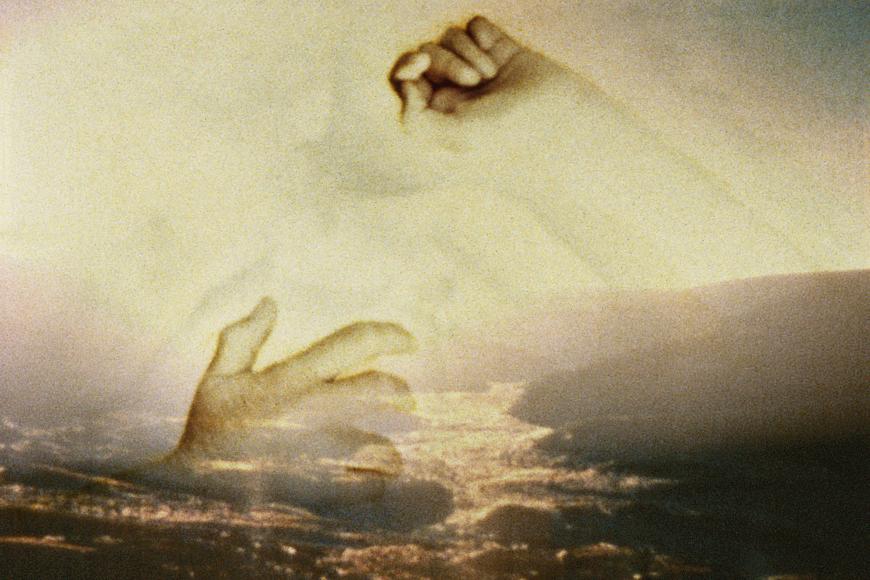
Found private photo albums: The connections between the pictures remain as abstract as that which the photographs show is concrete. In this film, grandparents, aunts and children do not look out of the past at the viewer in the now but into the mysterious depths of a corridor or the vastness of a bay. Poetic spaces of interpretation open up.
He carries a flag, and that flag is red: In 1968 Holger Meins takes part in this student flag run in West Berlin, in 1970 he joins the RAF and goes into hiding.
An exercise on “colour” in Michael Ballhaus’s class at the DFFB in West Berlin went down in the history of cinema and subversion. In retrospect, this silent miniature became the harried document of a movement of departure that was to grow criminal powers. It was shot on 18 January 1968, five years after JFK’s statement of bloc affiliation, “Ich bin ein Berliner,” just before the murder of Benno Ohnesorg, a few months before the assassination attempt on Rudi Dutschke. Director-in-training Gerd Conradt and fourteen fellow students and friends organised a relay race to the Schöneberg town hall to raise the red flag there. The final leg was run by cinematography student Holger Meins, who was to become a terrorist with the Red Army Faction and starved himself to death in Wittlich prison in 1974.
With the participation of several company and amateur film associations, the film accompanies a trip to Leipzig by delegations from 40 countries on the occasion of the 10thWorld Youth Games in Berlin.
East Berlin plays host to the world at the 10th World Youth Festival. The secret capital of the GDR, Leipzig, also gets some reflected glory. On 3 August 1973, festival delegations from forty countries take a special train to the trade fair city. Between the official events there is room for ambiguous side glances, captured in this report of the day made by several Leipzig company and amateur film groups.
Konstantin Wiesinger
Credits
Director
collective
Producer
Pionierfilmstudio Haus der Jungen Pioniere “Georg Schwarz” Leipzig, Ensemble “Deutsch-Sowjetische Freundschaft” Leipzig, Club Leipziger Filmamateure, VEB Verlade- und Transportanlagen Leipzig, VEB Spezialbaukombinat Leipzig
Every night, Paulette observes the same shooting star in the sky. Wishing that she will find her mysteriously missing pet rat, she learns that the shooting star can actually help her.
Every night, Paulette stands on the lookout of her lighthouse and observes the same shooting star. Her pet rat has mysteriously disappeared, so she sends her wish for a reunion up to the night sky. The apparent celestial body turns out to be a bat with a fondness for glitter. It helps Pauline in her search. A magical, fantastical fairytale with a happy ending.
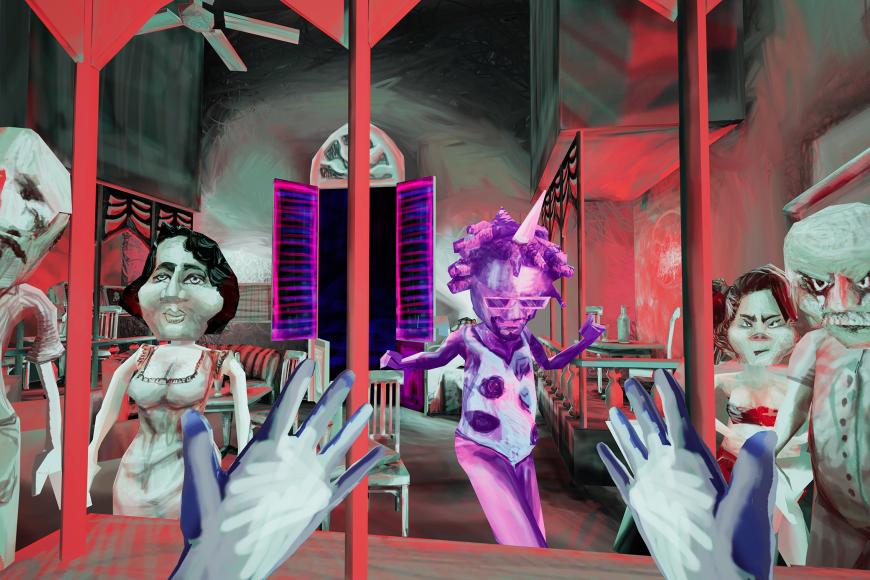
Animated in unique style, this VR-experience introduces Mr. Saul, an aging man who works in a brothel and is hiding a big secret. Follow his musically illustrated journey to self acceptance.
A music-filled journey towards self-acceptance. In this VR experience we meet Mr. Saul, an aging man who works in a brothel and is hiding a big secret. Through Samba, carnival and a touch of kindness, he learns to embrace himself. “Finally Me” was delicately animated by Marcio Sal, who also contributed his own voice and movement to bring Mr. Saul to life.
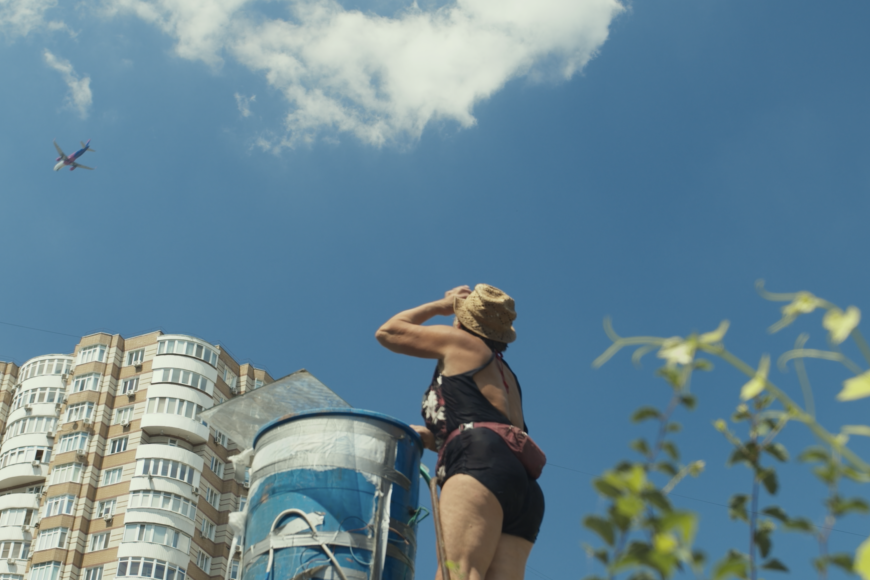
Surrounded by high-rises, Natalia has created her own, not-so-small paradise: Goats roam free, shrubs and fruit trees bloom, the chickens busily lay eggs. Natalia meets repeated attempts to buy the plot with brusque derision. Even when the city and country are attacked by Russia in the wintry February of 2022, she retains her apparent carefree resistance: While all the lights around go out at night, there is a warm and cozy glow from Natalia’s house. Only Kitty, with whom she lives, expresses concern, organises his flight from Ukraine and prophylactically shows the spots that would be safest in an air raid. Adelina Borets’ portrait of an incorruptible woman finds its own unique tone, shows a simple everyday life throughout the seasons that presents itself as self-determined and buoyant despite the worsening situation. Borets adopts Natalia’s manner as natural, gives her space. The dimensions of the war unfold step by step, at Natalia’s own pace and by skilful cuts and pans. “Flowers of Ukraine” is a film about a disaster. But it is also a love song to life – and pickled tomatoes.
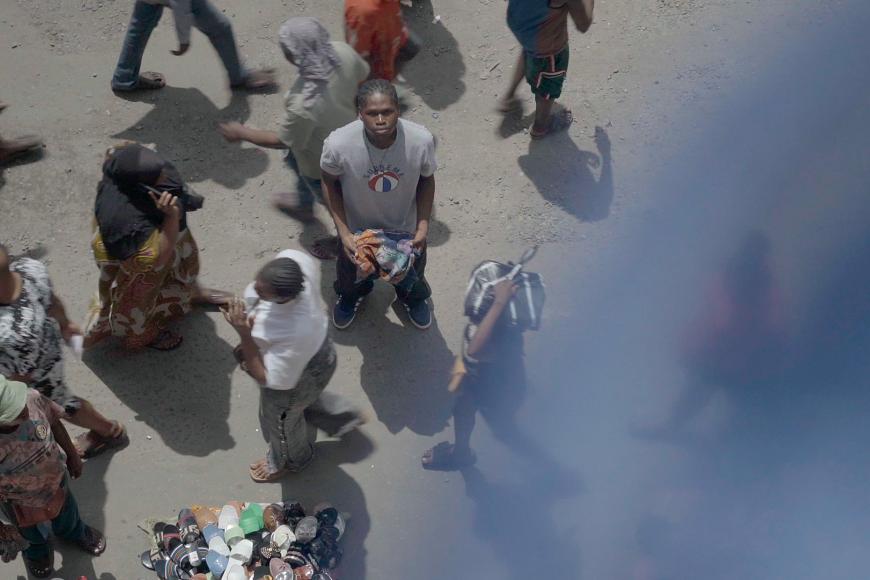
The Fluid Lagos Collective explores what water means to them and the city: through the eyes of a boatman, his passenger and through bodies made of water – sometimes sluggish, sometimes flowing.
In three chapters, this film takes us through the Nigerian megacity of Lagos and explores its fluid side. The tour begins with boatman Osan, constantly moving, balancing on his waterway. In split screens we see the human body as a vessel containing water. Then we are chauffeured through the flowing traffic to the Lagos market and finally perform a water dance above the rooftops of the city. Interspersed are mobile phone videos of a young man on Tarkwa Bay Beach: The waves are good, the sun is shining. May the water bless us! “Fluid Lagos” was created in three collective workshops conceived and moderated by filmmaker Nora Mandray. Inspired by documentary practices, the participants developed a hybrid film form in which different voices and perspectives combine to talk about water, about a place and its arteries.
Winter sports are going on in the white silence of the mountains – in blue and red. Slalom, chairlift and the whole fun of skiing can be cheerfully discovered in experimental and abstract style.
A thrilling short film by renowned Latvian animation artist and children’s book illustrator Edmunds Jansons. Winter sports enthusiasts in red and blue ski suits race down the slopes. Everything from queuing up at the ski lifts to wild downhill races happens to the rapid beat of an electronic music composition. All the pleasure of skiing, drawn cheerfully and with subtle deeper meanings.
1974, Palestinian reality in Israel and the West Bank, economic and political oppression – documented by an Israeli who wants to make a convincing appeal: the urgent need for dialogue.
Words of the poet Mahmoud Darwish open this film: “I do not hate people, I do not assault anyone, but if I get hungry, I eat the flesh of my usurper. Beware, beware of my hunger, and of my anger.” This is followed by the title, then the subtitle: “An Israeli reports.” Her name is Edna Politi; she was born in Lebanon, emigrated to Israel and was accepted into the German Film and Television Academy in West Berlin in 1971. Politi’s student film is explanatory: Where does the Palestinian rage, the desperation come from? Soberly and carefully, she compiles everyday observations, facts and figures to draw attention to the mechanisms of the economic and political disenfranchisement of the Palestinian people. Her aim is to convince, not persuade.