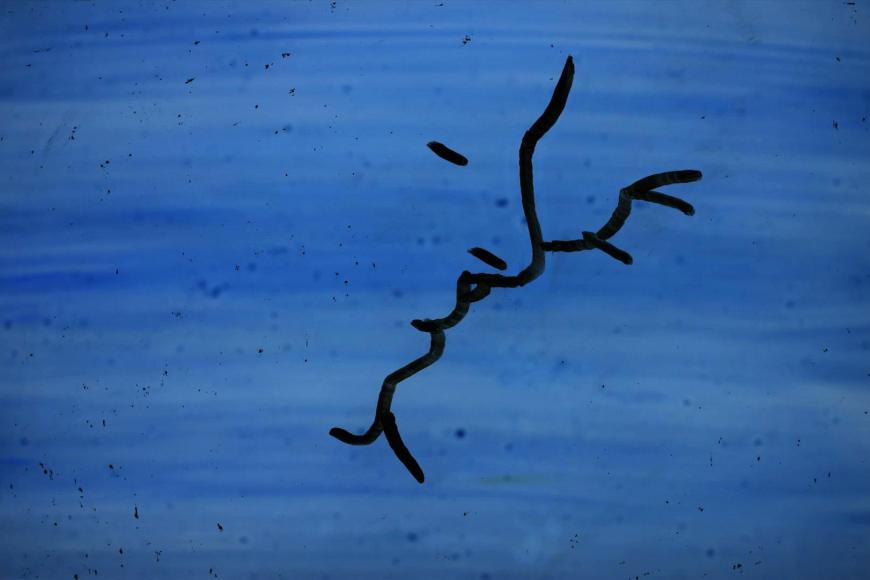
A macabre, hypnotic children’s song about Mario the soldier and his disappointed love announces a brutal murder. Images of memories flow into each other and make us shiver.
A macabre Italian children’s song tells the story of Mario, a soldier who returns from war and must learn that his girlfriend has left him for another man. Mario decides to kill her. The film picks up on the ambivalent mood of the song and reinforces its vibration in the space between blithe children’s game and brutal murder.
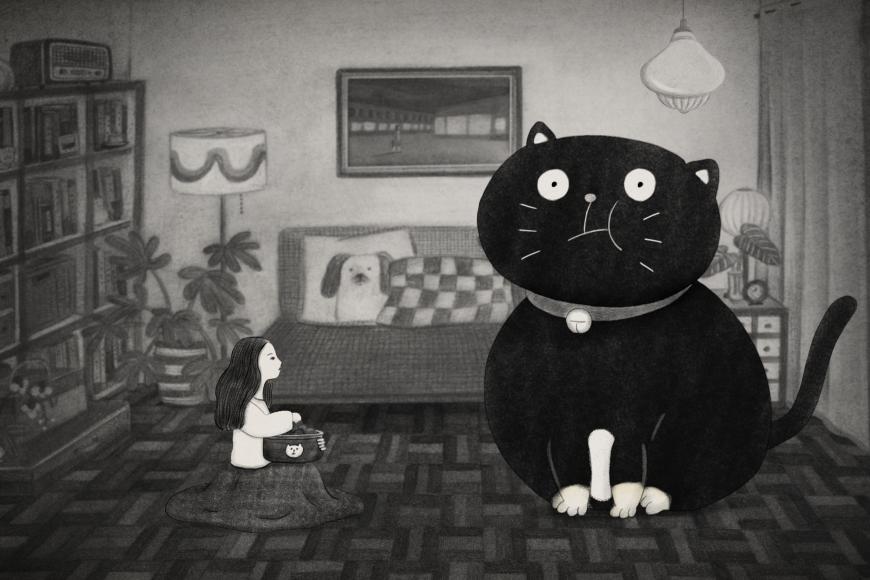
A woman lives alone with her cat in the city. The small miracles of life can be found in all kinds of everyday moments, and loneliness turns into a happy melody.
A woman and a black cat live together in the city. They seem a little lonely but make the best of it. The small miracles of life can be found in all kinds of everyday moments, and their loneliness is transformed into a cheerful melody. A buoyant piece in black and white which does get a little colour in the end.
Sometimes it really takes only two minutes to see through life. In her minimalist animated film, Anne Isensee comes quickly and straightforwardly to the point. What the direct line sketches out as a concept of life looks alluring, too. It is a good thing that there are one or two kinks after all. Nonchalant, witty and profound – and awarded the Golden Dove at DOK Leipzig in 2017.
André Eckardt
Credits
Director
Anne Isensee
Script
Anne Isensee
Producer
Filmuniversität Babelsberg KONRAD WOLF
Sound
Chandra Fleig
Sound Design
Dascha Dauenhauer, Felix Rösch, Robert Pilgram, Marcus Sander, Carl Ludwig Wetzig
Score
Dascha Dauenhauer, Felix Rösch, Robert Pilgram, Marcus Sander, Carl Ludwig Wetzig
Animation
Anne Isensee
World Sales
interfilm Berlin Short Film Sales and Distribution
A colourful luminous river flows through the black void. Geometrical surfaces dance around wondrous organic plants. Tina Turner’s hit in an enchanting animated jazz version.
A colourful luminous river flows through the black void. Geometrical surfaces dance in small repeating loops around wondrous organic plants. The abstract lines, rectangles and semicircles briefly form animated figures. Tina Turner’s classic in the musical interpretation of Miles Davis and the animated visual world of Irina Rubina and Michelle Brand.
Loneliness and threat, translated into surreal images in which the oppressive Hungarian reality of life under communism in the 1980s allegorically meets the 1956 uprising.
A feeling of fear spreads: In an apartment building, the stairs follow no logic, men get lost with a wardrobe, everyone is lonely. The surreal threat suddenly becomes real when security agents ring the doorbell: “Csengőfrász”, the symbol for the arbitrary arrest of citizens allegedly hostile to the state from the time of the Hungarian Uprising.
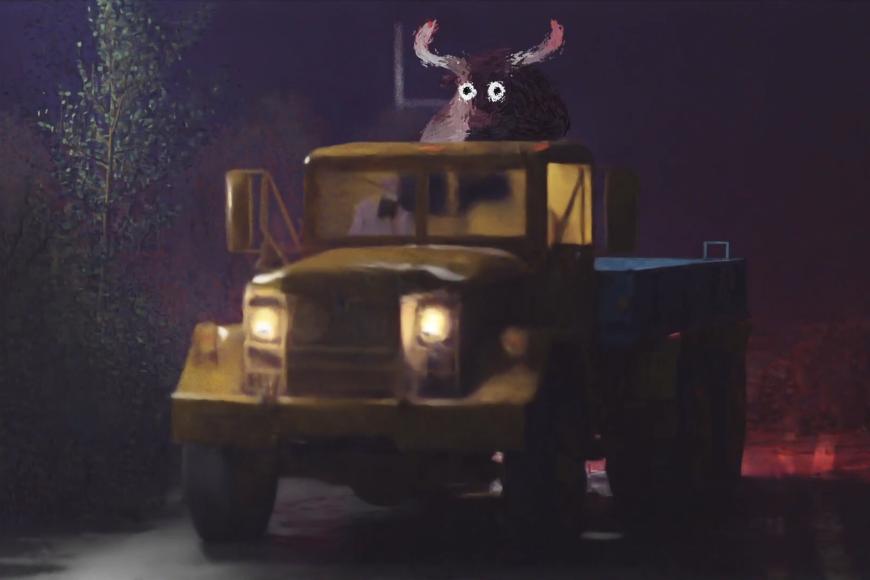
People wonder about the disappearance of the moon. Meanwhile, a bull escapes from his herd and takes a poetic trip through the night – with a surprising finale.
On a moonless night, a cheeky bull escapes from his herd. He dashes through fields and over hills until he finally stops at a pond, where a piece of paper on which a poem is emerging attaches itself to him. The bull shakes off the paper and sneaks into town, where he watches people at their nocturnal business. He witnesses a police investigation, listens in on two truck drivers and observes the theft of a bus stop shelter. All these experiences are accompanied by the narrator’s poetic comments and culminate in a hilarious singing sequence, complete with a dance and performance number by the bull.
Meanwhile, the people in the town are in an uproar about the undetectable moon. They search, discuss and protest. But the moon stays missing – until the bull transforms himself at the end of his journey.
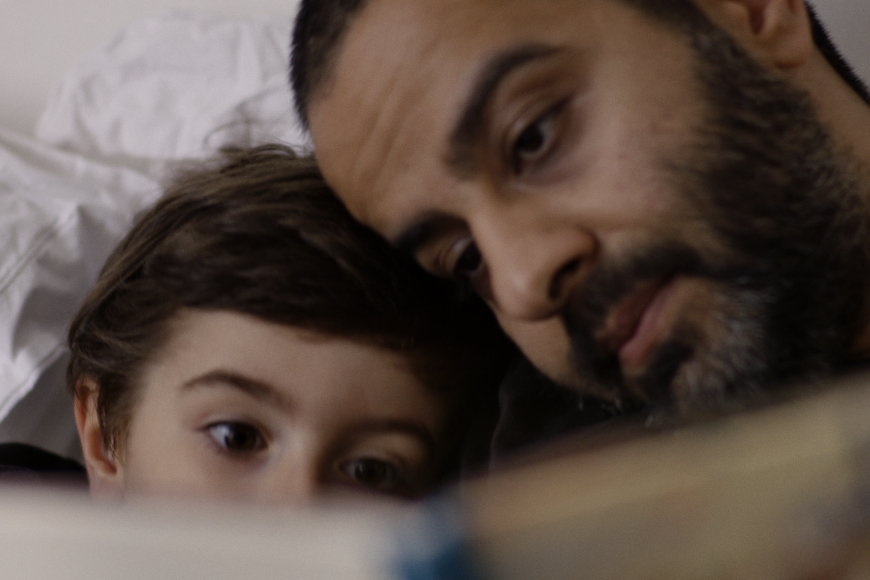
Twenty years ago, the filmmaker fled from Bagdad with his family – why has always been a taboo. For his son, he breaks his silence in this filmic family therapy.
German Subtitles for deaf and hard-of-hearing, English
Twenty years ago, filmmaker Wiam Al-Zabari fled Baghdad with his family in the middle of the night. His father, a dissident former ambassador, had already escaped from Iraq and was waiting for them in the Netherlands. Since then, no one in the family has ever spoken about the events. What exactly happened was always a taboo. Now that Wiam has become a father himself, he realises that his past life is catching up with him and that more and more questions are arising, the biggest being: Why did they have to flee in the first place? Wiam wants to finally find out. For the first time, he breaks the silence and begins to research the past in dialogues with his parents and siblings. Above all he wants to prevent passing on these traumatic experiences to his son.
In this filmic family therapy, he addresses Nour, his little son, directly. Wiam promised himself and the boy this film to clear up the long-suppressed themes in a way that will allow Nour to feel firm ground under his feet when he is grown up. In doing so, Wiam is unsparingly honest with himself and his relatives and chooses a number of unusual artistic tricks. For example, he inserts himself as a director from offscreen, critically analysing his own position in the fabric of speaking and silence: an attempted inside view from the outside.
Lina Dinkla
Credits
Director
Wiam Al-Zabari
Cinematographer
Niels van Koevorden, Jefrim Rothuizen, Wiam Al-Zabari
Editor
Augustine Huijsser, Renko Douze, Wiam Al-Zabari
Producer
Hasse van Nunen, Iris Lammertsma, Renko Douze, Boudewijn Koole
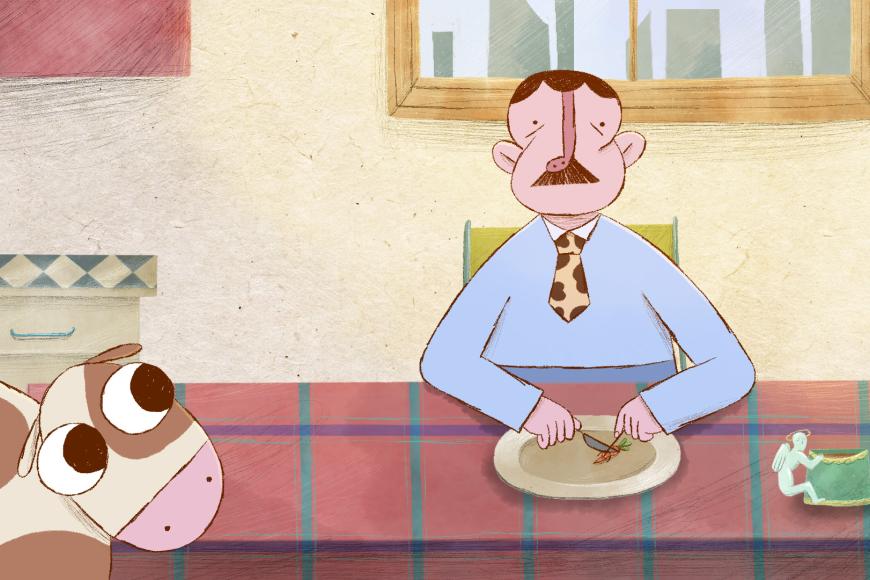
Everything in Edgar’s life is well-ordered. His favourite food is meat. A trip to the slaughterhouse makes him think and he takes in a calf. Will Edgar have to make more changes?
Everything in Edgar’s life is well-ordered and always in the same place. And his favourite food is meat. A trip to the slaughterhouse takes his appetite away and he brings a calf home. The calf grows into a cow and, of course, turns his well-ordered life upside-down. His favourite cup and the television set break and Edgar realises that he needs to make more changes.
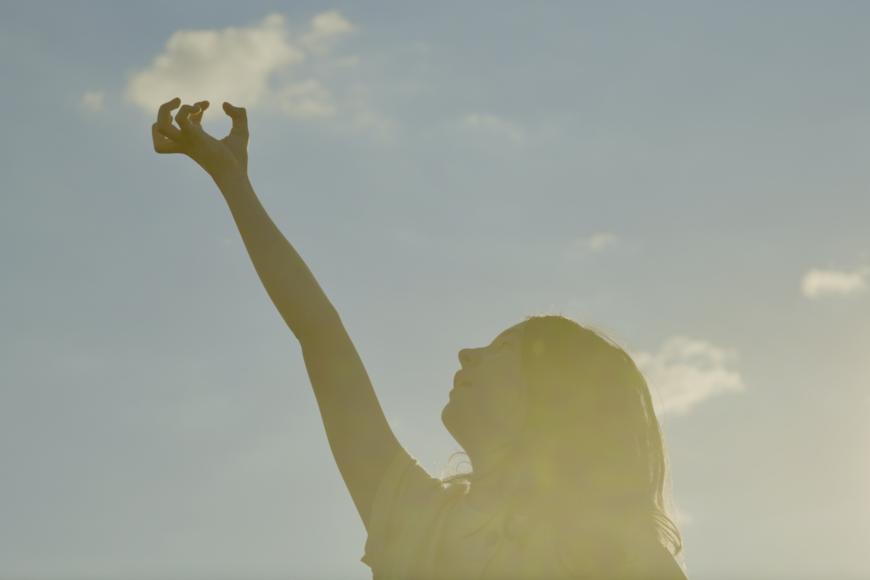
Nele dreams of taking a balloon ride. That’s not so easy because her mother has mobility problems and they need a lot of help to manage their daily life. Will her dream come true after all?
On the balcony Nele is really close to the clouds, though it would be much nicer to take a balloon ride and be even closer. The plan isn’t easy to realise, as Nele’s mother has mobility problems. They need help with every activity and their daily life is co-organised by many other people. They are doing fine together, but a trip in a hot air balloon would be something else …
After the graduation ceremony, Ba, a young musician, leaves the hall with his tuba over the shoulder. At the door he meets his teacher who makes him promise something: report back as soon as he has found a job. As nobody picks him up at the student residence, Ba makes his own way through the barren rural area. Home at last, he discovers that his father has found a new wife who now lives with him. There is no more room for Ba. He leaves his former home and sets out to look for a job. Various futile attempts to find employment follow, first as a musician, then unrelated to his training. All efforts fail in the face of the absurd requirements of potential employers. Ba would first have to buy an expensive suit and could expect to get wages only after an unpaid initial phase, as he was still a beginner. Ba can only fend off his teacher’s intrusive questions by inventing white lies.
This world, where there is not a shred of green landscape left, where the plaster crumbles from the walls, where everything is falling apart, has no use for the musician Ba. His daily expenses consume his last bit of money. Hopes of happiness and being able to earn his living fade away. Ba’s tuba falls silent.
Franka Sachse
Credits
Director
Xu Jingwei
Producer
Yang Leiting, Yang Xintong
Animation
Yang Leiting
World Sales
Shuting Li
Winner of:
Golden Dove Feature-Length Film (International Competition Animated Film)
In 2017, the “Reclaim the City” initiative occupied an unused hospital in Cape Town. Their symbolic protest against the housing shortage became a new home for hundreds of people.
In 2017, the “Reclaim the City” initiative occupied an empty hospital in the Woodstock district of Cape Town. Their symbolic protest against the housing shortage became a new home for hundreds of people: the “Cissie Gool House”. The work conveys intimate insights into an unusual housing project that combats criminalisation by politics and the public.
Lars Rummel
Credits
Producer
Dylan Valley, Annie Nisenson, Alex Hendricks, Valentia Fisher
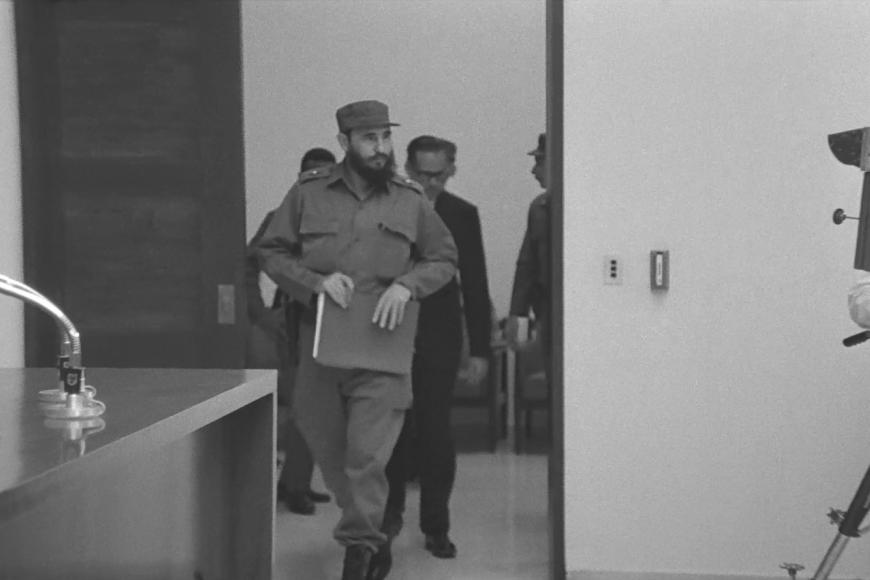
Fidel Castro comments on the events of the Prague Spring – in surprisingly critical terms. This newsreel report was withdrawn from the Leipzig festival programme in 1968.
In September 1968, Fidel Castro comments on the suppression of the Prague Spring in surprisingly critical terms. He opens his thunderous speech with the statement that it could endanger Cuba’s safety. Although Santiago Álvarez was the guest of honour at the Leipzig festival, this newsreel report was withdrawn from the programme. After long research it will be shown for the first time in Leipzig in this Retrospective.
Katharina Franck, Andreas Kötzing
Credits
Director
Santiago Álvarez
Producer
Instituto Cubano de Arte e Industria Cinematográficos ICAIC
The director, a stateless Filipino, returns to his native country. For more than twenty years, he lived without papers in the USA and feels trapped in a world full of borders.
English, German Subtitles for deaf and hard-of-hearing
How does an undocumented individual document themself? This is the question the Filipino filmmaker who grew up illegally in Los Angeles asks himself. His extended family live scattered across the USA and the Philippines. Now he embarks on a journey to his estranged native country, driven by the desire to overcome a curse that has profoundly disturbed the family history over generations. The colonial past is a heavy burden even today, even in the diaspora. Filipino itself, the official language with its countless loanwords from Spanish and English, is nothing but a linguistic by-product of the colonial era.
By re-locating Miko Revereza tries to come to terms with the experience of distance and loss of identity with a remarkably idiosyncratic and creative approach. His psychogeographical filmic journey is dense and meandering, the camera sometimes literally destabilised as if by the curse. By means of superimpositions and improvised music a melancholic but never accusing memoir is created that lingers in our minds. The filmmaker, who showed “The Still Side” at DOK Leipzig in 2021, lives in Mexico today.
Annina Wettstein
Credits
Director
Miko Revereza
Script
Miko Revereza
Cinematographer
Miko Revereza
Editor
Miko Revereza
Producer
Shireen Seno
Sound Design
Miko Revereza, Kevin T. Allen
Score
Vincent Yuen Ruiz
Nominated for:
Prize of the Interreligious Jury,
FIPRESCI Prize
A camera roams incessantly through an apartment and a life without any particular hallmarks. Sound and animated interventions portray family bliss and unhappiness, quarrels and separation, age and death. Radio news open the window a little to what is going on in the world outside. The constantly changing interiors tell of people who were at home here without ever showing them.
As we watch individual details and their interplay as a whole, presented on rotating discs, we get a spark of insight into the interactions of flora and fauna on earth and the elemental power of our central star, the sun. Temporality, rhythm and the functioning of film are hinted at. A look at the origins of life and the moving image.
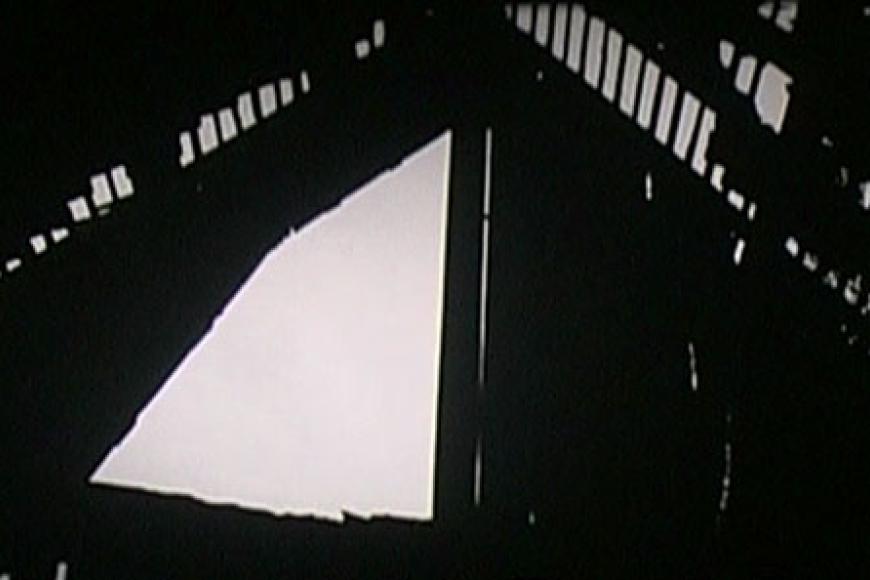
Inside a barn the camera catches daylight filtering through the gaps in the crooked walls. The flashing rays seem like the heartbeat of this fragile building.
Inside a barn the camera catches the daylight filtering into the fragile building through the irregular gaps and crevices in its wooden skin. It chases them with whip pans or ambushes the slowly creeping sunlight with time-lapse shots. The flashing, blazing rays seem like the heartbeat of this chamber of light. There is no outside view.