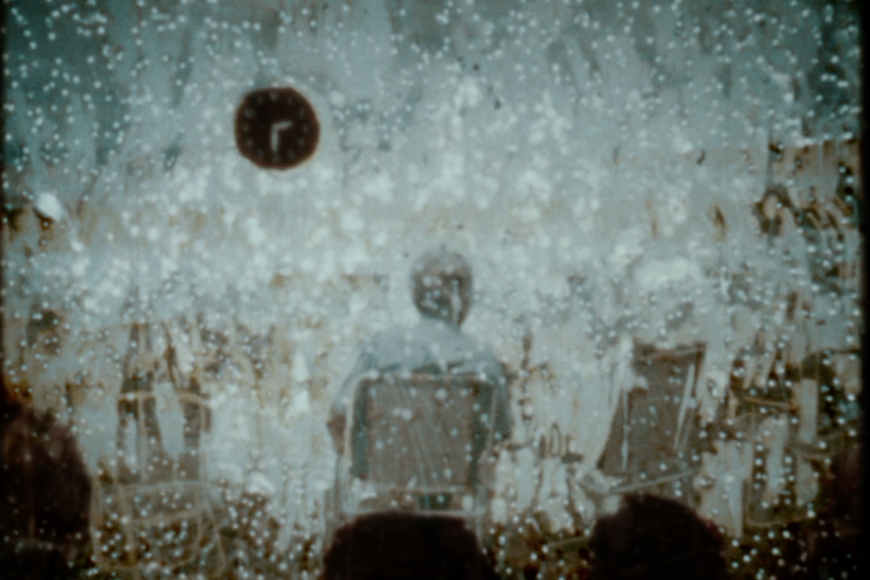
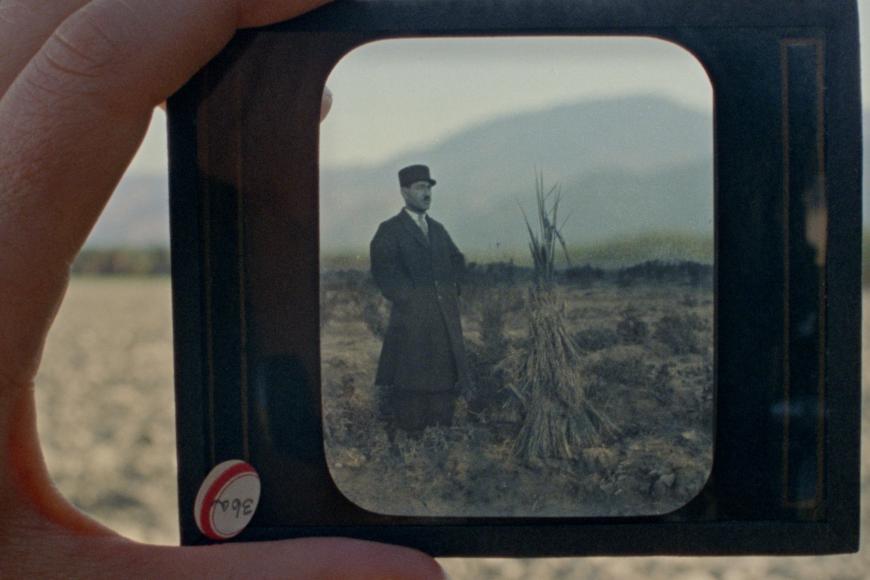
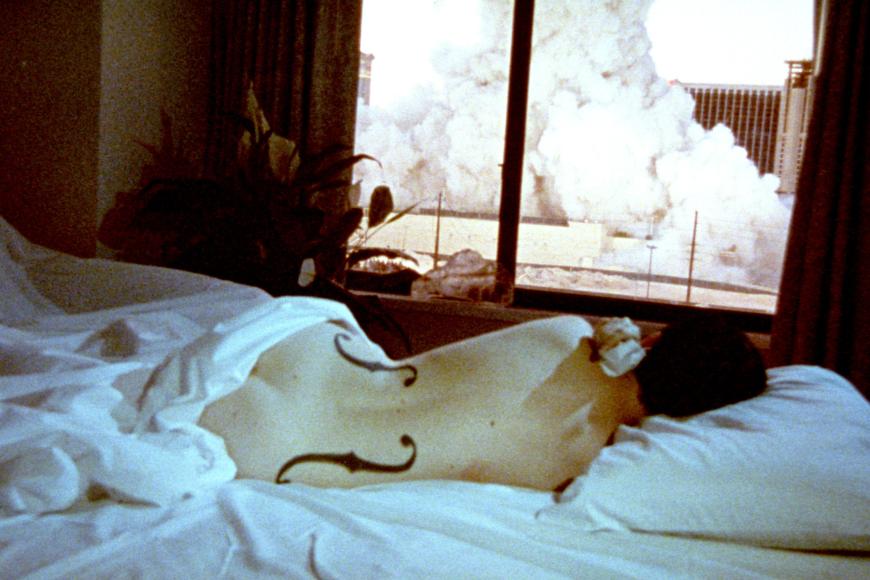
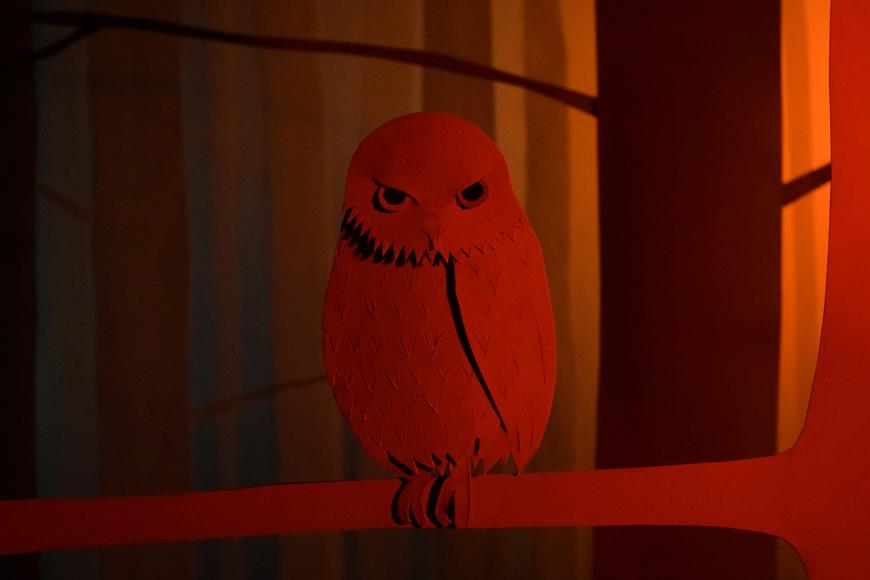
A representative of the Volgograd Section of the German-Soviet Friendship Society recalls German “comrades who fought against Hitler here […] and at other front sectors.” Equalisation with the people in the Soviet Union is completed at the Mamayev Kurgan memorial: The (German) visitors merge with the survivors who mourn their fallen.
Konstantin Wiesinger
Credits
Director
Volker Kastius
Cinematographer
Willy Reitze
Producer
Amateurfilmstudio VEB Elektromotorenwerk Wernigerode
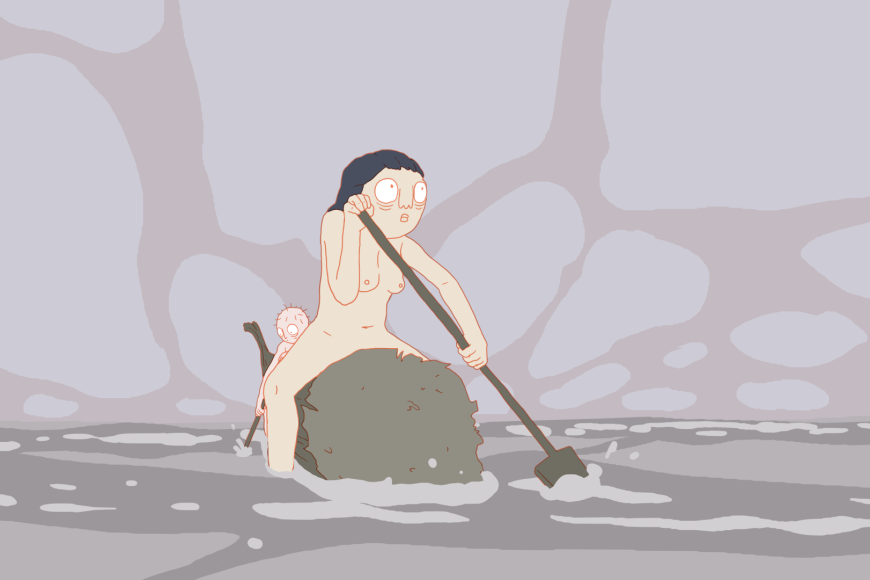
A relationship on the rocks, naked under the scorching sun and disoriented on a vast holiday sea. In search of funny dolphins, Aurora and Jeremy are paddling for their lives.
She and him, naked on the holiday seas in the bright sun. It may sound idyllic, but it is hell for Aurora and Jeremy. In search of funny dolphins, the two are paddling without orientation in the limitless expanse of water, no land in sight. Complete with dangers from above and below in the shape of heat and sharks. And at the centre of events is a near-defunct relationship. The roles are well-practised and grating, uptight lust is satisfied only solo.
Instead of roaring waves, it is above all the relentless silence of the sea surrounding them that provides the tension of the film. It is occasionally released in brilliant miniatures, for example a witty argument, or clumsy physical comedy. Another time, we are shocked by action-filled horror moments triggering absurd chain reactions. Whether it is the glaring light on the brutally calm water and the clueless couple, the visual fumes of decay one can almost smell, or a super dynamic dive – Levi Stoops’ direction is magnificent and timed with utmost precision.
André Eckardt
Credits
Director
Levi Stoops
Script
Levi Stoops
Cinematographer
Camiel Hermans, Sarah Menheere, Karolien Raeymaekers, Levi Stoops
Editor
Levi Stoops
Producer
Annemie Degryse
Sound
Paulo Rietjens, Arnout Colaert
Sound Design
Paulo Rietjens
Score
Mick Lemaire
Animation
Camiel Hermans, Sarah Menheere, Karolien Raeymaekers, Levi Stoops
A construction site in the Central African Republic, two career dreams: The double portrait of a native day labourer and a Chinese construction manager becomes a parable of globalisation.
German Subtitles for deaf and hard-of-hearing, English
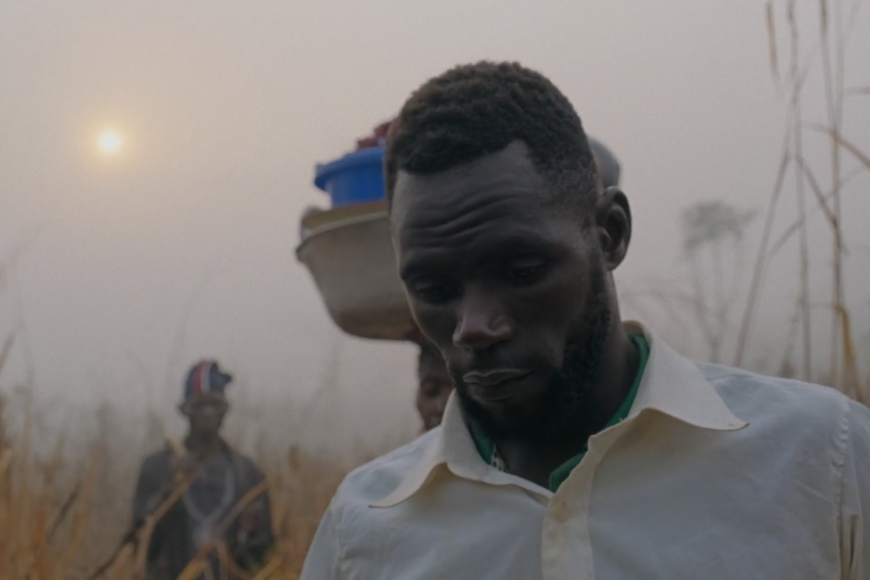
A man on a river at dawn. He prays, dives into the water, and comes back up with a bucket of sand. The single father Thomas Boa toils away as a sand diver in Bangui, the capital of the Central African Republic. The sand eventually ends up at the construction site of Jianmin Luan, a Chinese construction manager who went to Africa to further his career. Luan pays a price for this opportunity: He lives very simply, plagued by power failures and fears of malaria, typhoid, and civil war. After years abroad, he has become estranged from his family in China; his wife is mentally unwell.
Directors Ningyi Sun and Pascale Appora-Gnekindy tell a story of globalisation, poverty, and labour, asking how life can be lived with dignity. Instead of perpetuating clichés they introduce us to two men (and their families) who are tiny cogs in the gears of a global competition machine. There is a lot of inequality in this system and next to no winners. But there are also moments when it all seems worthwhile: when Luan’s wife visits Africa and intimacy is suddenly rekindled, or when Thomas cultivates a field and is finally able to look ahead. A visually powerful, enthralling and horizon-expanding film that skilfully evades stereotypes.
One Wednesday in June – 20 Years Ago: People’s Uprising, Workers’ Revolt or Secret Services Putsch?
Lutz Lehmann
Workers’ revolt or popular uprising? Or an attempted Western coup after all? 20 years after 17 June 1953, a television report looks for answers. The interpretations remain open.
One Wednesday in June – 20 Years Ago: People’s Uprising, Workers’ Revolt or Secret Services Putsch?
Ein Mittwoch im Juni – Vor 20 Jahren: Volksaufstand, Arbeiterrevolte oder Agentenputsch?
Lutz Lehmann
Retrospective 2023
Documentary Film
FRG
1973
60 minutes
German
Subtitles:
None
What happened in the GDR on 17 June 1953? Using a lot of original footage, Norddeutscher Rundfunk looks back on the events in a detailed report marking their 20th anniversary and shows different interpretations and explanations. Agent coup? Workers’ revolt? Popular uprising? The interpretations were controversial, even among contemporary witnesses and Western historians.
Katharina Franck, Andreas Kötzing
Credits
Director
Lutz Lehmann
Cinematographer
Hans Jacob
Editor
Elke Düring
Producer
NDR Norddeutscher Rundfunk / German TV ARD Network
The rescue of 104 castaways in the Mediterranean, person by person, step by step, in a real time documentary. Help against the clock – and the organised ignorance of the authorities.
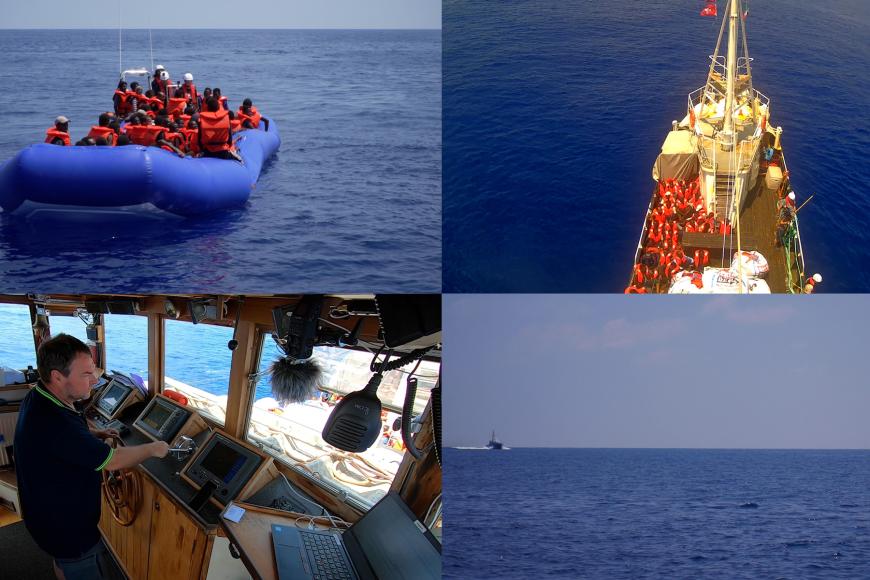
The deadliest refugee route in the world claims thousands of lives every year. In the first half of 2023 alone, almost 2,000 people died in the Mediterranean because the European Union’s border policy systematically violates existing laws. Instead of helping shipwrecked persons, Frontex practices illegal pushbacks, finances the violent operations of the Libyan coast guard and takes massive action against private sea rescue missions that act where the EU fails. All this has been documented in the media and yet remains incomprehensible to all who were never forced to live through this situation themselves: How can one deny assistance to hundreds of people in peril of life, even threaten and criminalise the civilian helpers?
Jonathan Schörnig was concerned with this dilemma of lack of perception and decided to bring a sea rescue to the screen as a real time documentary to show how agonisingly long it takes to rescue 104 persons from a sinking rubber boat. One by one, step by step, the film follows the action with several parallel cameras. When the Libyan coast guard turn up, the situation comes to a head. The rescued persons and the crew are stuck on the high seas for days because no Mediterranean country gives them permission to dock. It is only after a heavy storm that one port takes pity on them. What sounds like a bad script is actually – daily – reality.
Luc-Carolin Ziemann
Credits
Director
Jonathan Schörnig
Cinematographer
Jonathan Schörnig, Johannes Filous
Editor
Jonathan Schörnig, Moritz Petzold
Producer
Uwe Nitschke
Co-Producer
Adrian Then
Winner of:
Goethe-Institut Documentary Film Prize,
Golden Dove Feature-Length Film (German Competition),
Leipziger Ring,
ver.di Prize for Solidarity, Humanity and Fairness
A refugee camp built in Egypt in 1944 becomes the social model for Tito’s Yugoslavia. Archive material and contemporary witnesses tell a lived social-utopian origin story.
El Shatt in Egypt, in the middle of the desert, was both a haven and a projection. This is where in 1944, based on a deal between the Yugoslavian partisans led by Tito and the British allies, not only a refugee camp for the families of anti-fascist fighters from Dalmatia was built. This is where a model was created for the future Socialist Federal Republic of Yugoslavia – a state that was to build its founding narrative on the people’s liberation fight against fascism and declare collectively organised self-administration its social ideal.
Director Ivan Ramljak offers us multifaceted insights into this long-forgotten piece of primordial communist history spelled out in reality. After painstaking research, he combines hundreds of historical photographs and some (few) film recordings of interviews with contemporary witnesses. The lively voices of those who were children back then and are over 80 today tell their stories offscreen: of the struggle for survival, solidarity and lived ideology, in short, of a daily life that included self-organised schools, workshops, canteen kitchens, even a newspaper. Ramljak, tongue firmly in cheek, takes up the thread of history and juxtaposes his skilfully arranged archive material with staged scenes played by the ensemble of a theatre that was founded in El Shatt at the time.
In the midst of a blue-violet tinted mountain range are the remains of a lonely pavilion. Accompanied by the music of Max Cooper, this setting becomes the stage of a dance performance – in which our hands play the leading roles. Intuitively we let the rhythm take them over, move them playfully, form graceful gestures. At this hypnotic place everything is possible for the dancers.
Refugees from the GDR in Warsaw, shortly before the fall of the Wall. Emotional fates, unfiltered. The interviews were forgotten and only re-discovered 20 years later.
Shortly before the fall of the Wall, tens of thousands of GDR citizens fled to the West, most of them via Hungary. Many ended up stranded in the West German embassies in Prague and Warsaw. Refugees from the GDR were interviewed in Poland, speaking openly and emotionally of their fates. The footage was forgotten and only re-discovered 20 years later.
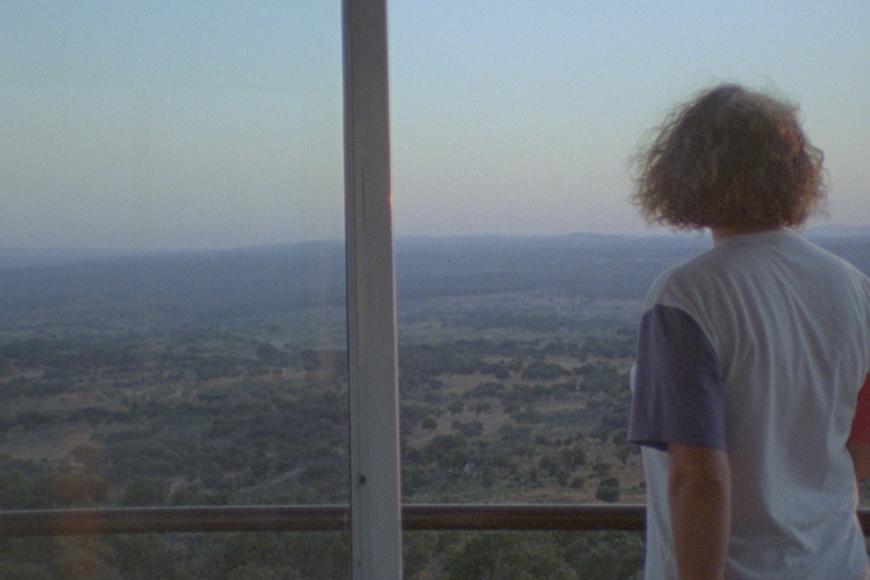
From their lookout towers, female fire wardens scan Portuguese landscapes for wildfires. An allegorically condensed, wordless study of vigilance and vision.
English, German Subtitles for deaf and hard-of-hearing
The gaze is firmly fixed on the horizon and distant tree lines, distinguishing natural from smoke clouds. Seasonal work for Portuguese women who observe the landscape from behind the glass panes of fire lookout towers, radio always in reach to report wildfires immediately upon discovery. While the boundary of the visible blurs in the grain of the analogue film stock, Dina, Adriana, Ana Paula, Helena, Luisa, Cristina, Dulce, Lídia, Inês, Fátima, Francisca and Vera emerge as agents of anticipation, modern-day seers whose gentle but persistent peering reaches beyond the burning world. Meanwhile, their male colleagues monitor the situation on computer screens. Poetical textures of waiting and wokeness. The female vision is sharpened and has expectations from the not yet visible future.
Images of blurred landscapes fade into each other. Apparent rock formations reveal themselves only at second glance as collages of human body parts. Browsing further through the family album uncovers something that is rather rarely found in such private pictorial chronicles: the backs of people’s heads. Grandparents, aunts and friends do not, as usual, look out of the album and the then at the viewer in the now but into the mysterious depths of a neon-lighted corridor. Its architectural elements form a filmic labyrinth behind whose closed doors animated collages of arms and hands perform everyday gestures in a ghost-like pantomime.
Moïa Jobin-Paré opens found private photo albums. The connections and stories between the pictures remain as abstract as that which the photographs show is concrete. Poetic spaces of interpretation open up. The Canadian artist offers a special reading. She scrapes individual elements or patterns off the analogue photographs and animates these “painterly” edits in a space of washed-out sounds. Scratches and white dots spread mushroom-like on the physically dissolving images.
In southern California, date palms from the Middle East grow, tales from One Thousand and One Nights are told and a volcanic eruption is expected. A document of enchanting simultaneity.
Not a single cloud ever seems to drift across this sky, the sun never ceases to send its powerful rays down. Here, in southern California, where the San Andreas Fault has created an unmistakable topography and invisible water currents run under the barren soil, date palms thrive best: feet in water, head on fire. Terra Long has looked around, traced the history of the plants which originally came to North America from the Middle East, and visited the parades and festivities dedicated to the sugary fruit. Layer by layer, she constructs her very own perspective on the landscape and the people, translates her haptic impressions into magnificent 16mm shots and designs a complex soundtrack.
Long manages to join the past and present and produce a concise, quasi sensual extract. The laborious manual pollination of the date palms plays a role in it, as do the collapsed ecosystem of the Salton Sea, archived dresses of Arabian Nights beauty queens and interviews that testify only to what is now historical; as do elderly white couples floating in their pools and walking across the lawns of golf courses. “Feet in Water, Head on Fire” is a document of simultaneity that captivates from the first minute to the last.
For years, Michelle has been trying to prove her imprisoned husband’s innocence. A documentary thriller about a tireless struggle against the U.S. American justice system.
At the beginning Michelle Bastien-Archer shows and comments on photos of her wedding. The African-American and her childhood friend Jermaine were married in the unhospitable visitors’ hall of Sing Sing in 2007. He had been sentenced to 22 years to life for voluntary manslaughter in 1998. Ever since, she has been fighting tirelessly to prove his innocence. Now new documents have turned up that reinforce doubts about the trial’s decisive witness statement. Michelle becomes more confident. She presses even more determinedly ahead with her efforts to get Jermaine released. The camera is with her as if live, for almost a decade.
It feels like a thriller whose script was written by life and the U.S. American justice system. Daily life under exceptional circumstances, scenes from an unusual marriage. Timed phone calls from prison, countless visits to the lawyer, appearances at solidarity events for wrongly convicted African Americans. Michelle works as a house painter for the City of New York, raising her two children alone. We learn in passing that their biological father was the victim of a brutal crime. The portrait of a confident woman who shares her fears and hopes with us emerges.
Having a crush – what a beautiful but equally fleeting, sobering moment. The senses go on their first physical explorations, breathtaking, deviant or repulsive.
Biology lesson. On one side the teacher in the light of the entomology projection, on the other the classroom in semi-darkness. Attention is slackening. Adolescent daydreaming: The boy at the desk in front is actually quite cute. The fingers want to run off. Still, rather touch only oneself at first. But then there is a spark …
Having a crush, what a beautiful and intense, but equally fleeting and sobering moment. Eyes, nose, ear, mouth and hands go on their first physical explorations, breathtaking, deviant or repulsive. Zhen Li observes with microscopic precision and magnificently captures this exceptional state of mind with different animation techniques. Charcoal drawings with smeared marks, furry waves of mould, intricately animated bodies and buzzing, sticky sounds circumscribe the sensual surge.
The motif of movement in film is a core element of Peter Mettler’s award-winning body of work: His journey here takes us from Canada via the USA to Switzerland and as far as India, the filmed moments associatively unfolding a tableau about different people. They are all, each in their own way, looking for transcendence and ecstasy. In this hypnotic trip about time and transience, the director is always ready to engage with the unexpected. His attitude is marked by curiosity and impartiality. Well over a hundred hours of footage feed into a brilliant montage in which transition and rapture also find visual and acoustic correspondences.
This desktop video essay examines how the media illustrate the issue of abortion. Clicking through photo databases and magazines reveals the consequences of suggestive images.
What images do we associate with abortion and why? Where do these images and the emotional scripts in our head come from? How do they influence women who (want to) have an abortion, how do they shape the general discussion? Franzis Kabisch’s personal desktop documentary investigates these questions with great precision, clarity and humour (yes, humour, too!).
In the process, she moves from early 2000s girls’ magazines to the late 19th century, sifts through troves of feminist knowledge and checks alleged cultural-historical facts (such as the discovery of hysteria in women) that haunt conventional wisdom to this day. At the end of the film, we have not only seen an exemplary examination of image politics and how they contributed to pushing the issue of abortion to the social sidelines and linking it with shame and guilt. Franzis Kabisch manages, almost “in the same breath,” to break up the false hubris of the documentary and demonstrate that the evidential value of filmic and photographic “testimonies” must always and implicitly be scrutinised. Ultimately, “cui bono?” – the question who profits, must be considered in every media-critical reflection – not just in the age of stock photos, editing software and AI but, strictly speaking, at the start of every documentary image production.
Luc-Carolin Ziemann
Credits
Director
Franzis Kabisch
Script
Franzis Kabisch
Cinematographer
Franzis Kabisch
Editor
Franzis Kabisch
Producer
Franzis Kabisch
Sound Design
Franzis Kabisch, Katharina Pelosi, Laura Schick
Winner of:
Golden Dove Short Film (German Competition)
A young woman is strangled. The mother’s moving dirge – based on a poem by Percy Shelley – accompanies us as her daughter Ginevra is laid out and resurrects.
The rising sun reveals a gruesome crime. In the orange-red dawn, between the dunes and the rippling sea, a young woman is strangled to death. The victim’s neck is marked by the deep imprints of her murderer’s hands. The mother’s moving dirge – based on a poem by Percy Shelley – accompanies us as her daughter Ginevra is laid out and resurrects.