Lenin’s long shadow reaches until 1970: The citizens of the Soviet Union pay their respects to Lenin, the founder of their state – at the mausoleum on Moscow’s Red Square.
A quote by the Soviet futurist Vladimir Mayakovsky about Lenin frames the plot of this film: A dead man who is “more alive than the living” today. On a tour through the Union of Soviet Republics, the film team meet friends “in the full sense of the word” without mentioning their names: encounters with people in the Soviet Union in 1970.
A construction site in the Central African Republic, two career dreams: The double portrait of a native day labourer and a Chinese construction manager becomes a parable of globalisation.
German Subtitles for deaf and hard-of-hearing, English
A man on a river at dawn. He prays, dives into the water, and comes back up with a bucket of sand. The single father Thomas Boa toils away as a sand diver in Bangui, the capital of the Central African Republic. The sand eventually ends up at the construction site of Jianmin Luan, a Chinese construction manager who went to Africa to further his career. Luan pays a price for this opportunity: He lives very simply, plagued by power failures and fears of malaria, typhoid, and civil war. After years abroad, he has become estranged from his family in China; his wife is mentally unwell.
Directors Ningyi Sun and Pascale Appora-Gnekindy tell a story of globalisation, poverty, and labour, asking how life can be lived with dignity. Instead of perpetuating clichés they introduce us to two men (and their families) who are tiny cogs in the gears of a global competition machine. There is a lot of inequality in this system and next to no winners. But there are also moments when it all seems worthwhile: when Luan’s wife visits Africa and intimacy is suddenly rekindled, or when Thomas cultivates a field and is finally able to look ahead. A visually powerful, enthralling and horizon-expanding film that skilfully evades stereotypes.
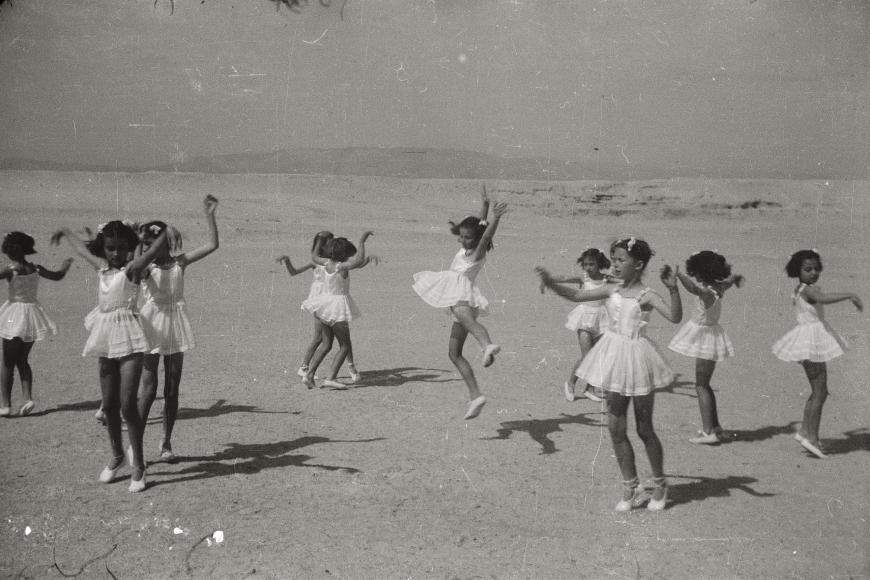
A refugee camp built in Egypt in 1944 becomes the social model for Tito’s Yugoslavia. Archive material and contemporary witnesses tell a lived social-utopian origin story.
El Shatt in Egypt, in the middle of the desert, was both a haven and a projection. This is where in 1944, based on a deal between the Yugoslavian partisans led by Tito and the British allies, not only a refugee camp for the families of anti-fascist fighters from Dalmatia was built. This is where a model was created for the future Socialist Federal Republic of Yugoslavia – a state that was to build its founding narrative on the people’s liberation fight against fascism and declare collectively organised self-administration its social ideal.
Director Ivan Ramljak offers us multifaceted insights into this long-forgotten piece of primordial communist history spelled out in reality. After painstaking research, he combines hundreds of historical photographs and some (few) film recordings of interviews with contemporary witnesses. The lively voices of those who were children back then and are over 80 today tell their stories offscreen: of the struggle for survival, solidarity and lived ideology, in short, of a daily life that included self-organised schools, workshops, canteen kitchens, even a newspaper. Ramljak, tongue firmly in cheek, takes up the thread of history and juxtaposes his skilfully arranged archive material with staged scenes played by the ensemble of a theatre that was founded in El Shatt at the time.
In the midst of a blue-violet tinted mountain range are the remains of a lonely pavilion. Accompanied by the music of Max Cooper, this setting becomes the stage of a dance performance – in which our hands play the leading roles. Intuitively we let the rhythm take them over, move them playfully, form graceful gestures. At this hypnotic place everything is possible for the dancers.
Refugees from the GDR in Warsaw, shortly before the fall of the Wall. Emotional fates, unfiltered. The interviews were forgotten and only re-discovered 20 years later.
Shortly before the fall of the Wall, tens of thousands of GDR citizens fled to the West, most of them via Hungary. Many ended up stranded in the West German embassies in Prague and Warsaw. Refugees from the GDR were interviewed in Poland, speaking openly and emotionally of their fates. The footage was forgotten and only re-discovered 20 years later.
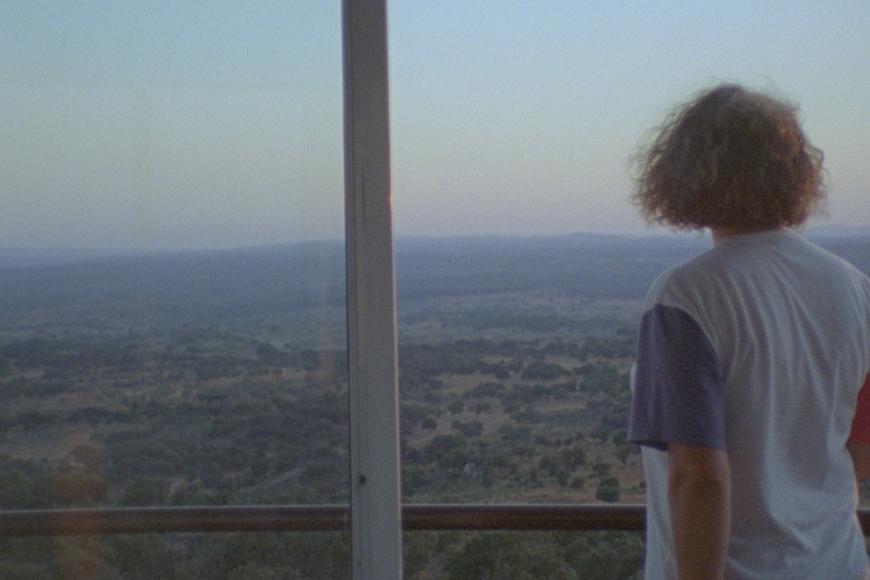
From their lookout towers, female fire wardens scan Portuguese landscapes for wildfires. An allegorically condensed, wordless study of vigilance and vision.
English, German Subtitles for deaf and hard-of-hearing
The gaze is firmly fixed on the horizon and distant tree lines, distinguishing natural from smoke clouds. Seasonal work for Portuguese women who observe the landscape from behind the glass panes of fire lookout towers, radio always in reach to report wildfires immediately upon discovery. While the boundary of the visible blurs in the grain of the analogue film stock, Dina, Adriana, Ana Paula, Helena, Luisa, Cristina, Dulce, Lídia, Inês, Fátima, Francisca and Vera emerge as agents of anticipation, modern-day seers whose gentle but persistent peering reaches beyond the burning world. Meanwhile, their male colleagues monitor the situation on computer screens. Poetical textures of waiting and wokeness. The female vision is sharpened and has expectations from the not yet visible future.