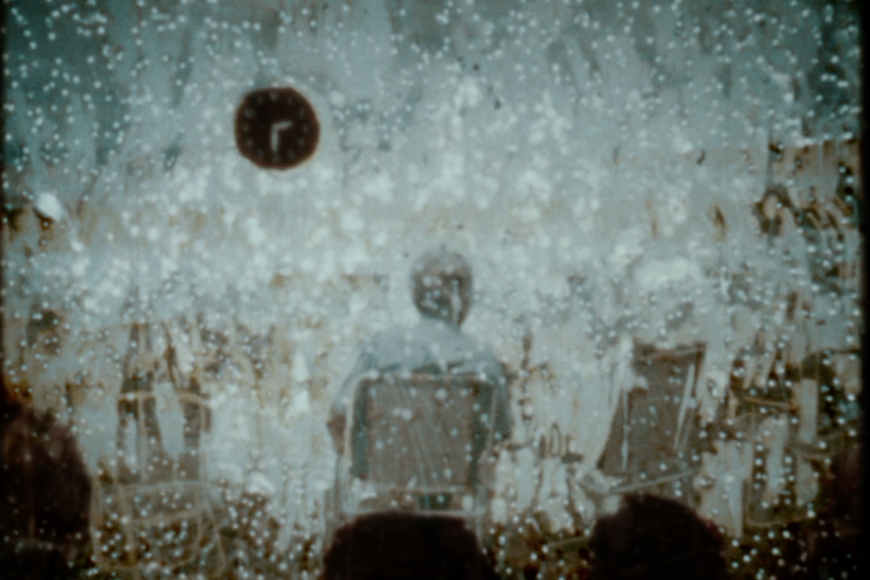
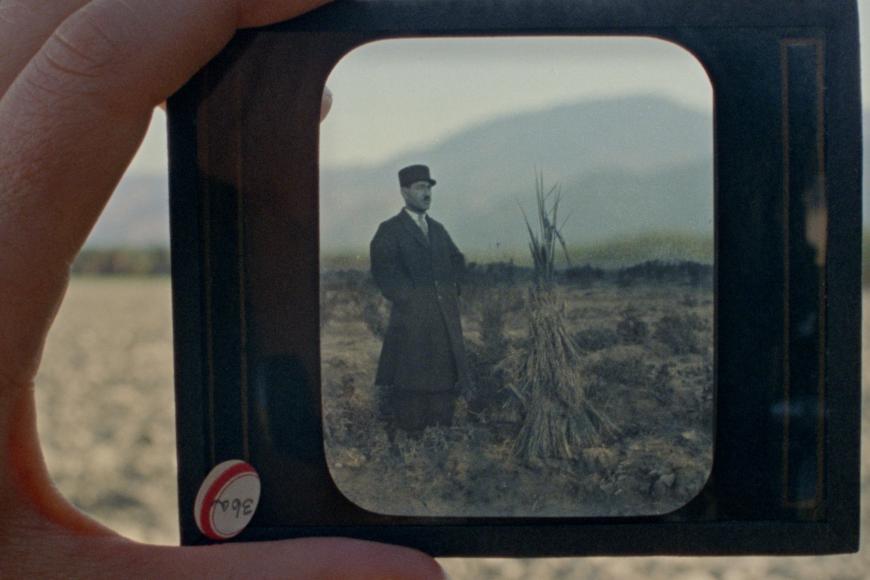
Images of blurred landscapes fade into each other. Apparent rock formations reveal themselves only at second glance as collages of human body parts. Browsing further through the family album uncovers something that is rather rarely found in such private pictorial chronicles: the backs of people’s heads. Grandparents, aunts and friends do not, as usual, look out of the album and the then at the viewer in the now but into the mysterious depths of a neon-lighted corridor. Its architectural elements form a filmic labyrinth behind whose closed doors animated collages of arms and hands perform everyday gestures in a ghost-like pantomime.
Moïa Jobin-Paré opens found private photo albums. The connections and stories between the pictures remain as abstract as that which the photographs show is concrete. Poetic spaces of interpretation open up. The Canadian artist offers a special reading. She scrapes individual elements or patterns off the analogue photographs and animates these “painterly” edits in a space of washed-out sounds. Scratches and white dots spread mushroom-like on the physically dissolving images.
In southern California, date palms from the Middle East grow, tales from One Thousand and One Nights are told and a volcanic eruption is expected. A document of enchanting simultaneity.
Not a single cloud ever seems to drift across this sky, the sun never ceases to send its powerful rays down. Here, in southern California, where the San Andreas Fault has created an unmistakable topography and invisible water currents run under the barren soil, date palms thrive best: feet in water, head on fire. Terra Long has looked around, traced the history of the plants which originally came to North America from the Middle East, and visited the parades and festivities dedicated to the sugary fruit. Layer by layer, she constructs her very own perspective on the landscape and the people, translates her haptic impressions into magnificent 16mm shots and designs a complex soundtrack.
Long manages to join the past and present and produce a concise, quasi sensual extract. The laborious manual pollination of the date palms plays a role in it, as do the collapsed ecosystem of the Salton Sea, archived dresses of Arabian Nights beauty queens and interviews that testify only to what is now historical; as do elderly white couples floating in their pools and walking across the lawns of golf courses. “Feet in Water, Head on Fire” is a document of simultaneity that captivates from the first minute to the last.
For years, Michelle has been trying to prove her imprisoned husband’s innocence. A documentary thriller about a tireless struggle against the U.S. American justice system.
At the beginning Michelle Bastien-Archer shows and comments on photos of her wedding. The African-American and her childhood friend Jermaine were married in the unhospitable visitors’ hall of Sing Sing in 2007. He had been sentenced to 22 years to life for voluntary manslaughter in 1998. Ever since, she has been fighting tirelessly to prove his innocence. Now new documents have turned up that reinforce doubts about the trial’s decisive witness statement. Michelle becomes more confident. She presses even more determinedly ahead with her efforts to get Jermaine released. The camera is with her as if live, for almost a decade.
It feels like a thriller whose script was written by life and the U.S. American justice system. Daily life under exceptional circumstances, scenes from an unusual marriage. Timed phone calls from prison, countless visits to the lawyer, appearances at solidarity events for wrongly convicted African Americans. Michelle works as a house painter for the City of New York, raising her two children alone. We learn in passing that their biological father was the victim of a brutal crime. The portrait of a confident woman who shares her fears and hopes with us emerges.
Having a crush – what a beautiful but equally fleeting, sobering moment. The senses go on their first physical explorations, breathtaking, deviant or repulsive.
Biology lesson. On one side the teacher in the light of the entomology projection, on the other the classroom in semi-darkness. Attention is slackening. Adolescent daydreaming: The boy at the desk in front is actually quite cute. The fingers want to run off. Still, rather touch only oneself at first. But then there is a spark …
Having a crush, what a beautiful and intense, but equally fleeting and sobering moment. Eyes, nose, ear, mouth and hands go on their first physical explorations, breathtaking, deviant or repulsive. Zhen Li observes with microscopic precision and magnificently captures this exceptional state of mind with different animation techniques. Charcoal drawings with smeared marks, furry waves of mould, intricately animated bodies and buzzing, sticky sounds circumscribe the sensual surge.
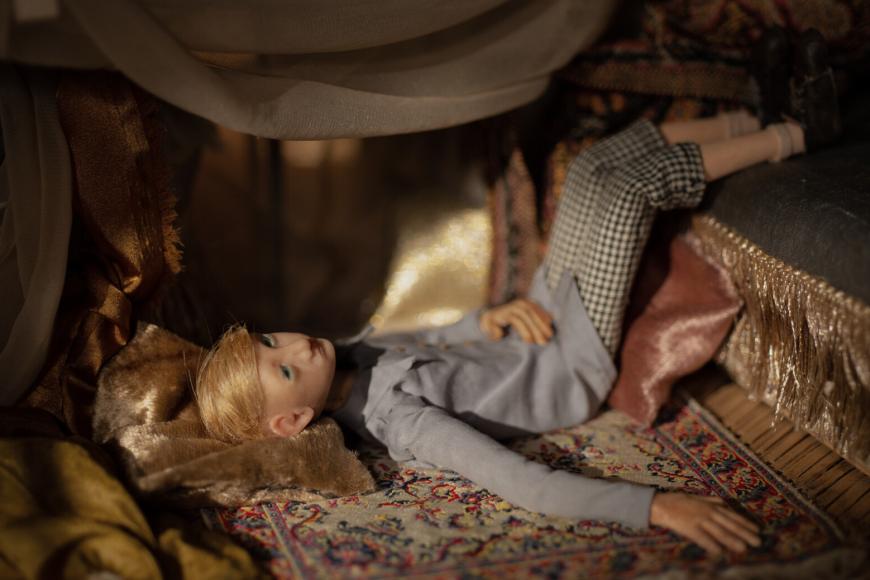
András and his daughter Zsófia enjoy a relaxed Sunday in their stately city mansion, just before the collapse of the Austro-Hungarian monarchy. But soon the silence in the house is disturbed by an escaped pig, closely followed by an unexpected visit: András’ brother, his large family and lots of luggage barge in through the front door. Running children and garrulous relatives bring noise and bedlam to all floors. Art objects are handled without permission, furniture is moved, objects fall to the ground. The visitors have brought chaos. Zsófia’s father and the maid try in vain to restore calm and order. Though András and his brother get closer to each other, the old house is not up to the changed circumstances. A leaking water pipe heralds a finale that at least makes them all stand still together.
Franka Sachse
Credits
Director
Lea Vidaković
Script
Lea Vidaković
Cinematographer
Lea Vidaković, Damien Buquen
Editor
Iva Kraljević
Producer
Draško Ivezić, Jean Francois le Corre, Nikolina Vucetic Zecevic
Sound Design
Zoran Maksimovic
Animation
Marion le Guillou, Bilitis Levillain, Violette Delvoye
A girl looks out cautiously but curiously for the first harbingers of growing up. Beside the protected family home there now is a new emotional space to explore.
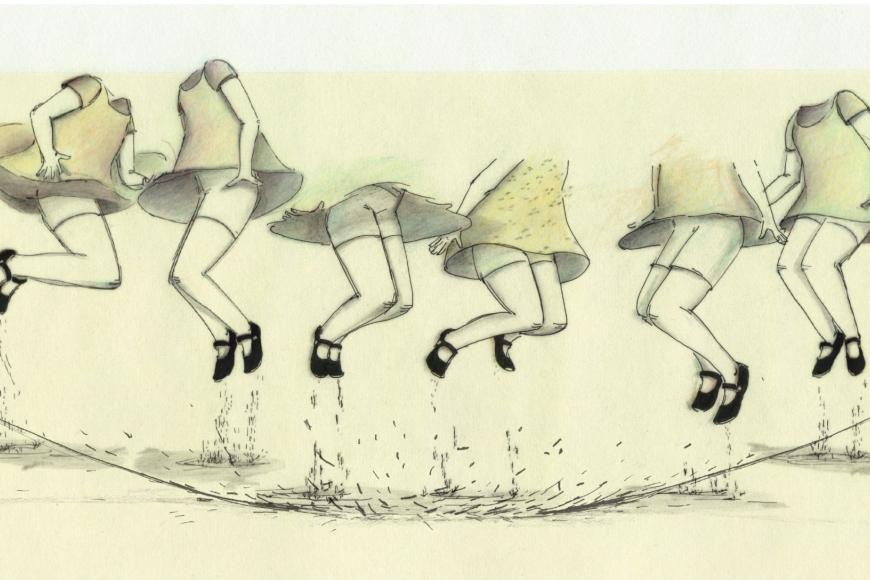
To enter the land behind the mirrors like Alice … A girl looks behind the mirror of her childhood for the first time, looking out cautiously, but also curiously, for the first harbingers of growing up. She steals away, detaching herself from her parents and siblings. Beside the small, protected family home, there now is a new, vast emotional space to explore.