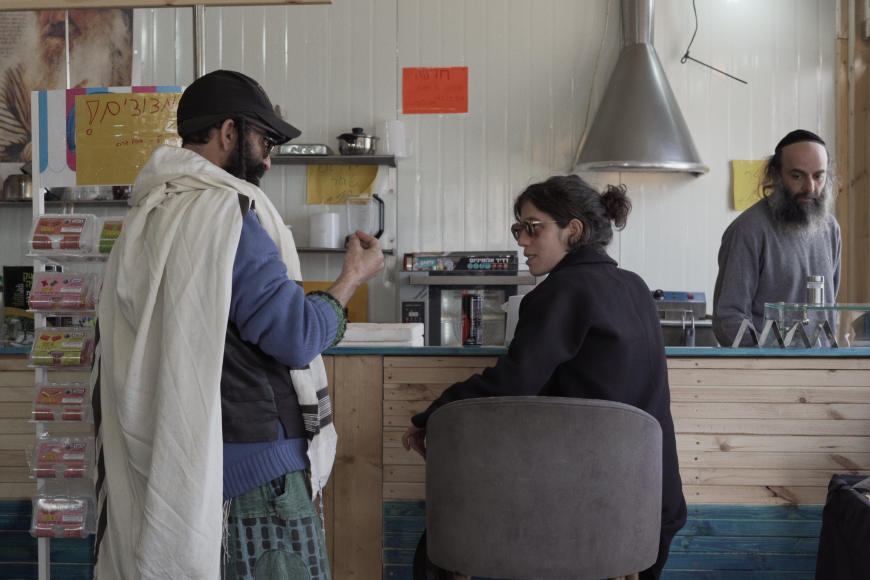
Maya Steinberg is a secular Israeli. Her father, however, had a late religious awakening. He will not appear in her film. Instead, the young director approaches his faith and her lack of understanding for it through a visit to the gravesite of rabbi Shimon bar Yochai in Galilee, where she spends a few weeks, observing believers, Orthodox and ultra-Orthodox, and wondering: Is there a place here for women? And can there be a place for queer women?
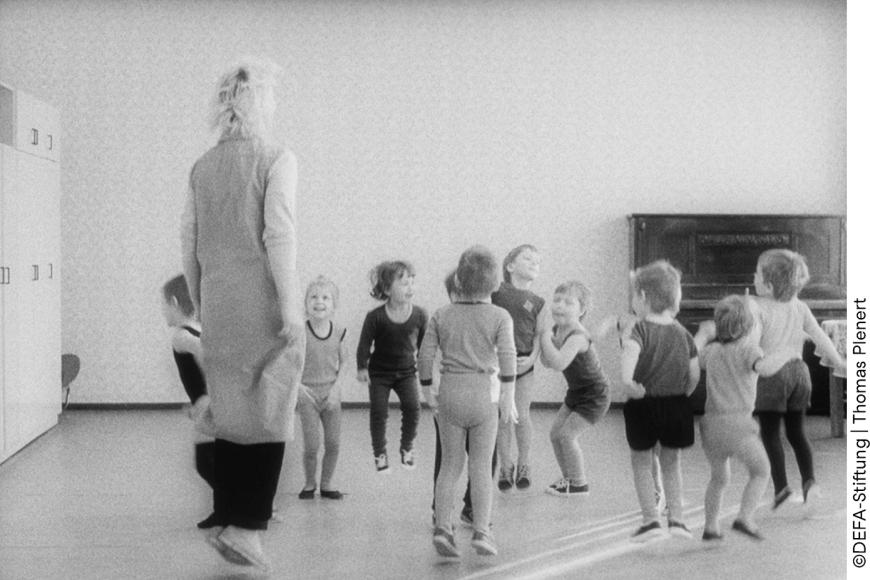
An equally delicate and lucid observation of life in a kindergarten: the childish joy of storytelling between free development and integration into the social norms.
The interviews conducted by Tamara Trampe in a Pankow kindergarten testify to a rare attempt to enter the world of the young interviewees completely, to give their stories a space where reality and fantasy, worries and wishes can mix freely. A space that’s not always provided in the daily life of the kindergarten, as the film casually suggests even after it was toned down by the DEFA censors: toilets without doors, ghastly birthday parties and friendly but unmistakable reprimands when the children let too much dialect slip into the grammar exercise or when their pictures of soldiers are not realistic enough.
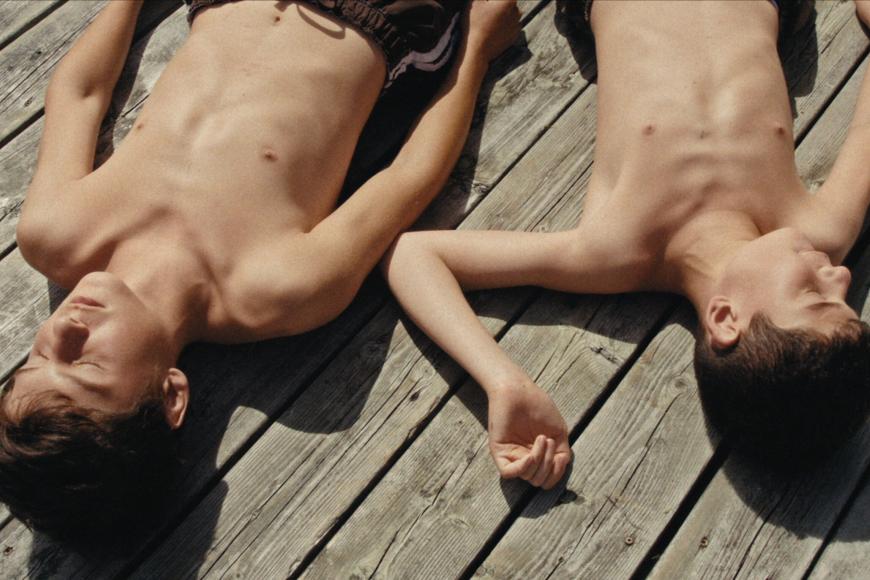
Raphaël and Rémi are twins who spend their holidays by the lake. But this is a time of farewell, because Raphaël will soon transfer to a school for children with disabilities.
Raphaël and Rémi are twins and very close. They spend their time in the skate park and their holidays by the lake. There’s always something to do: boating, catching frogs, bathing in the rain. This could go on forever. But we slowly realise that these holidays are also a farewell, because Raphaël will soon transfer to a school for children with disabilities.
A tour of a computer-generated desert landscape and a story of failure: The first casino in Palestine opened in 1998, only to close down again very soon.
A virtual tour of a computer-generated desert landscape and a story of failure: In 1998, the “Oasis”, Palestine’s first casino, opened. The peace-making idea associated with this development project lost out against political reality. Game over – the oasis becomes a multifaceted fata morgana of interviews with employees, operators and guests.
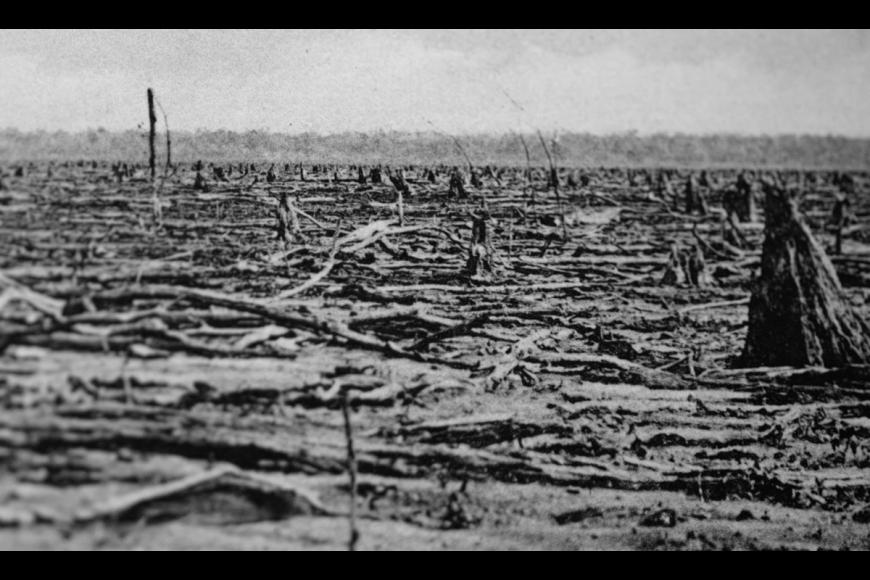
Johannes Weigelt, pioneer of taphonomy, was a palaeontologist, a dilettante photographer and Nazi. This essay makes his biography, fossilised in images, shimmer.
Competition for the Audience Award Short Film 2022
Documentary Film
Netherlands
2021
9 minutes
English
Subtitles:
English
A life dedicated to decay. Johannes Weigelt (1890–1948) was a palaeontologist, a dilettante photographer, a Nazi, all of it fervent. This essay is dedicated to the pioneer of taphonomy – sober and at the same time exciting in form. Three image fields are filled with changing content: black and white documents of fields of animal carcasses, a snapshot with Göring, text panels, artful photomontages. They all charge one another, containing a vibrantly shimmering biography fossilised in images.
Mike Brett, Steve Jamison, Pierre Zandrowicz, Arnaud Colinart
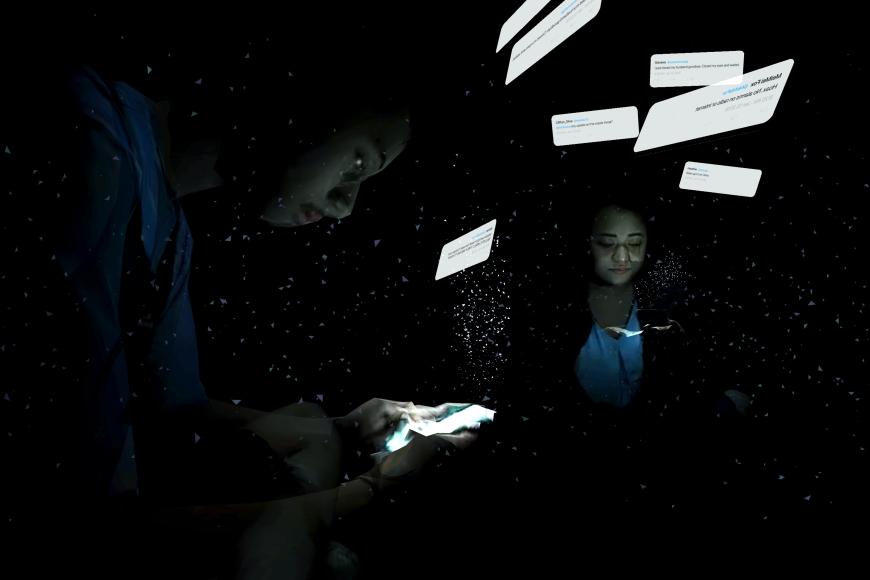
The nuclear threat became real for 1.4 million people on Hawaii. On 13 January 2018, a text message warned them of a missile. The message was false, its consequences momentous.
Mike Brett, Steve Jamison, Pierre Zandrowicz, Arnaud Colinart
Extended Reality 2022
XR
France,
UK,
USA
2022
42 minutes
English,
French,
German,
Korean,
Japanese,
Norwegian
Subtitles:
English
The peace of the superpowers is based on “mutual assured destruction”. States can annihilate each other completely with their arsenals. On 13 January 2018, 1.4 million people on Hawaii got a taste of this: A false missile alert text message brought their lives to a standstill that lasted 38 minutes, panic broke out and the nuclear threat suddenly became real.
Lars Rummel
Credits
Producer
Arnaud Colinart, Jo-Jo Ellison, Mike Brett, Steve Jamison
Executive Producer
Paul Mezier, Susanna Pollack
Production Company
Atlas V, Archer’s Mark
Animation
Alan Sorio
3D Artist
Renaud de Bellefon, Anthony Rubier
VFX Artist
Yasuyuki Otsuki
Script
Dr. Jamaica Heolimeleikalani Osorio
Score
Bobby Krlic
Key Collaborator
Games for Change, Princeton University, British Film Institute, VR for Good, ARTE France, CNC
Director
Mike Brett, Steve Jamison, Pierre Zandrowicz, Arnaud Colinart
An autobiographical and visually ingenious study of growing up (unprivileged), which raises questions about the (un-)interchangeability: of every individual, even a mother.
When director Mickaël Bandela was six months old, his biological mother Gisèle, who lived in France, handed him over to his foster mother Marie-Thérèse, who cared for him for almost twenty years. Though he stayed in touch with Gisèle, visits were always irregular. Now Mickaël is 35 and about to found his own family. It could be the perfect moment to include Gisèle into his life as a grandmother. But she decides to return to her old Congolese home.
Mickaël tries to understand – the woman who gave birth to him, the woman he grew up with and himself. His autobiographical film turns into a fragmented search for the traces of memories of his own becoming. Some sequences show moments of extreme disorientation. A loss of balance while revolving around oneself, as one might assume? No, that’s precisely what does not happen to Mickaël Bandela. His work, which counteracts the lack of archive material with visual ingenuity and an idiosyncratic rhythm, is full of empathy. Not only does he shine a light on growing up unprivileged in the French province, he also allows us to understand the actions of both his “mamans” and reveals backgrounds. In addition, he achieves an elaborate analysis of (un)interchangeability: that of every individual, even the often sacrosanct-seeming figure of the mother.
Quartzsite, Arizona. A small town in the middle of the desert becomes a huge camping ground in winter, where a motley community live the other side of the “American Dream”.
Quartzsite, Arizona. A town in the middle of the desert which regularly turns into a huge camping ground where up to a million people from the northern US states escape winter. It’s less chilly here, and people of every kind are welcome to rent a plot of dry land for 180 dollars. Ryan Maxey joins them for three seasons in a row, approaching the motley community with an intimate and at the same time soberly observant eye.
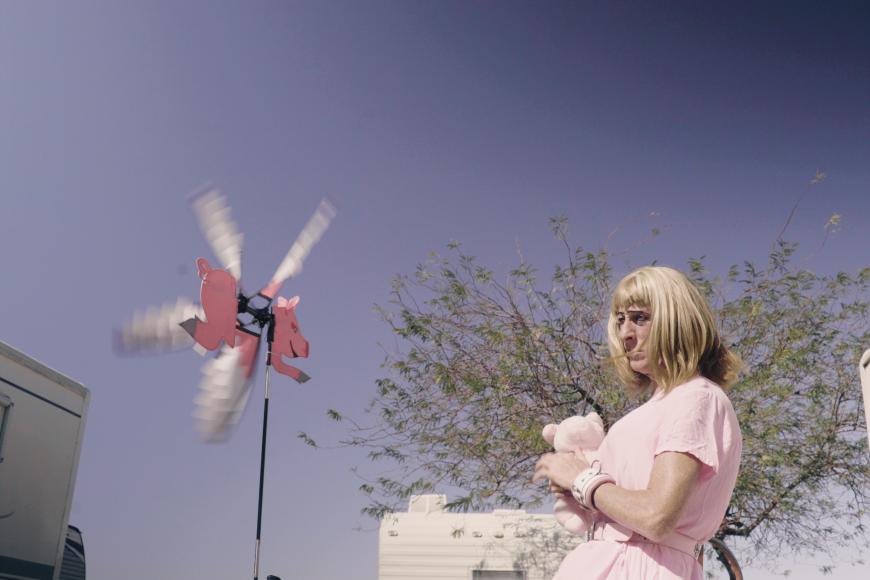
Meth junkies, gun lovers, constitution keepers, a trans woman dressed in pink and breeding cuddly pets and white men wearing “Black Guns Matter” t-shirts. People trade everything and help each other. Sometimes it can get rough. But the US-American flag, the ever-present guns and collective prayer are part of life, just like the democratic choice between pancakes and hamburgers. Maxey’s documentary foray takes him through all these lives and lifestyles which he seems to register sometimes with affectionate tenderness, sometimes shaking his head. Despite his critical semi-distance, he is clearly a part of the community he portrays. His film, a collaborative work in some ways, combines shots of this place from different perspectives and different times. Ambivalences persist, which is why all judgement must be preliminary.
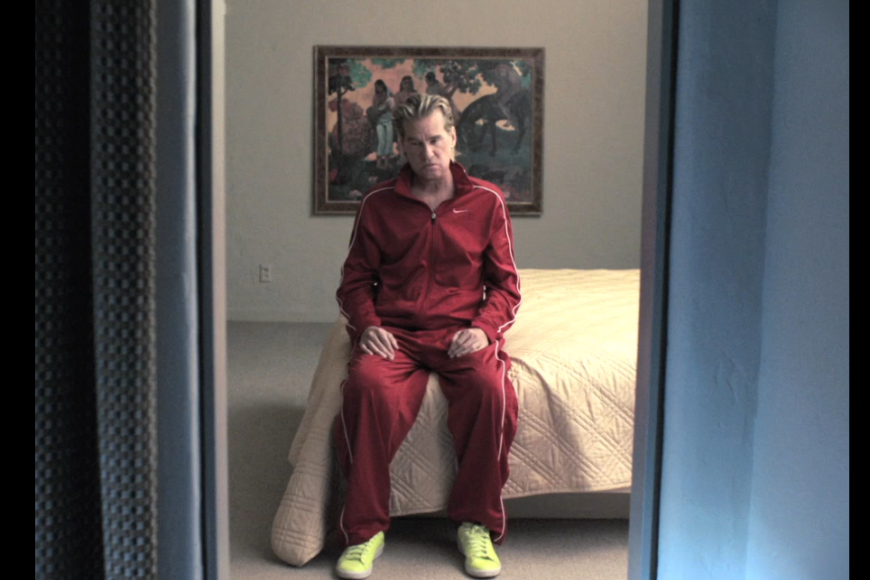
A ghostly voice sings about transience while the camera glides past closed curtains, capturing the expressive, lived-in face of a dozing Val Kilmer. Rick Alverson’s disconcerting stroboscopic video editing makes the dozing body twitch. The inner turmoil of a troubled soul and restless memories rise to the surface.
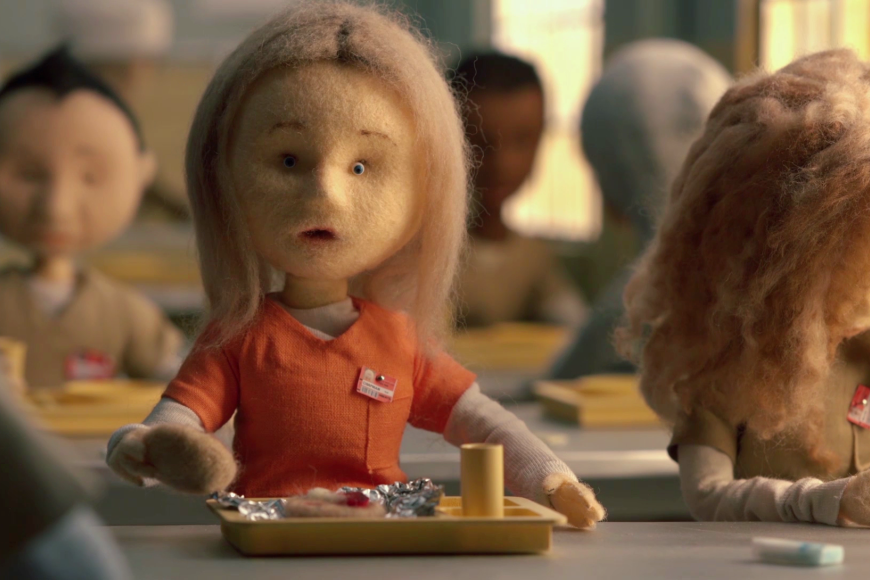
A commissioned work: Špela Čadež’s summary of the legendary comedy drama show set in a women’s prison, “unravelled” in soft and scratchy wool, yellow as urine and red as blood.
To promote the start of season five, Špela Čadež summarises the first four seasons of the legendary US comedy drama show for Netflix. From the streaming provider’s logo to the canteen food through to vomit – Čadež “unravels” her condensed version of the stories from the women’s prison in soft and scratchy wool, yellow as urine and red as blood.
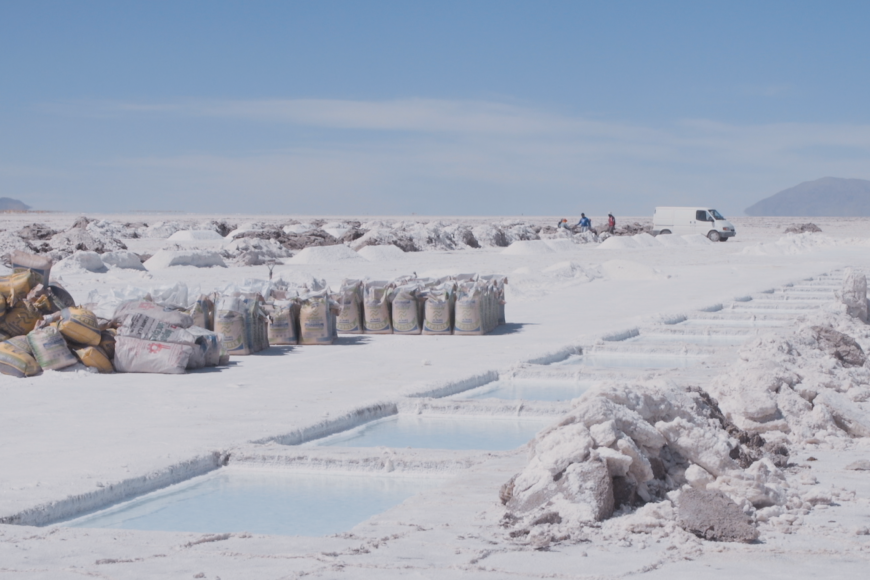
The downside of e-mobility: Because big corporations are mining lithium for batteries in the Argentinian salt deserts, the indigenous population have no water to live.
The vast expanses of the Argentinian salt deserts hold one of the greatest lithium deposits in the world. International corporations are mining the “white gold”, robbing the indigenous groups who, since time immemorial, have bred llamas and lived on traditional salt-mining in this area, of precious ground water. In magnificent images and with a narrative approach that combines poetry and agitprop, “Oro Blanco” shows how the indigenous population are fighting against the exploitation and destruction of “pacha mama”. Their resistance needs some heightened awareness on the other side of the world, where lithium batteries are all too often regarded as the cure-all against the use of fossil fuels.
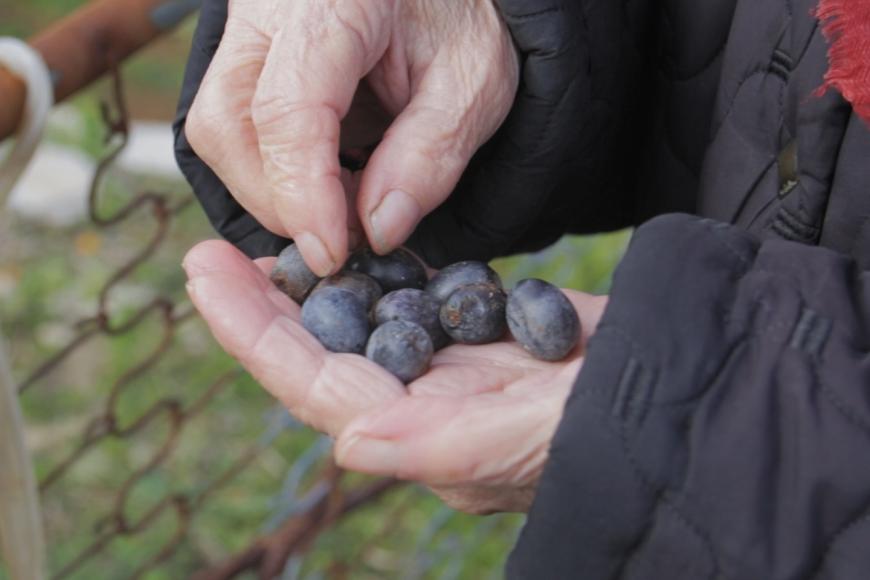
An elderly couple, a few olives on the ground that nobody collects any more. Once they were the livelihood of a family now scattered to the four winds.
Shaking his head, Michele looks at the olives lying on the ground. Nobody collects them now. He once planted the olive trees. They were his pride and fed the family. Now he sits by the fireplace with his wife. Their hands show the years of hard field work. With a tender gaze, their grandson watches his grandparents cook, argue, take walks. Moving snapshots that coalesce into a life lived, a chronicle of the rural exodus in Italy.
Once You’ve Worn Out the First Pair of Wooden Shoes …
Gabriele Denecke
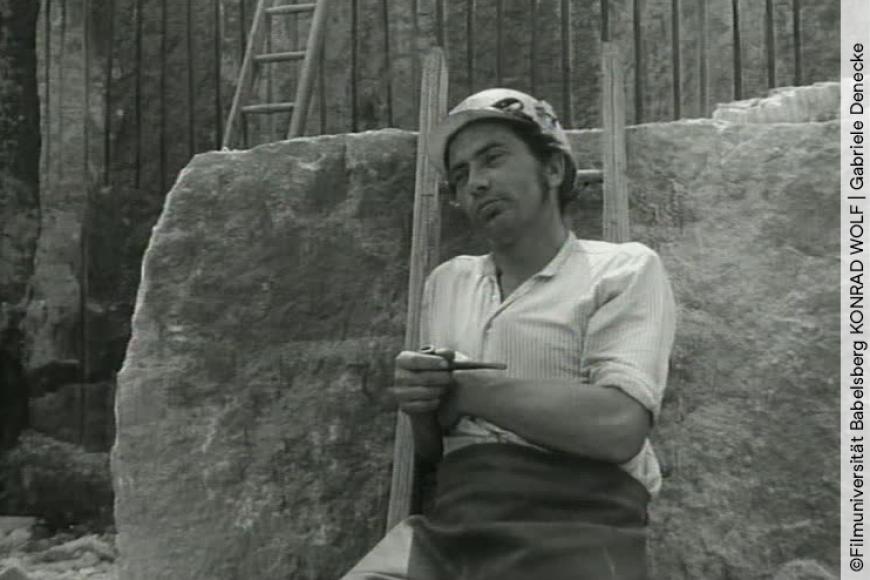
A visit to the quarrymen at the Reinhardtsdorf open cast mine: The film pierces through the dimensions of this traditional job and sets out on a sometimes hallucinatory trail.
Once You’ve Worn Out the First Pair of Wooden Shoes …
Wer ein paar Holzlatschen abgelaufen hat …
Gabriele Denecke
Retrospective 2022
Documentary Film
GDR
1976
33 minutes
German
Subtitles:
None
A handful of quarrymen in the Reinhardtsdorf open cast mine near Bad Schandau dig out the coveted Elbe natural stone. Gabriele Denecke’s approach to the men, who are of different ages, is almost trance-like, the movement to and from the stones marks the transition to another world. We hear about the merciless working conditions of the past, about alcohol, people worn out before their time. Today, digging out the massive rocks in the midst of nature also constitutes a degree of freedom. Open cast miners share a special mindset. And: Once you’ve worn out your first pair of wooden shoes, you’ll stay – probably forever.