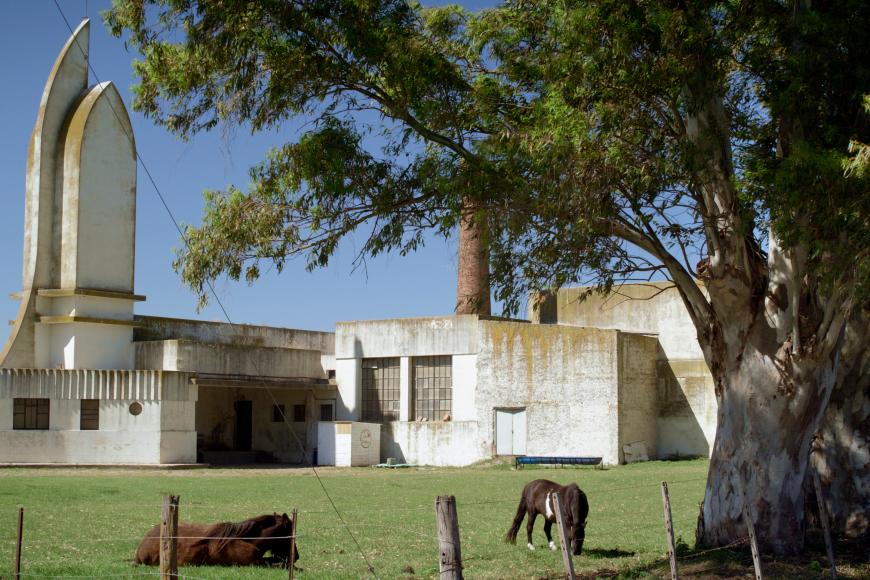
Slaughterhouses with concrete blades on top, monumental cemetery gates in the plains: Architect Francisco Salamone (1897–1959) shaped the image of the Argentinean pampa around Buenos Aires. In part 34 of his “Photography and beyond” series, Heinz Emigholz once more probes architecture for biographical traces. Salamone, who immigrated from Sicily as a child, realised his ideas between 1936 and 1940, when Mussolini’s Italy re-discovered architecture as an ideological craft.
Axes seem to be buried in the façade of the Coronel Pringles city hall. Elsewhere, stone tree fungi grow. And in front of the Saldungaray cemetery, viewed from the rear, a giant pancake or satellite dish forms, while in front the head of a suffering Jesus protrudes from the concrete. Monumental designs, occasionally incorporating elements of Art Deco or Italian Futurism, towering in the sky and advertising importance. Francisco Salamone worked in the years of the “Década infame”, that infamous decade followed shortly afterwards by the presidency of Juan Perón. The buildings seem inhospitable and full of hubris. They are supposed to herald modernity and progress and yet loomed terrifyingly over the peasantry of the country. Heinz Emigholz documents these intimidating buildings from every conceivable angle.
Carolin Weidner
Credits
Director
Heinz Emigholz
Script
Heinz Emigholz
Cinematographer
Heinz Emigholz, Till Beckmann
Editor
Till Beckmann, Heinz Emigholz
Producer
Irene von Alberti, Frieder Schlaich
Sound
Esteban Bellotto, Christian Obermaier, Jochen Jezussek
Competition for the Audience Award Short Film 2022
Animated Film
Croatia
2022
9 minutes
without dialogue
Subtitles:
None
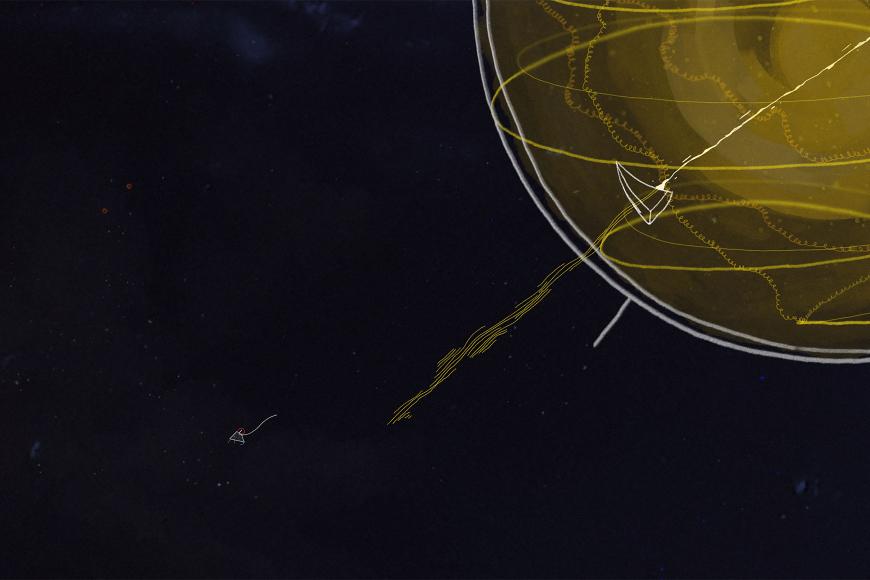
It’s lonely out in space and only the sun can warm you. In his imaginative 2D animation, Darko Masnec makes lines come alive and breathes life into abstract geometrical figures, as if Paul Klee and the Shadoks were celebrating a colourful banquet of metamorphoses. Stylised forms sprout luminescent organic compounds that tell a touching love story in outer space.
From the Argentinean pampa to the Bolivian highlands to the middle of Berlin: a trenchant critique of German history in its most visible manifestation, architecture.
An Argentinean builder who has built council halls, cemetery gates and abattoirs in the pampa as if from a modernist assembly line. Then a Bolivian architect, whose gaudy functional buildings in the highland defy description and imagination. Last, but not least, a new old palace in the middle of Berlin. Connections are plentiful, none of them edifying. Heinz Emigholz uses them for a pamphlet against stylistic amnesia and historical falsification.
The first film in Heinz Emigholz’s series “Photography and beyond” was released in 1983 and, including the two works screened by DOK Leipzig this year in the Camera Lucida section, there are now 35. But although “Slaughterhouses of Modernity” uses a number of sequences from the other two works, it has little in common with them in terms of form and ductus. While the aforementioned rather minimalist films do without commentary and partly without inserts, this one is characterised by its edgy monologues and courageous use of stylistic inconsistencies. Polemics and black humour are not unusual in Emigholz’s universe. But one has never seen him spoiling for a fight as gleefully as in this complex exploration of German history and its ugly manifestations. Not so much a late work as a new departure.
Christoph Terhechte
Credits
Director
Heinz Emigholz
Script
Heinz Emigholz
Cinematographer
Till Beckmann, Heinz Emigholz
Editor
Heinz Emigholz, Till Beckmann
Producer
Frieder Schlaich, Irene von Alberti
Co-Producer
Rolf Bergmann
Sound
Esteban Bellotto, Rainer Gerlach, Christian Obermaier, Jochen Jezussek
Score
Kiev Stingl
World Sales
Frieder Schlaich
Key Collaborator
Angel Cordero Siles
Narrator
Susanne Bredehöft, Heinz Emigholz, Kiev Stingl, Stefan Kolosko, Arno Brandlhuber
Nominated for:
VER.DI Prize for Solidarity, Humanity and Fairness
Ship ahoy, the musifants are afloat again! Charlie and Grandpa Günter get mail from the small green cactus in New Zealand. They set sail, singing their special shanty.
Ship ahoy, the musifants are back! This time, Charlie and Grandpa Günter get mail from the small green cactus in New Zealand and set sail with Fox and Captain Krause. On the way, they fish the little wild sow Svenja from the sea and sing their special shanty. The waves rise when the retired circus elephant makes musical forays into 1920s and 1930s song collections.
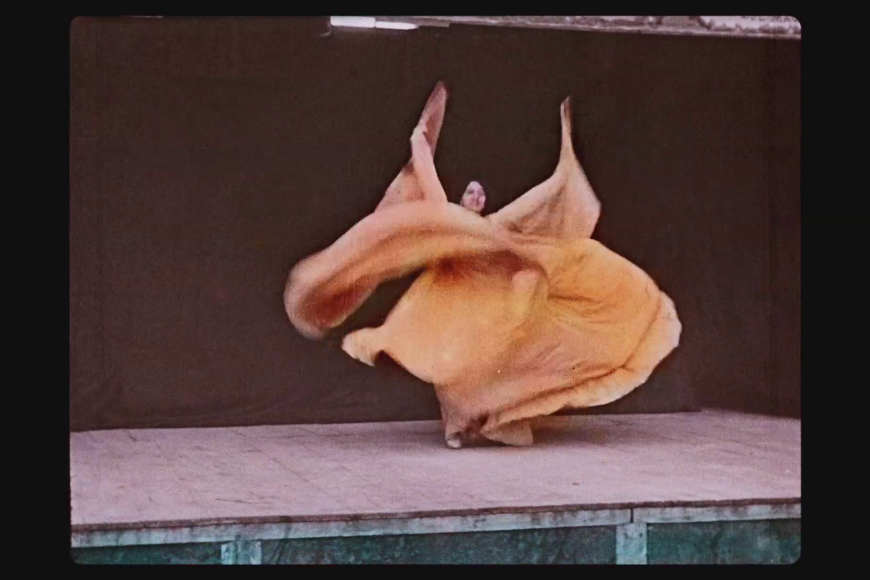
In the early days of cinema, audiences were hungry for pictures bursting with vitality. The serpentine dance with its graceful shifting patterns, and in colour, satisfied their wish.
Movement, movement: In the early days of cinema, audiences were hungry for pictures bursting with vitality. For many film pioneers, the subject par excellence was the serpentine dance, which produced graceful shifting patterns by means of ample veils. The Lumière brothers additionally had the film hand-coloured, frame by frame, reinforcing the vivid expression of the dynamic body geometries.
Our everyday digital life is unthinkable without mobile phones. But what natural and human resources does the tech industry require for this innovation?
Our everyday digital life is unthinkable without smartphones. Across the world, more than five billion such devices are in circulation. Each one of those is even touched more than 2,600 times per day. This AR experience takes us through the hidden history of this technology and thus into the Democratic Republic of the Congo. What natural and human resources does the tech industry require for its innovations?
Magnificent works of art made of fruit once lent the Chinese restaurant business a radiant glamour. Today they are overshadowed by a heavily economised food culture.
A giant ginger mountain landscape that five cooks spent a week to make: Once magnificent culinary works of art were created in Chinese restaurants. Food was associated with a wealth of money and time. The world today is short-lived, customers have become few and far between. Chefs talk about the connection between food culture and socio-economic change in China.
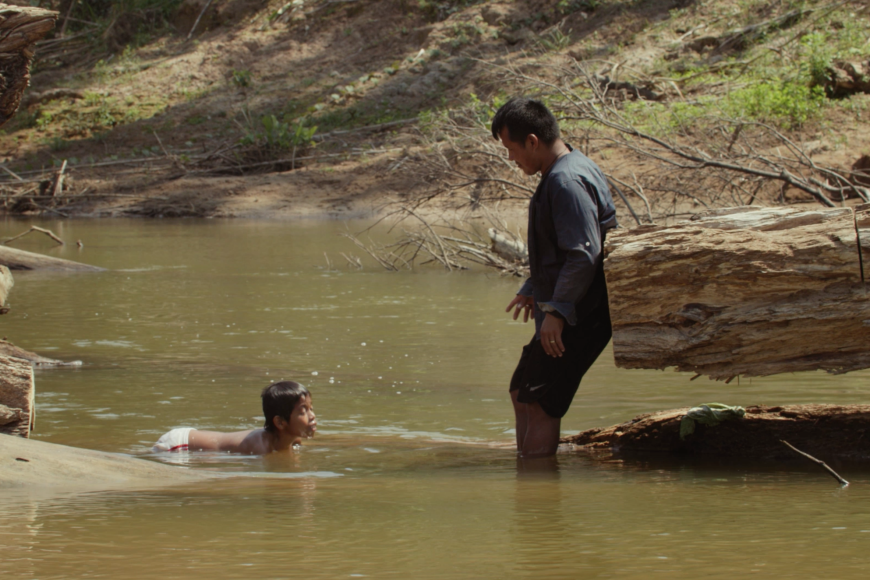
Ricky is a boy from the Ashéninka tribe who lives with his family in the Peruvian Amazon Forest. He wants to overcome his fears and goes hunting for a huge catfish.
Ricky is a boy from the Ashéninka tribe who lives with his family deep in the Peruvian Amazon Forest. But even here, the children’s favourite pastime is watching videos on their mobile phones. One day, Ricky is faced with the task of overcoming his fears and going hunting for a huge catfish that can only be caught by hook. This is where his journey to adulthood begins.
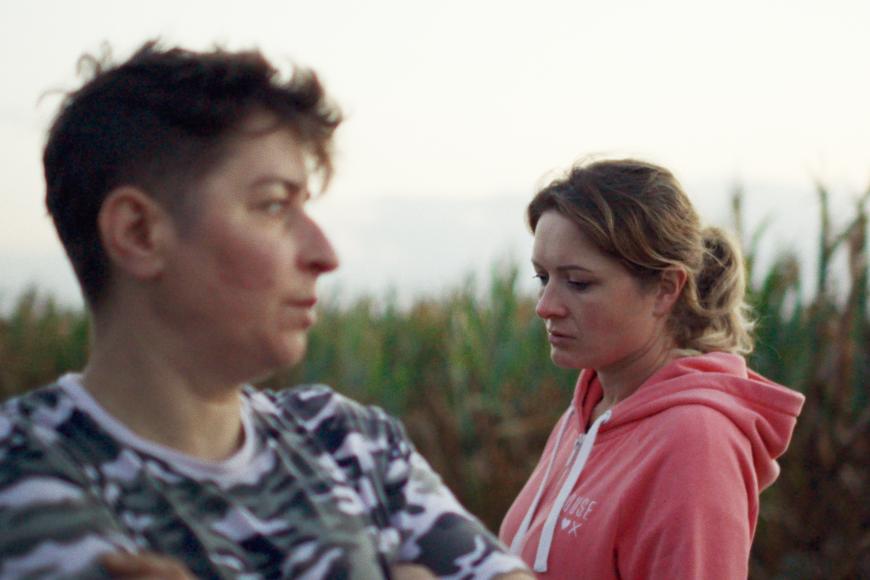
Father, mother, child – there are practically no exceptions to the ideal model family in the conservative part of Poland, and certainly no queer ones. Agnieszka hazards it anyway and takes the risk.
The rules in rural Poland are clear: Every man must have a woman; every dancer must have a female dancer. The pubescent Miłosz feels safe here, especially after his mother’s death. His sister Agnieszka, who is in a long-distance relationship with her friend Majka, does everything to obtain custody of her little brother. Gradually, a new family model is revealed, documented by Marek Kozakiewicz as an attempt that is as restrained as it is determined.
The windmills behind the houses rotate steadily, standing in place, signalling stability. But the lives of Miłosz and his 35-year-old sister are in turmoil. They are facing a red-tape marathon to make Agnieska his legal guardian: Both have been orphans for a few months. Director Marek Kozakiewicz depicts the establishment of a new family no one expects much applause for in conservative Poland. Because for Agnieszka and her partner, who is ten years older, the determination to try living together manifests tentatively. Without kisses, without celebrations, the decision almost casually becomes reality – the women are exploring the boundary between platonic tenderness and enforced secrecy. And Miłosz, too, seems to realise only slowly what the relationship between Majka and Agnieszka really is.
The tumultuous 1960s in China as a collage of archival images, clay figures and interviews. Lei Lei lets his father and his grandfather talk, about bicycles and bank clerks, about life in the countryside, re-education and class enemies. Their memories generate a multicoloured surreal world that is an enchanting fantasy of the time before and during the Cultural Revolution.
In his second feature-length film, artist and animation filmmaker Lei Lei once more takes up experiences of family members and uncovers a piece of national history via private stories. For more than six years, he collected family photos, postcards, propaganda images and old films. On this backdrop he forms and moves his characters made of gum-like pastel modelling clay, whose colourful, almost childlike appearance supports the impression that this is where a grandson imagines the anecdotal memoirs of his ancestors. But this imaginative animation is anything but naïve: It takes the time to accommodate the detours and pauses in the narrative and takes us – by means of a restrained soundscape, too – deep into a universe where one can lose oneself.
Marie Kloos
Credits
Director
Lei Lei
Script
Lei Lei
Cinematographer
Lei Lei
Editor
Lei Lei, Patrick Minks
Producer
Isabelle Glachant, Lei Lei
Co-Producer
Bruno Felix, Janneke van de Kerkhof, Femke Wolting
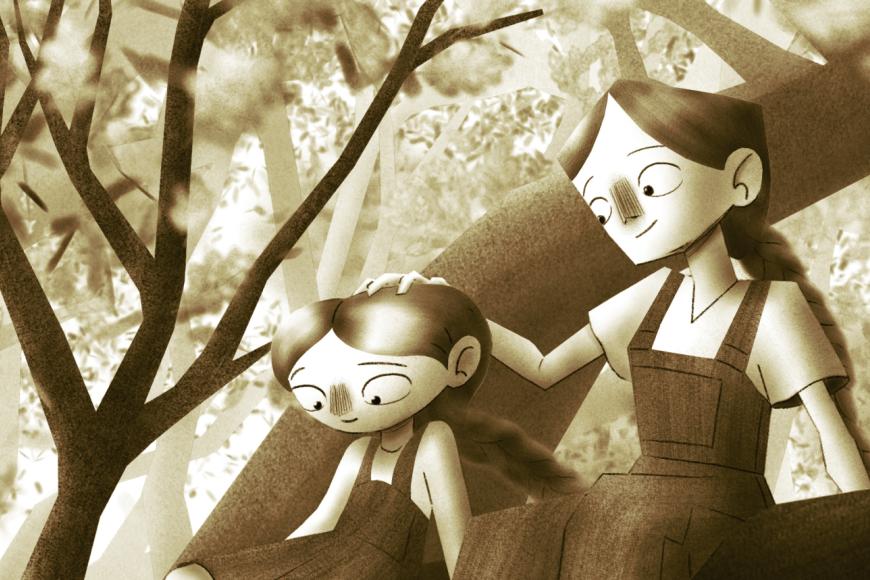
Two sisters travel to the realm of clouds on a paper plane, in search of the big tree with the golden leaf. Slowly they get closer to each other and their goal.
Two sisters travel to the realm of clouds on a paper plane. They are looking for the big tree with the golden leaf. Their plane has to be mended again and again, and the big sister is worried. When she falls ill, the little sister takes control. Slowly they get closer to each other and their goal on this arduous journey.
Lina Dinkla
Credits
Director
Kasia K. Pieróg
Editor
Kasia K. Pieróg
Producer
Marcin Podolec
Sound
Kacper Zamar
Score
Hubert Zemler
Animation
Kasia K. Pieróg, Jakub Baniak, Agnieszka Czachór, Przemysław Świdada, Dudek Pulit, Michalina Musialik, Adrianna Matwiejczuk, Karolina Kajetanowicz, Alicja Grotuz
Bizarre animations of strange beauty on a metal plate, set to Free Jazz. Light reflexes. Lines and circles that take on human or insect form, merge and dissolve.
Bizarre animations of strange beauty on a metal plate, set to Free Jazz. Light reflexes. Lines and circles that take on human or insect form, merge and dissolve. Sometimes a voice from offscreen gives directions, demands a new plate. Then everything starts again – but differently. The realization dawns slowly: This is an expedition to an underworld that generates silently communicating ghost lights.
Born blind, the tragic hero of this film sees his surroundings with a delay of seven years. The images from the past become a curse that’s irreconcilable with his present life.
Competition for the Audience Award Short Film 2022
Animated Film
Poland,
Portugal
2022
11 minutes
English
Subtitles:
None
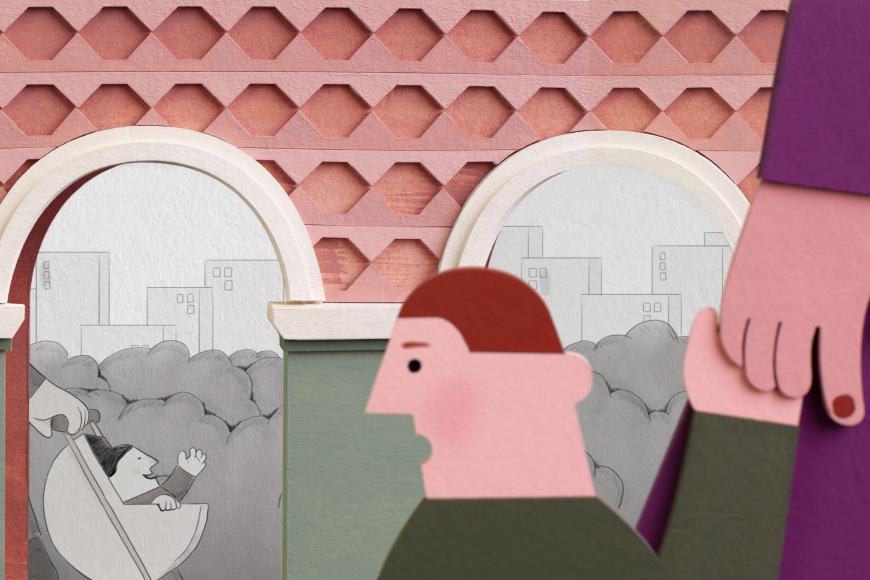
Born blind, the hero of this film turns seven before he begins to see images from the past that soon follow him like a curse. Like the stars in the night sky, what he sees has often long since passed away and gone out. In this tragic masterpiece by the directing duo Kijek/Adamski, the almost tangible pastel-coloured cut-out technique of the present-day narrative contrasts with delicate black and white 2D animations that represent the shadows of what is lost.
Christoph Terhechte
Credits
Director
Katarzyna Kijek, Przemysław Adamski
Script
Katarzyna Kijek, Przemysław Adamski
Cinematographer
Katarzyna Kijek, Przemysław Adamski
Editor
Katarzyna Kijek, Przemysław Adamski
Producer
Piotr Szczepanowicz, Grzegorz Wacławek
Co-Producer
Przemysław Adamski, Katarzyna Kijek, Bruno Caetano
Sound
Philip Lenkowsky, Carlos Abreu, Miguel Gonçlaves
Score
Piotr Kaliński
Animation
Katarzyna Kijek, Przemysław Adamski, Ala Nunu, João Gonzalez, Jakub Kaczmarek, Bartosz Stępnik, Hugo Sequeria
A demonstration set in an apocalyptic fantasy world with parable-like references to reality of how creatures (can) react when they are confronted with existential misery.
With his multiple award-winning animation, Jonatan Schwenk has created a haunting parable about compassion and solidarity. Mute creatures with burning eyes suddenly find themselves confronted with the distress of another species. At first their reaction is hesitant and stoic. But when the other species’ misery begins to disturb their peace of mind, they take action … “Sog” captivates with many creative ideas on the level of animation, succeeding in creating archaic images that look both abstract and realistic. Without a single word, the film makes us experience what a lack of empathy can lead to and that there are always at least two options for action.
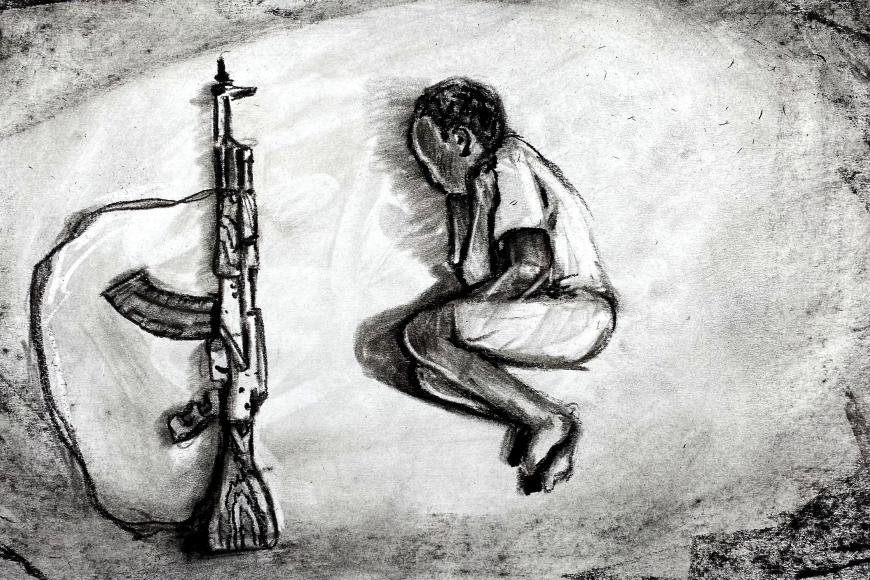
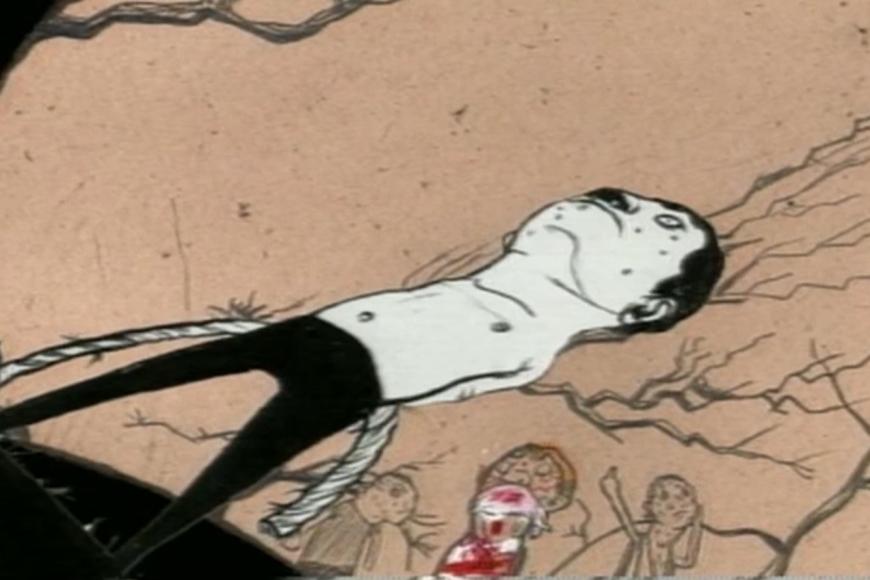
Children who play judges teach the neighbour’s boy a lesson. A scenario of bullying, based on Charles Bukowski, shows murderous group dynamics in rough comic book style.
A harrowing scenario of bullying based on a short story by Charles Bukowski, whose language is translated authentically into a rough comic book style. A children’s gang teach the neighbour’s boy a lesson. It’s their duty, the self-styled righteous ones tell themselves. What starts out like a game in a framework of dominance and banal irrationality escalates into murderous group dynamics.
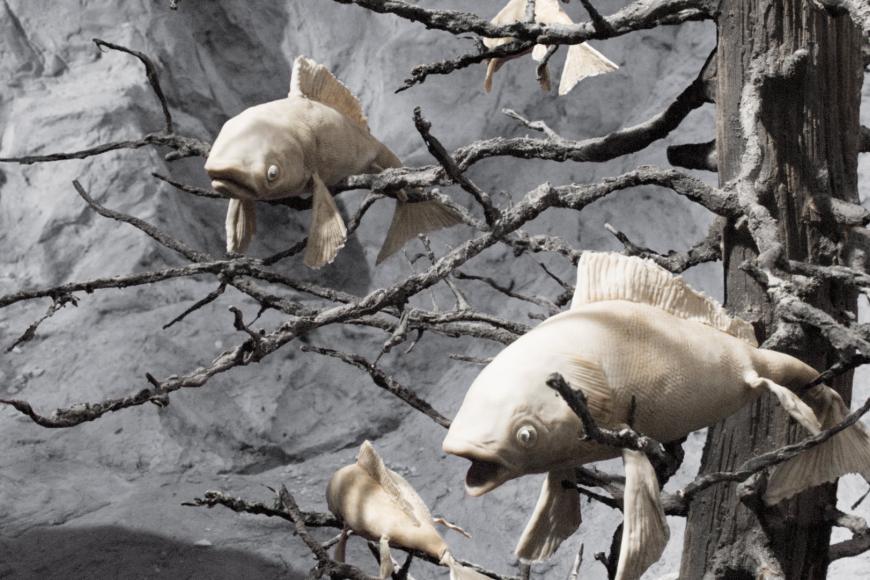
He and she are a good team. What was intended as a pleasant evening for two becomes overshadowed by an acrid cloud of roast fumes and ends civilized, but bloody: black humour, “well done”.
Coupledom has its own dynamics. Her professional obligations do not tick by the clock, his cooking and love are extraordinary, but, alas, precisely timed. This all too familiar incompatibility is condensed into murky, acrid roast fumes. What was intended as a pleasant evening for two ends civilized, but bloody: black humour, “well done”.
André Eckardt
Credits
Director
Špela Čadež
Script
Gregor Zorc
Cinematographer
Špela Čadež
Editor
Iva Kraljević
Producer
Tina Smrekar, Špela Čadež
Co-Producer
Emmanuel-Alain Raynal, Pierre Baussaron, Fabian Driehorst






![Filmstill Shape of Appetite [excerpt]](https://www.dok-leipzig.de/sites/default/files/styles/stepped_teaser_/public/fiona/films/stills/f9f67d36-b422-4576-91f4-91836e42e5ee.jpg?h=d1cb525d&itok=0hB_0_H1)






![Filmstill Shape of Appetite [excerpt]](https://www.dok-leipzig.de/sites/default/files/styles/film_stills_full_content_view/public/fiona/films/stills/f9f67d36-b422-4576-91f4-91836e42e5ee.jpg?h=d1cb525d&itok=W9TnQAfW)


