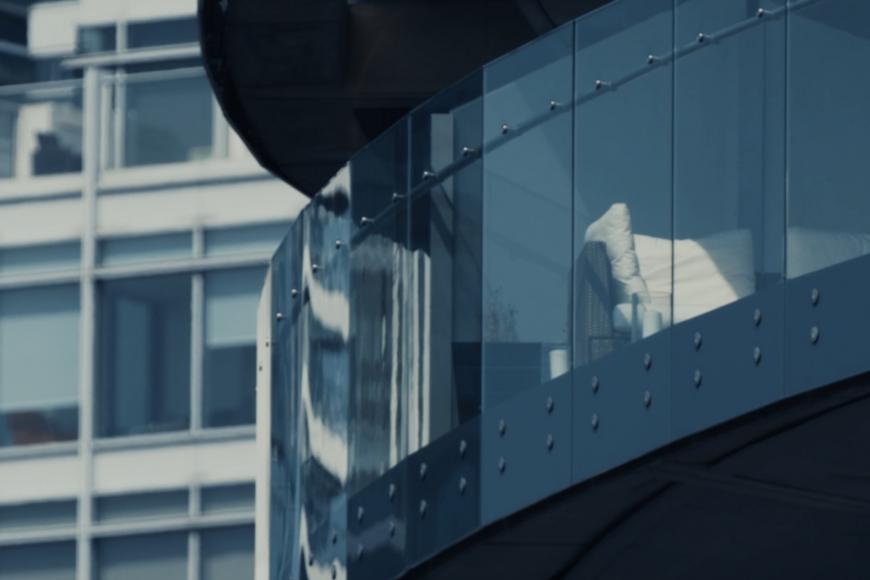
A reflective approach to observations during the spring 2020 Corona lockdown in London: the virus as a warning sign for the future of investor-friendly urban spaces.
What did the Corona lockdown look like from a window in the residential towers of posh East London in the spring of 2020? The reflective two-week observation shows serious shifts in the everyday coordinate system of a privileged urban population at an immediate level. Meanwhile, the vacant apartments in the district, which were deliberately caused by speculation, represent a warning sign for the future of investor-friendly urban spaces.
The Tunisian censors used “Error 404” to block unwanted websites. The situation changed only after Mohamed Bouazizi burned himself in public on 17 December 2010.
What’s growing in that empty space there? On 17 December 2010, the Tunisian grocer Mohamed Bouazizi burns himself to death in public – the Arab Spring begins, the fire spreads through the Internet. A fast-forward trip through the interior architecture of a modern revolution, right into the dispersed character of the event: from the planet’s surfaces to digital de-spatialization.
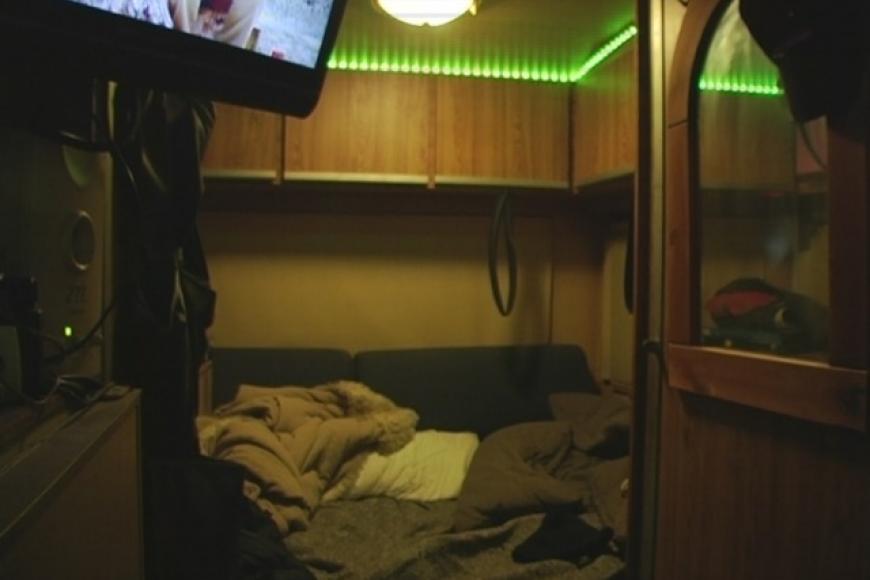
A mobile home in his front garden is Erwin’s refuge. Here he drinks his coffee and writes applications, here he satisfies his desire for men. Jan Soldat comes to visit.
58-year-old Erwin introduces himself as “old but horny”. He has declared the mobile home in his front garden his favourite refuge, where he has everything he needs: a computer, a bed, a coffee machine. Two webcams link Erwin to other men who satisfy his carnal desires. In this tiny space, Jan Soldat comes close to him, of course. He learns of love affairs, as great as extinguished, of a complicated family web and worries about the future.
Carolin Weidner
Credits
Director
Jan Soldat
Cinematographer
Jan Soldat
Editor
Jan Soldat
Producer
Jan Soldat
Winner of:
Silver Dove (German Competition Short Film)
Between three generations who grew up with three different languages, between New York and Buenos Aires, this intelligent and multi-layered film essay goes in search of identity.
Everyday observations from Buenos Aires, shot on black-and-white 16mm film material, alternate with twenty-year-old Hi8 colour shots from New York. The perspective of a father who collects memories for his daughters. The perspective of a son who records his father’s reminiscences. Richard Shpuntoff’s multi-layered montage film is a clever essay on cultural identities, on cities and languages.
When we watch a subtitled film, we look, listen and read at the same time. We assume that the three levels are congruent or at least add up to form a whole. “Even the best subtitles suck”, the subtitles of this film announce, however, because “You are still reading instead of looking at the images.” Translating means rewriting. Therefore, “Everything That Is Forgotten in an Instant” tells parallel stories in images, words and writing: of urban development and power structures in two distant metropolises, of identity and its transgenerational transfer, of three continents and three languages which draw equally dividing and connecting lines through a family. The insecurity caused by the discrepancy between the filmic elements turns into a school of selective perception. Images, languages and texts are no dictate, after all: They leave us a choice.