Even in death, you can’t get rid of bureaucracy! In the day-to-day business of a Warsaw funeral parlour, mourning is mired in paperwork, routine and triviality.
It is said of Krzysztof Kieślowski that he did not see himself as a political filmmaker. At least this early documentary casts doubt on this, for it depicts the cold stranglehold of bureaucracy. The setting is a municipal funeral home in Warsaw. Phone calls are made, documents checked and stamped. Business runs like clockwork, from the cradle to the grave. Leipzig naturally maintained ties with older Polish documentarists like Jerzy Bossak, even after he relocated to Denmark. The fact that Kieślowski and other notable Polish film artists of his generation did not appear in the programmes before 1990 fits into the image of a life consumed by pettiness painted here. The real issue was probably animosities with the festival in Cracow.
Via joyfully spacy performances and intellectual controversies, the Teatr 21, which consists of acting enthusiasts with Down’s syndrome, develops an idea of the autonomy they long for.
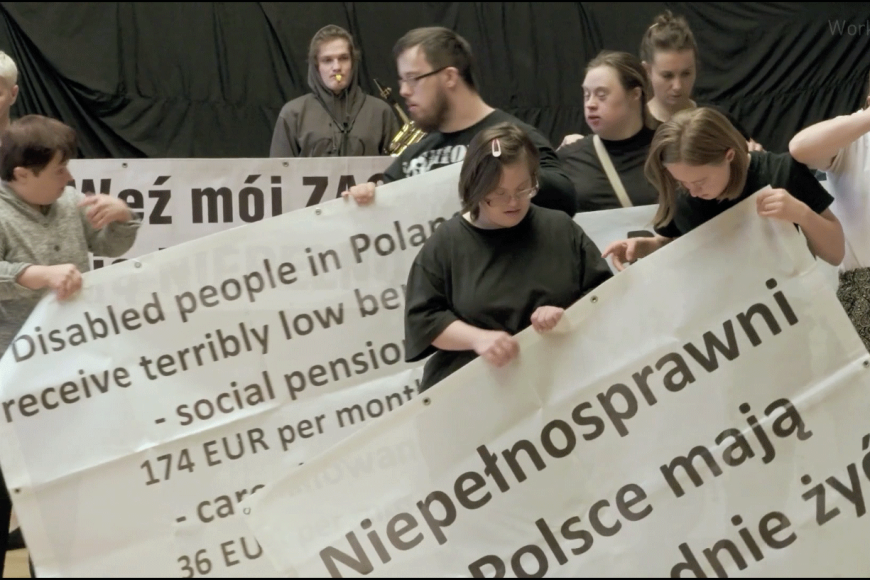
Inspired by a political protest movement, the Teatr 21 – a theatre company of acting enthusiasts with Down’s syndrome – develops a play in which the participants articulate their wishes and demands and at the same time get to abandon themselves with great joy to creative development. Martyna Peszko attentively follows the creation process as it unfolds in a productively bustling rehearsal atmosphere, with musical accents provided by the improvisations of a free jazz trio.
In 2018, people with handicaps occupied the government building in Warsaw for forty days to demonstrate for more support and recognition. The protest had almost no political consequences, and yet: The revolutionary spark ignited the public. The Teatr 21 project takes up the events, draws strength from the disappointment about the failed insurgence. That leads to discussions about their artistic craft: What does professional acting mean? What has nudity to do with revolution? And why do you always have to understand the lyrics to songs? In exploring the relationship between performance and politics, they reclaim an autonomy they are often denied in life: over their own body, their own stories. The stage direction and dramaturgy provide an unobtrusive and intelligent framework, which is extended by Peszko’s judiciously observant workshop report.
Carolin Weidner
Credits
Director
Martyna Peszko
Script
Martyna Peszko
Cinematographer
Magda Mosiewicz
Editor
Olga Kalagate
Producer
Justyna Sobczyk
Co-Producer
Katarzyna Tymusz
Sound
Adam Buka, Martyna Peszko, Konrad Wosik
Score
Zespol Pokusa
World Sales
Katarzyna Wilk
Nominated for:
Young Eyes Film Award,
MDR Film Prize,
Leipziger Ring