Daffy Duck is caught in an animation loop. Martin Arnold dissects the industrial animated film production with its extreme division of labour, where body parts of the characters are isolated on different cels and moved separately, in loops and outside their habitat, separated from the background. Daffy’s beak wiggles, his wing hands flutter in the black void. An artistic and psychological study.
Those who confide their secret desires to astrologer Luciana and seek advice are unerringly sent to a place for a new beginning. Entertaining dramas and the big questions in life.
Luciana’s office is a place of miracles. This is where strangers confide in her, share their most profound desires and concerns. And Luciana? She circles her huge magnifying glass over the pages of old books to soon find the perfect coordinates for a spiritual new beginning. In his new film, Peter Kerekes becomes nothing less than a witness to psychomagical acts. The Neapolitan astrologer is not only able to calculate the perfect birthday spot for those who seek advice – in her blunt way, she aims right at the centre of personal dramas. A pair of identical twins, for example, argue whether one of the sisters should fulfil the other’s longing for a child, while an unhappy mother yearns to rekindle her relationship. Luciana sends the twins to Beirut, the mother to Alaska. Kerekes accompanies them on their journeys of salvation, even if Alaska turns into an air conditioner and a few buckets of ice cubes for reasons of practicality. He always brings out the comic potential of a story while pointing out complicated conflicts with astonishing poignancy: possessive mother figures and absent fathers, loneliness in a relationship and the fear of change. “Wishing on a Star” is a charming consultation that boldly confronts the big questions in life.
Carolin Weidner
Credits
Director
Peter Kerekes
Script
Peter Kerekes, Erica Barbiani
Cinematographer
Martin Kollar
Editor
Marek Sulik
Producer
Erica Barbiani, Lucia Candelpergher
Co-Producer
Peter Kerekes, Anna Mach Rumanová, Ralph Wieser, Vit Schmarc, Vanja Jambrovic, Tibor Keser
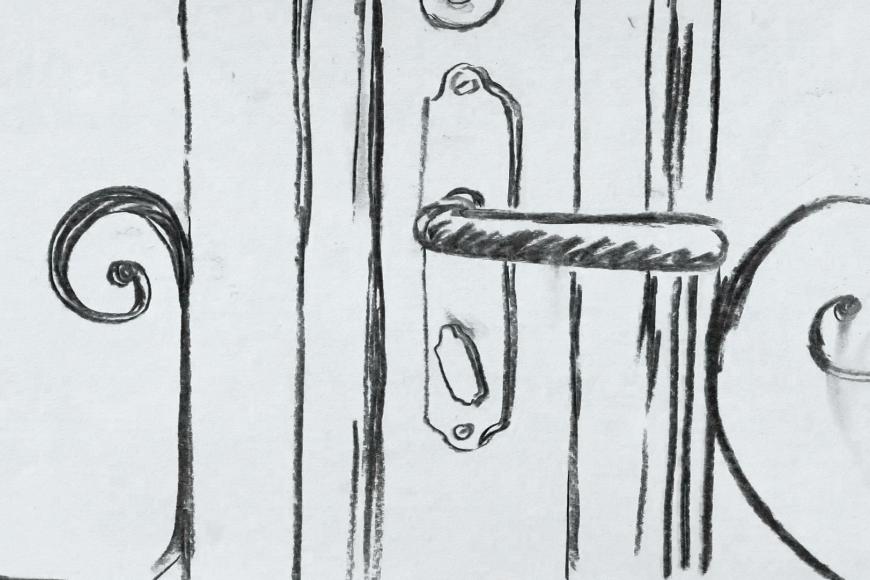
“I don’t want to say it out loud, but my flat’s lower down,” the narrator remarks. The camera at first follows her legs climbing up the stairs of the hallway. That is all we see of her. Very soon, her gaze determines our perspective in this unsettling story. At first it all sounds like a mistake, but at some point, the tenant gets used to the fact that in some inexplicable way and completely unceremoniously she is pulled down from the fourth floor to the coal cellar, floor by floor. A decline that the neighbourhood lets happen in deafening silence.
The “falling” protagonist’s irritated soliloquy, sometimes resigned, often full of calculated optimism, is accompanied by charcoal drawings. Their clarity and architectural detail – down to the curlicued decorations of the upper-class mansion – gradually fade over the course of events. The spatial representation becomes more and more vague and is reduced to a few strokes, only to dissolve into soft areas of charcoal dust in the end. In this nightmarish story, reality no longer offers any support, only one’s own ego. Susi Jirkuff has adapted Ilse Aichinger’s eponymous, multilayered story, which was first published in the mid-1950s, with a remarkable urgency that demonstrates the topicality of Aichinger’s text and writing.