Nothing is closer to us than our skin. Its beautiful and less beautiful parts envelop the self, separate it from all else. A foray along naked parts of the body takes us from a shiny ridge via a rounded protuberance to a shady gorge. A neck. A belly…ear. A fellybear? Photos, videoclips and sounds form an irritating body collage.
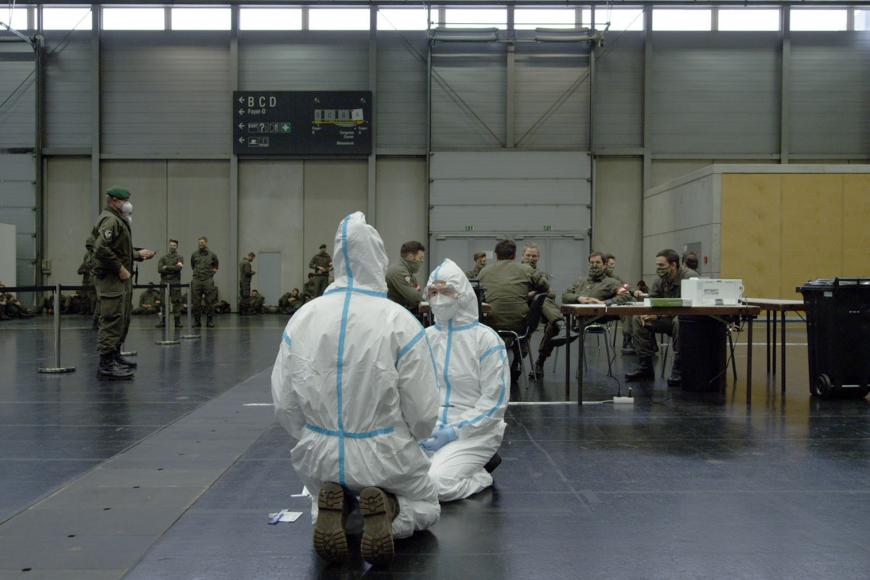
Lockdown, easing, lockdown: Vienna in the Covid-19 pandemic from March 2020 to December 2021. Generous tableaus document paralysis, fear, learning, anger – and incipient repression.
The film opens with the image of an elderly individual in a hospital, hooked to a machine: assistance is needed to slowly breathe in and out. This existential moment of physical precariousness is followed by Nikolaus Geyrhalter’s typical long shots, though in this case they do not document work processes but look like a prequel to his fantastic science fiction documentary “Homo Sapiens” (2016): deserted airports, swimming pools, playgrounds.
The filmmaker sets out with his identifiable aesthetic tools to tackle the documentation of the first three waves of the Covid-19 pandemic, from March 2020 to December 2021. In Vienna, a major city with a relatively well-functioning health system, he looks at institutions that are in a “flexible learning mode”: intensive care units, emergency shelters, schools, cinemas. Time and again he visits a flower shop that is not system-relevant but, by its own definition, sells food. Lockdown followed by eased restrictions followed by lockdown. The camera registers how paralysis in the face of a natural disaster is superseded in some people by anger at the restrictions. Meanwhile, cases of Long Covid are being treated in the hospitals. Topical, only a little later, these images cut across the repression of what has been experienced.
Jan Künemund
Credits
Director
Nikolaus Geyrhalter
Cinematographer
Nikolaus Geyrhalter
Editor
Gernot Grassl
Producer
Nikolaus Geyrhalter, Michael Kitzberger, Wolfgang Widerhofer, Markus Glaser
Sound
Sergey Martynyuk, Lenka Mikulova
Sound Design
Nora Czamler, Manuel Meichsner
World Sales
Andrea Hock
Nominated for:
FIPRESCI Prize,
Prize of the Interreligious Jury
The Smallest of Worlds – A Social Landscape of Collected Privacy
Uwe Brunner, Bettina Katja Lange, Joan Soler-Adillon
Walk-in archive, time capsule and storage for the collective memory of a state of emergency: globally collected snapshots of self-isolation and quarantine.
The Smallest of Worlds – A Social Landscape of Collected Privacy
The Smallest of Worlds – A Social Landscape of Collected Privacy
Uwe Brunner, Bettina Katja Lange, Joan Soler-Adillon
Extended Reality 2020
-
Austria,
Germany,
Spain
2020
10 minutes
English
Covid-19 has made quarantine and self-isolation the everyday experience for many. This project, developed at the CPH:LAB, invites people to scan their most personal places and moments. The resulting VR experience is a walk-in archive and time capsule, the collective memory of a state of emergency which also preserves forgotten virtues like deceleration and the spirit of discovery.
Lars Rummel
Credits
Director
Uwe Brunner, Bettina Katja Lange, Joan Soler-Adillon