The Tunisian censors used “Error 404” to block unwanted websites. The situation changed only after Mohamed Bouazizi burned himself in public on 17 December 2010.
What’s growing in that empty space there? On 17 December 2010, the Tunisian grocer Mohamed Bouazizi burns himself to death in public – the Arab Spring begins, the fire spreads through the Internet. A fast-forward trip through the interior architecture of a modern revolution, right into the dispersed character of the event: from the planet’s surfaces to digital de-spatialization.
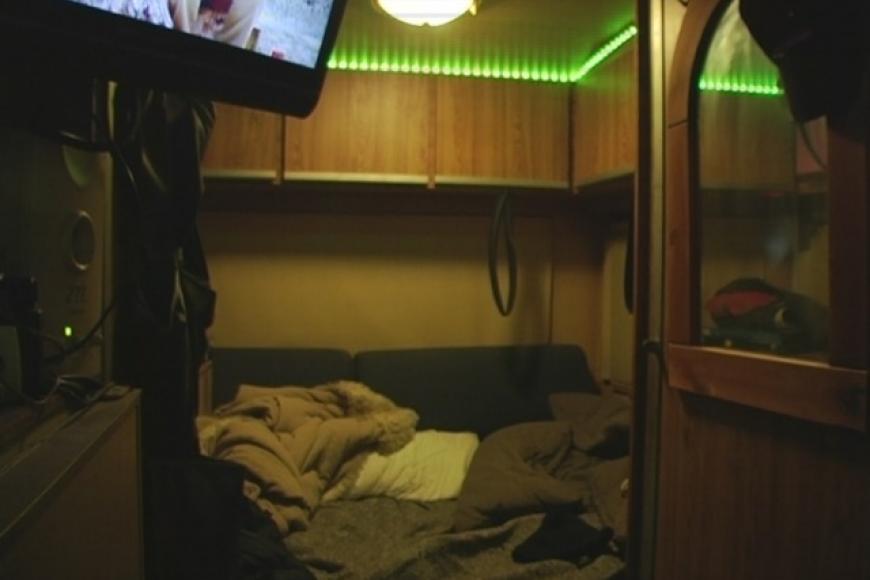
A mobile home in his front garden is Erwin’s refuge. Here he drinks his coffee and writes applications, here he satisfies his desire for men. Jan Soldat comes to visit.
58-year-old Erwin introduces himself as “old but horny”. He has declared the mobile home in his front garden his favourite refuge, where he has everything he needs: a computer, a bed, a coffee machine. Two webcams link Erwin to other men who satisfy his carnal desires. In this tiny space, Jan Soldat comes close to him, of course. He learns of love affairs, as great as extinguished, of a complicated family web and worries about the future.
Carolin Weidner
Credits
Director
Jan Soldat
Cinematographer
Jan Soldat
Editor
Jan Soldat
Producer
Jan Soldat
Winner of:
Silver Dove (German Competition Short Film)
How close is too close? The attempt to produce the portrait of an actor turns into a struggle between closeness and distance and a balancing act between fiction and reality.
English, German Subtitles for deaf and hard-of-hearing
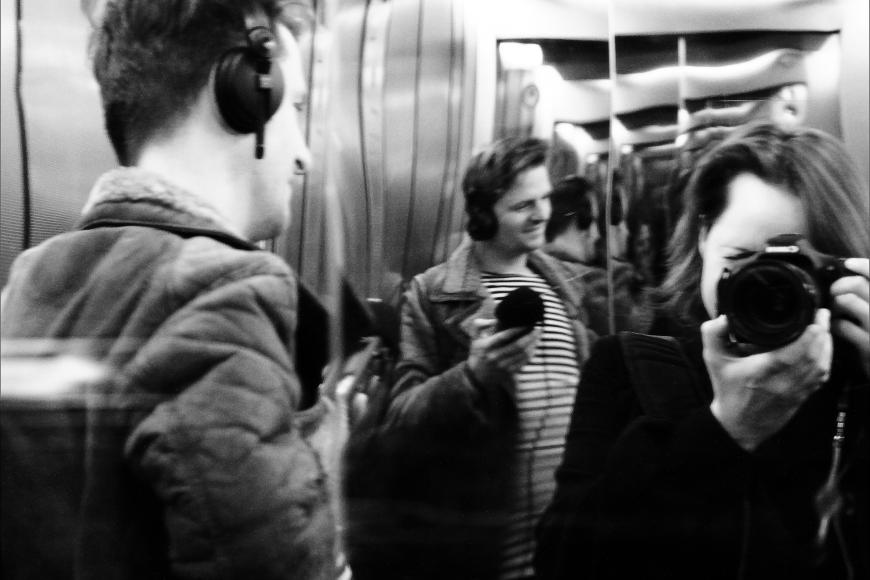
Is it possible to get close to someone who sees their sole task in life in losing themself in the parts they play? How can a film portrait be created when every image only contributes to further fictionalization? Who is facing each other when the line between fact and fiction becomes blurred? Katharina Pethke looks back to dissect the past and her contradictory feelings for the celebrated actor Philipp Hochmair, following the lines of her own artistic and personal doubts.
The magnificent black and white images guide the eye from the surfaces to the details, whose meaning the director probes and questions in her subjective, tentative voiceover. The film preserves the rawness of unfinished reflections without getting mired in vagueness. Step by step, the honest assessment of a desire is achieved; a desire which could function only in the delicate balance between attraction and repulsion and from which Katharina Pethke frees herself by adopting a position of artistic distance. Her sometimes self-mocking commentary is supported by dramatic guitar riffs (provided by Hochmair’s band project “Die Elektrohand Gottes”) and underpinned by filmic references, all of which revolve around the making of images and the relationship between reality and imagination.
Luc-Carolin Ziemann
Credits
Director
Katharina Pethke
Cinematographer
Katharina Pethke
Editor
Katharina Pethke
Producer
Katharina Pethke
Co-Producer
Fünferfilm UG, Julia Cöllen, Frank Scheuffele, Karsten Krause