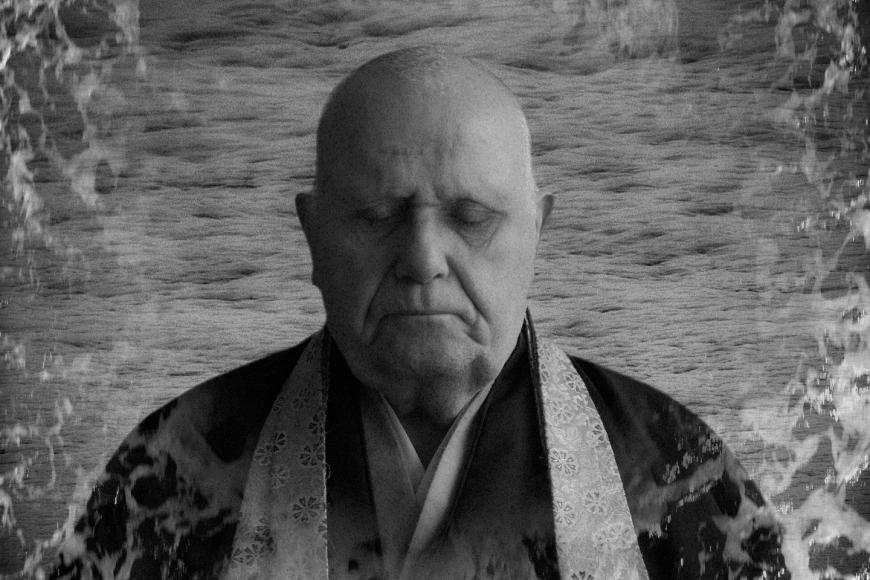
Eating together with chopsticks, forks, or cheese sandwiches: Heinz Toku-Zen Anneser and his students practice Buddhist rituals without pretension. In his study, which is as precisely measured as it is poetic, Thomas Köhling observes the daily routines of this small, quiet group in the German provinces and finds appealingly bizarre moments when Eastern religion and western culture overlap. The sky above the Velux window is the same as above Mount Fuji.
This cinematic search for traces takes us from silkworm breeding in a Leipzig allotment garden to the island of Crete. Idyll and war begin to converge – historical, scenic, complex, surprising.
What’s the parallel between a Leipzig allotment club and the Wehrmacht’s invasion of Greece? Alert to historical lines of connection, outstanding archive material and enchanting images of the austere Cretan landscape, the complex links between silkworm breeding here and German war crimes there are laid bare. The focus is less on settling questions of guilt than on depicting the inner dynamics of war, resistance and forgetting.
Luc-Carolin Ziemann
Credits
Director
Deborah Jeromin
Script
Deborah Jeromin
Editor
Deborah Jeromin, Sofia Hernández
Producer
Deborah Jeromin
Sound
Pedro de Sousa Pereira
Funder
Kulturstiftung des Freistaates Sachsen, Stiftung Maecenia
DJ Vika is 84 and a star of Warsaw’s nightclubs. She refuses to grow old and sit at home. Instead, she wants to celebrate life, enjoy herself and music.
Imagine the last day of your life has dawned. What will stand up to review? What brings contentment? What brings regrets? “Vika!” is a film about the value of life and self-discovery, inspiring us to reflect on one’s chosen path and its forks and to stay true to oneself.
Vika, the 84-year-old main protagonist, a mother and grandmother several times over, looks back on a difficult childhood and many years of working in a “proper” job. When she retired, she seized the opportunity to reinvent herself. She became a DJ and star of the Warsaw nightclubs, who regularly drives her young audience wild. Super cool? Inappropriate for an elderly lady? Agnieszka Zwiefka’s portrait deconstructs the borders between the “acceptable” and “unacceptable” roles of a woman who refuses to acknowledge her age. Vika wants to live in the moment, with no ties to the past. Zwiefka combines elements of music and narrative documentary films and creates an enchanting, immediately accessible and utopian world. Dancing to Vika’s rhythms means freeing yourself from the limitations dictated by society, age and sometimes even one’s own children.
Victoria Leshchenko
Credits
Director
Agnieszka Zwiefka
Script
Agnieszka Zwiefka
Cinematographer
Monika Kotecka
Editor
Katarzyna Orzechowska, Michał Poddębniak
Producer
Katarzyna Ślesicka, Anna Stylińska
Co-Producer
Heino Deckert, Tina Börner, Outi Rousu, Elena Filippini
An Instagram user surface ripples, turns into a graceful feedback vortex and attempts to impress in virtual space. Its motif: the absence of a photographic object.
An Instagram user surface ripples, turns into a feedback vortex and attempts to impress in virtual space. Every segment is an aesthetically arranged repetition. We catch a brief glimpse of the alleged visual content: in a film studio, equipment and a white background are lurking for their photographic object. Absence is staged as a motif that feeds the vain social media channel.
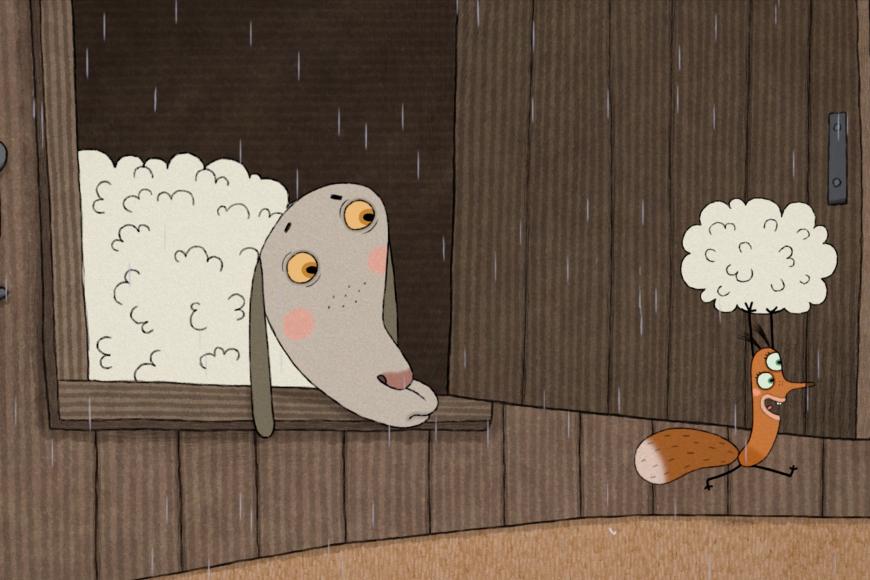
Winter is coming and it gets cold on Lena’s farm. The squirrel pinches something warm from all corners to pad its drey until it is nice and cosy. Rain floods all the meadows and the mice flee from the forest: “Squeak, squeak, where are we to go?” The squirrel quickly recognises the danger and shares its cosy loot with them. A new episode in the KiKA series.
Set to Vonfelt’s pop beats, the nocturnal city lights fly by, creating a slipstream of colours and forms. With this animated soundtrack, escaping it all might succeed.
You need momentum to escape it all. Vonfelt packs the necessary energy into unstoppable pop beats and verbal images. On a backdrop of fleeting nocturnal city lights, Michelle Brand creates a refreshingly dynamic slipstream of fading forms and intense colours. You let yourself fall gently and with a smile into the rush of acceleration.
André Eckardt
Credits
Director
Michelle Brand
Producer
Stink Films
Score
Vonfelt
Animation
Michelle Brand, Toby Auberg, Lisa Cruz, Camille Gibut
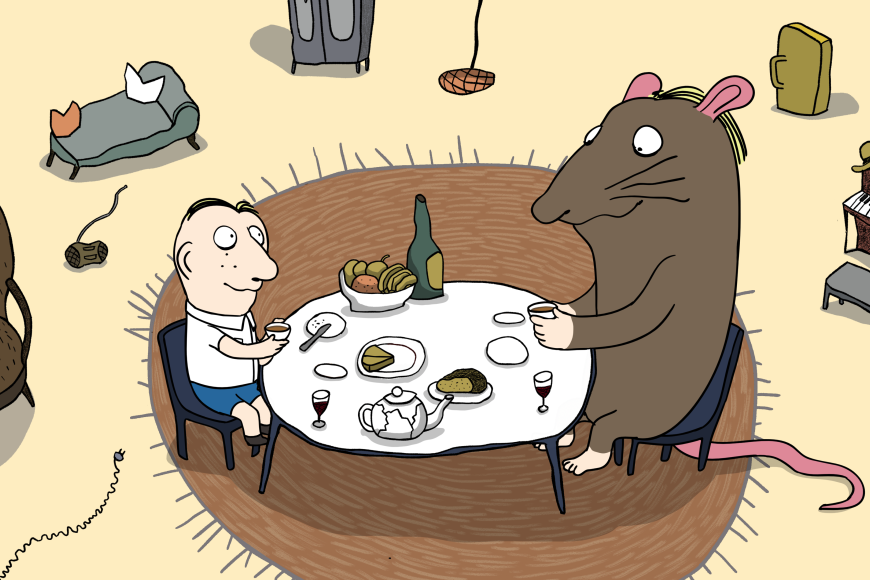
A huge, cheeky rat has moved in with the little man and makes itself at home. One day he angrily throws it out. But then he realises how empty and lonely everything is without it.
A huge, cheeky rat has moved in with the little man. It whistles to the music from the radio, helps itself from the fridge without asking, splashes in the bathtub and is simply everywhere – loud, annoying, just too much. When it suddenly disappears, the little man realises that the apartment has never been so quiet – and so empty. A heart-warming adaptation of Nadia Budde’s eponymous picture book.
The director – or more precisely, her alter ego – sets out in search of traces of her family history in Silesia. What she finds are dinosaurs. Including a few made of plastic.
German Subtitles for deaf and hard-of-hearing, English
Silesia: a contested region marked by migrations. Animosities between the peoples have a long tradition here, not only since the Second World War. But the National Socialist tyranny left clear lesions behind. The director’s grandfather comes from this region, was the organist in a church in Krasiejów – a place which was once also called Krascheow and, for a while, Schönhorst.
The filmmaker Juliane Henrich – or more precisely, her alter ego, the writer Nannina Matz – sets out in search of her family history. What she finds are bizarre ways of representing the history of humanity – and the history of earth. She comes across all kinds of traces of dinosaurs. Some may only be made of plastic, but others are not: A certain species of this genus, whose fossils were found in Silesia, was christened “Silesaurus opolensis” by the Polish palaeontologist Jerzy Dzik. That’s why there is a Dinosaur Park in Krasiejów. And a local museum, of course. But also many people with different individual memories. They do not necessarily lead to ground-breaking discoveries regarding the looked-for family past, but they broaden the view: of the complex history of this region and the way it is thought together, represented and codified.