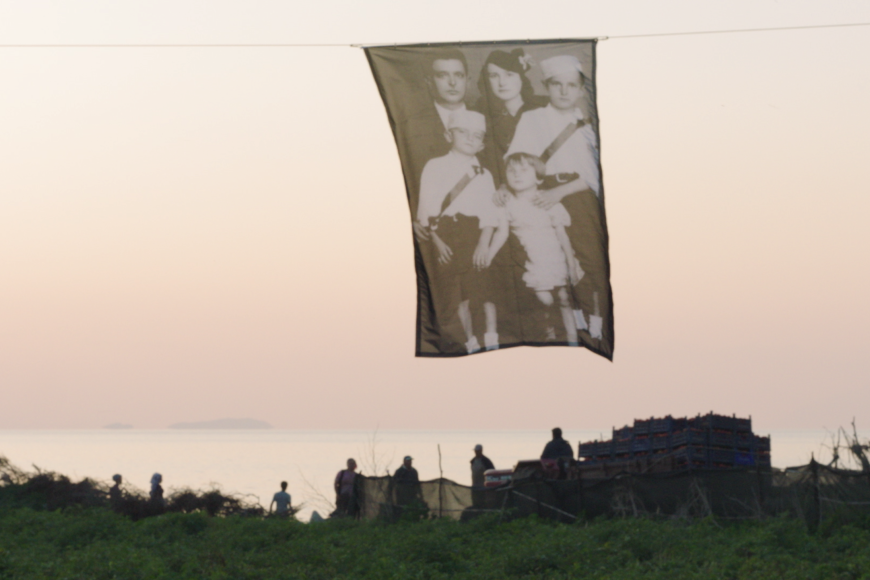
You feel welcome on Güler Yücel’s terrace. The temperamental artist presents colourful paintings of the life she knows intimately. Yücel lives and paints on the Turkish Datça peninsula. Her paintings are a chronicler’s narrative. They capture the exuberance of a wedding, follow labourers during the olive harvest, show a flock of goats. They also tell of her marriage to Can, a politically persecuted poet now dead.
When Güler Yücel feels too hot, she laughingly hoses herself down. Even her latest works must withstand the water test. We meet an unconventional woman who, though old, explores her surroundings with a beautiful joy of life. Inspired by the conversations and by Yücel’s works, the camera goes on a journey of discovery, resting on other women who confidently look and talk into its lens, like the goat herd about her time in the city, where she felt other-directed. Now she has found herself. Later, at a wedding party, the young bride proudly strides towards her future. Güler Yücel, too, has lived her life and known love. One of her paintings shows Can and her sitting naked in the sun. She remembers her husband, the political battles they fought together.
Anke Leweke
Credits
Director
Helke Misselwitz
Script
Helke Misselwitz
Cinematographer
Ferhat Yunus Topraklar, Yunus Roy Imer, Thomas Plenert
The company and details of its machinery are presented. A montage from two different sources on the title, one of them tinted fragments, the other well-preserved black-and-white footage.
A tinted nitrate fragment of the company film “A. Gutberlet & Co., Leipzig-Mölkau, Spezialfabrik für Falzmaschinen und Faden-Buchheftmaschinen, gegründet 1901“ (specialist in the manufacture of folding machines and thread book stitching machines, established 1901) was an exceptional find. It could be restored in its original colour tones by analogue methods in 2024 and then digitised. Combined with the dupe negative of another version, it now offers insights into the factory halls and the work on the machines.
Competition for the Audience Award Short Film 2020
Animated Film
Germany
2019
4 minutes
English,
German
Subtitles:
English
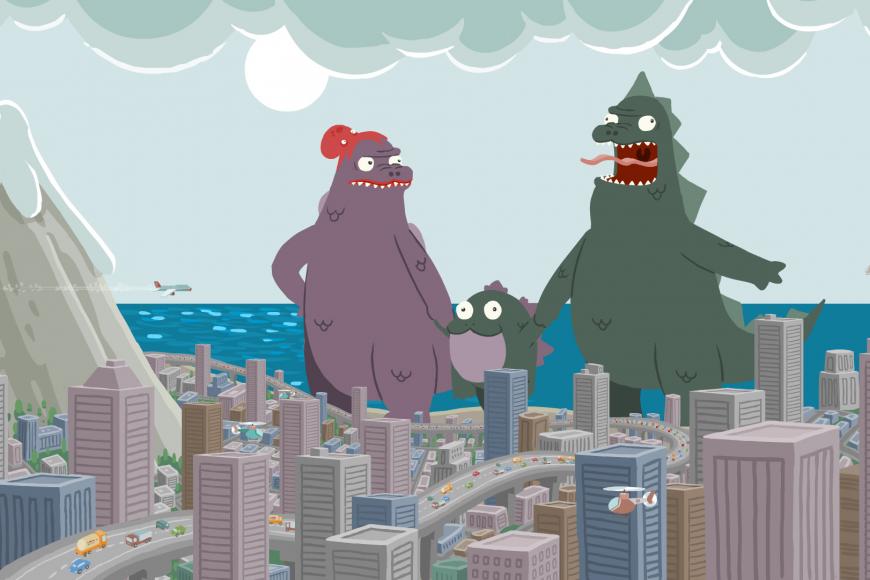
A cosy family picnic at the place they have been visiting since the Cretaceous period is what Mom, Dad and Go Zilla want. But first the big city that has annoyingly sprung up there must be flattened. In the father’s opinion, the performance of his offspring unfortunately leaves a lot to be desired: Too dreamy and still sucking on a pacifier, the little one just doesn’t wreak enough havoc. It’s an entertaining story in the almost normal everyday life of a family.
A father disappears, literally flying away. What to do when a parent suffers from mental illness? A tender father-daughter reconciliation in poetic images.
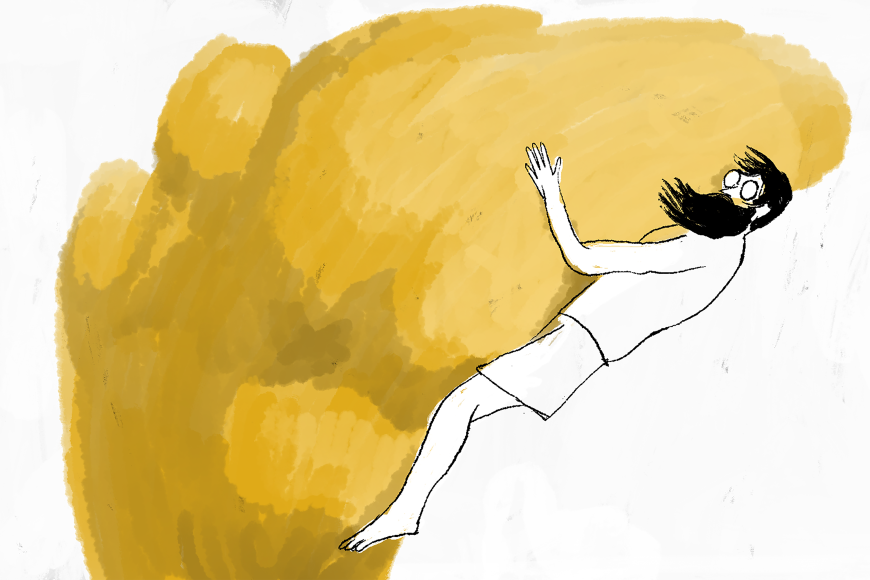
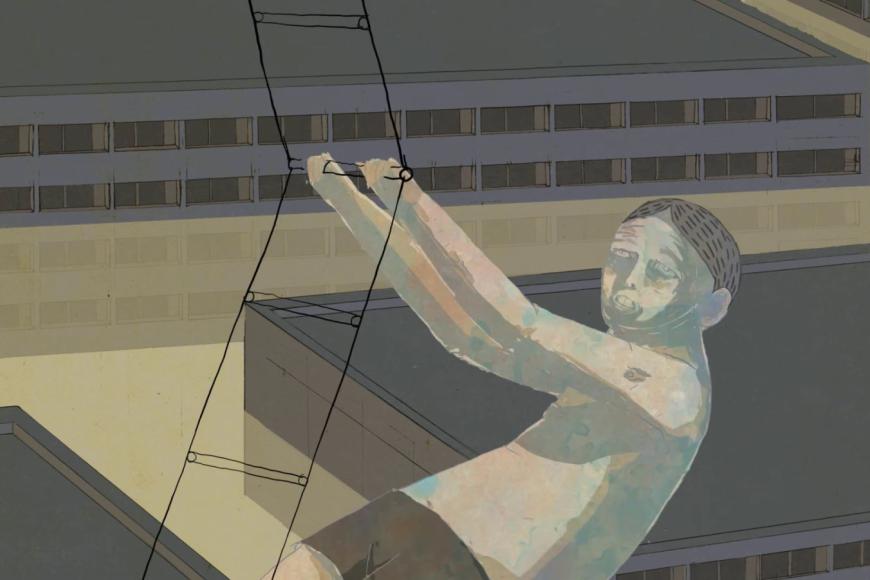
When the woman in curlers opens the door, Papa is blown away: Like a breath of air, a storm or tornado, he is blown in and back out. Even in his own apartment he is ungraspable: He grows and shrinks, becomes fragile or threatening, knocks everything down. And then he literally flies away, hurling eggs at passers-by. Caught in all this is his daughter, who at first can only helplessly stand by and who finds it increasingly difficult to visit him – the steps grow higher, the floor turns into chewing gum. Finally, she looks up at the sky and sees him hover there. What to do when one’s father suffers from mental illness? How to deal with it when the responsibility (of care) switches sides so early in life? Jelena Milunović explores this, using bold, very tender and not always obvious parables. She sets strong colour accents: The depressed episodes are in claustrophobic black and white, the ecstatic highs are colourful free-hand drawings. And the red balloon, which briefly appears in the beginning as a metaphorical vehicle of hope, might point the way to bringing the two of them back together.
Marie Ketzscher
Credits
Director
Jelena Milunović
Script
Jelena Milunović
Producer
Miloš Ivanović
Co-Producer
Draško Ivezić, Jelena Milunović, Filmuniversität Babelsberg KONRAD WOLF
While an adolescent boy follows his clique to a shits and giggles party, his mother floods their sparse home with separation anxiety. A mysterious tale of cutting the cord.
Sigmund Freud’s dream symbolism relates birth to water that one – or so he says – either dives into or rises out of. While an adolescent boy gets mysterious phone calls and shyly follows his clique to a shits and giggles party, his mother floods the ever-sparser home with separation anxiety and absurd scenes, mocked by the pompously wall paper pattern with all its curlicues.
For years, Michelle has been trying to prove her imprisoned husband’s innocence. A documentary thriller about a tireless struggle against the U.S. American justice system.
At the beginning Michelle Bastien-Archer shows and comments on photos of her wedding. The African-American and her childhood friend Jermaine were married in the unhospitable visitors’ hall of Sing Sing in 2007. He had been sentenced to 22 years to life for voluntary manslaughter in 1998. Ever since, she has been fighting tirelessly to prove his innocence. Now new documents have turned up that reinforce doubts about the trial’s decisive witness statement. Michelle becomes more confident. She presses even more determinedly ahead with her efforts to get Jermaine released. The camera is with her as if live, for almost a decade.
It feels like a thriller whose script was written by life and the U.S. American justice system. Daily life under exceptional circumstances, scenes from an unusual marriage. Timed phone calls from prison, countless visits to the lawyer, appearances at solidarity events for wrongly convicted African Americans. Michelle works as a house painter for the City of New York, raising her two children alone. We learn in passing that their biological father was the victim of a brutal crime. The portrait of a confident woman who shares her fears and hopes with us emerges.
Is living as a mythical creature, mouse or furry not the most radical form of self-realization? In her film, Masłoń moves through VR spaces as an avatar to explore touch.
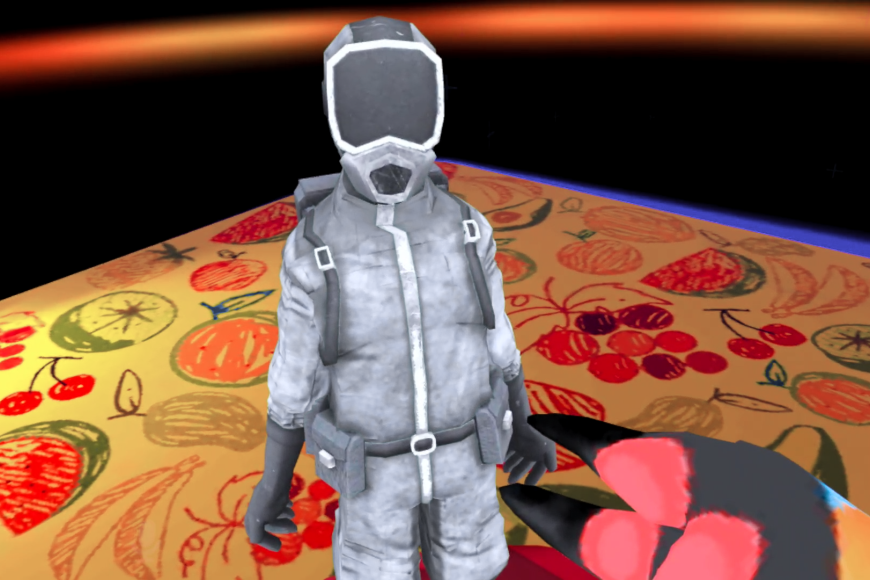
Is it not unlimited freedom, the most radical form of self-realisation, to exist in every conceivable setting as a flying mythical creature, a sad mouse or a furry figure with an extended naked spine as a tail? In her film, Monika Masłoń moves through different spaces as an avatar, exploring the subject of touching and being touched on VR platforms. Anything our phantasy can imagine can be created from pixels here. The limits of existence can be extended infinitely by a click. But what about human – or avatarian – closeness? Can an emotional signal like shaking hands be simulated in this VR world, despite the complete absence of physical bodies? When I see my avatar being touched, can my body memory suggest that I feel this tactile event even though there is no other physical body? Masłoń examines these questions with a delicate sense of humour and in exchanges with other avatars. But then we enter a VR space that feels more intimate: She has taken us on a personal date. How does the impossibility of physical touch in a long-distance relationship differ from that in VR? Can a VR date create more physical presence and still the longing for the beloved person better than other forms of communication?
The First 54 Years – An Abbreviated Manual for Military Occupation
Avi Mograbi
Why and for what purpose does politics resort to the model of “military occupation”? Avi Mograbi uses the example of “Israel-Palestine” to explain its standard mechanisms and aporias.
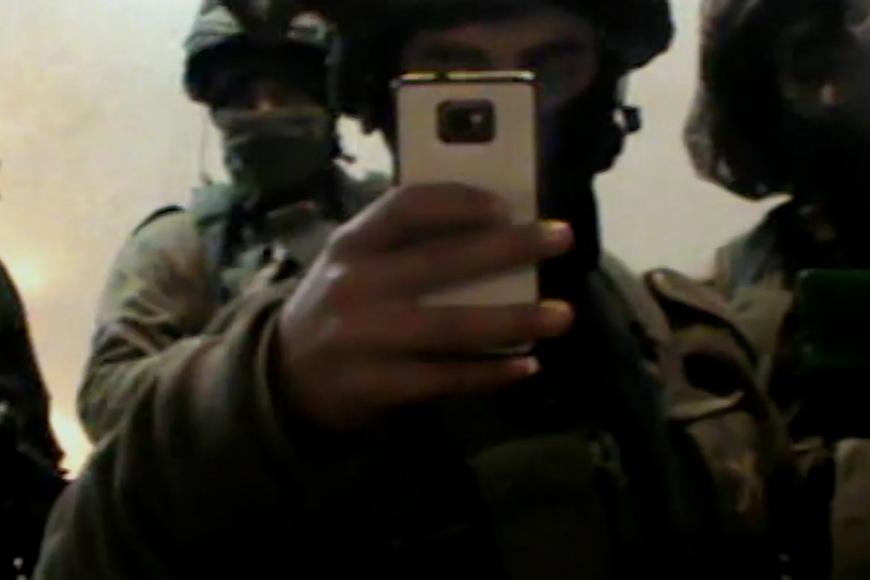
The archived testimonies of “Breaking the Silence”, an association of military veterans, are to be turned into a compilation of “service incidents” in the Israeli-occupied territories. But Avi Mograbi confesses: “My films tend to get complicated, even when my intention is to make a very simple film.” His reaction to a complex doom is artistically and intellectually commensurate: complex. Once again he uses a built-in commentary function in which he himself, white-bearded, explains the tricky situation to his audience: not as a special “Israel-Palestine” case, but as the bitter standard application of the globally familiar aporetic model of “military occupation”.
Sylvia Görke
Credits
Director
Avi Mograbi
Script
Avi Mograbi
Cinematographer
Tulik Gallon, Philippe Bellaiche
Editor
Avi Mograbi
Producer
Camille Laemlé, Serge Lalou
Co-Producer
Annie Ohayon-Dekel, Fabrice Puchault, Heino Deckert, Leila Lyytikäinen, Elina Pohjola, Farid Rezkallah, Anne Grolleron, Avi Mograbi




![Filmstill Fa. Gutberlet & Co. [Ausschnitt]](https://www.dok-leipzig.de/sites/default/files/styles/stepped_teaser_/public/fiona/films/stills/94a765f0-53ce-4935-bc20-309db0abbb7f.jpg?h=346bc062&itok=5n_TqdCp)





![Filmstill Fa. Gutberlet & Co. [Ausschnitt]](https://www.dok-leipzig.de/sites/default/files/styles/film_stills_full_content_view/public/fiona/films/stills/94a765f0-53ce-4935-bc20-309db0abbb7f.jpg?h=346bc062&itok=0mNa-FNw)


