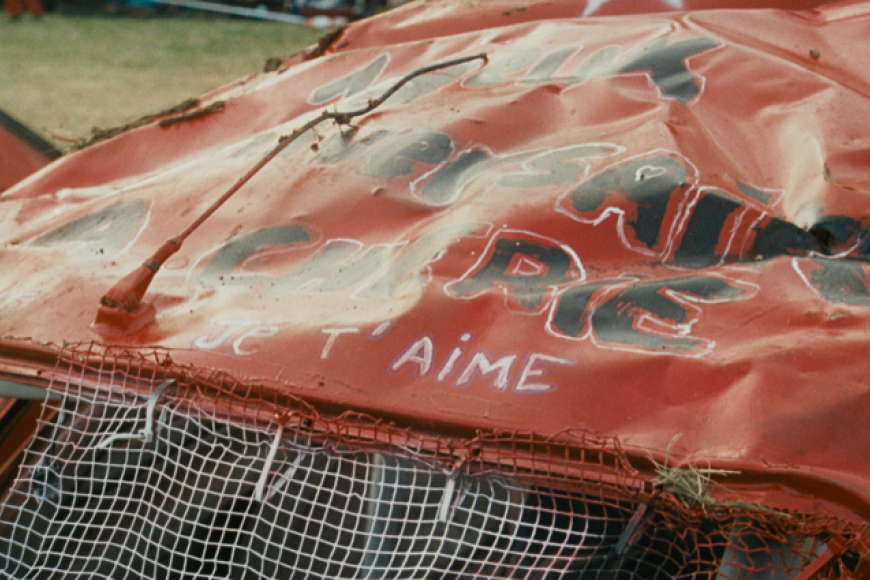
A stock car race that leaves only the carcasses of cars in the end. From offscreen, the director talks about a violent relationship. A metaphor, as precise as knife stabs.
Summer, dust, a burning sun. It is stock car race season, a loud, aggressive show that leaves only smashed carcasses of cars in the end. After each lap, the dents are worked over with heavy hammer blows before the damaged racing cars are sent back on the smoky track. The audience are standing at the edge of the sand pit and can’t get enough of the pile-ups. From off screen, the director gives a matter-of-fact account of the violent relationship in which she got caught up at the age of 18 and from which she only managed to free herself two years later. She analyses precisely what happened to her back then, using the dented, destroyed vehicles as a powerful metaphor for her injured body. The interplay of images and words is spot-on – like precisely placed knife stabs.
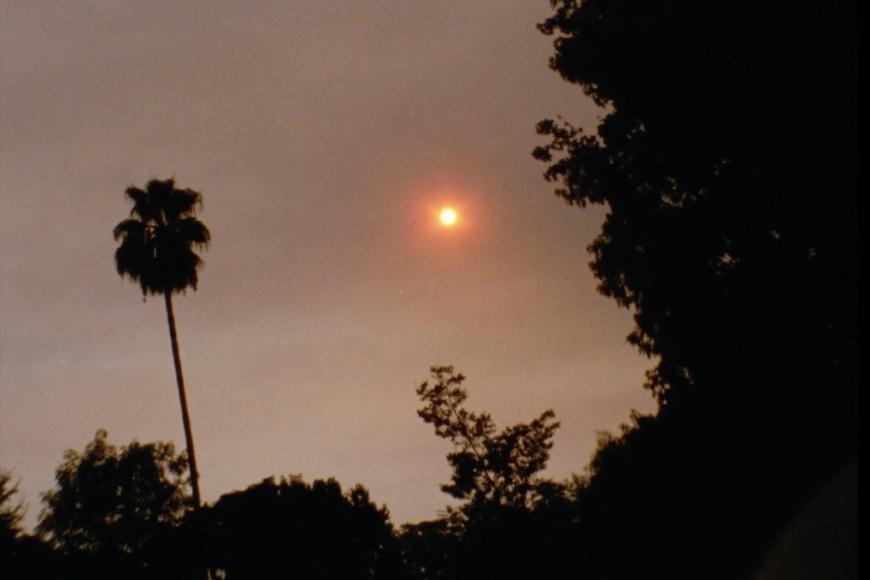
Made at the start of the pandemic, Lee Anne Schmitt’s most recent short contrasts the tranquillity of nature with a sense of underlying dread at the state of the world.
Made at the start of the pandemic, Lee Anne Schmitt’s most recent short contrasts the tranquillity of nature with a sense of underlying dread at the state of the world, even if the former is hardly immune from the latter. The lush leaves, lithe stems and blooms of all shapes and colours seen through frames both round and rectangular feel in perfect harmony with the gentle clang of the wind chimes, until Schmitt’s voice interrupts the calm to tell of how they decided to pack the car and leave. The recurring shot of a forest, with clouds slowly billowing forth in the gap between the trees. Fog or smoke? “Nothing’s where it’s supposed to be”.
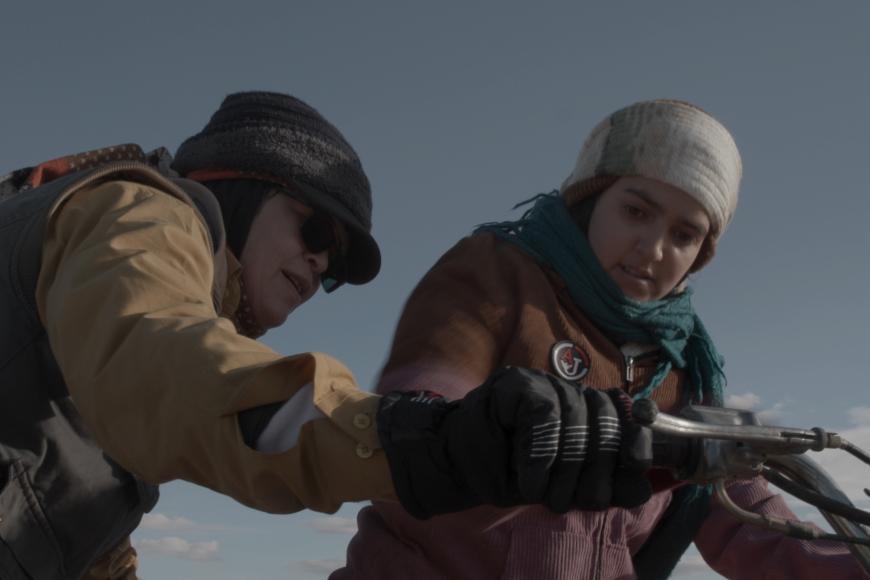
Fighting patriarchy on a motorcycle: A female local politician in rural north-western Iran is campaigning for the self-determination of the women and girls in her community.
The “Woman, Life, Freedom” protests in Tehran and other major cities seem far away from the place where Sara lives. But in her rural community in northwestern Iran, the protagonist of this film advocates the same feminist values in a practical, everyday way. Again and again, we are reminded by the images that her father once taught her to ride a motorbike – to the disapproval of the whole village. A small favour with big consequences: For Sara, it paved a way outside patriarchal marriage. Mobile on two wheels, she works as a midwife and has delivered many girls for whom she now wants to fight: At the start of the film and in middle age, Sara decides to be the first woman in the history of her community to run for the local council. A step which earns her enthusiastic support on the one hand; on the other, she must endure open hostilities and an interrogation by the moral enforcers of the Islamic Republic. In “Cutting Through Rocks”, Sara Khaki and Mohammadreza Eyni capture these power structures and their individual impact as precisely as the gestures of solidarity and self-determination.
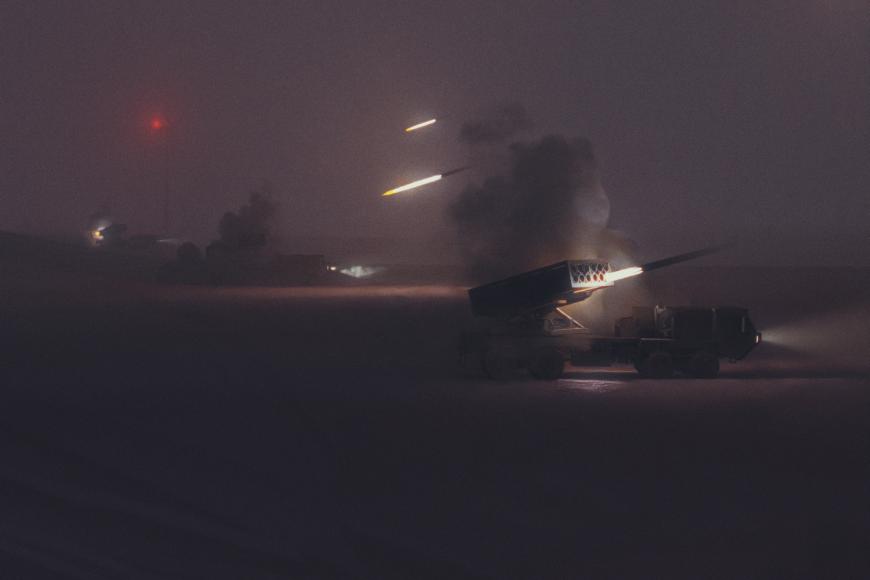
A man on an e-scooter on the outskirts of the city. Only the rifle over his shoulder irritates. The mood of high alert is deceptive. The disaster has already happened.
On the outskirts of the city, the new modern buildings are silent and the motorway bridge drones. Birds are circling in the sky, a young man, concealed by his hoodie, is riding his e-scooter along a park path. The only irritating element is the rifle over his shoulder.
Anton Cla’s film depicts a mood of high alert, while the disaster has in fact already happened. Unexplainable scenes that could not be more disconcerting and grow increasingly drastic unfold calmly. The screaming silence is decisively enhanced by the imperceptibly accumulating mixed drone of the daily sounds of a mechanised world: motorway, tramway, clicking indicators, pulsating emergency signals. What the soundscape adamantly refuses to deliver is a loud discharge that would release the tension. The suburban landscape is steeped in a red theatrical warning light, blurs restrict the view. The 3D computer design masks neither the artificiality nor the computer-based deformations of the images of a normality that has become a combat zone – the machine matrix seems to rule already.
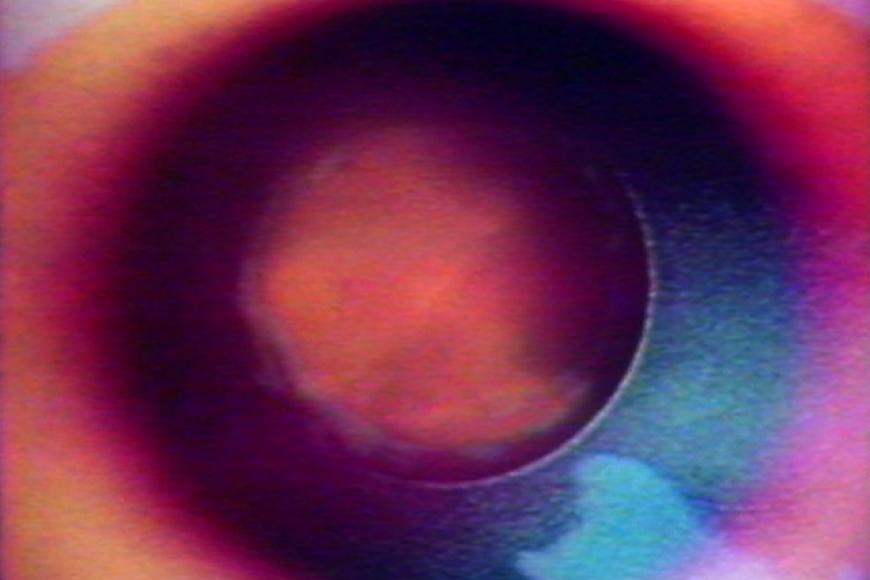
A union of two artists and their two mediums of expression: celluloid film and synthesized video. A deeply psychedelic and meditative cycle of transformations in the weightlessness of light.
A union between two artists and their respective mediums of expression: celluloid film and electronic video. Stephen Beck, inventor of his own video synthesizer, and Jordan Belson, a famed abstract filmmaker and animation artist twice Beck’s age, spent two years working together on this journey through spheres of thought, mysticism and form. Deeply psychedelic and yet with all the weightlessness of light.
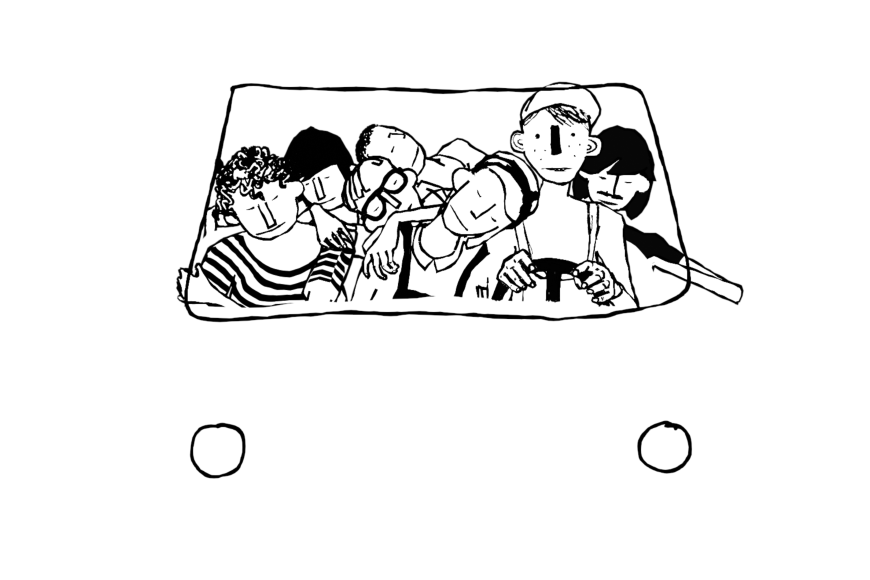
Poland, 1981. There is hardly any food, no fuel, only limited freedom. Six friends squeeze into an old car and set out for the Baltic Coast – and perhaps beyond.
Poland, 1981. Six friends squeeze into an old car that is far too small and set out for the Polish Baltic coast, fuelled by their longing for freedom. The further they come, the clearer the decrepit state of their country emerges. The pension where they spend the night has nothing that could be served for breakfast. Food and fuel are also in short supply elsewhere. There is a shortage of everything. The only thing one can buy anytime and anywhere is booze, which is plentiful. Just like the country, the car also falls apart piece by piece. But the trip continues, past demonstrating crowds, tanks, barricades and armed policemen. Singing, laughing and carefree, Leszek and his companions finally make it to the sea. Is this the end of their journey? Or should they join the hundreds of thousands who have already left Poland? The borders of the frame, at least, are open. The sparse, fragmented graphic elements on the empty white background hardly seem an incentive to stay. There is no obstacle that could keep the friends from setting off for new shores.
Franka Sachse
Credits
Director
Jadwiga Kowalska
Editor
Fee Liechti Seigner
Producer
Jadwiga Kowalska
Sound
Thomas Gassmann
Score
Christian Aregger, Roland Bucher
Animation
Jadwiga Kowalska, Marco Ellensohn, Jérémie Dupraz, Laure Clemansaud
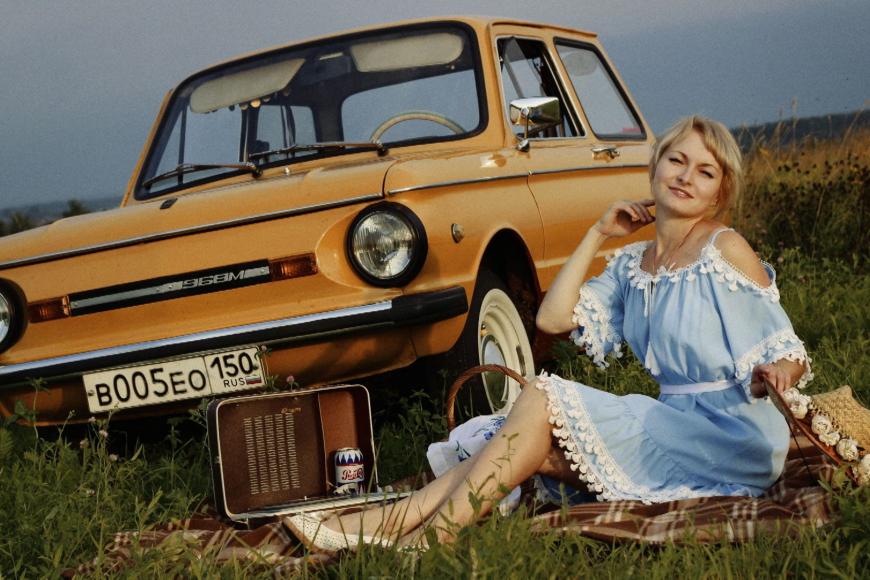
A cheerfully edited collection of auto biographies from socialist production in seemingly carefree times – when the motorized vehicle was still allowed to be a status symbol.
A nostalgic trip into a past when buying a car constituted a lifetime’s work – especially for those Europeans who had a maximum of two handful of brands at their disposal. This cheerfully edited collection of auto biographies from socialist production evokes seemingly carefree times when the motorized vehicle was allowed to be simply a status symbol: free from ideological turf wars revolving around the climate crisis and mobility diets.
From Russia via Bulgaria and the Czech Republic to Germany and Norway, love stories between humans and Trabi, Moskvitch and Volga are captured on film. We meet protagonists who are fond of their beloved piece of tin, then or now, or have even amassed a considerable collection. There’s a couple who met and fell in love at a retro car exhibition and still drive the same model today. We meet a sexton who passes on his official car after 32 years of use. We make the acquaintance of a pin-up who always poses in front of vintage cars from the East. They all have a soft spot for these rickety rust buckets, because even though the products of the socialist car industry were usually slow, chunky, tedious to drive and to repair, they were all regarded as showpieces of a successful life. And there was one in almost every family: coveted, long longed-for, assiduously polished.
Lina Dinkla
Credits
Director
Georgi Bogdanov, Boris Missirkov
Script
Boris Missirkov, Georgi Bogdanov
Cinematographer
Boris Missirkov, Georgi Bogdanov
Editor
Emil Granicharov, Jacob Thuessen, Georgi Tenev
Producer
Martichka Bozhilova
Co-Producer
Tina Leeb, Miljenka Čogelja, Dana Budisavljević, Jiří Konečný, Sigrid Jonsson Dyekjær, Sascha Beier, Simone Baumann
When Soviet troops invade to suppress the independence movement, barricades are erected in Riga. A bloody struggle begins. The cathedral becomes a place of refuge.
The Latvian director’s graduation film from Moscow Film School does not deliver images loyal to the regime but is a testimony to her journalistic background. When the independence struggle is to be suppressed by military power, the people in Riga erect barricades. Laila Pakalniņa captured the dramatic events whose topicality is frightening.
Jerry Blumenthal, Suzanne Davenport, Sharon Karp, Gordon Quinn, Jenny Rohrer
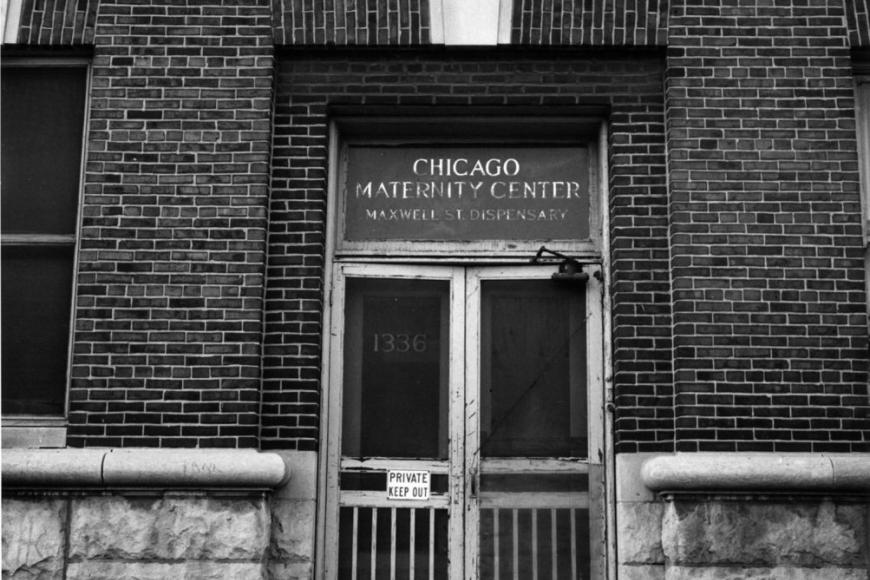
The Chicago Maternity Center, which provided safe and affordable home births primarily to Black women, is threatened with closure. Resistance begins to form.
Jerry Blumenthal, Suzanne Davenport, Sharon Karp, Gordon Quinn, Jenny Rohrer
Retrospective: Un-American Activities 2025
Documentary Film
USA
1976
60 minutes
English
Subtitles:
German
In 1974, the Maternity Center, located in a low-income Chicago neighbourhood, is acutely threatened by lack of financing from its funding body, North Western University. Resistance begins to form in the predominantly Black community, since this is an institution with a 75-year-old history that has provided countless woman with safe and affordable home-births. “The Chicago Maternity Center Story” uses this civil protest as a starting point to tell the story of the rampant commercialisation of medical care in the USA, including its sexist and racist connotations. A film that approaches the issue sometimes gently, sometimes with agitprop vigour.
Tobias Hering, Tilman Schumacher
Credits
Director
Jerry Blumenthal, Suzanne Davenport, Sharon Karp, Gordon Quinn, Jenny Rohrer
The last archivist secures artefacts of a civilization that is collapsing outside in the real world. A documentary science fiction in the field of tension between image and sound.
Photographs are dusted, records cleaned, insects removed from books and everything is digitized for eternity. The matter-of-fact shots of fastidious archival work, though, are combined with the voice of a young woman who reports on the collapse of civilization, the fragile artefacts of which she secures as the last human being left in the “Congress”. In the field of tension between image and sound a space for our imagination opens up.
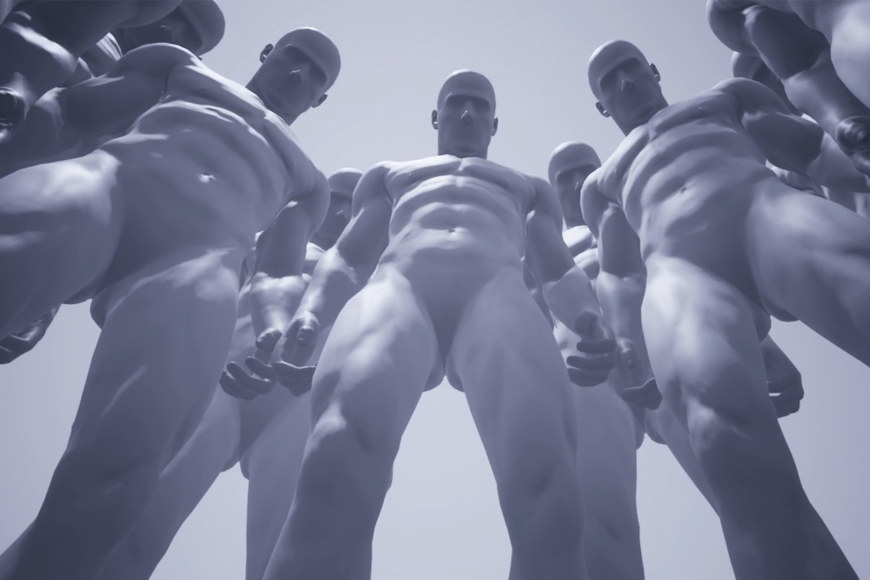
Surrounded by giant statues, we become an object of appraisal: A field of tension between arbitrariness and control, power and impotence, diversity and uniformity opens.
We are exposed to evaluations every day. The norm by which they are made is usually out of our hands. This VR experience creates a field of tension between arbitrariness and control, power and impotence, diversity and uniformity. A circle of 16 real objects marks the entrance to a virtual process of evaluation in which 16 giant grey statues examine us.