A father disappears, literally flying away. What to do when a parent suffers from mental illness? A tender father-daughter reconciliation in poetic images.
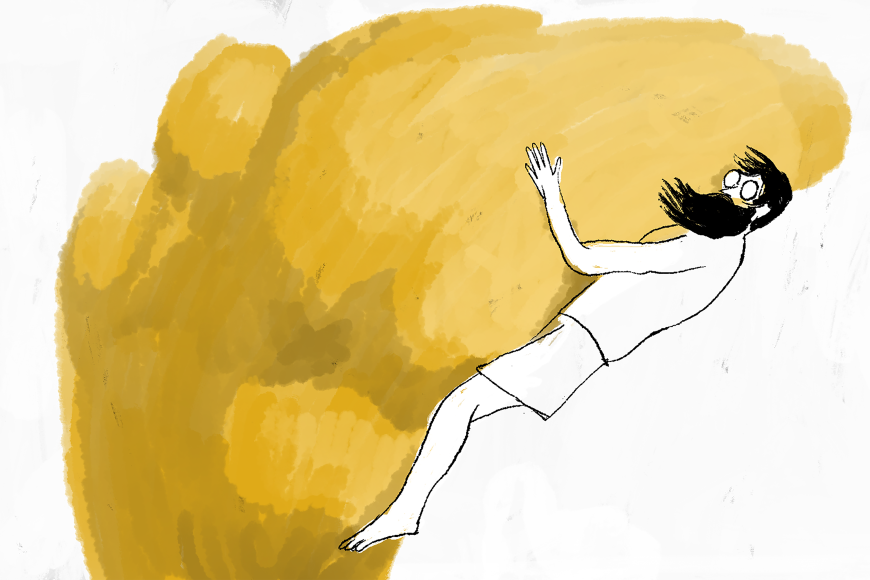
When the woman in curlers opens the door, Papa is blown away: Like a breath of air, a storm or tornado, he is blown in and back out. Even in his own apartment he is ungraspable: He grows and shrinks, becomes fragile or threatening, knocks everything down. And then he literally flies away, hurling eggs at passers-by. Caught in all this is his daughter, who at first can only helplessly stand by and who finds it increasingly difficult to visit him – the steps grow higher, the floor turns into chewing gum. Finally, she looks up at the sky and sees him hover there. What to do when one’s father suffers from mental illness? How to deal with it when the responsibility (of care) switches sides so early in life? Jelena Milunović explores this, using bold, very tender and not always obvious parables. She sets strong colour accents: The depressed episodes are in claustrophobic black and white, the ecstatic highs are colourful free-hand drawings. And the red balloon, which briefly appears in the beginning as a metaphorical vehicle of hope, might point the way to bringing the two of them back together.
Marie Ketzscher
Credits
Director
Jelena Milunović
Script
Jelena Milunović
Producer
Miloš Ivanović
Co-Producer
Draško Ivezić, Jelena Milunović, Filmuniversität Babelsberg KONRAD WOLF
Work equals force times distance. Based on this physical formula, Angel Wu thinks about work, self-exploitation, and hamster wheels – and the possibility of escape.
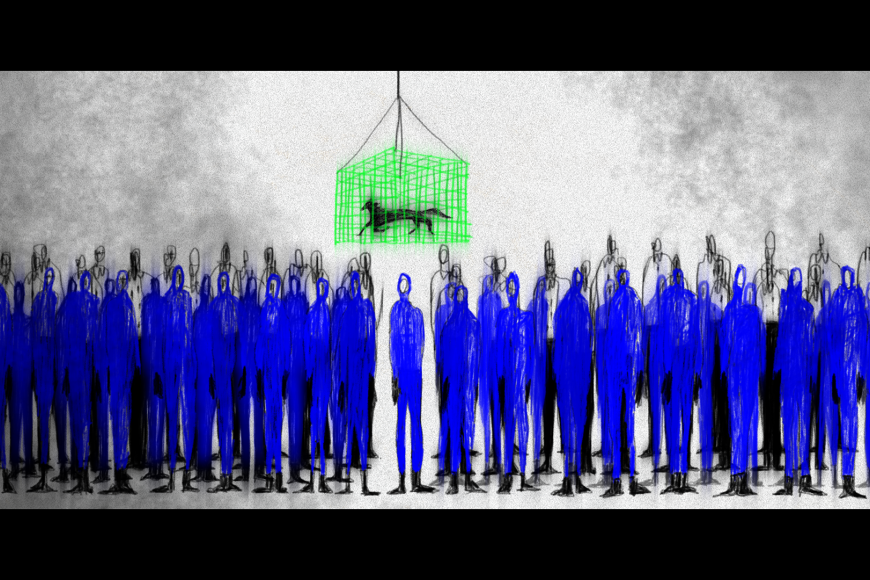
Is that a belly or a cell that is in visible turmoil? In any case, in Angel Wu’s film the capitalist hamster wheel is a living organism – though it is not quite clear whether we live in it or it in us. When a young factory worker makes a wooden fetish, prays to it, and then eats it, he is physically and visibly consumed with ambition and work mania. Without further ado, the people around the fire turn into a column of factory workers with a number-crunching management, the free-roaming zebra is put into a cage that is quickly shipped off as a container. But Wu does not just stage this development as a simple series of recognisable capitalism markers but also retains the cryptic, haptic quality of her magnificent mixed media reflection on the content level. Is the fetish an anvil that symbolises human malleability? Does the worker long for something else? Are the delicately drawn insights into the interior of the machine visions of hell or simply an Anthropocene in its final stage? Based on the physical formula “work equals force times distance,” Wu not only combines 2D animation, photography, collage, and drawing – as well as Taiwanese music featuring some unsavoury retching. Rather, she condenses reflections on working life in (Asian) societies and our imprisonment within it.
Marie Ketzscher
Credits
Director
Angel Yun Wu
Script
Angel Yun Wu
Cinematographer
Angel Yun Wu
Editor
Angel Yun Wu
Producer
Angel Huang
Co-Producer
Singing Chang
Sound
Fen Cheng
Sound Design
Jin-De Lin
Score
Fen Cheng
Animation
Angel Yun Wu, Ji-Tian Li, Vanto Chien, Hao Ping Wang
Is living as a mythical creature, mouse or furry not the most radical form of self-realization? In her film, Masłoń moves through VR spaces as an avatar to explore touch.
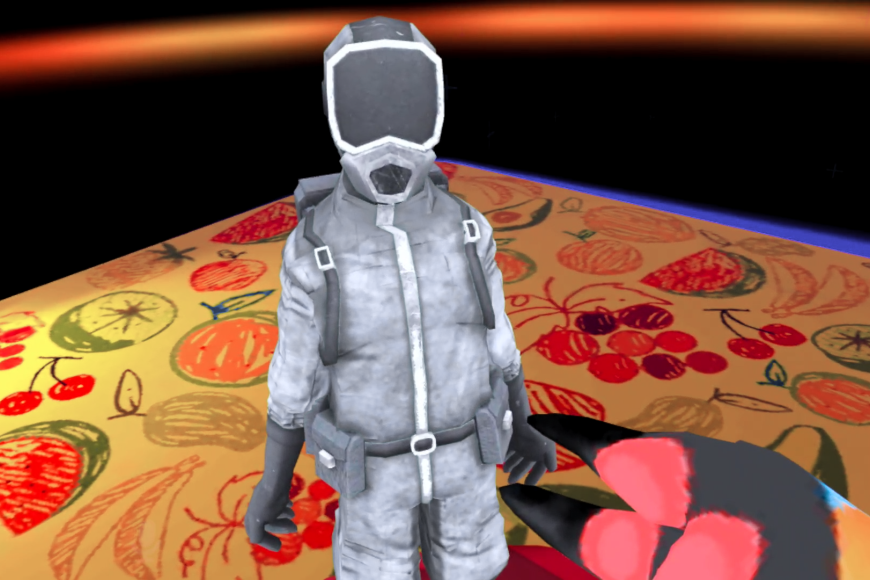
Is it not unlimited freedom, the most radical form of self-realisation, to exist in every conceivable setting as a flying mythical creature, a sad mouse or a furry figure with an extended naked spine as a tail? In her film, Monika Masłoń moves through different spaces as an avatar, exploring the subject of touching and being touched on VR platforms. Anything our phantasy can imagine can be created from pixels here. The limits of existence can be extended infinitely by a click. But what about human – or avatarian – closeness? Can an emotional signal like shaking hands be simulated in this VR world, despite the complete absence of physical bodies? When I see my avatar being touched, can my body memory suggest that I feel this tactile event even though there is no other physical body? Masłoń examines these questions with a delicate sense of humour and in exchanges with other avatars. But then we enter a VR space that feels more intimate: She has taken us on a personal date. How does the impossibility of physical touch in a long-distance relationship differ from that in VR? Can a VR date create more physical presence and still the longing for the beloved person better than other forms of communication?