Exploding tomatoes, bullet-riddled walls, snails looking for houses. A return to a childhood during the Bosnian War where beautiful memories lie next to traumatic ones.
There is no return to paradise. There is a rupture between now and then, the realisation that this place no longer exists. Our protagonist, too, must learn this when she lifts the green of the map beneath her like a blanket to crawl under it with a tomato in her hand – back to Sarajevo, to Yugoslavia. Initially, the strangeness of the return flight with its obligatory tomato juice is as nostalgically exciting as the smiley stickers that are everywhere. But by the time she reaches her parents’ home, the past catches up with her completely: In the corridor of the deserted flat, bullet holes cast cones of light on old family photos and when she opens the fridge, the sight of a single tomato suddenly triggers memories of bombs and explosions. Matea Radic finds haunting and original images to visualise her own traumatic experience of the Bosnian War and its confusing entanglement with her haptic and sensual childhood memories – complete with Dadaistic advertisements for Šipad furniture and Bosnian melodies. Her generous and yet spare animation style brings out the childlike wonder of her protagonist beautifully. She stalks through the world with scraped knees in a babydoll dress. And she learns that it is sometimes okay not to stick a smiley on things but perhaps a band-aid.
How does it feel when your body becomes a different one? Menopause is too rarely talked about in positive terms. This is about the solemn farewell of this great transformation.
How does it feel when your body becomes a different one? Milla Cummings and Geneviève Tremblay explore (peri)menopause with a physical, concrete approach: The menopause they show is a living stop-motion organism, a cave with pulsating walls where a naked elderly woman gently inters her last eggs. From offscreen, a number of mature women recount their experiences – of dry skin, especially in the vaginal area, of rage against the universally asserted sex appeal of aging men, and of the increasing loss of their social visibility. For every negative aspect, these worldly-wise narrators formulate a counterpoint or constructive course of action in authentic audio recordings. And they also report on the positive sides of this drastic transformation: The energy that the body would have reserved for childbearing along with the eggs is now released for new projects! On screen, a curtain aptly opens to offer a view of a shimmering, glittering foam of possibilities. At the end, our protagonist leaves the cave and climbs the nearest mountain. This film describes more than just arduous passages one has to go through: The “passageways” might just as well be transitions to a new life.
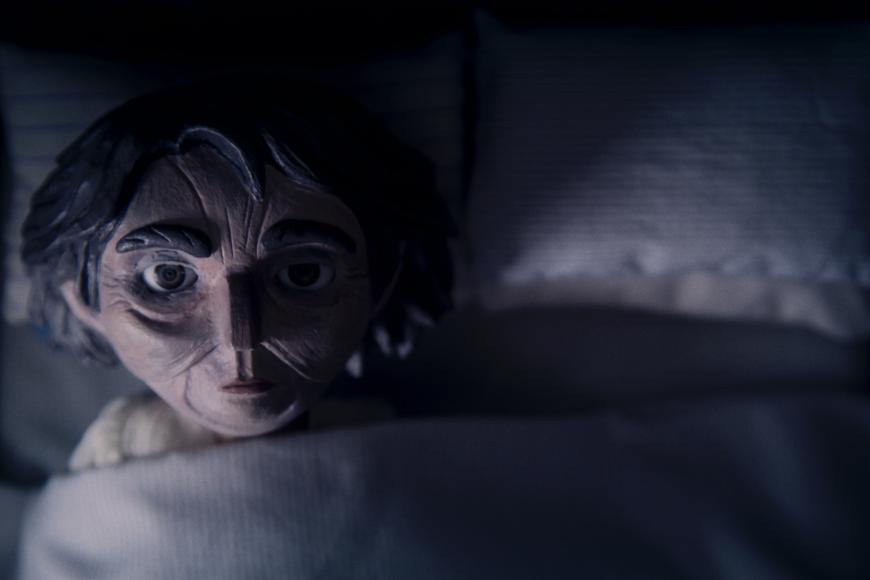
Petra spends her twilight years with her four-legged friend in the wilderness. She has perfected the art of living alone, but then her dog finds a handsome, frozen man in the snow.
Spending your twilight years alone in a remote forest cabin in the Andes with your faithful four-legged friend – what more could you want? Petra, in any case, seems quite content all alone, chopping wood and listening to the radio. But one day her dog discovers a permafrost body in the snow and literally sinks its teeth into it. The result is that Petra has no choice but to take this accidental find back home. With gloriously absurd and light-handed twists, Stefania Malacchini and Malu Furche tell a warm-hearted and macabre story of growing old – and of late love, for the frozen body is marvellously easy to unthaw, integrate into daily life, or swing back and forth as a dancing partner. The puppet animation is just as affectionate and detailed, whether it is the resolute grey-headed Petra with her no-nonsense style, her dog, whose hunting instinct and playfulness have comic consequences, or the frozen body itself, this 20th-century hiker who died in the deep snow and sometimes looks as if he was about to come to life and run away fast. Petra enjoys her new happiness. But it could be finite: The police are looking for the missing body …
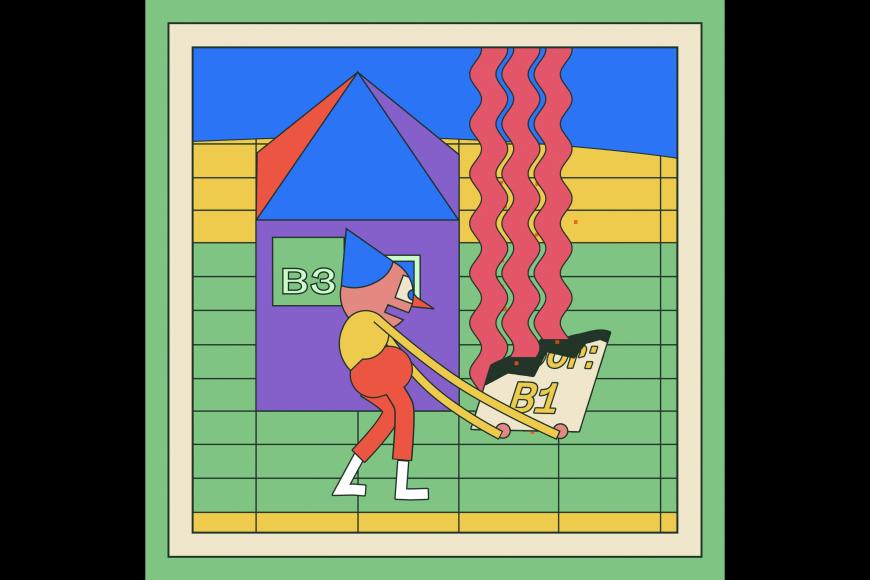
Can a calculated vector line inspire the same feelings as a drawn pixel line? A tongue-in-cheek declaration of love to the technology and aesthetics of the past 60 years.
This film grows somewhere between “forever” and “no longer”, between infinity and constraint, between absoluteness and concreteness. Everything is set in a square format, the original or pixel shape. But this square seems to be like a mirror facing another mirror, a self-referential optical illusion of infinity – with more than a grain of salt. We experience the humorous negotiation of an eternal issue of dispute among visual artists: Can a mathematically calculated vector line, scalable ad infinitum, inspire the same feelings in the beholder as a finite, imperfectly drawn line of pixels? Is the former not the visual equivalent of the neo-liberal illusion of infinite growth – shiny, but sickening? Could the mysterious pixelated moth resolve this eternal dispute? It guards the “Vectorial Superlooper” to ensure that this marvellous invention does not fall into the wrong hands. Jon Frickey spans an arc from our absurd, finite existence to the technological inventions that shape our sense of style, our taste, and thus our life. His film is a tongue-in-cheek declaration of love to the technology and aesthetics of the past 60 years: to pixel art, video games, television series, vector monitors – and, of course, to pixels and vectors themselves.