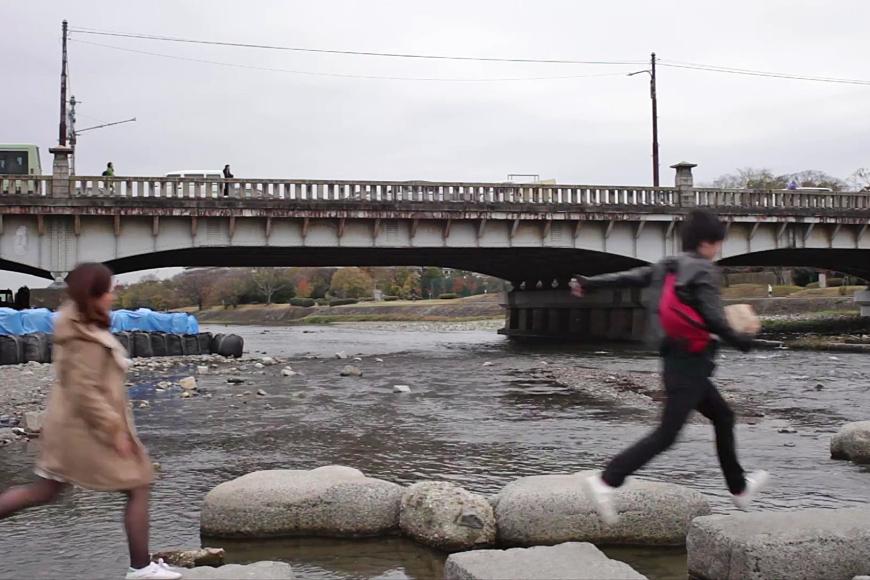
Moving snapshots of people taken along a river in Kyoto develop a captivating rhythm one is only too willing to give in to. People play, sing, and take walks.
A train rattles in the distance, a heron stalks through the water, children practice gymnastics on the promenade. A couple is on its way to the opposite bank, hopping from stone to stone. One of the stones is shaped like a turtle, symbolising wisdom. An elderly man sings beneath a concrete bridge, his voice echoing. Moving snapshots of the Kamogawa, the wild duck river in Kyoto, develop a captivating rhythm that is easy to get lost in. The men, women and children seem absorbed in their activities and themselves. Like the fisherman who is downright surprised by the fat fish on his line. Sometimes the camera also peeks into the houses behind the embankment. An elderly couple make fabrics with fancy patterns in a workshop, the regular clacking of their loom has a soothing quality. The images are full of cheerful serenity.
Kyiv, before 24 February 2022. A family is trying to make ends meet – though the fridge is permanently empty and the electric metre has sharp teeth. Then bombs hit the building across the street.
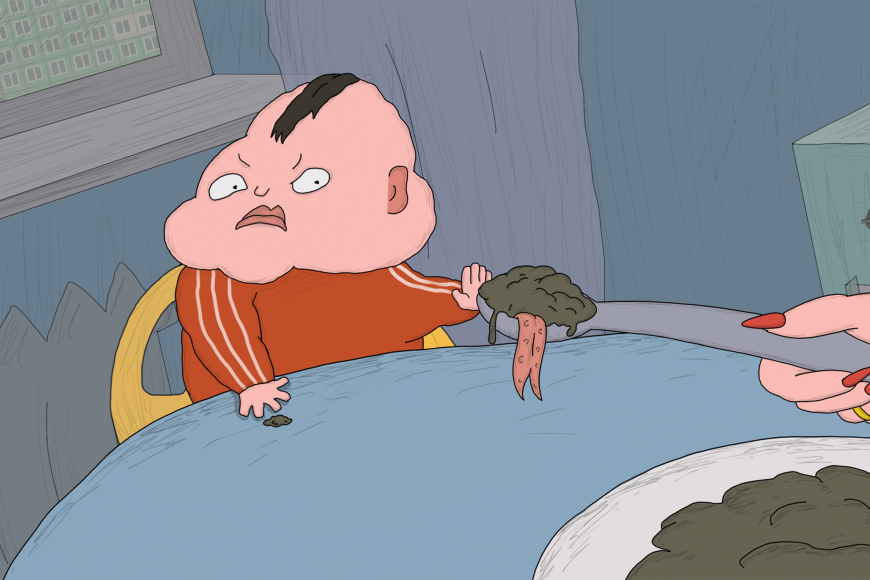
The stag in the bedroom painting vigorously stomps on the grass and the father wakes up. His wife and baby are still asleep. In worn-out boxer shorts that reveal one lost-looking testicle, he begins his daily battle with the electric metre which only closes its snapping jaws when it is fed enough banknotes. Mykyta Lyskov’s film is a scathing, incredibly funny and deeply sad portrait of the precarious pre-2022 life of a Ukrainian family. He uses anthropomorphic and surrealist exaggeration to bring home their poverty, and countless cultural references to raise questions of belonging and national pride. In Lyskov’s film, everything stays bleak, as if 1990 was not so long ago: endless canyons of prefabricated buildings, garbage, lack of perspective. No wonder then that the father guards his passport like a veritable treasure and flutters away as a small yellow-blue bird to work in Western Europe. He leaves behind his wife, who ingeniously keeps the greedy electric metre at bay, while the son grows up to become a hooligan. It is absolutely outrageous that this family, sort of re-united around the kitchen table in this hopeless hodgepodge, is forced to watch as a bomb coming out of nowhere demolishes the building opposite. It is fantastic that Lyskov captures this for us with so much exuberant rage.
Marie Ketzscher
Credits
Director
Mykyta Lyskov
Script
Mykyta Lyskov
Editor
Mykyta Lyskov
Producer
Kalev Tamm
Sound Design
Horret Kuus
Animation
Aili Allas, Tarmo Vaarmets, Mykyta Lyskov, Shara Arus
Nominated for:
Gedanken Aufschluss Prize,
mephisto 97.6 Audience Award