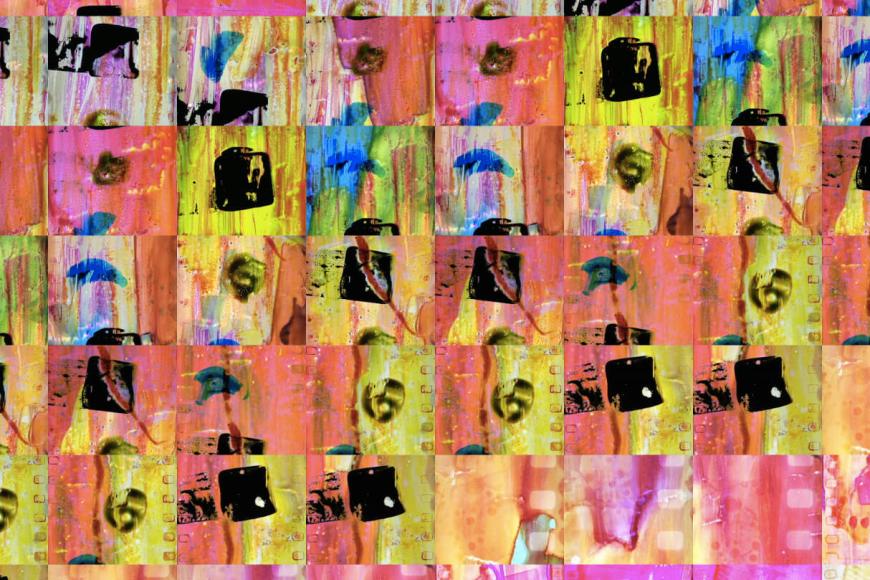
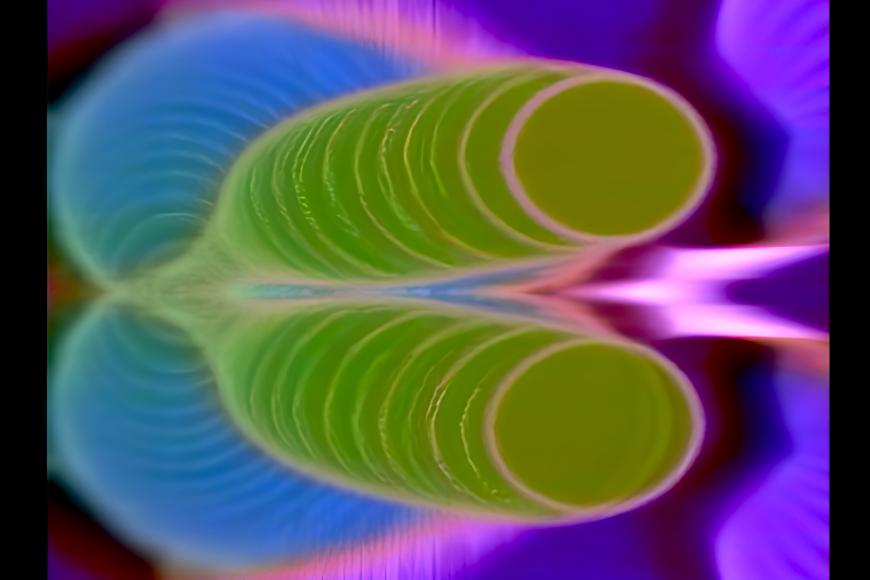
Single frames from a direct animation appear on the screen in staggered repetition. The shapes painted, printed and scratched on 35mm material evolve, with minimal time lapses, from one edge of the frame to the other. A trace is left, telling of time itself and asking: When exactly is “now”? The past, present and future are spinning in the chaos of moments.
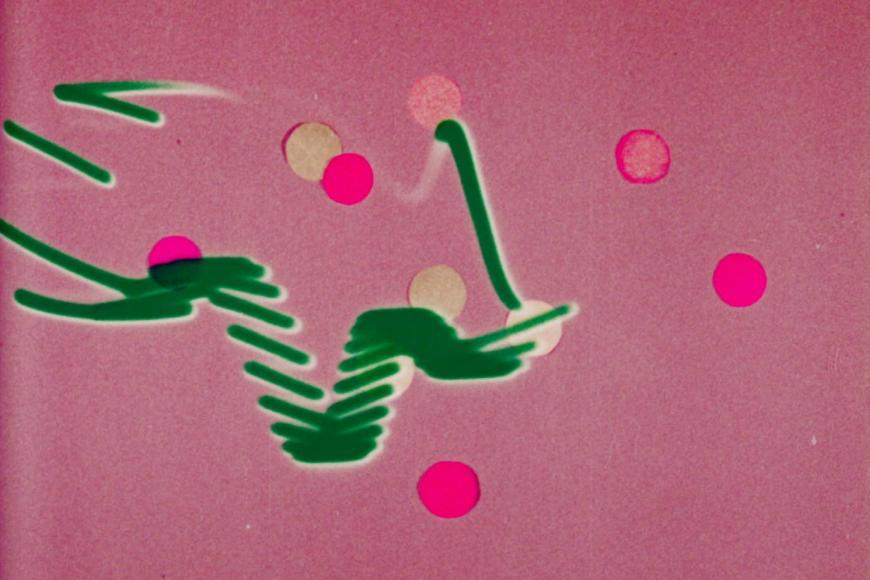
A universe of colourful and lively rhythmic forms created using a pioneering combination of traditional animation and electronic images from a specially designed oscilloscope.
Hand-coloured and from the mind of one of the 20th century’s most innovative abstract filmmakers, “Abstronic” combines abstraction and electronics to produce a playful flow of images reminiscent of an abstract painting in motion. Mary Ellen Bute, who was also a painter, created the film using electronic images generated by a specially designed oscilloscope in combination with traditional animation.
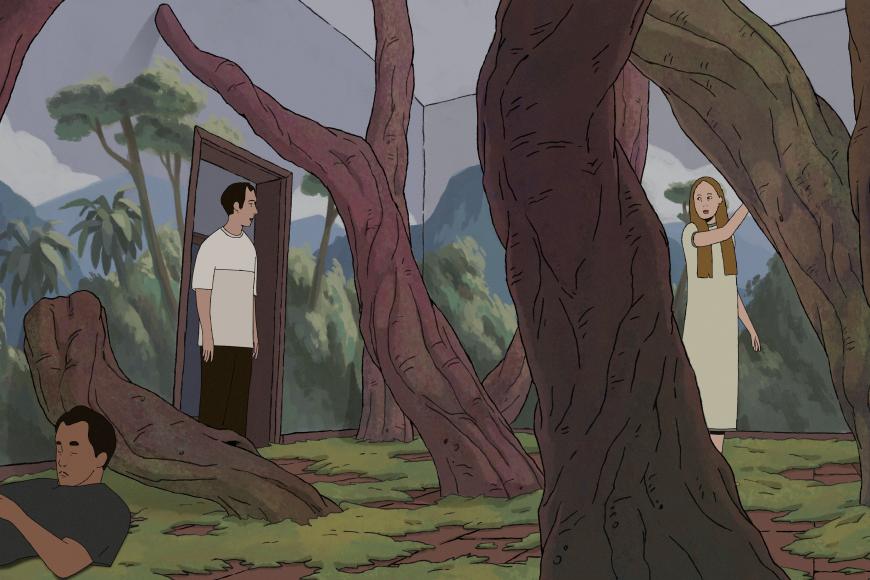
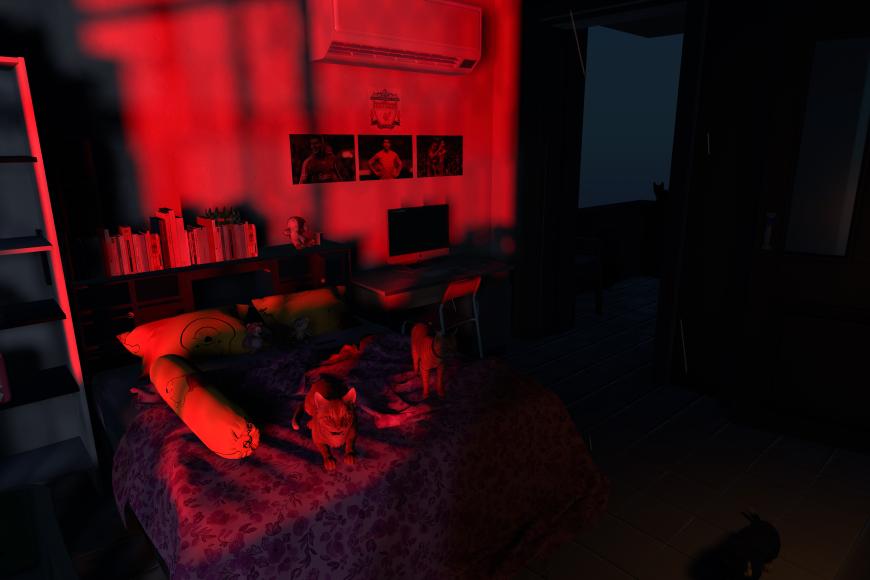
“Are you with us or against us?” A cult-like community in the neighbouring flat who displays ape-like behaviour and fanatical faith tries to convert a man after work.
“Are you with us or against us?” Nothing less lies in the air, unspoken. No nuances, no discussions, hardly any choice. Did the tired man expect such life decisions after work? Unlikely. He just wanted to chill out and watch mindless television when suddenly an alien world on the screen catches up with him in the comfort of his home: A cult-like community lives next door, their behaviour ape-like, their faith fanatical, determined to convert him. Their flat is decorated with forests and deserts. Anyone who tries to look behind the painted wallpaper, to separate scenery from reality, commits treason and deserves banishment or death. Plato’s Cave Analogy in a radicalised version for the 21st century. Freedom and truth or stability and a sense of belonging? Is the price of accepting a distorted reality just to be allowed to live too high? And most of all: Is there an alternative worth living? The world outside, behind the window, remains vague, its threats only implied. In this parable about passivity, curiosity and free choice, Alexandre Sousa touches on the urgent questions of our time: questions of isolation, echo chambers and the impossibility for humans to stay unpolitical. Do we even have a chance to resist?
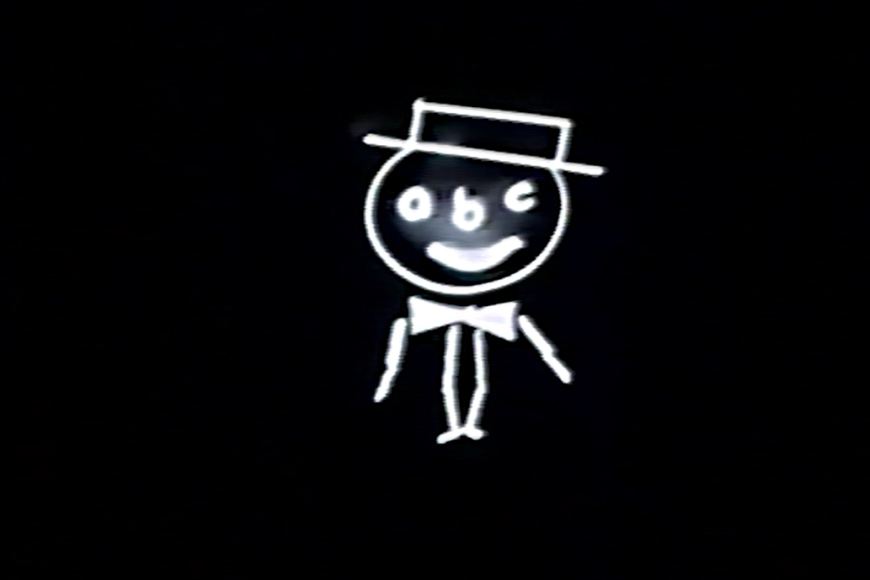
A block of films showing some of the earliest examples of video synthesis using analogue computers, in addition to some early examples of electronically designed and animated characters.
This compilation of four films demonstrates the capabilities of the ANIMAC analogue computer, the predecessor to the later Scanimate video synthesizer, which would kickstart a new era in motion graphics during the 1970s. The ANIMAC’s jaunty and fluid forms, created using manually controlled cathode rays which drew on screen in real time, give an early example of electronically designed and animated characters.
A nighttime journey through the streets of Paris with Renée, a trans asylum seeker from Thailand. Through the dark of night, her lightness of being shines brightly.
Renée, an asylum seeker from Thailand, walks the night-time streets of Paris. Suspended by the asylum system and invisible to passers-by, she is neither here nor there. For one night, viewers are invited to walk with her, in a cinematic VR experience led by light and shadow-play. “Another Place” was made in collaboration with Renée and is grounded in her experience.
Dana Melaver
Credits
Director
Domenico Singha Pedroli
Producer
Luc-Jérôme Bailleul
Production Company
Le Fresnoy – Studio national des arts contemporains
A dream team of talented artist engineers takes us on a psychedelic drift through synthesized new age landscapes made of vapourwave colours and swirling, fractal-like shapes.
Sorensen, DeWitt and Winkler were a dream team of artist engineers, a talented trio whose fluency in new media and technology won them numerous awards and accolades. Their skills in video synthesis and processing are deeply visible in this dreamy, psychedelic drift through synthesised New Age landscapes made of vapourwave colours and swirling, fractal-like shapes.
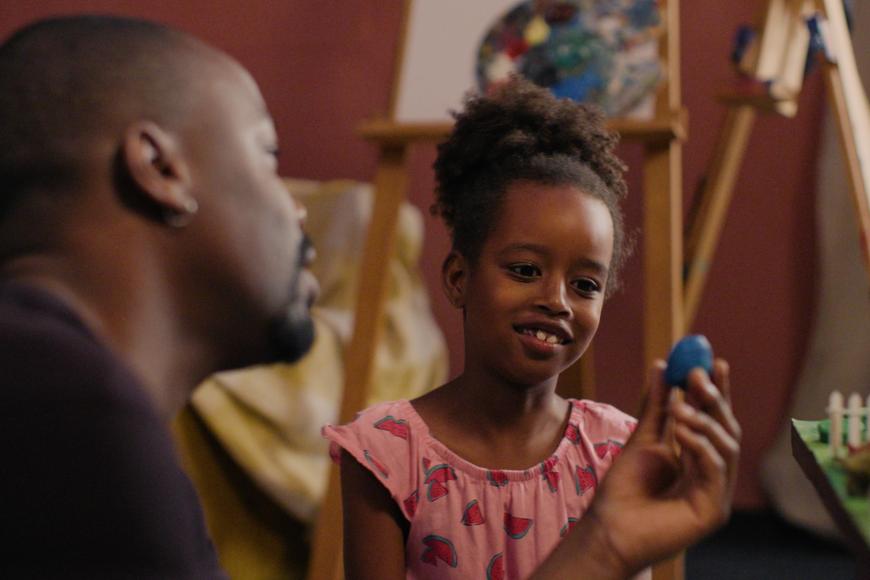
All creatures in Greenland are green, except Bluekid. In this partly animated handicraft world, Mwita Mataro reflects on experiences of racism in Austria with children and experts.
In his early twenties, Mwita Mataro set himself three big goals: become a rock star, make a film, and then found an art school in Tanzania. He has already accomplished the rock star part – he is the frontman of a band. And this film is his directorial debut. There was a choice of many subjects, something beautiful like friendship, for example. But there is one thing that bothers him more than his white film colleagues, and that is the colour of his skin. So what does it mean to grow up as a Salzburg native with Tanzanian roots, as a Black Person of Colour in predominantly white Austria? To investigate this, he has teamed up with young BPoCs to create the animated fantasy world Greenland: a place where all the potato creatures are green except Bluekid and his blue family. They paint themselves green to be less conspicuous, but since this does not always work out, Bluekid experiences rejection and marginalisation.
In his documentary essay, Mataro reflects on a daily reality based on colours: racism, alien attributions, otherness, blues experiences in Greenland. He listens to children and adults, lets the audience participate in talks with pedagogues, psychologists and politicians and opens up in front of the camera at home. With “Austroschwarz”, Mataro also comes one step closer to his third goal.
Tina Jany
Credits
Director
Mwita Mataro, Helmut Karner
Script
Mwita Mataro, Helmut Karner
Cinematographer
Jasmin Schwendinger
Editor
Christin Veith
Producer
Stephan Herzog, Andrea Elaiza Arnold
Sound
Cristi Iorga
Sound Design
Eli Frauscher
Score
Nicola Mpunga
Animation
Vladimir Savić
Nominated for:
Gedanken Aufschluss Prize,
Young Eyes Film Award,
Leipziger Ring