Film Archive

Retrospective 2024

The Mad Masters

Jean Rouch
Followers of the Hauka cult in Ghana enter the bodies of the colonialists and go mad to European marching music. An ethnofiction that remains disturbing and controversial to this day.
Filmstill The Mad Masters

The Mad Masters

Les maîtres fous
Jean Rouch
Retrospective 2024
Documentary Film
France
1955
28 minutes
English
Subtitles: 
None
This still controversial ethnofiction is one of Jean Rouch’s most famous films. It stages followers of the Hauka cult in Ghana incorporating their colonial masters to marching music imported from Europe. The disturbing work was released at the same time as the first Leipzig festival year, but would have gone beyond the scope of the “Culture and Documentary Film Week”. This was because the festival did not adopt an international focus until 1960. Nevertheless, Rouch floats through Leipzig’s festival history as an inspiring genius: He is regarded as the founder of Cinéma-Vérité, a documentary concept that was pursued with great interest in Leipzig, and he irritated the colonial gaze by encouraging African filmmakers to determine the images of their continent themselves.
Sylvia Görke

Credits DOK Leipzig Logo

Director
Jean Rouch
Cinematographer
Jean Rouch
Editor
Suzanne Baron
Producer
Les Films de la Pléiade
Sound
André Cotin
Narrator
Jean Rouch
Retrospective 2024

The Truth About Fidel Castro Revolution

Victor Pahlen
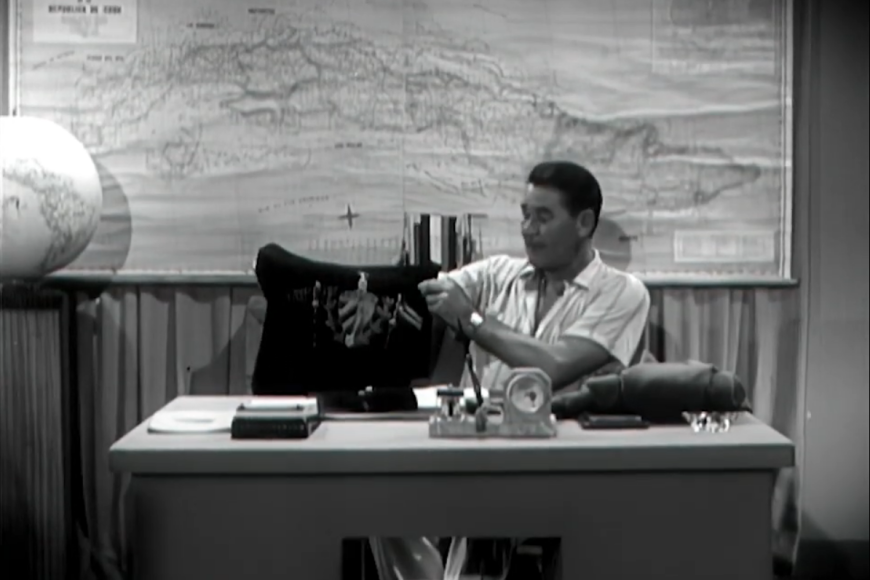
Hollywood star Errol Flynn loves Havana, its casinos and its cocktails. As an eyewitness to the Cuban Revolution, he also learns to love Fidel Castro, the “Cuban Robin Hood.”
Filmstill The Truth About Fidel Castro Revolution

The Truth About Fidel Castro Revolution

The Truth About Fidel Castro Revolution
Victor Pahlen
Retrospective 2024
Documentary Film
USA,
Cuba
1959
51 minutes
English
Subtitles: 
None
When Hollywood star Errol Flynn appeared on the Leipzig festival screen in 1960, he had been dead for a year. The audience saw him in his last role: as an aged lover – of Havana, casinos and cocktails, as the nemesis of the Cuban liberation movement, which had declared war on corrupt bon vivants like him. The movie swashbuckler rhapsodises about his Cuban counterpart Fidel Castro and nonchalantly moderates the history of the dictatorship and liberation of the island state, cigarette holder in hand.
Did Hollywood call Leipzig to recommend this film? It was probably Moscow, because its world premiere is said to have taken place there in 1959. But how did the self-confessed anti-communist Errol Flynn come to make this declaration of love? Maybe his new friend Fidel did not tell him the whole truth?
Sylvia Görke


Credits DOK Leipzig Logo

Director
Victor Pahlen
Script
Victor Pahlen
Producer
Victor Pahlen
Narrator
Errol Flynn
Retrospective 2024

W.R. – Mysteries of the Organism

Dušan Makavejev
Does the sexual revolution complete the communist revolution? Some believe that Makavejev himself invented subversion. This footage, fiction and Wilhelm Reich film seems to confirm this.
Filmstill W.R. – Mysteries of the Organism

W.R. – Mysteries of the Organism

W.R. – Misterije organizma
Dušan Makavejev
Retrospective 2024
Documentary Film
Yugoslavia,
FRG
1971
85 minutes
Serbian,
English
Subtitles: 
English
A Soviet figure skater, a female Yugoslav sex partisan, a Vietnam veteran, Father Stalin and the Austro-American orgasm researcher Wilhelm Reich rumble in the belly of this film. Some people believe that Dušan Makavejev invented subversion in the first place. He exploited the gaps of freedom in the Yugoslav brand of socialism and developed an exceptional cinematic model which irritated both the dos and don’ts of the medium as well as those of political unambiguousness. The Western world was amused by this collage of feature, documentary and sexual education that transgressed all boundaries of ideology and modesty, but the tolerance of the Yugoslav censorship authorities was overstrained – at least temporarily. The 1971 screening ban was lifted in 1986. In 1988, Makavejev returned to Yugoslavia from the West.
Sylvia Görke

Credits DOK Leipzig Logo

Director
Dušan Makavejev
Script
Dušan Makavejev
Cinematographer
Predrag Popović, Aleksandar Petković
Editor
Ivanka Vukasović
Producer
Neoplanta film, Telepool
Score
Bojana Makavejev