Family discussions flare up against the backdrop of the “Woman, Life, Freedom” protest movement in Iran: Elahe does not want to wear a hijab. An intimate and honest discussion.
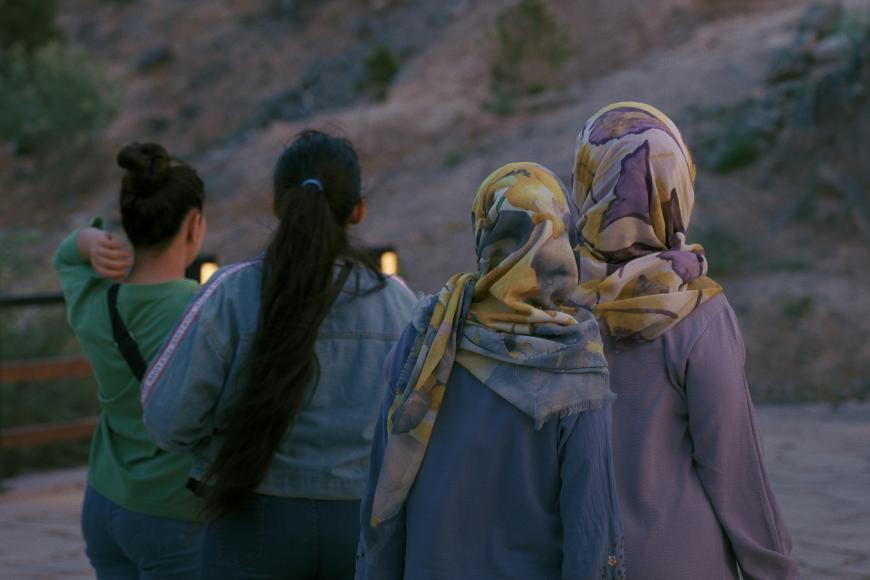
Filmmaker Elahe returns to her hometown of Mashhad in Iran to help her parents move house. Boxes must be packed, old stuff must be rummaged through together. Meanwhile everyone involved discusses what Elahe should wear at the upcoming big party, because Mr. Hossein, the respected and devout patriarch of the extended family, has invited his relatives to his garden. Elahe will not wear a headscarf, nor a hat, not even a borrowed baseball cap for this occasion. On previous visits, she was willing to make a lot of compromises in order not to shame anybody at home. But those days are over. The “Woman, Life, Freedom” movement encourages her to force a change. In Hossein’s garden the director has intimate and moving conversations with sisters and cousins. They have all had similar experiences with hijab and chador but found different ways of dealing with it. Elahe boldly confronts her family’s fears and wishes and films the honest discussions.
The exclusive found footage from the early eighties shows a Poland groaning under martial law. At the same time, it shows a Poland where Solidarność is about to emerge.
In the early 1980s, Poland is in a state of emergency. The country’s democracy movement, represented by the free Solidarność trade union, is to be suppressed. To this end, President Wojciech Jaruzelski declares martial law on 13 December 1981. In collusion with the Soviet Union a threatening scenario is staged to justify the “stan wojenny”. As a result, Western nations like Great Britain and the USA impose economic sanctions on the Eastern Bloc state. This produces a complex field of tension in which the Polish population are confronted with existential shortages on the one hand but continue their struggle underground on the other – despite curfews, telephone surveillance and a media system controlled by the military. In his found footage film, Tomasz Wolski brings the explosive, the everyday and the iconic together to provide an insight into a situation that is as absurd as it is dangerous. The extremely dynamic (and musical) montage illustrates the rapid and convoluted succession of events while at the same time intervening through comments, quite often with a notable sense of humour, for example, when Wolski helps a British news correspondent not always on top of events to a bit of retroactive glory: “Most fundamental is the … Hang on, sorry, sorry, could you … Photography and filming will be widely controlled …”
An sensitive study of family, loneliness, friendship and love, set against the background of the mass exodus of women from the rural area along the Croatian-Bosnian border.
Renata Lučić, both director and protagonist, returns to her hometown to visit her father in a small village in the Croatian part of Slavonia, near the Bosnian border. She has always hated the rural area on the banks of the river Sava, “those endless meadows and gardens,” as she reveals right in the opening sequence. Even as a child she knew that she would leave. Like her older brother, like her mother. And like 124,667 other women who “went West” after the war, usually to Germany or Austria, to work – and never to return. She now hangs out in the almost abandoned and womanless village with her estranged father Tomislav and his best friend Joso. The men follow their routines, working in the forest or eating river fish they caught themselves. Emotional closeness and intimacy gradually form in at first seemingly trivial conversations and despite initial misunderstandings and distinctly different world views. The film project, which started as the story of an emigration, gradually turns into a sensitive study of loneliness, human relationships, friendship and love; about the beauty of the little things that leads to larger insights – not just for Renata.
Animals caught by chance by Google Maps car cameras disrupt the claim of capturing the world accurately. Their appearance in the image creates – involuntarily – funny situations.
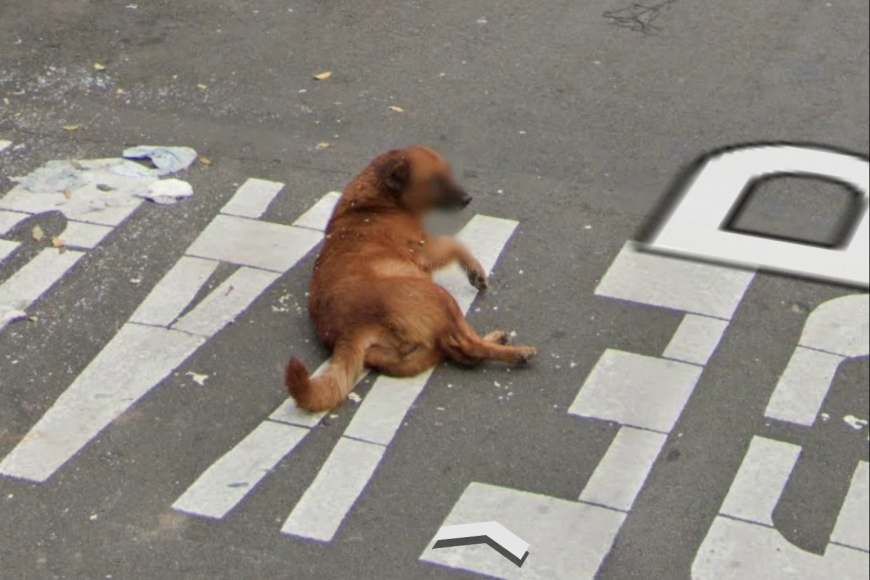
We have probably all thought about the influence of digital logic and algorithms on our perception of the world at some point. This equally humorous and profound short film takes the interactive online tour service “Google Street View” as a starting point for an investigation of where the reality mapped by fifteen automatic cameras and the one perceived by human senses drift apart – and what the consequences are. The “Accidental Animals” that happened to come across the lenses of Google cars defy the claim that every area, however remote, is reproduced as realistically as possible. Instead, their appearance in the frame produces unintentionally funny situations. Like glitches in the matrix, they remind us that we are watching only a patchy series of snapshots. Before we “drop” into a random place on the map, before we arrive to look around, the animals are already there. The fact that Google’s technology blurs many of those bird, dog and pig faces – like ours – to protect personality rights furnishes the directors with the perfect excuse for a provocative question: How is it that in this respect the algorithm acts more ethically than the humans who programmed it?
A woman in love ventures out of her cocoon to go out into the mundane world of “dead language.” Two universes meet in raw, intimate drawings, shimmering stones and overpainted video sequences.
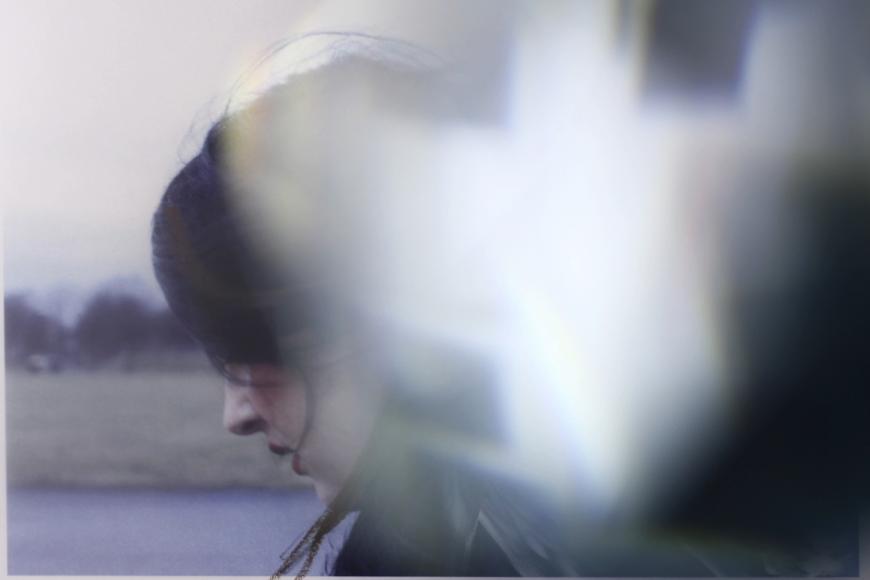
The truth is hidden behind blurs, but the allure of secrecy fades as the clarity increases. A woman in love ventures out of her cocoon to go out into the mundane world of “dead language.” Accompanied by a restless musical motif by Marian Mentrup, “Achill” boldly balances on the thin line between two universes – with raw, intimate drawings, shimmering stones and overpainted video sequences.
Joel repairs engines, but now his own is overheating because of his side job as a gangster’s henchman. He must take a decision. A breathless ride through Mexico City begins.
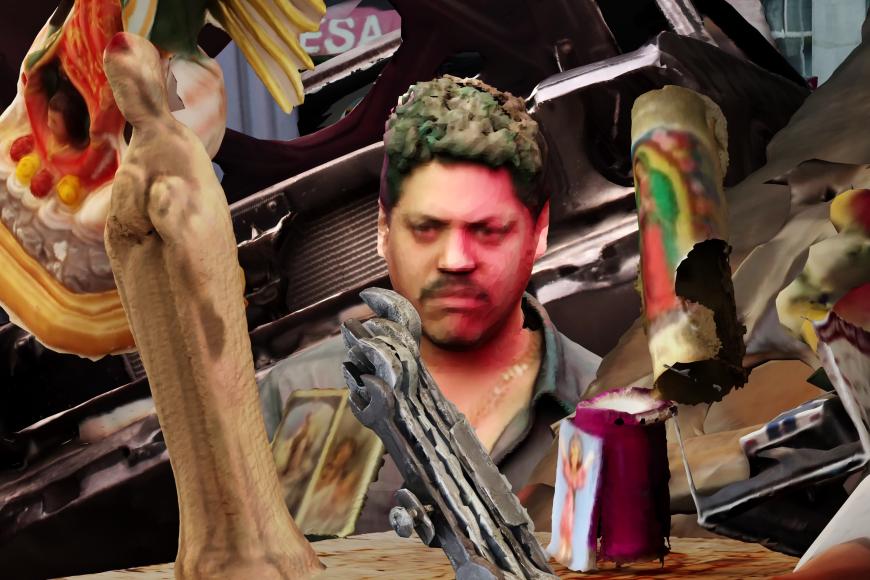
At some point years ago, Joel’s life took a wrong turn. He let himself be drawn in by the energy of unscrupulous gangsters to run criminal errands for a pittance. He has known his way around envelops and guns ever since. But now the day has come when he wants to leave the sinister night shifts behind and follow his actual destiny: repairing motors, keeping his car repair shop in Mexico City afloat and getting people moving. But the gang boss chooses the birthday of Joel’s beloved nephew of all days to direct him to a last job. Joel must debate this with himself and, above all, make a decision. Director Esteban Azuela stages this debate in a space of passage between this world and the next, where decisions can no longer be revised, only relived. With an intricately composed mix of memory fragments, car body parts and existential junk he adequately brings his protagonist’s breathless existence to the big screen. Jagged 3D scans animated in single-frame captures as well as camera angles and plotlines from the early days of ego shooter games stylishly evoke the urban Mexico of the 1990s: heated, threatening, refusing to stand still.
Andreas Körner
Credits
Director
Esteban Azuela
Script
Esteban Azuela
Editor
Pedro G. Garcia
Producer
Daniel Cabrera Guzmán Belmont, Esteban Azuela
Sound Design
José Miguel Enríquez
Score
Héctor Ruiz, Raúl Topete Torre, María Bonita, Álvaro Lamadrid Isoar
From ritual dance performances on the Indonesian island of Java, to colonialist film images, to an intervention at the Amsterdam Rijksmuseum: T.A. Kusno settles the score with colonialism.
The powerful interventions of the Indonesian artist, cultural studies scholar and filmmaker Timoteus Anggawan Kusno are internationally renowned. What distinguishes them are the empowering attitude and the breathtaking aesthetics he employs to re-interpret in different media the cultural traditions passed on in his homeland. With “Afterlives”, he delivers another unequivocal reckoning with the representations of history shaped by colonial annexation. The opening sequence is already a declaration: On the soundtrack we hear screaming, in which both pain and its liberating relief are manifest and united. On screen we see an explosion of colours: Jathilan, a ritual Javanese war game, is being performed. Men are dancing on horses made of plaited bamboo until they fall into a trance or the evil spirits are driven away. The impressive precision of the editing to tribal trance music by Setabuhan makes the colonialist archive images expose themselves – and fade. Those of (dance) performances in which the Javan tiger, killed multiple times in historic rituals, is symbolically reanimated come to the fore. In the Rijksmuseum Amsterdam, it now guards – in the shape of a re-interpreted colonial sculpture – the empty frames that once gave (representative) power to the governors-general of the Dutch East Indies.
Borjana Gaković
Credits
Director
Timoteus Anggawan Kusno
Script
Timoteus Anggawan Kusno
Cinematographer
Aditya Kresna, Krisna E. Putranto, Timoteus Anggawan Kusno
Marwan Salamah was delegated by the Palestine Liberation Organization to study in Babelsberg. As a one-man team, he realised this portrait of a young educator in a PLO orphanage in Tunis.
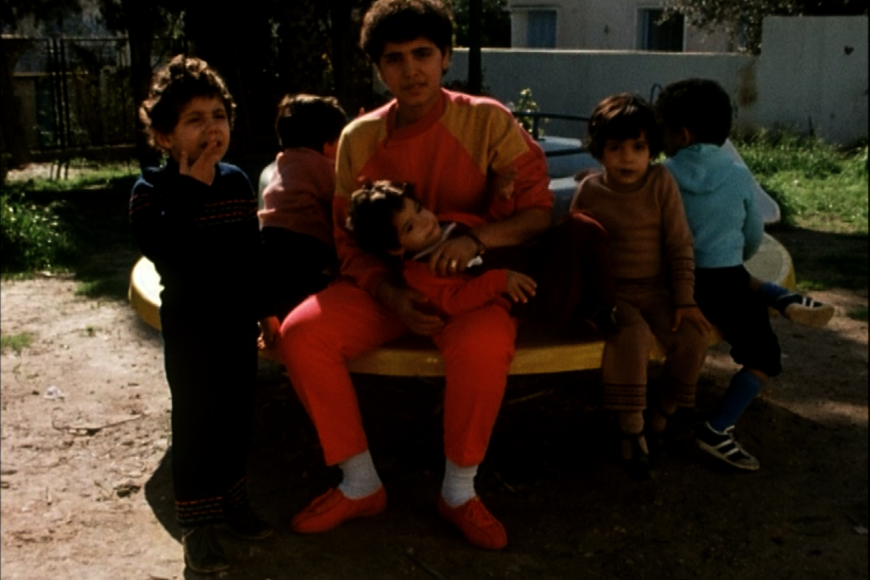
Words of the poet Mahmoud Darwish float through this film: “Tell me. Perhaps I will remember my home whose perfume is only on my lips.” A 17-year-old Palestinian introduces herself: Aida, the returning one. When her father was killed in battle, her mother was already dead, killed by a bomb. When she was eight, she was sent to a PLO orphanage in Beirut, then to an orphanage in Damascus, then to an orphanage in Tunis. Here she takes care of new orphans. The portrait of a girl expands: countless children who will forget their homeland and origin. There is nothing but war left in their drawings. The PLO had assigned its collaborator Marwan Salamah to study cinematography at Babelsberg. Here, he is also the director. In 1985, “Aida” won the Prize of the World Federation of Democratic Youth in Leipzig.
Among the Palms the Bomb, Or: Looking for Reflections in the Toxic Field of Plenty
Lukas Marxt, Vanja Smiljanić
The Salton Sea, a former nuclear testing ground on the brink of ecological collapse. The few people who still live here are campaigning to protect the abandoned area.
Among the Palms the Bomb, Or: Looking for Reflections in the Toxic Field of Plenty
Among the Palms the Bomb, Or: Looking for Reflections in the Toxic Field of Plenty
Lukas Marxt, Vanja Smiljanić
Camera Lucida 2024
Documentary Film
Austria,
Germany
2024
86 minutes
English
Subtitles:
English
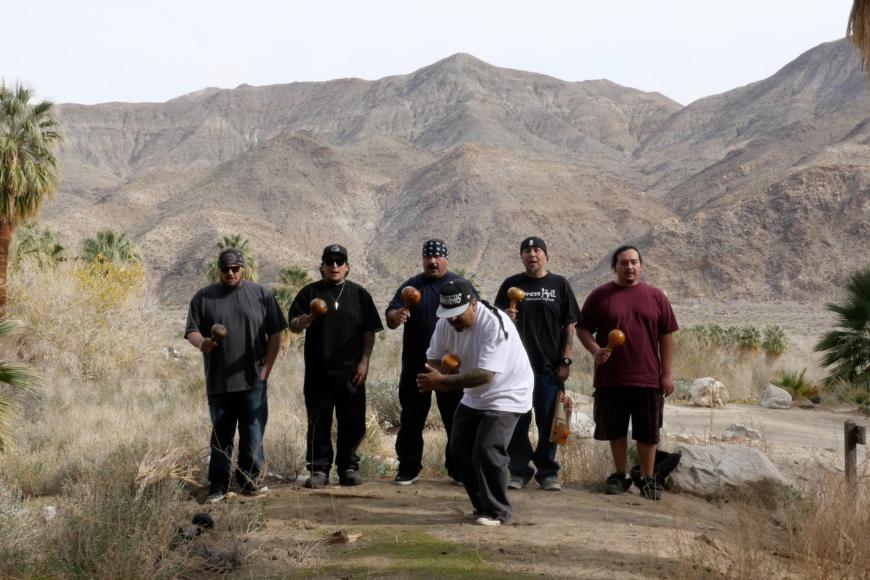
Where the sandy beach of the Salton Sea, the biggest lake in California, begins to crunch harder, it does not even consist of sand any more: Millions of dead fish, plants and insects pile up on the shore to form a highly toxic substance. This is how Derek explains it, a member of a Cahuilla tribe that managed to escape an attempted genocide in the 19th century to the Salton Sea and now sees itself as a protective force for the once flourishing but increasingly deserted area and its outcasts. Derek is one of the many locals whose trails Lukas Marxt and Vanja Smiljanić calmly follow, gliding with them through the desolate landscapes. In the process, they pick up slivers of nuclear history time and again: During the Second World War, the area was a test site for the bombs that were dropped on Hiroshima and Nagasaki. The experiments continued through the Cold War; the armed forces are still training here. The film finds its starting point and end two states away: The nuclear devices were sent on their way from Wendover, Utah. The local Airfield Museum pays tribute to their development. Once, the camera performs an almost weightless dance around a model of the Hiroshima bomb “Little Boy” on display there, to the sounds of the indestructible World War classic “We’ll Meet Again.”
A human-amphibian hybrid creature wriggles through a post-apocalyptic world. A masterful avant-garde balancing act between dance, performance and puppet theatre.
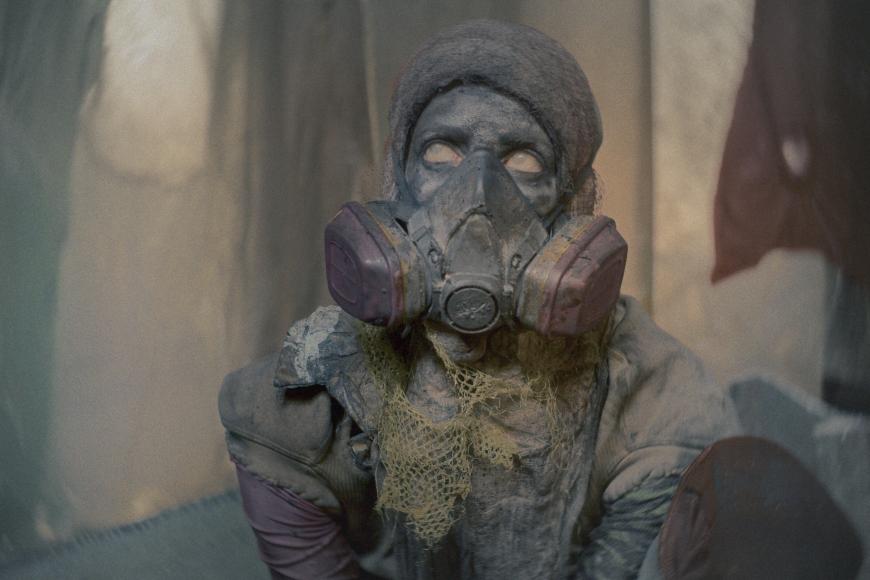
A slight body, wrapped in dusty rags. The gas mask on the face reveals only a tired pair of eyes with almost extinguished pupils. The figure slowly winds its way through a grey landscape of crumbling concrete and rusty iron parts. The human-amphibian hybrid contorts itself so bizarrely in this post-apocalyptic world that the laws of physics seem suspended. It is unclear what is up and down, almost impossible to determine on which planet the action is taking place. Observed by other fantastic chimeras, the creature sneaks out of its hiding place again and again to find water for a modest bath. This avant-garde balancing act between documentary remnants of civilisations, found footage, dance, performance, puppetry and pantomime finds fascinating ways to push familiar definitions of animation to the limit – and beyond. With superbly staged movement choreographies, clever visual ideas and outstanding audio design, Niles Atallah makes a different kind of tale shine brightly.
Motion is the art that binds the changing characters of this AR-project, which are drawn by exhibition visitors. An artwork created by all, always fluctuating.
Art is often in the unseen, and in this AR project art is in the motion. Motion is what brings together the changing characters, drawn by exhibition visitors and updated daily. By bringing anyone and everyone’s artwork to the Museum der bildenden Künste Leipzig, this piece challenges the notion of authorship in the art space. Come draw!
Nail polish, a general, a mule. John Smith recites from a text by the linguist Herbert H. Clark. The words evoke appropriate images, but mean something different.
It was only long after the end of the GDR that the Leipzig audiences had an opportunity to get to know the work of John Smith, the British master of the trenchant, short artist film that continues to expand enormously in the mind. The ideas of conceptual art and structural minimalism prevalent in the 1970s have influenced his works, which he sees as documentary films according to John Grierson’s definition, as “creative treatment of actuality.” In his view of the world details are highlighted which then cease to be taken for granted. In “Associations”, he recites a text by the linguist Herbert H. Clark. Words conjure up matching images, but mean something different. An experience that could also be had in the “actually existing socialism” of the GDR.
A school in Berlin that offers subjects like horticulture and animal care. The film portrays a group of young people between lessons, childhood and adulthood.
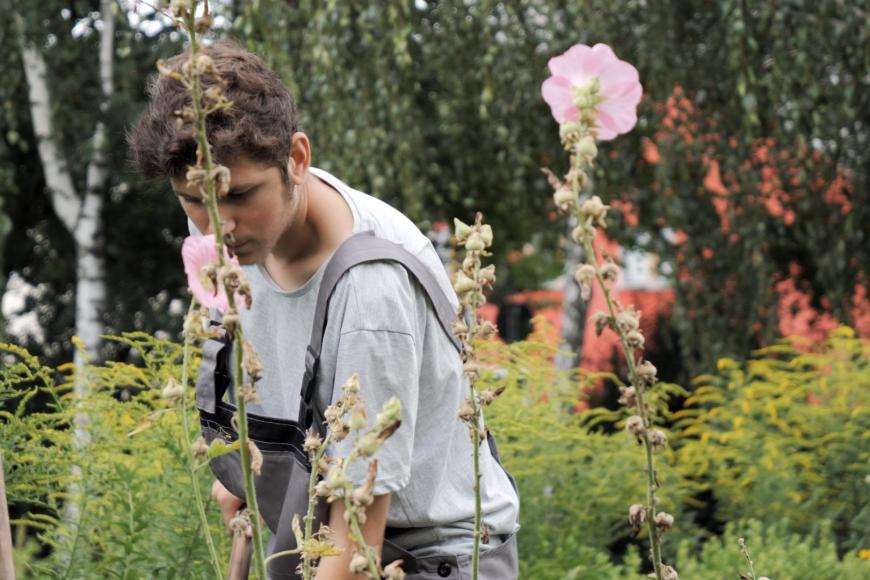
Can school be exciting and even fun? The integrative pre-vocational August Sander school in Berlin-Friedrichshain at least seems the perfect place for this. The noise of the cars of the big city can be heard from the distance, birds are singing on the lush green grounds. Lessons here include horticulture, agriculture and animal care. And when you watch the students weed garden plots and feed rabbits, things look extremely enviable at first glance. But of course, even in this paradisiacal place there are conflicts, annoying teachers and the anxious question: What comes after graduation? This documentary follows the school life of a group of pupils with different learning disorders and other impairments over one school year. At its focus are young people who are on the way from training to work, from childhood to adulthood, and struggle to find their place in the narrow regulatory system of school and in society.
A religious community have created their model town in the Siberian wasteland. A long-term study and post-Soviet narrative, while the
militarisation of the country draws closer.
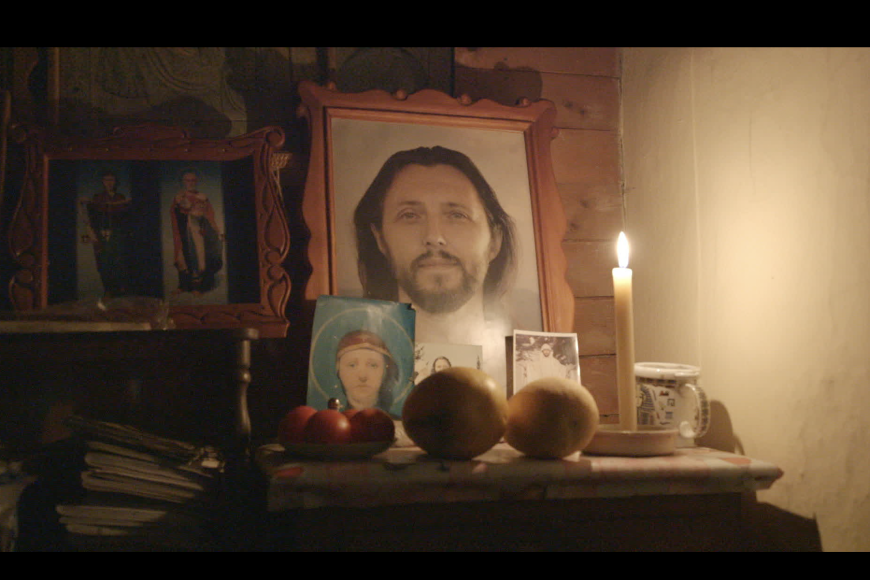
The winters in the Siberian taiga may be long, but at least Moscow is far away. In the early 1990s, a religious community lead by former traffic cop Sergei Torop settled in the endless landscape at the foot of the eastern Sayan Mountains. After a religious revival he calls himself Vissarion, wears flowing robes, long hair and acts as the Son of God on earth. Misty-coloured portraits on which “the Teacher” gazes obliviously into the distance hang in the homes of his followers. Together they have created the model town of “Abode of Dawn”, also called “Sun City” by the locals, to build a new society. Director Kristina Shtubert travelled to Siberia five times between 2013 and 2022. Her gaze is observational, less concerned with the search of faith and meaning than with the question whether the Sun City dwellers are happier here than in their discarded lives. And what would their alternatives be? More and more, the long-term observation turns into a post-Soviet narrative of a faded-out state. Meanwhile, the militarisation of the country progresses. Moscow is coming closer.
Anke Leweke
Credits
Director
Kristina Shtubert
Cinematographer
Hanna Mayser
Editor
Dietmar Kraus, Calle Overweg, Adrienne Hudson
Producer
DFFB Deutsche Film- und Fernsehakademie Berlin
Co-Producer
Kristina Shtubert, Rolf Bergmann
Sound Design
Sasha Valent
Production Company
DFFB Deutsche Film- und Fernsehakademie Berlin
-
Andreas Louis, Margarita Amineva-Jester
Nominated for:
Leipziger Ring,
DEFA Sponsoring Prize,
VER.DI Prize for Solidarity, Humanity and Fairness,
MDR Film Prize