A box of film material from Tito-era Yugoslavia becomes a narrative engine. With dry wit and philosophical verve, this essay burrows through family and contemporary history.
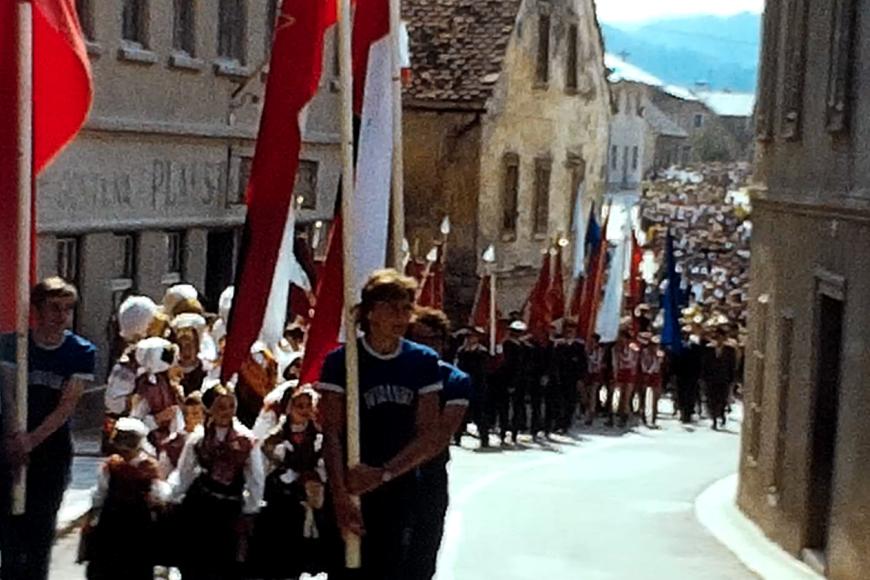
Tomaž Pavkovič finds reams of film material in a box that tells not only the story of his family but of a whole country: His father’s life ran almost parallel to the development of Yugoslavia, which permeates each of his recordings. The parades in the countryside, later the move to the city and life as a working-class family, in between always President Tito, even if only as a tattoo on a diver’s chest. The sons are left with the abstract memory of a state that has ceased to exist, that is itself a box. Do the images you find in the box tell you something about yourself, too?
The essayistic off-text by the Croatian poet Marko Pogačar, written in close collaboration with the director, frequently describes scenes that are shown at an entirely different point in the film – gaps yawn between the representation and one’s memory that can only be approached by circling them. To do this, not the least tools the film uses are an idiosyncratic, driving selection of music and a good dose of dry humour.
Insights into the Russian opposition before the war in Ukraine. In the Yekaterinburg metropolis, only a few take to the streets against Putin. There is a lack of support – but not of courage.
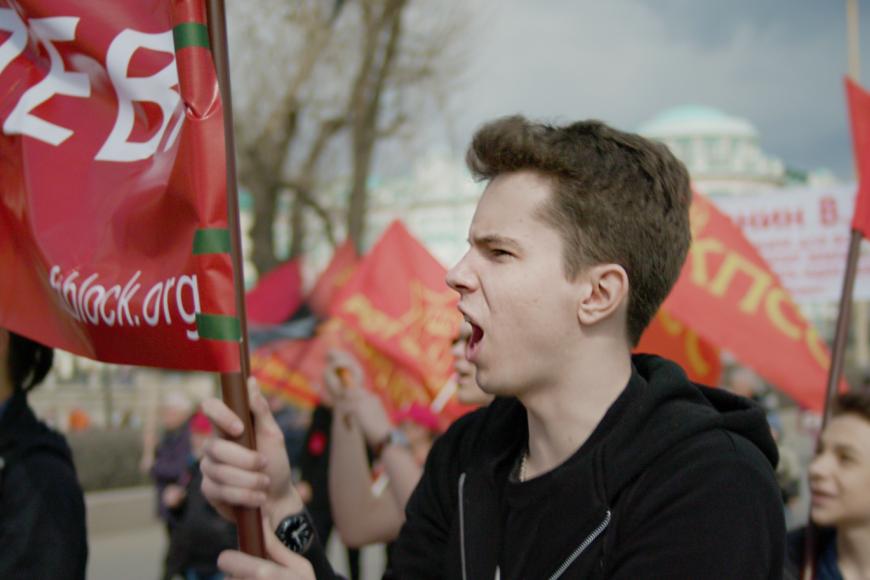
In the passing busses and trams, people look out of the windows in disbelief. The reverse shot shows a crowd of protesters. Two dozen people perhaps, some holding signs, one shouting “Putin behind bars!” It is a symbolic image of the pathetic state of the Russian opposition. The year is 2017, the war of aggression against Ukraine is still to come. Over a period of several years, “The Last Relic” portrays people from different opposition groups: a student from the Marxist-Leninist “Left Block,” a teacher with sympathies for Navalny; a digger driver demands the redistribution of resources. These activists lack support, but not courage. One of them has just been released from prison and survived a hunger strike. The others must expect to be prosecuted at any moment.
The setting of this film is the Ural metropolis of Yekaterinburg. The bulk of the population, an insert announces, dreams of a “return to imperial glory.” Estonian director Marianna Kaat, born in 1965, has spent a considerable part of her life in the Soviet empire. She shows the majority society as a uniform crowd at military parades, contrasting it with the individuals of the opposition. Few films offer such insights into the latter’s continuing precarious situation.