A naïve and pushy reporter travels to the provinces to find out about the state of equal rights in practice. A film curiosity of enlightening absurdity.
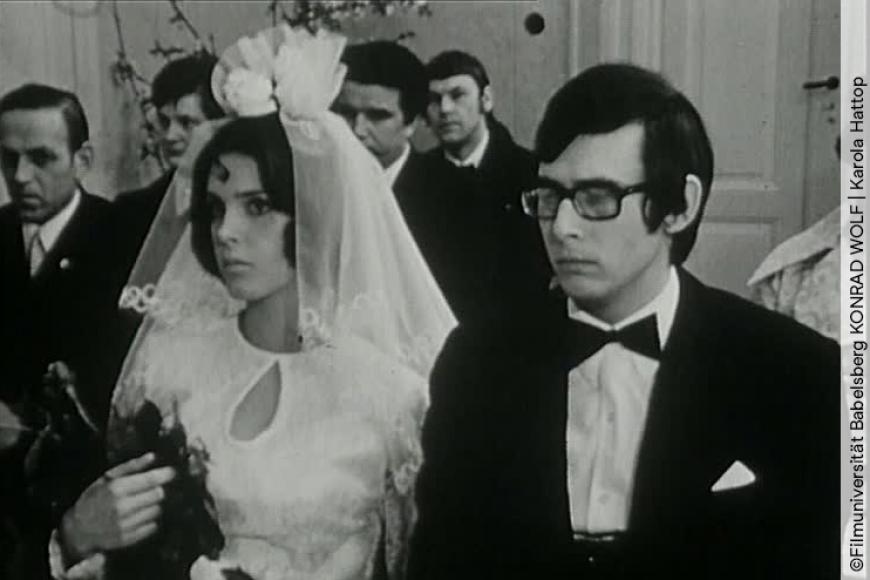
Karola Hattop juxtaposes the many media images of confident working women and the men who support them with a naïve reporter who finds out that in practice equal rights are often quite a different matter. Somewhat pushy, he seeks out women at the hairdresser’s and in the maternity wear department, joins functionaries in their cars, crashes wedding parties and sneaks into museum tours for children. A revelatory curiosity full of the casually captured mundane drabness that was often revealed more clearly in student films than in comparable DEFA productions.
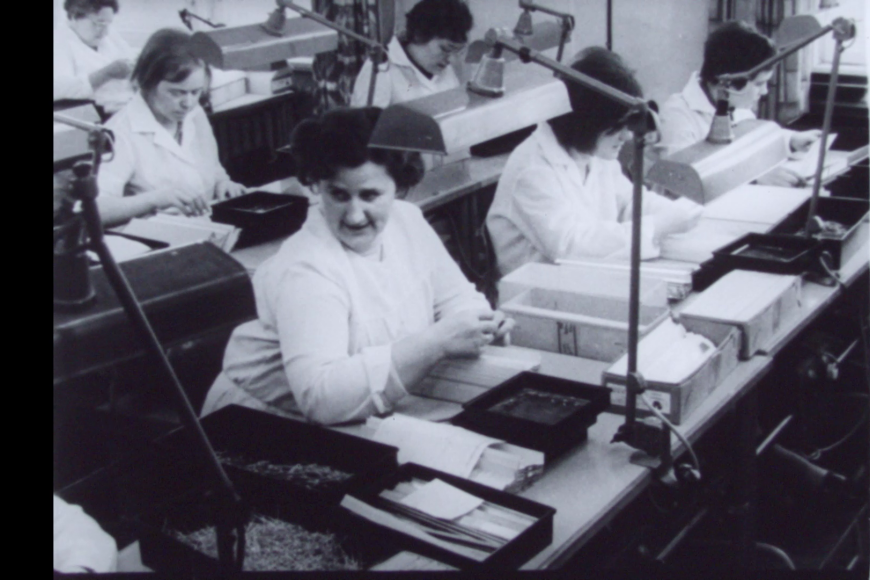
According to the film’s voice-over, it is the duty of a factory’s women’s committee to “exert a constant influence on systematic ideological-political and technical qualification”.
The women’s committees in the GDR factories promote the technical and ideological-political qualification of female staff members. However, the film identifies deficits in the women’s private environment, since the men by their side often support their professional development only to a limited extent and the women’s multiple responsibilities persist despite state support.
An animated folkloristic Western, using clichés, local stereotypes and national myths to sketch a kind of satirical profile of “wild” Slovenia, its colourful costumes and strange customs. Boris Dolenc has adapted a cartoon by Vladan Nikolić, who in turn drew on the motifs and visual language of the painted beehive boards typical of Slovenia.
Lina Dinkla
Credits
Director
Boris Dolenc
Script
Sandra Ržen
Editor
Boris Dolenc
Producer
Eva Rohrmann
Co-Producer
Jure Vizjak, Jaka Oman
Sound
Julij Zornik, Igor Iskra, Jure Strajnak, Peter Žerovnik, Samo Jurca
Narimane Mari dedicates a touching portrait that tells of parting to her now deceased companion, the artist Michel Haas. A contemplative tribute to love.
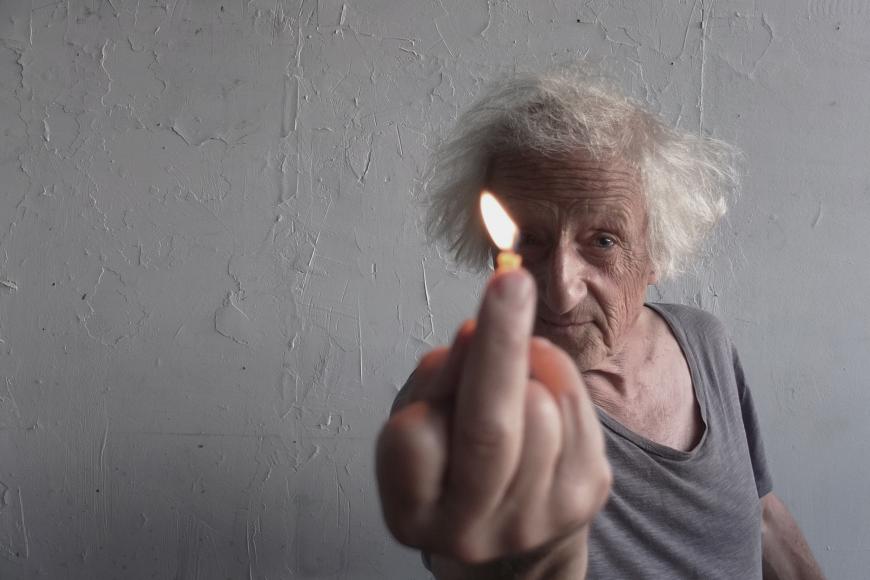
Narimane Mari dedicates a touching portrait that tells of parting to her now deceased lover, the artist Michel Haas. She captures first and foremost the small, everyday moments – street scenes, working at the studio, watching films together, reading to each other in bed. The absence of a traditional narration, long shots and intense conversations invite us to think about our own relationship with temporality.
A recurring potpourri of poems, prose and music by Nâzım Hikmet, Stéphane Mallarmé through to Sun Ra gives the film its very own leisurely rhythm. The scenes at the studio are carried by this mood, too. As with Jackson Pollock, the art is created mostly on the floor. But Michel Haas works with ink, large-format paper sheets and hot water instead of canvas and thinned paint. Humming happily, he hits the soaked paper with his bare hands until edges, creases and folds form. The abstract outlines and flat shapes are recognisable as figures only when viewed from a distance: Often, they are intertwined couples. A contemplative tribute to love.
A hungry and solitary weasel roams the dry landscape, intent on hunting the last remaining birds in a tree. The birds try to keep the tree in balance while the weasel doggedly climbs its trunk. The tree sways, the stomach growls, the weasel persists until it’s too late. A classic anti-hero cartoon – not just for children.
Prenzlauer Berg depends on reliable coal deliveries, even in the watershed year of 1989. Renate Uhle and her men deliver the briquets, followed by a direct camera.
Coal briquets hit the waggon with a thundering sound, are loaded, unloaded and finally end up in the houses of Prenzlauer Berg. Renate Uhle is the owner of a coal shop run by her family since 1922. Together with her men – Klaus, Kalle, Manne, Erwin, Pummel, Felix and Würstchen – she sees to it that no one in the neighbourhood freezes. Work is hard, the afterwork beer obligatory, and Renate’s tongue quick and sensitive. Helke Misselwitz follows the workers on their chugging diesel-driven ants through the streets and the watershed year of 1989, sweats with them as they climb up endless stairs and listens to them through the cigarette smoke.
When There Is No More Music to Write, and Other Roman Stories
When There Is No More Music to Write, and Other Roman Stories
Éric Baudelaire
Camera Lucida 2022
Documentary Film
France
2022
59 minutes
English
Subtitles:
None
The kidnapping and murder of the politician Aldo Moro; four slashed tyres that were to save a florist’s life; the lost soundtrack to Antonioni’s film “Zabriskie Point”; the meeting of two avant-garde composers; archive material and found footage – these are the elements of this “freely composed” film that is imbued with the city of Rome and juxtaposes the human urge for constant rebellion and the thesis of the end of history.
For the US electronic composer Alvin Curran, whose intellectual and artistic world are at the centre of Éric Baudelaire’s exceptionally rich collage, music is a vehicle that carries us to places we have never travelled before. In Rome, where Curran settled in the 1960s, he met his then considerably more experienced professional colleague Franco Evangelisti, who shocked him with the question: “Don’t you know that there’s no more music to write?” Baudelaire’s congenial montage of image and sound fragments suggests that Curran’s solo work – as well as his collaboration with the pioneering collective “Musica Elettronica Viva” – is the answer to Evangelisti’s question: We have to keep reassembling the world.
The video diary of a Kyiv artist fluctuating between fear, agony and activism in the face of life in wartimes, for which she finds touching words and images.
With this personal video diary from Kyiv, artist Hanna Trofimova manages to make us comprehend something of how the war infiltrates and destroys life and everyday routines, even if one’s own apartment has not been hit by a bomb yet. Images of an oppressive “normality” between alarm sirens and explosions are combined with the touching words of a young woman who tries not to lose herself and her life to the new reality.
A mother, a daughter, their close relationship and the question why sex does strange things to people. The cinematic reappraisal of a trauma, complete with a few show numbers.
“Sex does strange things to people!” This sentence reverberates from her childhood. What did her mother mean? What fears did she pass on to Emma? The budding filmmaker sets up the camera in her mother’s apartment, invites mum’s friends, creates an open atmosphere. Coby opens up more and more, talks about a repressed topic. At the same time, she gets to show a wholly different side of herself, performing song and dance numbers in front of her daughter’s lens.
The summer after graduation: Own life plans and expectations of the parents’ generation collide. While Shuli films his friends with a Super 8 camera, his mother wants nothing more than for him to get married. She resolutely refuses to speak about the fact that her son loves men and has been living with his boyfriend in Beijing for years. A deafening silence. Idyllic family pictures are overlaid by a long overdue confrontation.
Marie Kloos
Credits
Director
Shuli Huang
Cinematographer
Shuli Huang
Editor
Shuli Huang
Producer
Shuli Huang
Sound
Nicolas Verhaeghe, Jingxi Guo
World Sales
Flavio Armone
Winner of:
Golden Dove Short Documentary (International Competition Short Film)
Environmental protection was firmly anchored in the legislation of the industrial state of the GDR. The tension between exploitation and preservation of nature, however, seemed unresolvable.
On the occasion of the GDR Landeskulturgesetz (Law on the Conservation and Protection of the Environment), passed in 1970, the speaker explains the various aspects of environmental protection through vivid, visually pointed examples. The film repeatedly refers to the fundamental contradiction between exploitation and preservation of nature in a developed industrial state but is unable to resolve it.