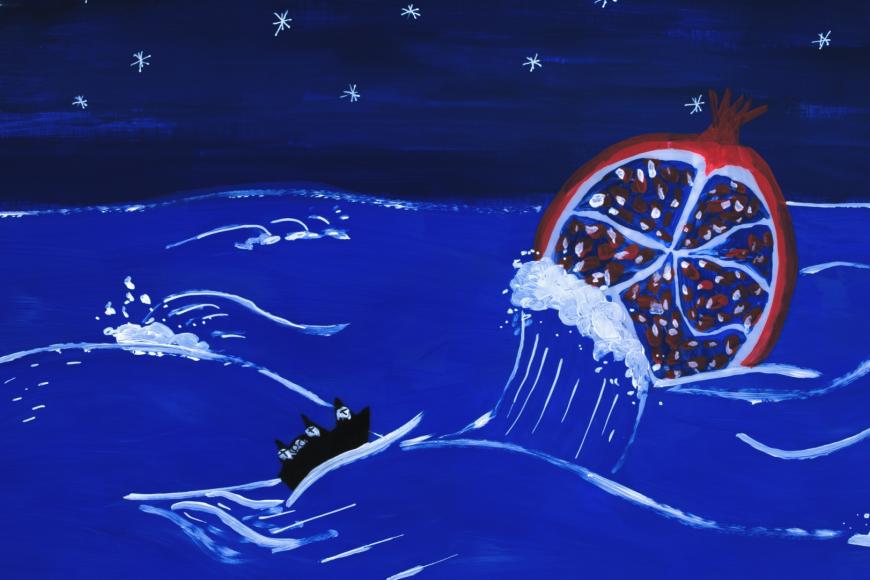
A young Swiss woman searches for her Armenian roots. A wooden wardrobe roaming through night-blue landscapes forms the leitmotif of her critical feminine family historiography.
A young Swiss woman searches for her Armenian roots. Various lovingly animated drawers of the simultaneously accumulating family archive open. This very personal examination of collective traumas of post-migrant communities finds images and words for racism and the difficulties of talking about feelings with male family members. Its leitmotif is a wardrobe roaming through night-blue landscapes which – despite the cracks – holds everything and everyone together.
To animate means to bring to life, but that’s precisely what this architectural film does by means of a machine. What happens when an AI is entrusted with the creation of art?
Her “artificial assistant” is what Claudia Larcher calls the AI that digitally analysed her analogue “Baumeister” series of collages and generated this film from them. Creator or servant spirit, the machine makes architectural sketches waft biomorphically and enlivens (i.e. animates) rigid shapes. The Japanese Metabolists who called for the fluid renewal of their buildings, the organic growth, deformation and decay of architecture, would have liked “The Artist in the Machine”.