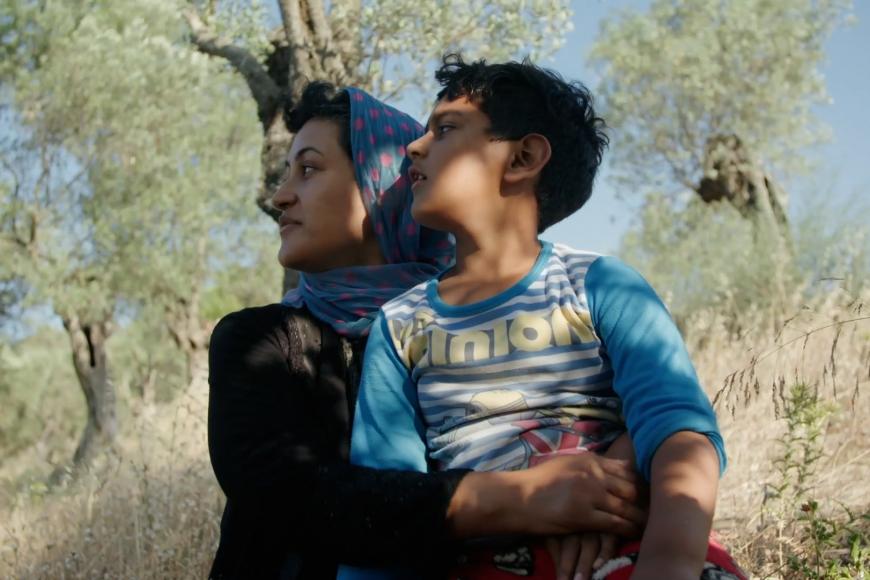
Sensitive and intimate portrait of an Afghan woman and her family in the Moria refugee camp on the Greek island of Lesbos – before and while the camp went up in flames.
German Subtitles for deaf and hard-of-hearing, English
For eight months, Ole Jacobs’s and Arne Büttner’s film team followed the Afghan Nasim and her family in the Moria refugee camp on the Greek island of Lesbos, where at times 20,000 people had to live in a space designed for less than 3,000 people. This documentary observation shows with great empathy the daily life of the mother of two who time and again manages to deal impressively with the challenges of this unacceptable and extreme situation.
Nasim previously lived with her family in Iran, where she had already endured discrimination. Her marriage is broken; the camera gingerly captures the mute conflicts with her husband – glances tell everything. Nasim suffers from rheumatism and can hardly move her hands, but she finds loving words to explain this – to her own children and others from over the way. For a while, she even fills in for the school teacher who has left: “Today we will be painting …” She herself, however, is denied the understanding she always shows for others: Everyone around her thinks they know better what she needs. When the camp goes up in flames in September 2020, every hope of a better world seems lost. Nasim is left to fend for herself – but perhaps this new disaster is a chance in disguise.
Borjana Gaković
Credits
Director
Ole Jacobs, Arne Büttner
Cinematographer
Arne Büttner
Editor
Janina Herhoffer
Producer
Ray Peter Maletzki, Ayla Güney, Stephan Helmut Beier
Co-Producer
Ole Jacobs, Arne Büttner
Sound
Ole Jacobs, Azadeh Zandieh
Performer
Nasima Tajik
Winner of:
DEFA Sponsoring Prize,
ver.di Prize for Solidarity, Humanity and Fairness
A neighbourhood dispute escalates … The pixilated movements of actors and scenery seem more and more absurd, heightened by the frantic sounds of the hand-drawn soundtrack.
An escalating neighbourhood dispute as a pacifist parable on the Korean War. The pixilation, which Norman McLaren is said to have pioneered, makes plot and scenery look more and more absurd. The madness is heihgtened by frantic electronic sounds, which were also created by a special technique: McLaren drew optical sound signals in lines and dots by hand directly on the soundtrack.
Manuela was four years old when her parents went abroad to work. She is growing up with her grandparents in Cameroon and has learned to cope with absence.
Manuela lives in Cameroon and was four years old when her parents went abroad to work. She’s eleven now and preparing for her first graduation. She is growing up with her grandparents and, despite leading a good life, had to struggle with grief for a long time. Now she has learned how to cope with absence and how to be together despite the long distance.
A background study of a dying amusement culture, filmed in slovenly dressing rooms in front of badly polished make-up mirrors. – That’s how far editor Mary Stephen follows director Yoichiro Okutani’s montage interpretation of his own footage about the Japanese strippers called Odoriko. But Stephen’s editor’s cut begins fully dressed: a tastefully lit stage overture in costume, starting from which she rearranges or rather sheds the material, reintegrating image and sound sequences originally discarded by Okutani, for example the titular statement of an Odoriko explaining her choice of profession: “It was about being nude at heart.”
Paul Celan, creator of the “Death Fugue”, shaped the West German reception history of Resnais’ film with the lyrical rhythm and tense switches of his translation.
“Le sang a caillé, les bouches se sont tues,” Jean Cayrol writes. Paul Celan translates: “The blood has congealed, the mouths have fallen silent.” Alain Resnais’ archive film about the National Socialist concentration camps set new standards for the essayistic form. The score by Hanns Eisler had nothing to fear from changes to another language version. But the words of Jean Cayrol, more elegy than commentary? Paul Celan, creator of the “Death Fugue” and already associated with Cayrol as his translator, was asked to translate it into German. His lyrical rhythm, his tense switches deviating from the original text have shaped the West German reception history of Resnais’ film.
Henryk Keisch’s new translation for DEFA made up for Paul Celan’s omissions. In his version of the text, the Soviet Union, left out of the FRG version, returned to the circle of Nazi victims.
“Le sang a caillé, les bouches se sont tues,” Jean Cayrol writes. Henryk Keisch translates: “The blood has dried, the mouths have fallen silent.” When Resnais’ film was to be licensed for theatrical release in the GDR, it seemed obvious to resort to the West German dubbed version. But Celan’s translation failed to meet the approval of DEFA. They found fault with elisions that, for example, omitted the deportees from the Soviet Union. The official correspondence ended on an apodictic note: The acquisition was considered “irresponsible”. The writer and translator Henryk Keisch, loyal to the party line, was commissioned to write a new version – and of course made up for Celan’s omissions.