Grandfather fortune teller, father developer, son filmmaker: A portrait of generations about tradition and change, violence and alienation in Chinese society.
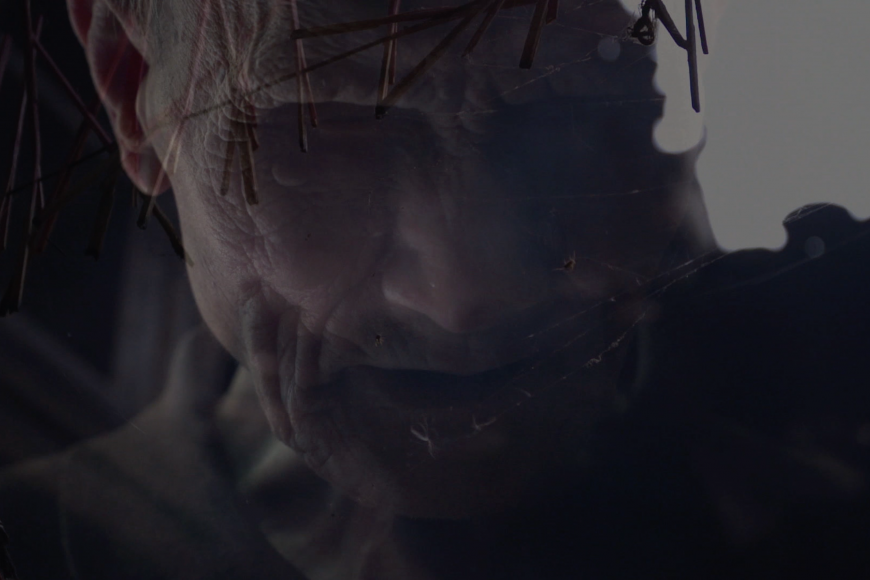
“After I die, show your film at my funeral!” Zuogui, the director’s grandfather, is 86 years old and has been blind since childhood. Becoming a fortune teller was a way out of poverty for him. People are still coming to him for advice, including his son Donggu, a developer: “Dad, how is my fortune next year?” In his portrait of generations about his father and grandfather, Wei Deng depicts tradition and change, violence and alienation in Chinese society.
Pale greys and dim lights create an atmosphere that seems to correspond to the dark memories of famine, dead siblings and the violently enforced one-child policy. The camera stays close to the grandfather as he feels his way along the walls of his flat. Orienting himself in his own environment has become harder since Donggu had the old house torn down and a new one built. Zuogui has little use for the modern China that claims to stand for economic boom and prosperity. Only when another of his son’s developments, which the fortune teller had warned against, threatens to fail does affection between the two seem possible again.
Jan-Philipp Kohlmann
Credits
Director
Wei Deng
Cinematographer
Wei Deng
Editor
Wei Deng
Producer
Wei Deng
Nominated for:
FIPRESCI Prize,
Prize of the Interreligious Jury
Winner of:
Golden Dove (International Competition)
A change of perspective on migration to Europe: Having returned because she missed her children, Fati meets with little understanding in her Ghanaian home village.
A beach reminds us of Fati’s recent past. She came to Italy by sea, without papers, pregnant for the fifth time. Longing for her children, she returned to Ghana six months later – without her husband. The people around her can’t understand this decision. “You’ve created a mess,” a friend says. “How do I tell people?” a sister asks. But Fati wants to provide for her family, even though she still has to liberate three of her children from the custody of her in-laws.
Numerous recent documentaries have been dedicated to the experiences of people who arrive in the EU and get caught in the degrading conditions of asylum politics, but this work by Ghanaian director Fatimah Dadzie offers a change of perspective. In Fati’s hometown, Europe is considered a paradise – and what fool would voluntarily run away from there? The decision has lost the returnee all prestige. Her social exclusion is shown here by relatives as talking heads, directly in front of the camera. But when the film overlays everyday images of care work or street hawking with Fati’s voiceover, it gives a voice to its steadfast protagonist.
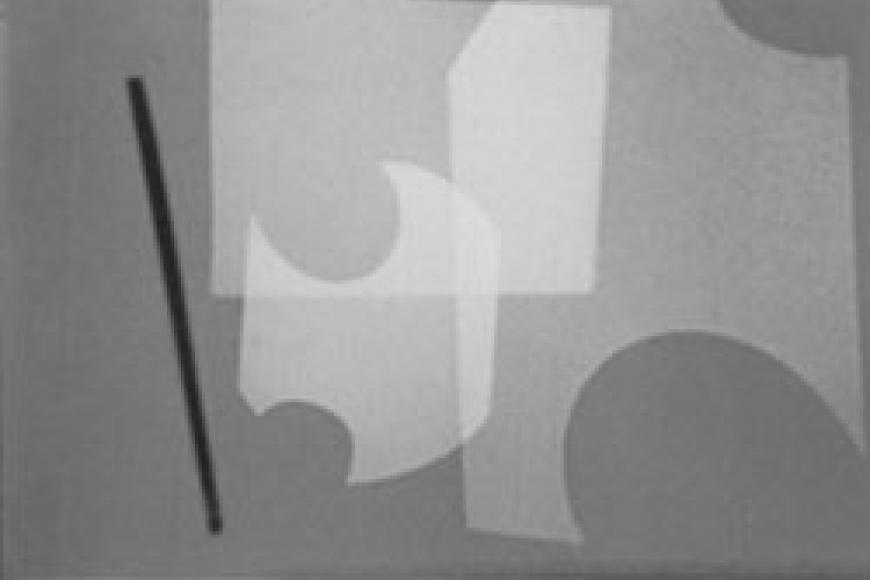
An impact pendulum writes directly on the soundtrack of the film, producing analogue bleeps and bits. In alternating coloured light, shades change their shape.
The Whitney brothers are pioneers of abstract animation. In 1943/1944, they experimented in five film exercises with modernist form and a device of their own that wrote directly on the soundtrack of the film by means of an impact pendulum. The resulting analogue electronic bleeps and bits are accompanied by moving stencils in constantly alternating coloured backlight whose shadows change their geometrical shape.
Ghostly creatures of light come to life in short dance etudes. Accompanied by percussive sounds they stretch into gaunt shapes or unfold in a thousand layers like exotic animals.
Dark percussive sounds call forth anthropomorphic creatures. They come to life in short dance etudes. Optically manipulated, they stretch into gaunt shapes, unfold in a thousand layers like exotic animals, dissolve into abstract paintings. They are pure creatures of light: fleeting, immaterial. The rhythmic sound motif colours their movements with sometimes pithy, sometimes breathy variations.
It is only after many years that Amin is able to tell his true story. An award-winning animated documentary about the traumatic experience of fleeing from Afghanistan to Denmark.
For many years, Amin was unable to speak about the experience of his flight. It is only now that he finds the courage to open up to his schoolmate, filmmaker Jonas Poher Rasmussen. From earliest childhood Amin’s life was marked by political unrest in his native country of Afghanistan and soon by growing up without a permanent home. His painful memories are visualized in haunting animations, interwoven with documentary footage.
It’s a well-known fact that flight does not lead from point A to point B and then simply ends. Amin’s story, though, shows how rocky and tortuous it can really be, leading from Afghanistan via Russia, Estonia and a few other stations to Denmark. Only when his life is on a safe track with an upcoming wedding and a good career does he find the strength to talk about what he had to go through to be where he is today. In an almost psychoanalytical setting, the protagonist – lying down – talks about his past. The narrative moves in a spiral between then and now, allowing for frequent respites between the traumatic impressions that the poignant animation makes almost physically tangible. It’s no coincidence that “Flee” has already won multiple awards and is considered an “instant classic” even now.
Kim Busch
Credits
Director
Jonas Poher Rasmussen
Script
Jonas Poher Rasmussen, Amin
Editor
Janus Billeskov Jansen
Producer
Monica Hellström, Charlotte De La Gournerie, Signe Byrge Sørensen
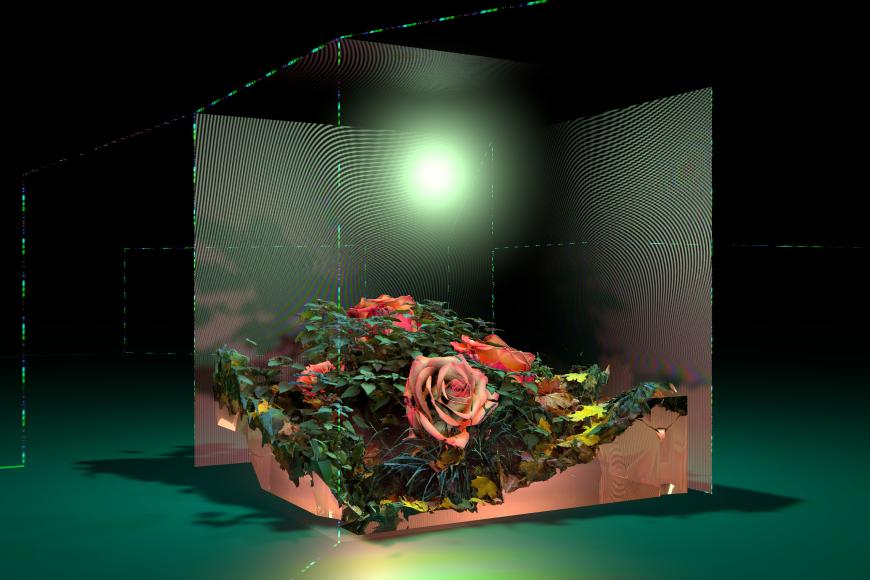
A piece of soil with plants displayed in a cabinet – three-dimensional and yet only a digital image. Forest sounds awaken leaves and blossoms; an organic rebellion flares up.
A piece of soil with plants displayed in a cabinet – three-dimensional and yet only a digital image. The sound suggests a sterile exhibition space. As forest sounds start to play, the stems, leaves and blossoms dissolve in particles and layers. As if awakening from a coma, an organic rebellion flares up, a brief revolt against the technically perfect simulation of nature.
A poetic portrait sketch in analogue film aesthetics: Living by and in the water shapes the daily life of a woman who has lovingly converted a freighter into a houseboat.
Competition for the Audience Award Short Film 2021
Documentary Film
Czech Republic
2020
6 minutes
Czech
Subtitles:
English
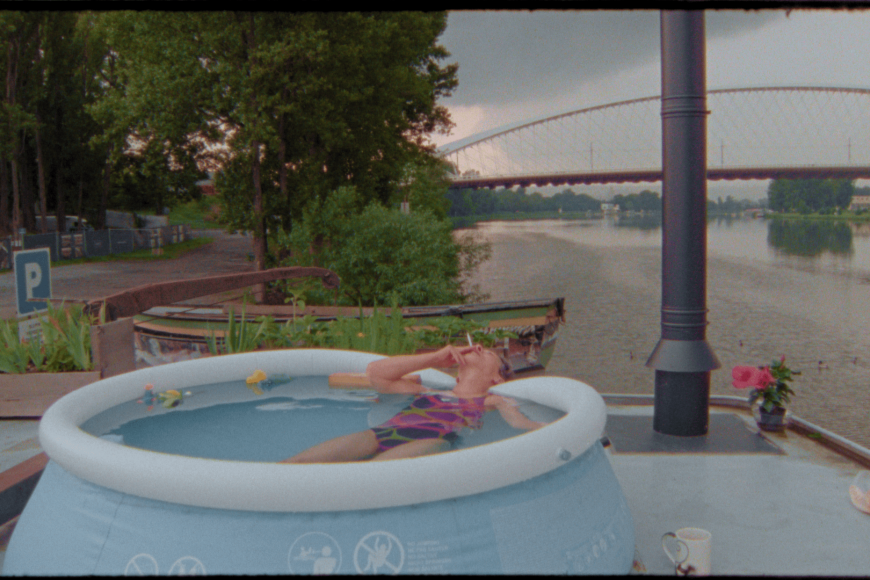
Everything splashes in this poetic portrait sketch: the rain on the roof, the dog in the puddle, the grandchildren in the kiddie pool and the protagonist in the river Vltava. A middle-aged woman has lovingly converted a freighter into a house boat. The film captures her daily life in impressionistic, analogue aesthetics, from morning coffee in her bathrobe to the last cigarette on deck at dusk. She seems to have fulfilled a wish – a life by and in the river.
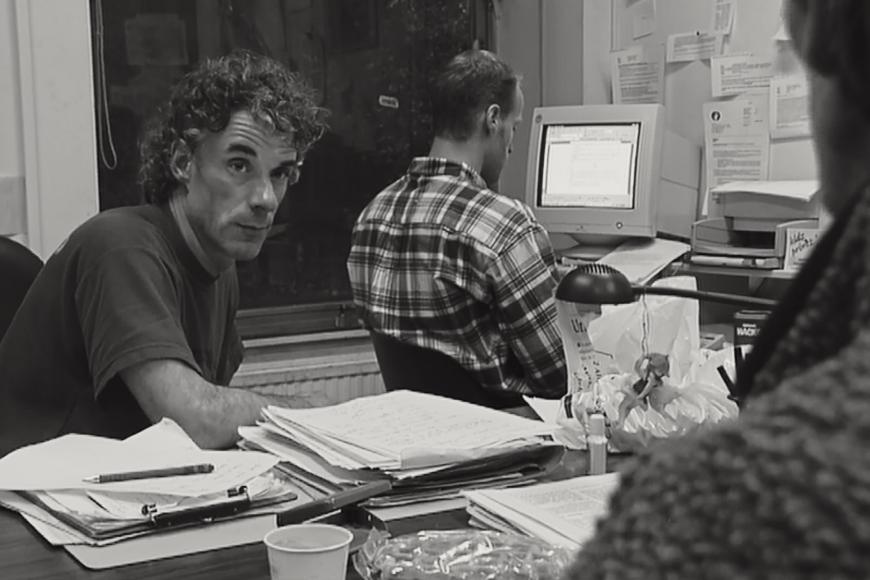
True Crime in Brussels: Inspector Lemoine has to investigate the murder of a prostitute. The discovery of a few French fries enables him to track down the perpetrator.
In Belgium and France, the documentary series “Strip-Tease” is real cult viewing. The creators of the TV production have now used more than twenty-year-old material to make a crime documentary in dirty black and white. The Brussels CID are investigating a murder case: A casual prostitute was killed in her flat. The discovery of a few French fries enables them to track down the perpetrator. True Crime.
The dead woman’s name was Kalima Sissou. Very quickly, the investigation focuses on her former boyfriend Alain, and so, in authentic, raw images, we watch Inspector Lemoine and his colleagues at work: at the crime scene, interrogating witnesses and, naturally, cross-examining the main suspect. Despite the serious character of the events, Jean Libon and Yves Hinant’s offbeat mixture of dark thriller and absurd reality comedy does not lack (black) humour. Shot in a simple cinéma-vérité style, the film does not embellish on what it shows. The creative and conceptual model is, of course, the series “Strip-Tease”, co-developed by Libon in 1985 and widely known for the unconventional, blunt and politically incorrect manner in which it tackled even delicate subjects. “For a Fistful of Fries” continues in this vein and takes us very close to the often incredibly profane action.