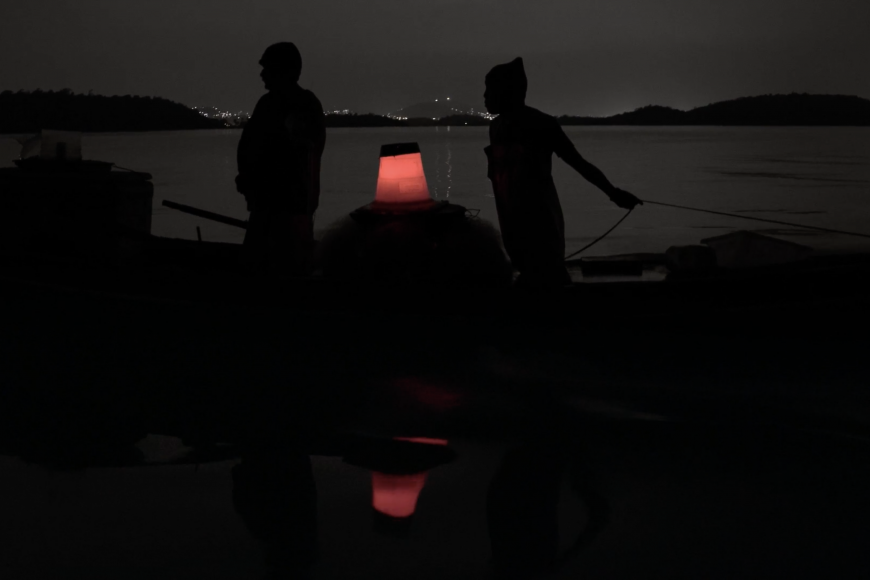
The Baía de Guanabara is not just any bay: the metropolitan area of Rio de Janeiro has sprawled around it. Its waste water threatens the rich ecosystem, planes roar along the approach corridors above. These filmic explorations on the margins of the megacity portray various environments that are all connected to the bay in a specific way. The people here are micro-wage earners making a modest living.
At night the lights of the city and the promises of capitalism shine in the distance. To the people living at the periphery, they seem out of reach. In eight chapters this documentary essay meditates on their habitats along the bay, following the repetitive and physically exhausting activities of humans and farm animals. Unusual perspectives, careful camera work and a poignant sound design elevate these observations to a commentary on the crisis in Brazil. Murilo Salles, who won a Silver Dove in Leipzig in 1978 for his debut “These Are the Weapons”, sheds light on the close link between geographical space and social inequality.
Annina Wettstein
Credits
Director
Murilo Salles
Script
Murilo Salles, Eva Randolph, Itauana Coquet
Cinematographer
Léo Bittencourt, Fabrício Mota
Editor
Eva Randolph
Producer
Murilo Salles
Sound
Felipe Luz
Score
João Jabace, Sarah Lelièvre
Nominated for:
FIPRESCI Prize,
Prize of the Interreligious Jury
Three friends explore the radiance of the Mediterranean, which connects Christian and Islamic countries and has always been and still is a site of conflicts.
English, German Subtitles for deaf and hard-of-hearing
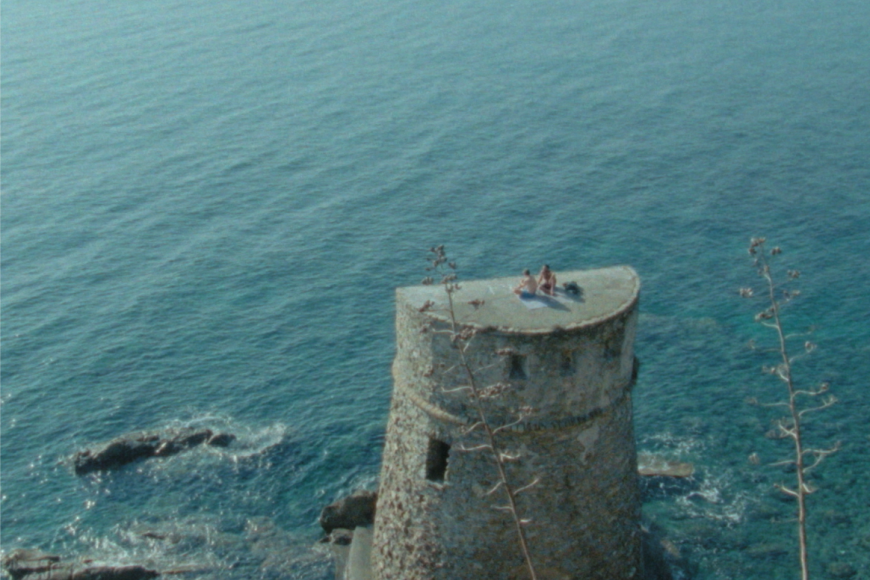
Porto Maurizio, where the director, who lives in France today, grew up, is located on the Ligurian coast. The village is the starting point for a cinematic journey into the past that spans a surprisingly wide arc to a time when Muslim pirates, the corsairs, haunted the Mediterranean and took Europeans as slaves. To this end, the film light-handedly draws from the rich fund of film history and its iconography.
Adventure films from the 1940s and historical murals depict the naval battles of the early 19th century in powerful images. The director ingeniously combines such visual finds with analogue new recordings of a journey with two friends. Their seemingly loosely told anecdotes and chance encounters combine to form a coherent whole, forming a geopolitical system of coordinates around the Mediterranean that deals with eurocentrism, colonial history and religiously motivated conflicts between Christian and Islamic countries. The subjects couldn’t be more topical.
Birdsong and meandering lines, sometimes solo, sometimes as a swarm movement. A park landscape, a staircase, and a man with a dog emerge fleetingly from the permanently changing forms.
Birdsong and meandering lines, sometimes solo, sometimes as a swarm movement. In their midst a park landscape, a staircase, and a man with a dog seem to emerge fleetingly. In Robert Breer’s minimalist drawn animation, the abstract and the figurative briefly overlap, then fall apart again. The permanent change of the forms follows the pulse rate of the birdsong recorded in nature.
Impressions of an imaginary city, filmed on the background of the Chinese zeal for globalization: Contexts of meaning and geographical borders blur and reconstitute themselves.
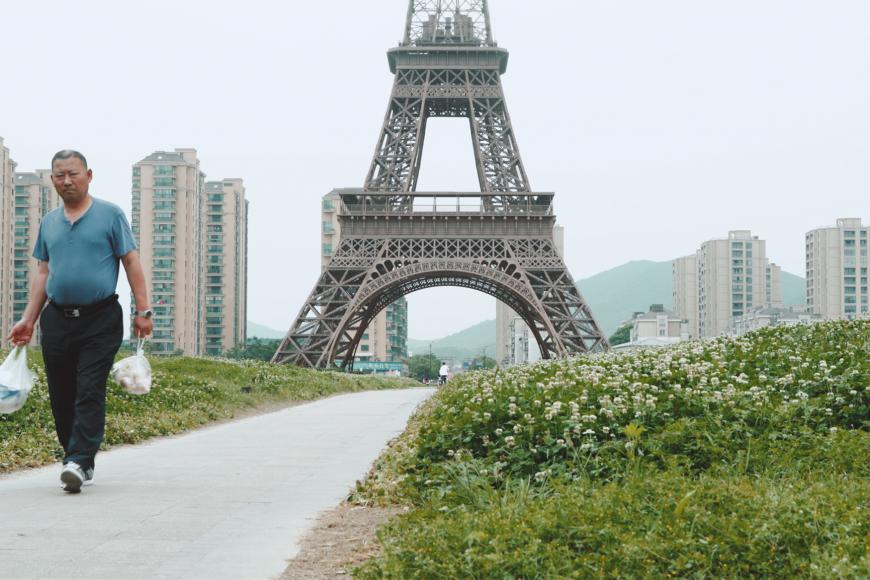
The account of a journey through an imaginary city, filmed along China’s new trade routes. Like the fictionalized Marco Polo from Italo Calvino’s “Invisible Cities”, the traveller in this film talks of worlds that resemble familiar places but follow their own, sometimes seemingly incredible rules. The observations condense into a meditation about the nature of cities and the transformation of the concept of globalization.
The foreign visitor’s voice sounds muffled, as if it were coming out of the cave whose interior views open the film. Time and again, the eye returns there – but the fluorescent rock faces soon turn into the sparkle of distant galaxies, the narrow confines of the cave indistinguishable from the vastness of space. It is a symbol of the decoupling of sign and meaning, of “real” and “false”, of sensual impressions and their positive geographical allocation that pervades the film: Daft Punk perform in front of a Chinese shopping mall; the Eiffel Tower stands first in a housing estate, then, folded up to a fraction of its size, in view of Big Ben and Tower Bridge.
Unread love letters tell of a student rebellion against repressive Indian politics – and at the same time of the difficult relationship between memory and the present.
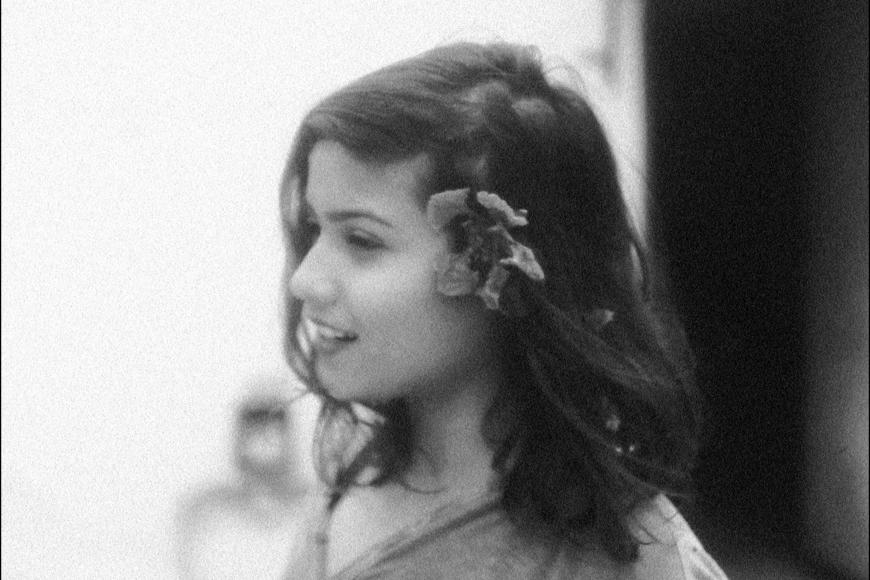
Riots and protests at an Indian film school, told in letters written by student L to her lover K, in which she reflects on what’s happening around her. While government forces gradually push back the rebellion, L realizes that she will never receive an answer because K belongs to a higher caste. The anonymous lines are wistful echoes of a love tragedy in times of the resurgence of a nationalistic class society.
Director Payal Kapadia steeps the visual material, compiled from a variety of sources and testifying to long, draining nights of protest, but also to great determination and a youthful exuberance, almost consistently in grainy black and white. Even mobile phone or surveillance camera footage are thus aesthetically related to 16mm student films from past decades. But against this contrast the immediate, unfinished nature of what is shown becomes all the more apparent, referencing the complex dialogue between a fragile memory and a tumultuous present that goes on in the film. A present in which questions of artistic representation, but also of personal responsibility, must be renegotiated.
Cine film footage, transformed into magical visual worlds that unfold in the glistening drizzle of electronic sounds. A diary of awake dreaming observation.
Patrick Bokanowski subjects his own early cine film footage to a magical optical transformation. In the glistening drizzle of electronic sounds and the deep rumbling of drone waves by Michèle Bokanowski, light eruptions, sweeping colours and shadowy apparitions unfold while the original footage shines through. A diary of awake dreaming observation.
A visually and aurally outstanding film about the musician Marja Burchard, leader of the legendary band “Embryo”. An ode to hearing, experimentation and inspiration.
She first appeared on stage at the age of eleven with the legendary Krautrock band “Embryo”. Her father, Christian Burchard, founded the band in 1969 and led it until 2016. Today – in her mid-thirties – Marja Burchard is the bandleader in this project, which has become a kind of family for her. But what seems so simple and organic is far from self-evident in an extremely male-dominated sphere, as Rebecca Zehr shows in her precisely observed and designed film.
This strictly and yet lightly composed melange mixes archival footage, psychedelic animation sequences and everyday observations of the normal life of a female musician between organisation and inspiration. With the visual level restricted to black and white and thus deliberately restrained, all the more attention is focused at the sound. The – who wonders? – outstanding score never takes the music for granted but works robustly with our perception. It’s the lucid, calm images and the narrative that is always anchored in the here and now that let this film stay incredibly haptic despite its concentration on our sense of hearing. Rebecca Zehr is not interested in portraying a musical legend, but in showing us what it could look and feel like to not only make music but live in it.
Luc-Carolin Ziemann
Credits
Director
Rebecca Zehr
Cinematographer
Felix Press
Editor
Melanie Jilg
Producer
Rebecca Zehr, Katharina Rabl, University of Television and Film Munich (HFF)
The abandoned village looks like an oil painting, like a still life painted in sometimes delicate, sometimes broad brushstrokes. Light and mood change with the time of day.
At first there’s nothing but clouds. A cock crows, sheep bells ring, a herd of cows begins to move. The sounds seem to come from another age. When the morning mist clears, we recognize the outlines of an abandoned village. Decayed huts, broken fences, crooked roofs. The film looks like an oil painting, a still life painted in sometimes delicate, sometimes broad brushstrokes, bathed in different lights with the shifting times of day and changing its mood.
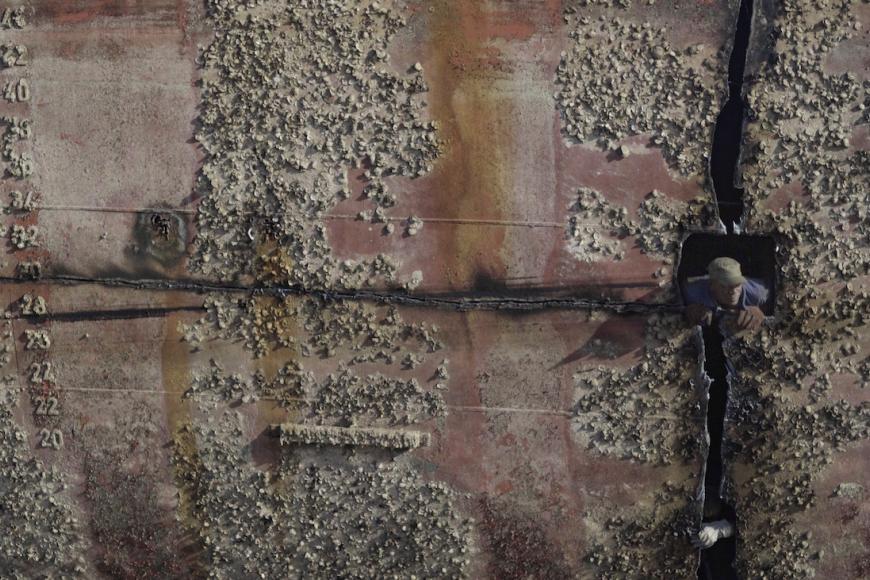
Beautiful images and rhythmic sounds of hard work on a ship scrapyard in western Cuba, yet there’s no aestheticization. One can almost smell the oil and metal while watching the film.
A ship scrapyard in western Cuba. The observing camera follows Raudel and his colleagues who work in what seems like a hermetically sealed microcosm. A homing pigeon strays into the place; the workers contemplate it silently as they smoke. Sometimes they talk about their dreams. Shots are focussed in turns on their bodies and their surroundings. Rhythmic, artfully crafted and authentically produced sounds accompany precise and lucid images, without aestheticizing the harshness of their work.
Borjana Gaković
Credits
Director
Alejandro Alonso
Script
Lisandra López Fabé, Alejandro Alonso
Cinematographer
Alejandro Alonso
Editor
Emmanuel Peña
Producer
Boris Prieto, Alejandro Alonso, Oderay Ponce de León
Sound
Glenda Martínez Cabrera, Velia Díaz de Villalvilla, Alejandro Pérez
Score
Pepe Gavilondo
World Sales
Boris Prieto
Funder
Norwegian Fund for Cuban Cinema, CNC / Aide aux cinémas du monde
Winner of:
Golden Dove Short Documentary (International Competition Short Film)
Home birth or clinic? In the field of tension between traditional and modern midwifery, the conflicts of women in Ethiopia’s changing society come to light.
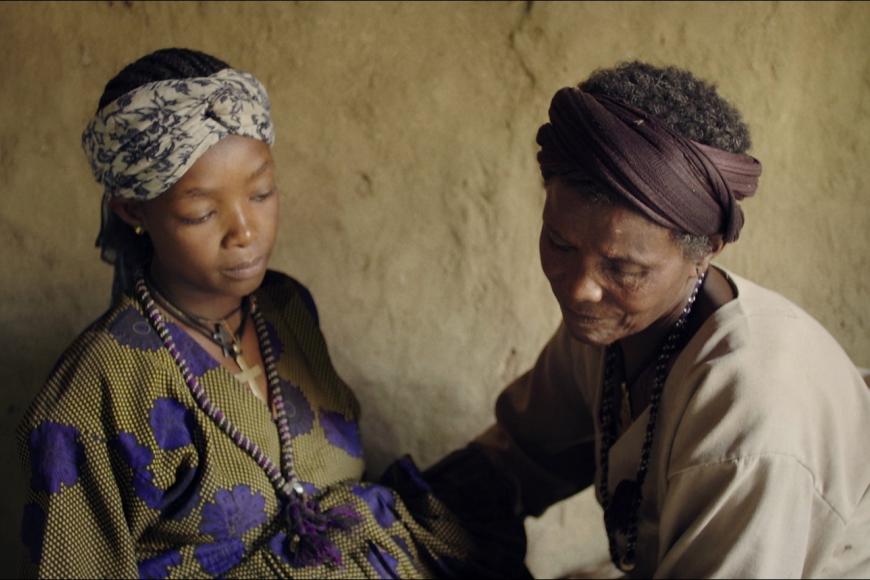
In rural Ethiopia the staff of a health centre are fighting maternal mortality. They tirelessly appeal to women to give birth in the clinic. But reservations are strong, and so are the practical obstacles. How are heavily pregnant women supposed to arrive in time when the ambulance comes hours later or not at all? Against medical advice, Hulu Ager decides to give birth at home, assisted by a traditional midwife.
With palpable familiarity, the film crew captures moments of intimate communion between Hulu Ager, the midwives and other women. On the margins of the central conflict, the many challenges they face in a patriarchal society emerge. The debates are most lively under the hood dryer at the hairdresser’s: She doesn’t enjoy sex because of her circumcision, the medical professional Welela reports. “Sometimes you have to prepare yourself for sex,” another customer advises. Sometimes it helps to get drunk. But the perky hairdresser is sure: Bad sex is grounds for divorce. The women share their desires and woes with each other, experience solidarity and gather courage for small and great acts of departure and resistance. Men are relegated to the role of extras, if at all.
Sarina Lacaf
Credits
Director
Sarah Noa Bozenhardt, Daniel Abate Tilahun
Script
Sarah Noa Bozenhardt
Cinematographer
Bernarda Cornejo Pinto
Editor
Andrea Munoz
Producer
Sonja Kilbertus
Co-Producer
Hiwot Admasu, Beza Hailu Lemma
Sound
Alex Praet
Score
Anna-Marlene Bicking
Winner of:
Honourable Mendtion (International Competition)
Tszzzzidd – skin and adhesive tape separate slowly, almost lasciviously. Sensual variations on pain and pleasure in a calm but scalpel-sharp drawn animation.
Tszzzzidd – skin and adhesive tape separate slowly, almost lasciviously. From a sober physical point of view, forces between molecular bonds are being overcome. Yoriko Mizushiri composes brief, highly sensual variations on pain and pleasure based on this phenomenon. Restrained, calm and scalpel-sharp, she creates two-dimensional drawn animations in subdued colours, accompanied by cool electronic sounds that explode in one’s head only to scatter into the anxious but curious body.
André Eckardt
Credits
Director
Yoriko Mizushiri
Producer
Emmanuel-Alain Raynal, Pierre Baussaron, Nobuaki Doi / New Deer
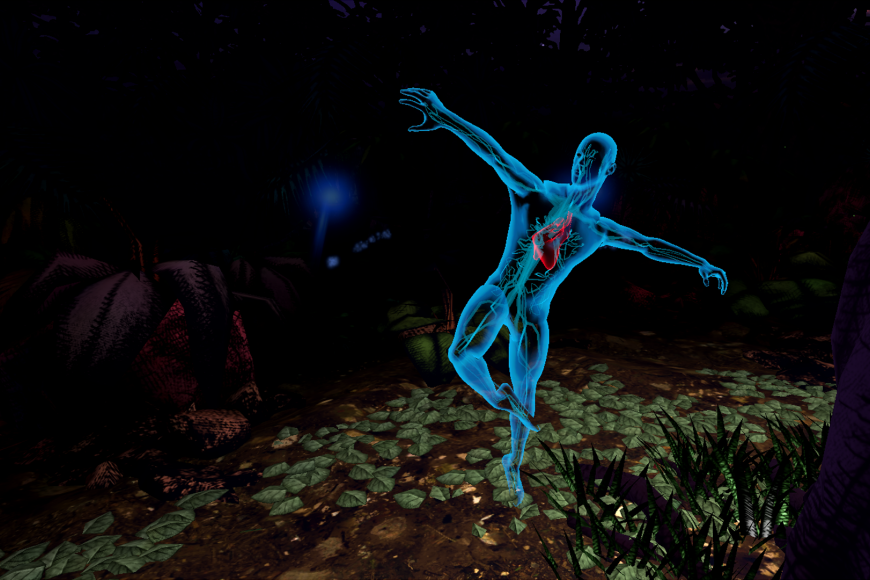
This multiplayer VR experience invites us to witness a sacred ritual of the Kenyan Kikuyu community, in which a man can turn into a woman and a woman into a man.
In the mythology of the Kikuyu community the Mugumo, the Kenyan fig tree, represents transformation and rebirth. This multiplayer VR experience invites us to witness a sacred ritual: Dancing around the Mugumo can turn a man into a woman and a woman into a man. We follow Waicici, a genderless person, in the quest for the most honest version of themselves.
Lars Rummel
Credits
Producer
Antoine Cayrol, Steve Jelly
Co-Producer
Steve Jelly, Arnaud Colinart, Opeyemi Olukemi, Rafael Pavon, Annick Jakobowicz, Simon Windsor
Production Company
POV Spark, France Télévisions, Dimension, Atlas V
Choreographer
Stephen Buescher
Key Collaborator
Andrew Orkin, Banna Dasta, Toby Coffey, Steve Jelly, Simon Windsor, Akash Kushwaha, Annick Jakobowicz, Stephen Buescher, Opeyemi Olukemi, Arnaud Colinart, Rafael Pavon, Antoine Cayrol, Derren Sinnott
Patterns, profiles, letters – the photocell of the film projector translates Moholy-Nagy’s “handwriting in sound” on the optical soundtrack of the film into electronic sounds.
No sooner had optical sound been invented than it was used in other than the intended way. Geometric patterns, intertwined lines, facial profiles and letters instead of voice recordings and music – Moholy-Nagy imaginatively designs the optical soundtrack of the film. The photocell of the film projector then translates his “handwriting in sound” into electronic buzzes and beeps, along and beside the musical scale.