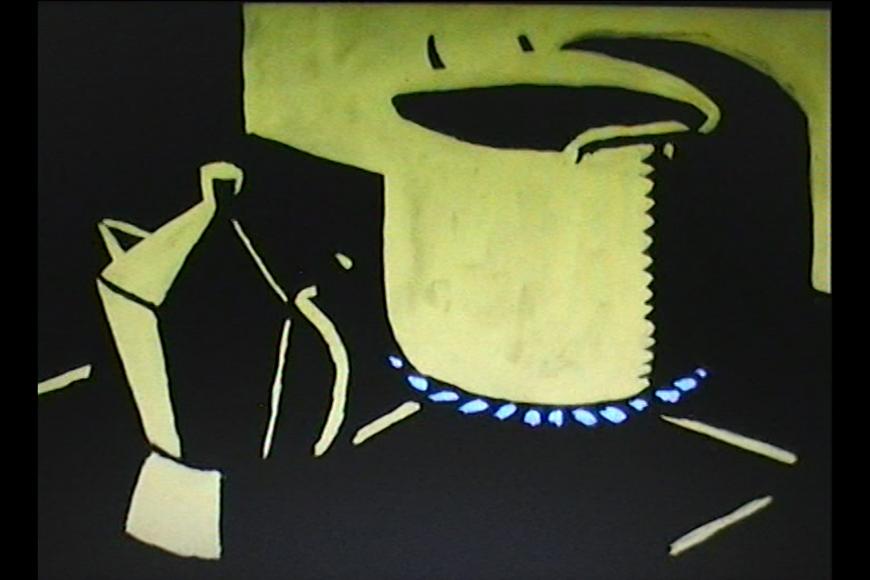
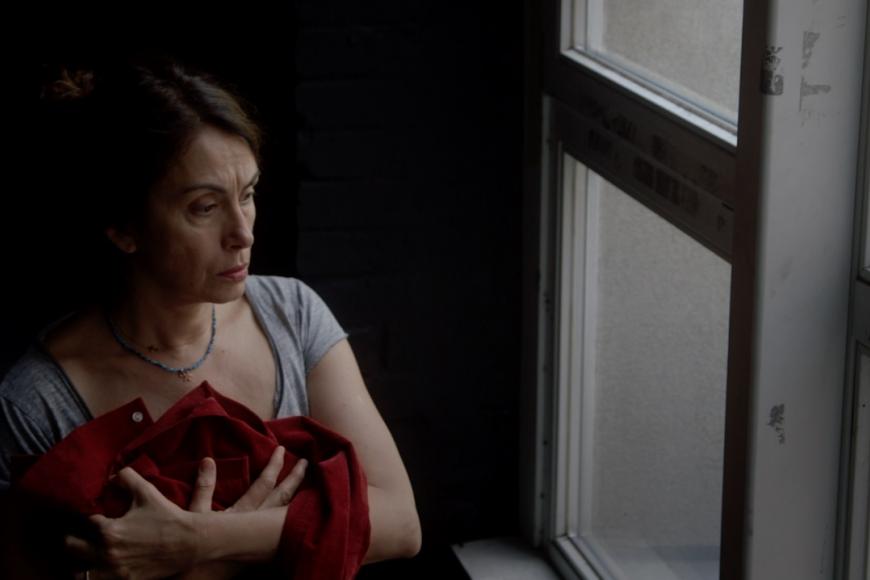
She cares for senior citizens at home for five euros an hour. At their bedsides the ticking clock counts down the working day and falters frighteningly when death comes.
Between coming and going time feels leaden – a half-life in the light and dark contrasts of a linocut. The narrating voice’s mother cares for seniors in their homes for five euros an hour. At their bedsides the ticking clock counts down the working day, caught between the frightening sounds of the heavy breathing that comes with impending death and the roar of promises made by television. The dying are mother’s livelihood.
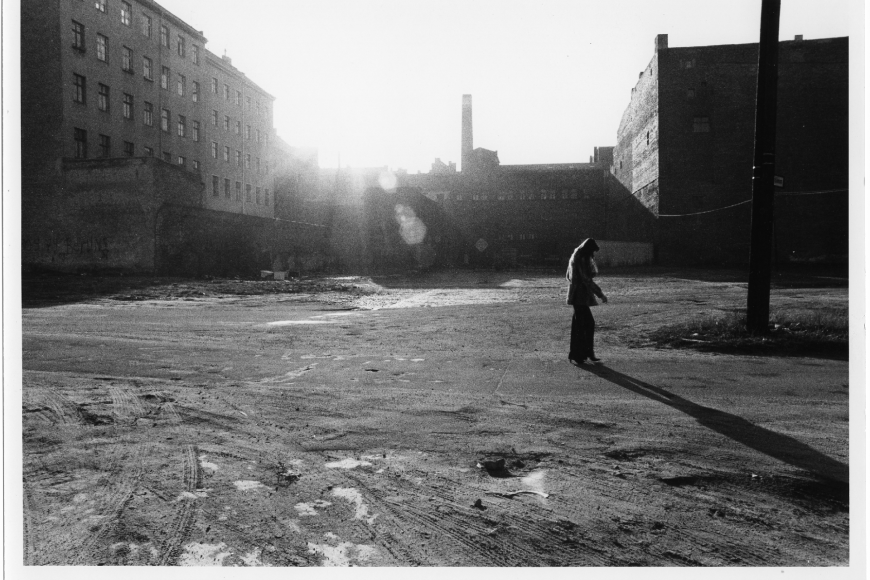
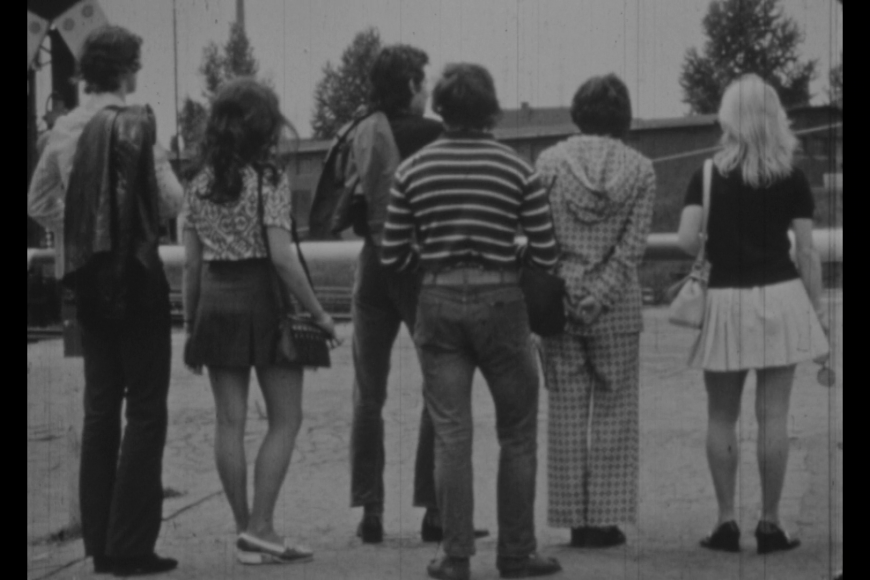
Long walks through almost deserted cityscapes which even in the late 1970s still bear the distinct scars of the Second World War: a Belgian filmmaker encounters West Berlin. She tries to re-adjust in this terrain saturated with European history and films this transformation in the first person singular. The images of twilight captured on grainy 16mm footage make Berlin look like a city that lies deep in the East, even though it sees itself as a Western city. But Annik Leroy mistrusts the mirror images: they don’t help if you want to see things more clearly.
Ralph Eue
Credits
Director
Annik Leroy
Script
Annik Leroy
Cinematographer
Annik Leroy
Editor
Eva Houdova, Daniel De Valck
Producer
Gamma Films, ZDF, Centre de l'Audiovisuel à Bruxelles (CBA)
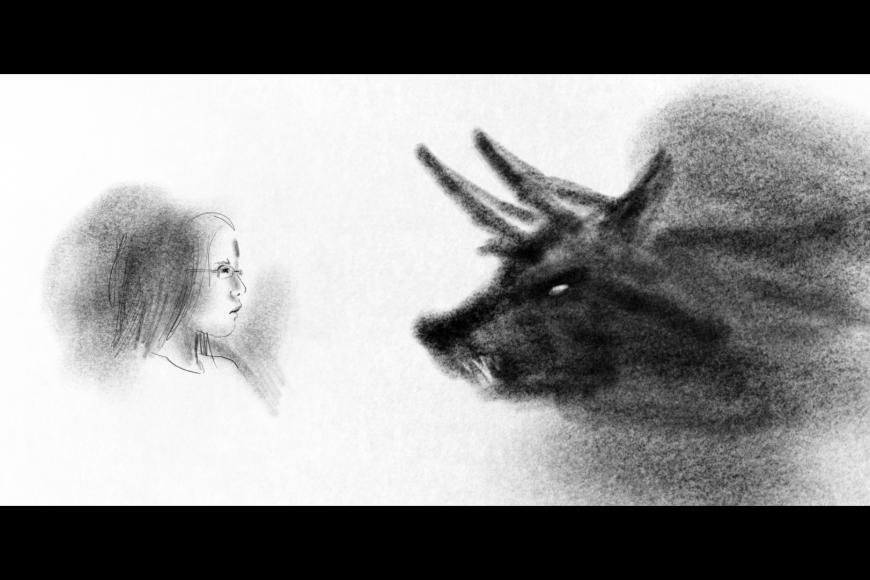
Bertha is determined to tame the wild wolves in her life. She counters her disease, which limits her in her daily life, with brushes, colour palettes and crayons.
Bertha loves to draw. She needs help in her daily life for she has a rare disease that impairs her vision. But Bertha refuses to be discouraged. She has organised an exhibition together with a well-known painter. The proceeds will go to research into her disease, the so-called Wolfram syndrome. Can Bertha tame the wild wolves in her life?
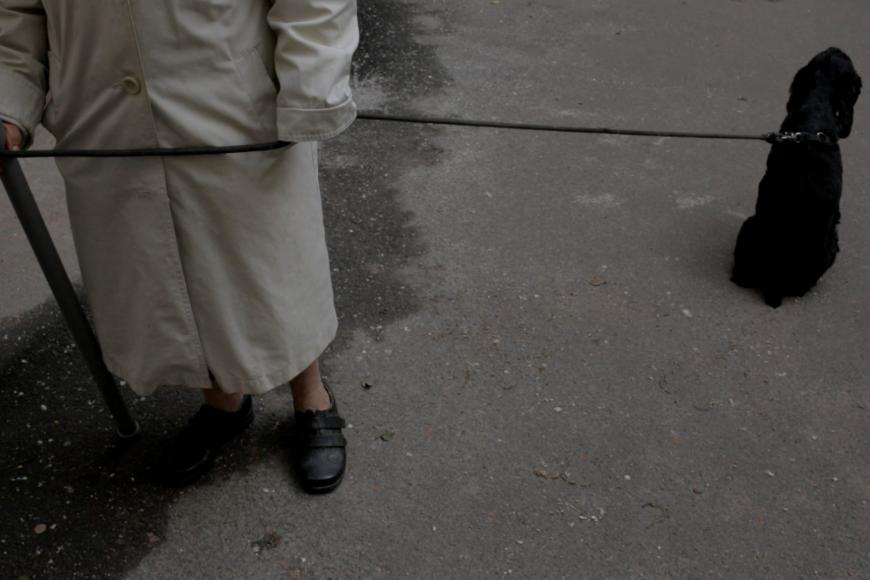
During the Corona lockdown in Saint Petersburg recorded calls to a help hotline reflect a dilapidated system in which the weak and elderly suffer the most.
Competition for the Audience Award Short Film 2020
Documentary Film
Poland
2020
30 minutes
Russian
Subtitles:
English
Against the backdrop of Saint Petersburg’s back courtyards during the Corona lockdown, Tatyana Chistova fuses recordings of the almost empty city and calls to a municipal hotline tasked with offering help and advice, but topics range from the banal to existential questions. Elderly people in particular are affected by poverty, hunger and loneliness. Chistova highlights that in a system that neglects its weakest members, the virus is not the only threat.
At American high schools, the threat of school shootings has become omnipresent. In addition to regular drills of how to act in case of assault, security forces and metal detectors are now part of everyday life in the schools. In the name of security, a whole industry is busy developing bulletproof hoodies and blackboards, arming teachers and installing ever more surveillance devices. Is this prevention? Or a self-fulfilling prophecy?
While cheerleaders rehearse, basketball teams play and homecoming queens are crowned, adults in the background prepare for the emergency: What to do if a school is attacked – from inside or outside? Behaviour and meditation training to prevent violence in the first place are one thing. More money, however, is spent on armament. The so-called security industry has long entered the school market. Todd Chandler’s restrained observation takes a look at the arms and service industries and the media, at social psychologists as well as teachers. He cleverly focuses not on individual schools and incidents but rather on how a whole system responds to a threat.
Eating dirt and burping with relish – an earthworm refuses to be satisfied with this embarrassing evolutionary outcome for his species. He sets out to learn better things.
Competition for the Audience Award Short Film 2020
Animated Film
USA
2019
10 minutes
without dialogue
Subtitles:
None
Eating dirt and burping with relish – an earthworm refuses to be satisfied with this embarrassing evolutionary outcome for his species and sets out to learn better things. But imitating many-legged and winged insects does not result in distinguished behaviour but rather leads to mortal danger. Ethan Barrett demonstrates magnificently that clay is the pinnacle of the evolutionary pyramid of animation, especially when it is set to such a light and poignant score.
An unappreciated filmmaker wants to be part of the big industry, sell himself and be bought. A torrent of buzzwords from the beginner’s guide to self-marketing.
A genius of independent cinema looks back on his hitherto unrecognized work. From now on he will leave this unprofitable art well alone, be part of the big business, sell himself and be bought. A brilliant future seems within reach. A torrent of buzzwords from the beginner’s guide to self-marketing. Burning ambition. Caustic sarcasm. Biting irony.
A trauma therapy on film for an uprooted elephant cow – a social creature that, like all of us, needs security and a home to form stable relationships.
The biography of the female elephant Bibi, who is considered to display abnormal behaviour, is marked by misfortunes: Born in Zimbabwe in 1985. Lost her mother shortly after birth. Imported by the East Berlin zoo in 1989. Deported to the Halle zoo in 2008. On the basis of an empathic reappraisal of these traumatic events the film reflects on the significance of social issues and how to deal with exclusion today: a therapy by proxy on film that will hopefully have a long-distance healing effect on Bibi.
Along the river Oder: Virulent questions about homeland and community, everyday life and politics, asked with confident casualness, provide an account of the present.
The river Oder: A historical and cultural landscape churned again and again by the tide of events of the past century. A tale told in concentric circles about a region which was and still is the scene of the beginning, end and open middle of voluntary and involuntary migrations. Virulent issues of daily life and politics that, asked with confident casualness, provide a robust account of the present.
Movements and stories in the border region between Poland and Germany – Andreas Voigt’s new film takes up the themes of his 1992 work “Borderland – A Journey”. The charged term “homeland” stirs up (trouble in) the minds and hearts of the people: What it once was and what has become of it! Sure, that’s not the top priority in their daily agenda. But how people appropriate this term and how that in turn structures their attitudes also determines how they figure out the taste of life in the here and now of Europe. The search for closeness is confronted with the insistence on distance. Communication about belonging becomes flimsy because the body language says something different than the spoken word. As a film that’s not about administering a politically correct separation diet, “Borderland” provokes experiences and enables encounters.
An ironic short film set to the music of Schlager singer Chris Doerk: The seemingly endless wait at railway crossings leads to the formation of couples and other fateful events.
The railway from the point of view of people who travel by bicycle, on foot or by car: A Schlager music recording of GDR singer Chris Doerk is re-cut many times to accompany the endless-seeming wait at a railway crossing. Meanwhile, young people find each other, couples form. Even the birth of a child finds a place in this ironic short film.