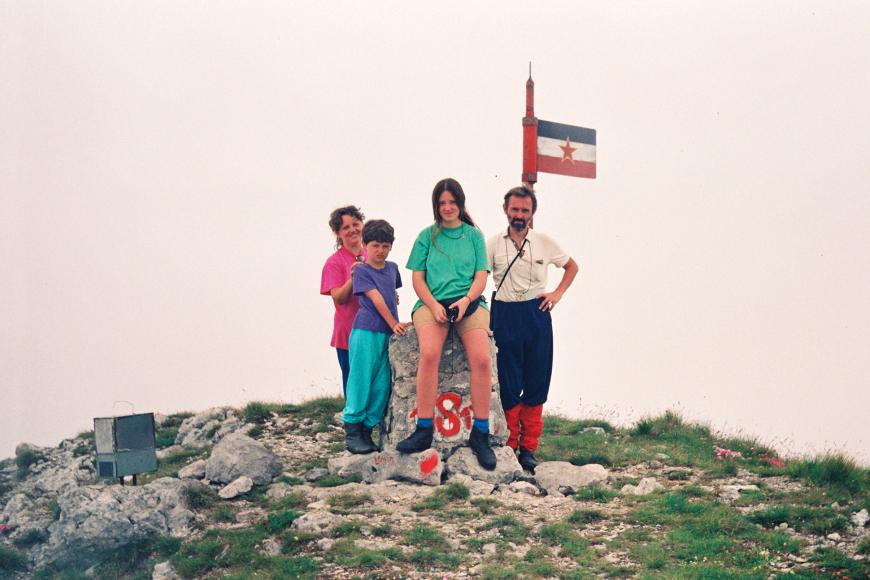
When Nataša Urban finds her father’s hiking diary, she takes it as a starting point for an enchantingly beautiful film about how she grew up during the Yugoslav War.
She left Serbia a long time ago and never looked back. But then Nataša Urban discovered her father’s hiking diary and began to connect his entries to the events of the Yugoslav Wars of the 1990s. The 1999 total eclipse of the sun is the central motif, employed by Urban as a metaphor for the way a dark past remains part of the present.
Kitted out with analogue film equipment, the director travels back to find the stories of her family, intimate friends and acquaintances. She listens to memories of inconceivably cruel acts; she watches the wind blow through leaves of grass. Her father, a lean, grey-haired man, hikes through the forest, striding again through the places he once visited. Dreamlike scenes meet sober descriptions of almost unbearable atrocities. Urban skilfully combines 16 mm and Super 8 film with archive material to explore the blurred boundaries between the individual and the collective, the private and public spheres, the personal and the political, resulting in an enchantingly beautiful work of art, a poetic reflection on growing up during the war.
While buying an apartment, a pair of siblings meet a woman who looks exactly like their dead sister. An intriguing true crime story unfolds bit by bit.
German Subtitles for deaf and hard-of-hearing, English
In the Swedish town of Gullspång, Kari and May meet a woman who looks exactly like their sister Lita who died more than 30 years ago. No coincidence: Olaug was born on the same day as Lita in the rural north of Norway; a DNA test confirms that the two were born as twin sisters. The happy reunion with Kari, May and the rest of the family, though, soon shows the first cracks. At the age of 80, Olaug’s identity is shattered. Why did her parents give her away? Will she fit in with her new, deeply religious kin? She does not believe in divine revelations. Instead, she is haunted by Lita’s alleged suicide – and indeed her investigative research raises questions about the circumstances of that death.
At least at one point in the film, director Maria Fredriksson is audibly dumbfounded behind the camera. What starts as a feel-good film becomes a character study of identity, then a kind of true-crime and finally a mystery story. The direction takes it up a notch, sometimes to dramatic, sometimes to quite funny effect: The perfectly lighted country houses with portrait photos on the walls and the ironically suggestive use of music are reminiscent of “Twin Peaks.” Sometimes life writes the crazier plot twists.
Insights into the Russian opposition before the war in Ukraine. In the Yekaterinburg metropolis, only a few take to the streets against Putin. There is a lack of support – but not of courage.
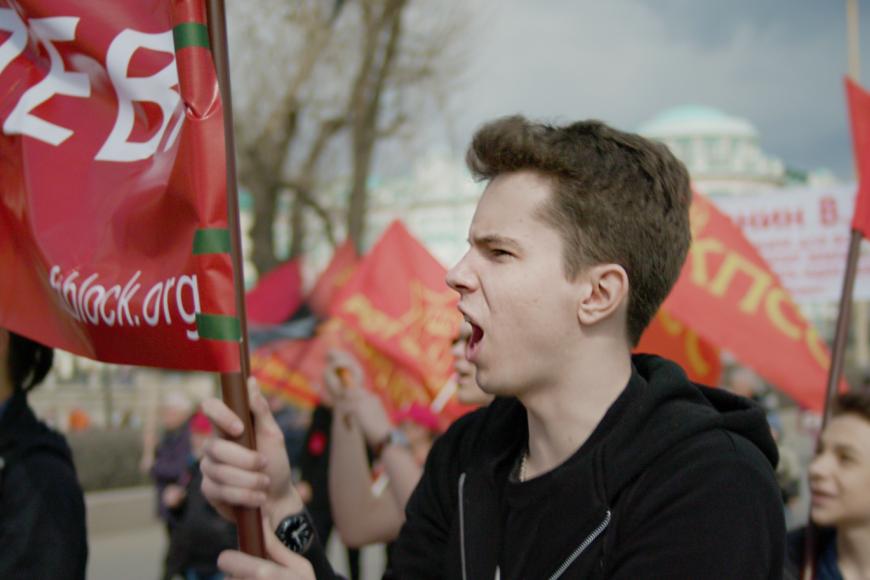
In the passing busses and trams, people look out of the windows in disbelief. The reverse shot shows a crowd of protesters. Two dozen people perhaps, some holding signs, one shouting “Putin behind bars!” It is a symbolic image of the pathetic state of the Russian opposition. The year is 2017, the war of aggression against Ukraine is still to come. Over a period of several years, “The Last Relic” portrays people from different opposition groups: a student from the Marxist-Leninist “Left Block,” a teacher with sympathies for Navalny; a digger driver demands the redistribution of resources. These activists lack support, but not courage. One of them has just been released from prison and survived a hunger strike. The others must expect to be prosecuted at any moment.
The setting of this film is the Ural metropolis of Yekaterinburg. The bulk of the population, an insert announces, dreams of a “return to imperial glory.” Estonian director Marianna Kaat, born in 1965, has spent a considerable part of her life in the Soviet empire. She shows the majority society as a uniform crowd at military parades, contrasting it with the individuals of the opposition. Few films offer such insights into the latter’s continuing precarious situation.
Remembering and preserving is part of survival in Mosul after the IS terror. Fakhri collects relics, Bashar dreams of saving his parents’ home. Their paths cross in front of an ancient portal.
“It’s nice here, let’s play,” says Fakhri, holding a small loudspeaker for Fadil, the violinist. But there is no audience. The two men are standing in the ruins of Mosul. Three years of occupation by the Islamic State terrorist militia have left the old town almost completely destroyed. Along with the buildings, the 8,000-year history and culture of the second-largest Iraqi city seemed to have been wiped out forever. Life returns slowly. Art treasures are being restored, there are theatres, music again, and Fakhri’s small private museum where he collects anything he can lay his hands on: wooden doors, bronze figures, soap from1910, a ventilator. He has already amassed 7,000 exhibits and is especially fond of an ancient portal with two lions. Damaged, but perhaps still salvageable, it sits enthroned in the ruins of Bashar’s parents’ house like a peace time relic. Bashar visits it almost daily, hoping that reconstruction is possible. But Fakhri turns out to drive a hard bargain – he wants this portal at all costs … With a steady hand, Kurdish-Norwegian director Zaradasht Ahmed tells a deeply human story, intertwining the darkest and lightest side of the species: the mania of destruction and the strength to go on.