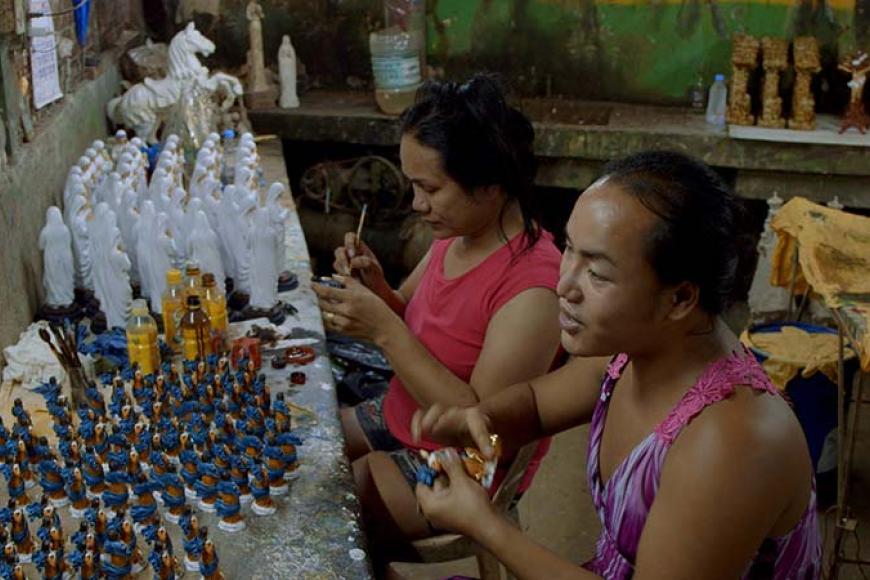
A factory for statues of Catholic saints in a city near Manila, portrayed as a microcosm of economic, social and religious conditions on the Philippines.
When the time “when St. Joseph came” is mentioned in this film, it doesn’t refer to a religious phenomenon, but to the most popular product of TML Holy Crafts Incorporated. In the factory on the Philippines, the country with the third-largest Catholic population in the world, the employees manufacture statues of saints under exploitative conditions. Joseph Mangat portrays this place with a focus on the workers, including some from the LGBTQI community.
In the first scene, a plaster bust is uncovered layer by layer. This image could also serve to describe the approach of “Divine Factory”: From the shop to the workshop, from the entrepreneur to the simple worker, from the production to the uses made of the religious articles, this film reveals the social and economic facets of this institution. The Filipino director not only observes precisely how people work and trade there, he also involves the participants in frank conversations about love, wages and living conditions. The employees’ profit-oriented payment model reveals how economical and religious ideas interlock. The success of the company in the city of Antipolo near Manila, desirable for all, thus appears as nothing short of a divine blessing.
Jan-Philipp Kohlmann
Credits
Director
Joseph Mangat
Cinematographer
Albert Banzon
Editor
Ilsa Malsi, Joseph Mangat
Producer
Alemberg Ang, Stefano Centini
Sound
Duu-Chih Tu
World Sales
Lya Li
Nominated for:
FIPRESCI Prize,
Prize of the Interreligious Jury
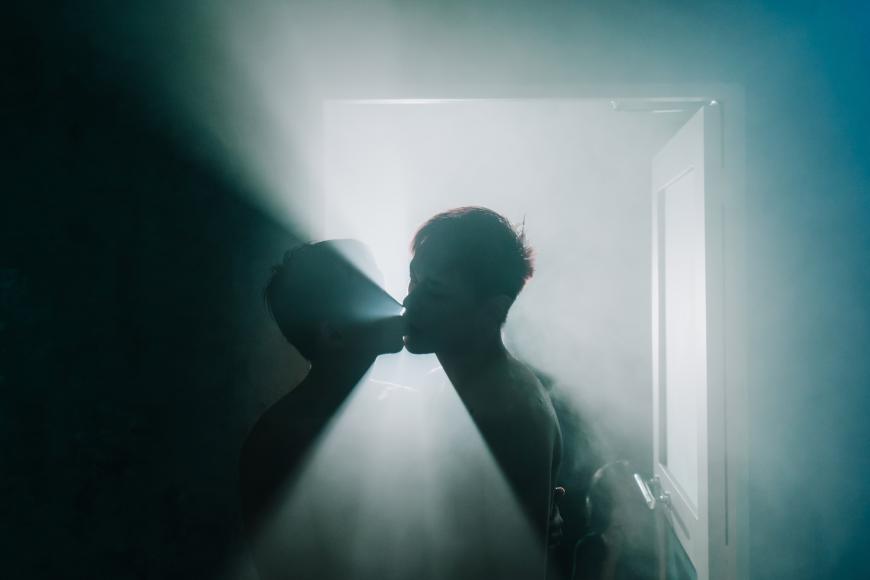
A group sex scene in a gay sauna becomes a real-surreal stage for desire and reflection: on sex positive spaces, our own lust and our own sense of morality.
We find ourselves in the middle of a gay sauna. In search of physical contact outside ideas of bourgeois romantic love, we are part of a group sex scene. We look at the protagonists, just as they look at us. The space becomes a stage, both real and surreal, that provokes reflections: about sex positive spaces, our own lust and our own sense of morality.
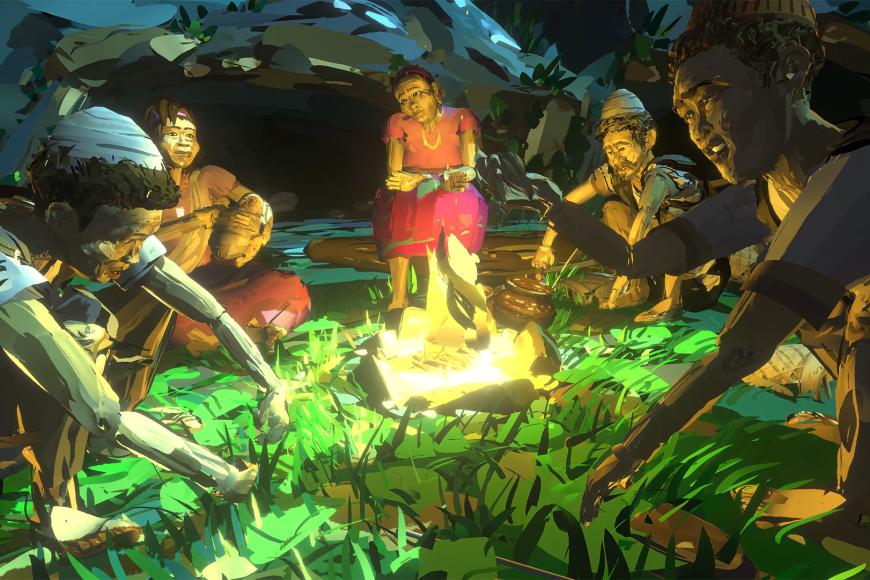
A Nepalese shaman and his granddaughter have dedicated themselves to the revival of the indigenous language of Kusunda. We get to participate – and become human archives ourselves.
The Nepalese shaman Lil Bahadur and his granddaughter Hima have dedicated themselves to the revival of his native language, Kusunda. It’s about more than communication, namely identity, tradition and awareness of one’s own history. The interactive voice-control of this VR experience allows us to learn Kusunda ourselves. We learners become human archives of an all but lost indigenous language.
Lars Rummel
Credits
Co-Producer
Sönke Kirchhof, Philipp Wenning, Emma Creed, Aliki Tsakoumi, Kuan-Yuan Lai
Executive Producer
René Pinnell
Creative Producer
Felix Gaedtke, Gayatri Parameswaran, Mia von Kolpakow
Production Company
NowHere Media
Animation
Moritz Mayerhofer
VR Developer
Tobias Wehrum
Sound
Mads Michelsen, David Segal
Key Collaborator
Gyani Maiya Kusunda, Lil Bahadur Kusunda, Hima Kusunda