A Saudi artist is trampolining at a military airfield in Arizona. She would have to lift off to get home. A struggle not just with gravity, but with the patriarchy.
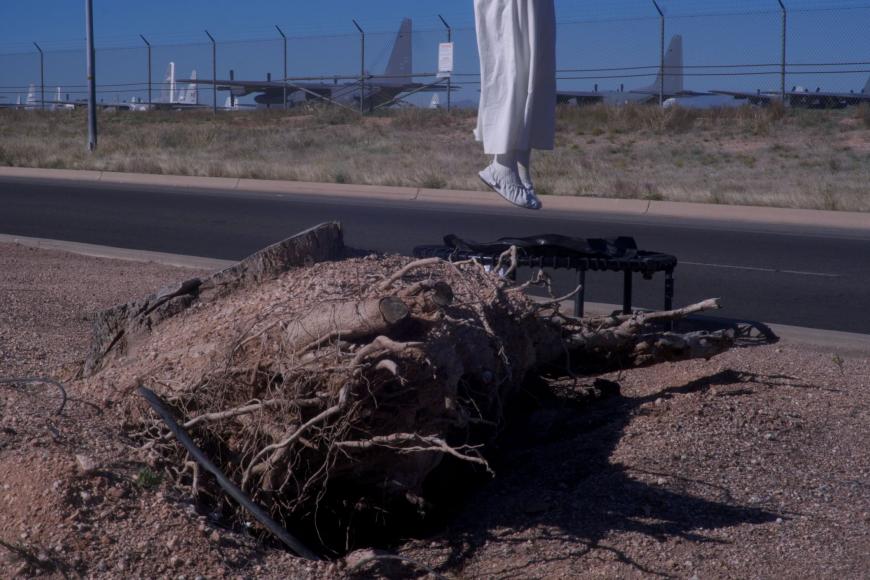
The aeroplanes are stationary, nothing moves, nothing takes off at the US military airbase in Arizona – until a young woman in a white dress begins to jump on a trampoline outside the fence, framed by an idyllic sunset. She conveys her story from the silent offscreen – only through subtitles. Having come from Saudi Arabia, she is stuck in the US because her father stole her identity papers. So homesick that she is considering drastic measures to get back home, she almost enlists in the military. But the US Army is suspicious and would not station her, a risk factor, anywhere near the Middle East. But there is a Baghdad in Arizona, too … Artist Samar Al Summary’s work is an investigation into systems of power. She does not only talk about herself, the prejudices and obstacles she faces as a Saudi woman, but also about the crash of two Iraqi air force pilots who were to be trained by the US Air Force but never made it home either. In her dramatically condensed film essay, she takes up the symbolic fight – both against gravity, which she can at least temporarily defy by using cinematic means, and against patriarchy. The latter, however, is not so easy to fight.
Borjana Gaković
Credits
Director
Samar Al Summary
Cinematographer
Samar Al Summary
Producer
Samar Al Summary
Nominated for:
Silver Dove
Winner of:
Silver Dove Short Film (International Competition Documentary Film)
An orange grove threatened by gentrification in suburban Los Angeles becomes the starting point of a discussion about how realistic documentary film can, may and should be.
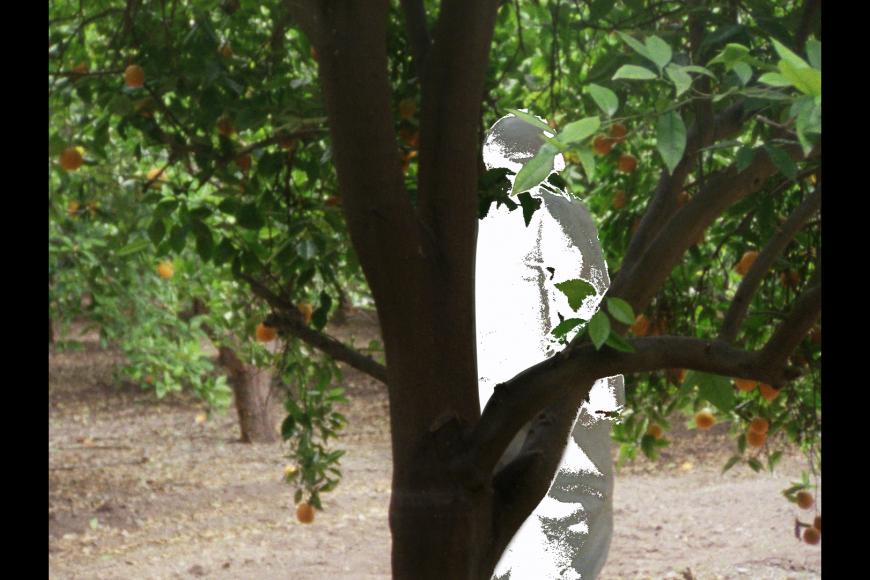
In her light-footed film miniature, Zaina Bseiso links the disappearance of the last orange grove from the suburbs of Los Angeles with the fate of the Jaffa orange, a native fruit of Palestine. When she engages her father in a conversation regarding this content and artistic concept, it turns into a discussion about how a good documentary can approach reality and why – with all due respect for realism – we must never underestimate the power of illusion.
Aesthetically inspired by the fragmenting of the 1990s, Young (de-)constructs the image of a controversial political figure who is about to enter history for good.
An inventive examination of the legacy of the 1990s: In his experimental short film, Ben Young portrays the figure of the then U.S. president – whom he is said to have met once in person in Louisville, Kentucky – as a foil for the questionable political developments, the beginnings of a globalised world and a society marked by collective amnesia. The director’s intelligent, witty and very personal reckoning with Bill Clinton.
The centrepiece of Jeremy Blake’s moving triptych looks into the heart of the Winchester House. Hit hard by the 1906 San Francisco earthquake, interior construction continued nonetheless. Only differently.
How much do staircases and doors leading nowhere in the Californian Winchester House reveal about the owner’s superstitions and how much about the years of converting and rebuilding after the 1906 earthquake? In the centrepiece of his trilogy, Jeremy Blake fills the labyrinthine interiors of this architectural rarity with unreal light and colour apparitions of impressive beauty and oppressive impact.
In 1964, the dreamy Winchester House was given a spacey counterpart to go on dreaming: the “Century 21” cinema. The stylistic punchline of Jeremy Blake’s architectural trilogy.
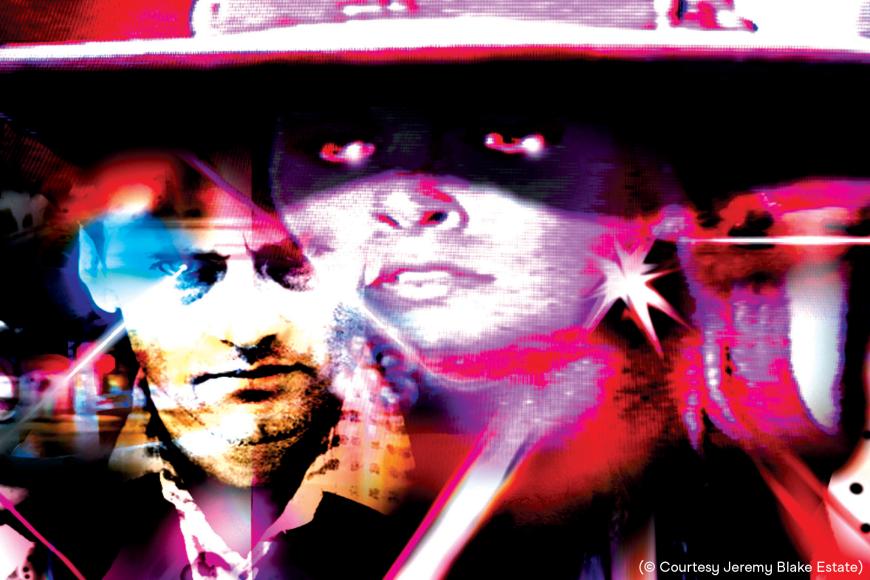
In the third part of this study of the Winchester mansion in San Jose the eye wanders to the “Century 21” cinema built opposite the street in 1964. Jeremy Blake makes the dream houses correspond visually by means of overpainting in time-based painting technique and visual mass media quotes. The film house contributed to the myth that at the frontier a home for the American Dream was built by gun violence.
Jeremy Blake’s three-part study of the residence of the widow Winchester, which grew from eight to 500 rooms over a period of 38 years, begins with a soul-searching in coloured folded images.
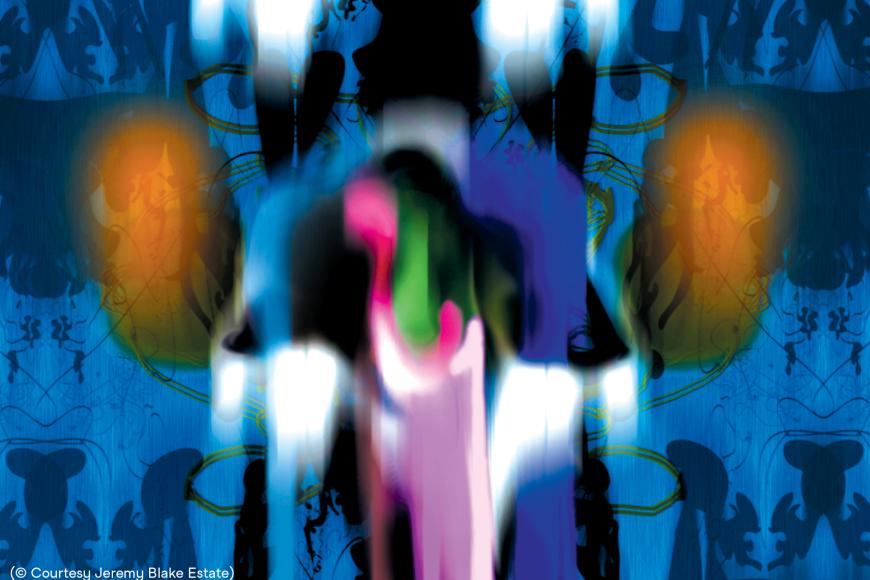
From 1884 to 1922, the widow of arms manufacturer Winchester transformed a modest manor in San Jose into a residence of temporarily more than 500 rooms. Rumour has it that it was to protect herself from the ghosts of those shot dead at the frontier. Jeremy Blake starts his Winchester trilogy with a diagnosis of the state of mind of the eccentric building in a Rorschach test of fantastic folded images.