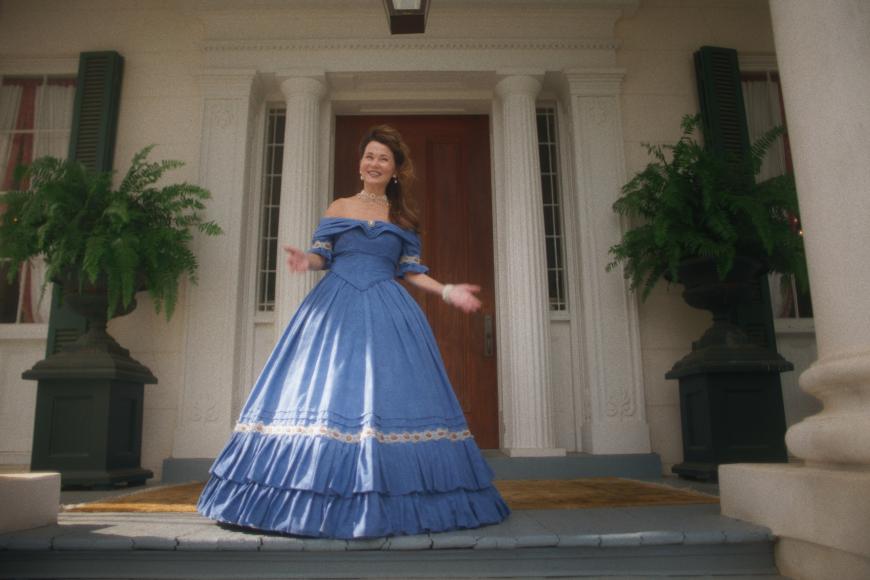
A small town in Mississippi: Many come here to bask in Dixieland nostalgia, oblivious of history. Black tour guides expose the white gaps in the narratives.
Once upon a time there was a town on the banks of the Mississippi. The streets are still lined with neo-classicist Antebellum houses. Horse-drawn carriages full of tourists move through the streets, a travelling organist performs on a truck bed. Time seems to stand still in Natchez. But while the descendants of the European colonists, dressed up as “Southern Belles” in historical hoop skirts, welcome their guests and feed them Southern nostalgia, the façades are beginning to crumble. Built on the shoulders of children, women, and men in chains, the epicentre of cotton capitalism and the second-largest slave market in the US, with 750,000 Black exploited persons, emerged here in the mid-19th century. This part of the former “Cotton Kingdom” is practically absent from the whitewashed version of history. On the contrary, it is dripping with romanticisation and racist clichés. But people like the Black pastor and tour guide Rev are breaking with this tradition and shattering the nostalgically glorified illusion of an ideal world. Suzannah Herbert directs the clash of different perspectives and characters with an unerring eye for direct and indirect contradictions. At the same time, she exposes a rift in society that extends far beyond the Natchez microcosm.
A collaboration between artists and machine, this continuously-running generative film is based on the visual archive and music of Brian Eno, as well as new interviews.
This film can go on forever. Or at least until we shut it off. A collaboration between a filmmaker, an artist and a machine, this generative film spans the length of the festival. Based on the visual archive and music of Brian Eno, as well as new interviews, this meditative audiovisual experience is created in real time through the imagination of a machine.
Women should be financially independent so they don’t have to spend their life in the kitchen, her mother taught. Her daughter pays tribute to her cooking skills.
Cooking is a wonderful occasion to think, reminisce and talk. And if you have never learned to cook, if you’ve spent your life seeing the place at the stove as a feminist step backwards, then you can only have braised pork ribs while reflecting on your distant first home, your mother. How fortunate then that one can also reminisce in animated form and do it so impressively that the fragrant images make our mouth water.