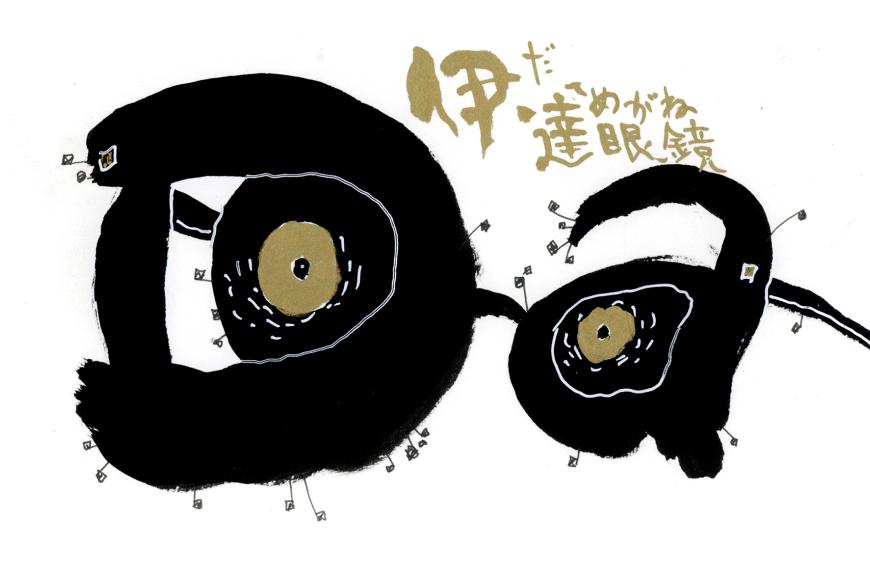
The last syllable on the lips of a dying man is “da”. Koji Yamamura translates a short story by author Hideo Furukawa into a thrilling and highly dynamic film.
Life is short, extremely short. The time between birth and death seems to fly by. Snip your finger – and it’s all over. The last seconds are just long enough to pronounce the syllable “da”. It is precisely this syllable, spoken with someone’s last dying breath, that is picked up by a man who looks for the shortest of all things in the streets of Tokyo. The syllable whirls through his thoughts, triggering a torrent of reflections on the Japanese language that he gets more and more worked up about. In a dadaist manner, the “da” words hurtle at us like notes in jazz. Bold ink drawings move across the white background, sometimes fluidly, sometimes explosively. A last “da” completes the extemporisation and brings to a standstill all the energetic circling and vibrating that dominated the image before. The dying man closes his eyes. But the end is followed by a new beginning. “Extremely Short” marks the start of the series “Bungaku Bideo” – literature videos – which, commissioned by the Yanai Initiative, makes innovative accomplices of contemporary Japanese literature and international animation. In this case, Koji Yamamura encounters a piece of prose by Hideo Furukawa, listens to the monologue recited by the author himself and translates his linguistic furor into an exciting visual form.
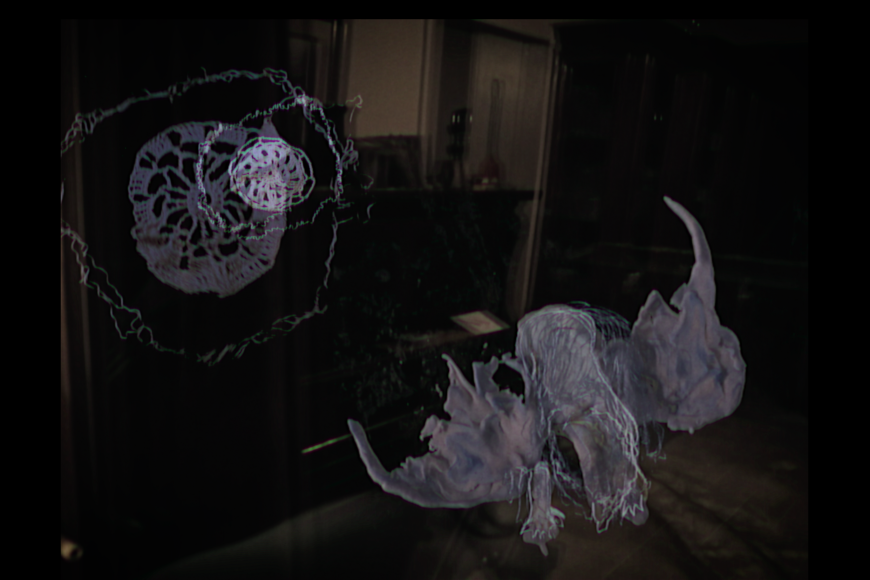
The dark confines of a flat, light still burning in the kitchen. Ghostlike apparitions mingle with old video recordings. This was the home of a loved one who lived in two worlds.
Memories of a loved one: The camera explores the dark confines of a flat. Light is still burning in the kitchen; objects are scattered haphazardly on the living room tables. The eyes follow into the labyrinthine self, now turned into space, of a once familiar and now absent person. The narrator’s voice begins by asserting that everything in this place is true. It “shows” the places where the remembered person learned to crochet and where she shelled peas. The narrative remains factual, but a gap begins to open. Ghost-like apparitions intrude in the old video images, phantom voices populate the noise-like echo sounds. Just like the crocheting and the peas, a naked murderer and other unpleasant shadows are part of the house inspected here. As things progress, individual threads are spun together to form the symbolic crocheted doily of a home. Incredibly poetic and very personal, Ayden Lamb’s “Haunted House” brings to life on film a person who during their lifetime was present – had to be present – in two worlds.
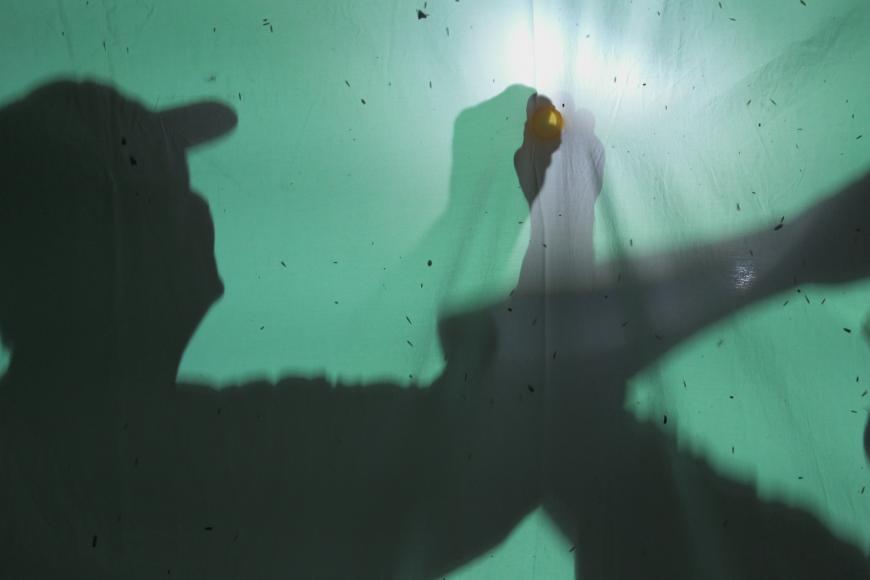
Conservationist on the trail of the sixth great mass extinction. An experimental portrait that tells of frogs, starfish and bats – and ultimately of us humans.
Highly focused groups of humans move through nature. It is night and they are listening. Or it is midday and they are counting. Sometimes they carry antennas on their backs and roam meadows at the edge of the forest. They are the witnesses of the so-called sixth extinction, the people who document the disappearance of biodiversity in the Anthropocene. Marianna Milhorat approaches them with patience, spending a long time with women who discuss the intensity of the croaking of frogs, while the roar of the streets can be heard in the background. Others report on the “sea star wasting disease”, a mysterious illness that turns starfish into a whitish mush. “Just Above the Surface of the Earth” leaves little room for hope, but at the same time puts its faith in the indefatigable individuals who have at least decided not to close their eyes. It is to them that Milhorat dedicates this experimental portrait, sophisticated on all cinematic levels. For it is not only bats that flutter through the film, but also thoughts: by Cormac McCarthy, William Golding, Martin Heidegger, or about the mythical river of the dead, Styx. The score, composed by Brian Kirkbride, translates the various microcosms into immersive sound art, giving us access to a world that we often inhabit as if blind and deaf.
Myriads of dots orbit the kaleidoscopic centre to the sweeping sound of a sitar. A breathtaking piece of visual music, realised by means of early computer animation.
To the sweeping sound of a sitar, thousands and thousands of dots orbit a kaleidoscopic centre, like the individual notes of a raga circle the keynote. Repeated graphic patterns blossom and crumble back into the mass. As traditional as the reference points for James Whitney's breathtaking visual music were, the realisation with early computer animation by his brother John Whitney was just as innovative.
The spirits of the dead from a Mexican cemetery rise and set out to cross the wall to the USA. The topicality of this ghost story from 1994 gives you goose-bumps.
Spurred by an extremely convincing young man with an American accent, the spirits of the dead rise from their graves in a Mexican cemetery and set out to cross the wall to the United States. This ghost story from 1994 gives us goosebumps with its topicality and enchants with its wit, shimmering colours and vibrant shapes.
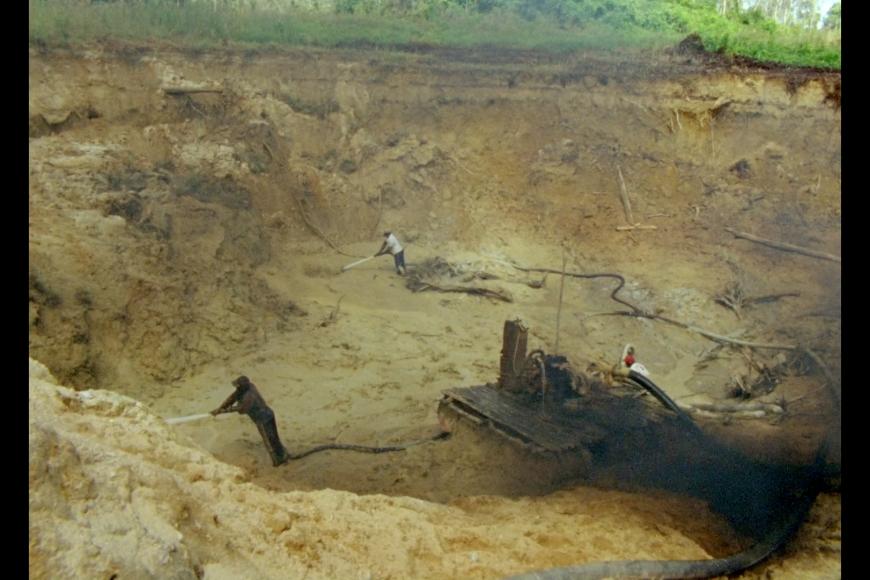
A fictitious explorer reports on gold-mining and its commercialization in Venezuela. Paradoxically, the gold diggers live off nature – and destroy it at the same time.
In the deliberately chosen style of an old-fashioned field report, a fictional explorer describes his observations on gold-mining in Venezuela. His mission takes him along the Orinoco, from remote jungle mines to industrial zones. His focus stays on the workers and their environment. The titular Moriche palm tree, an edible and crop plant growing along the river, serves as an example for the relationship between humans and nature and their use of raw materials. Paradoxically, the gold-diggers live in harmony with Mother Earth as their nourisher and healer, but at the same time destroy her. As in so many other places in the world, their very survival depends on an economic system inherited from colonialism. The rapid pace of capitalism is in glaring contradiction to the arduous extraction of the gold dust, produced only by slow processes of erosion. As the narrator drifts along the river and meditates on different contexts, the images work their way through the layers of the complex subject. The immersive poetic journey alternates between observational Bolex shots, hand-drawn illustrations and abstract visualisations of photochemical reactions. Accompanied by a sound design both distinct and elaborate, the lustre of the gold literally glitters from the screen.
Annina Wettstein
Credits
Director
Chris Gude
Script
Chris Gude
Cinematographer
Chris Gude
Editor
Felipe Guerrero, Chris Gude
Producer
Chris Gude, Felipe Guerrero, Maite Bermúdez, Adriana Agudelo
Sound Design
Felipe Guerrero, Chris Gude
Score
Maximilian Gude
World Sales
Michaela Čajková
Narrator
Jorge Gaviria
Nominated for:
Prize of the Interreligious Jury,
FIPRESCI Prize,
Silver Dove
A collaboration between artists and machine, this continuously-running generative film is based on the visual archive and music of Brian Eno, as well as new interviews.
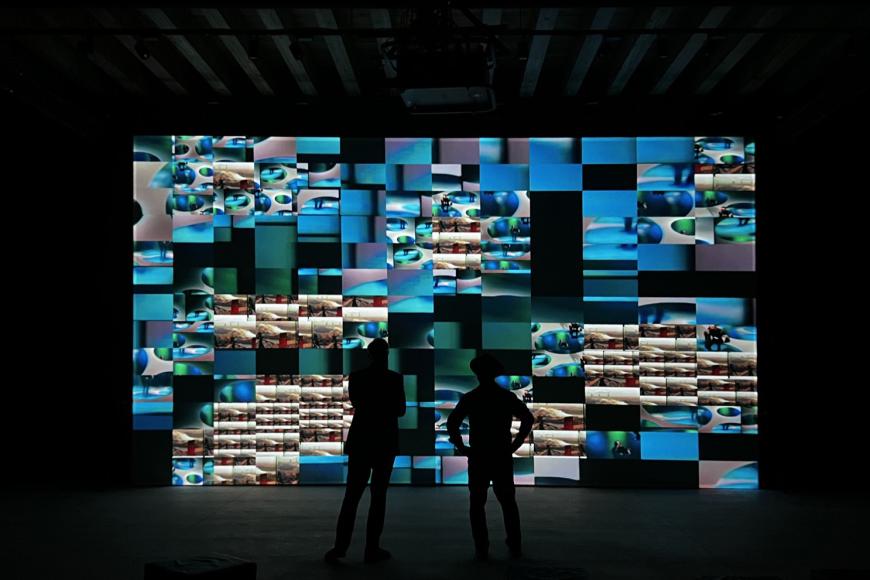
This film can go on forever. Or at least until we shut it off. A collaboration between a filmmaker, an artist and a machine, this generative film spans the length of the festival. Based on the visual archive and music of Brian Eno, as well as new interviews, this meditative audiovisual experience is created in real time through the imagination of a machine.
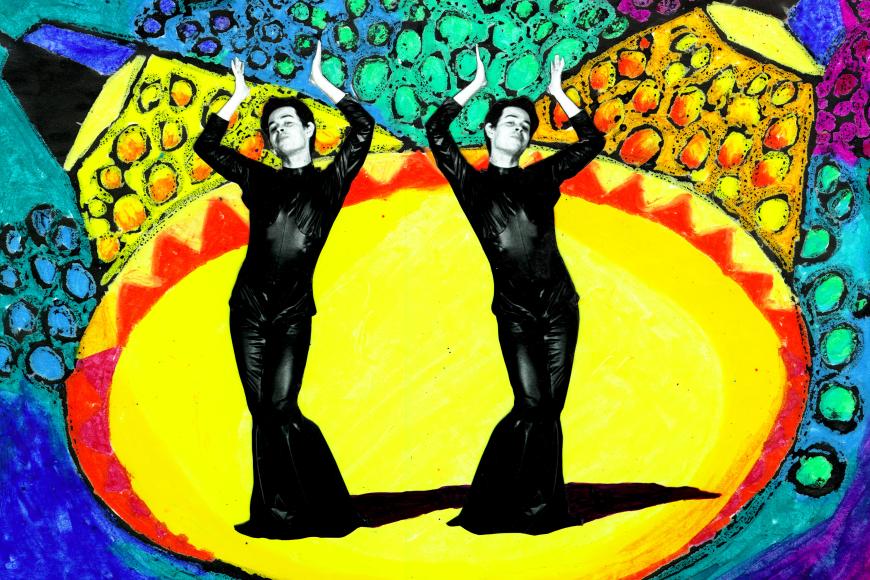
“Only transgression will bring salvation!” Amichat Lau is a rabbi, drag queen, father and revolutionary. The long-term portrait of a man to whom his faith is as important as his freedom.
“Who are you to change anything!?” Yisrael Meir Lau, once Ashkenazi Chief Rabbi of Israel, rages against non-orthodox movements in Judaism. His nephew, queer activist Amichai Lau-Lavie, has an answer that packs a punch: born in 1961 on Israel’s Independence Day, 38 generations of rabbis in his family tree, son of a Holocaust survivor, drag queen, today also an ordained rabbi and spiritual leader of an interdenominational Jewish congregation in New York. Amichai wants to be a “virus inside the system” to break patriarchal traditions and make Judaism more humane, more open. His drag alter ego urges: “Redemption will only come through transgression!” Director Sandi DuBowski followed his protagonist over more than twenty years. The long production period enabled him to document different phases in Amichai’s life, to show him celebrating, crying, doubting and triumphant. Supporters and critics comment on every decision and life change. The result is a complex portrait that sensitively introduces not only Amichai but also his family and congregation. An inspiring story that gives us hope.
Daria Janke
Credits
Director
Sandi DuBowski
Script
Francisco Bello, Jeremy Stulberg, Sandi DuBowski
Cinematographer
Kirsten Johnson, Wolfgang Held, Dan Gold, Laela Kilbourn, Dror Lebendiger, Sandi DuBowski, Nadia Hallgren
Editor
Jeremy Stulberg, Francisco Bello, Jeremy Stulberg, Kyle Crichton, Philip Shane
Vuk Jevremović, Juan Camilo González, Cecilia Traslaviña, Isabel Herguera, José Belmonte, Carlos Santa, Richard Reeves, Kemei Cheng, Liming Wang, Koldo Almandoz
A shipwreck, the fog bells of a lighthouse, the changing tides. A film as the result of an inter-oceanic workshop: an intuitive narrative, generated by a collective act of creation.
Vuk Jevremović, Juan Camilo González, Cecilia Traslaviña, Isabel Herguera, José Belmonte, Carlos Santa, Richard Reeves, Kemei Cheng, Liming Wang, Koldo Almandoz
Hommage: Isabel Herguera 2024
Animated Film
Spain,
Colombia,
China,
Oman,
USA,
Singapore
2013
6 minutes
English
Subtitles:
None
Tattooed skin, harbour music, the horror of a shipwreck, the fog bells of a lighthouse, the changing of the tides. This film about the glorious and deadly ocean, which pulls you down into the depths of the sea, is the result of an interoceanic workshop that uses the creative mechanisms of the cadavre exquis technique. An intuitive tale arises from a collective act of creation.
Franka Sachse
Credits
Director
Vuk Jevremović, Juan Camilo González, Cecilia Traslaviña, Isabel Herguera, José Belmonte, Carlos Santa, Richard Reeves, Kemei Cheng, Liming Wang, Koldo Almandoz
A girl, a passion: everything that flies high. The swing, the balloon. But then she falls into the clutches of a bird dealer. The only way out is through the window.
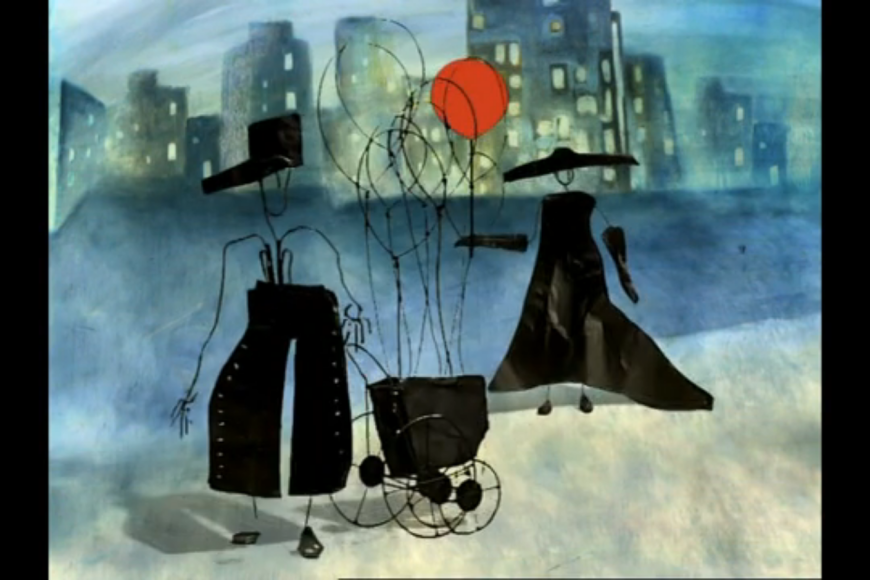
A film about a child with a passion: The little girl loves everything that flies high. She lets herself being pushed on the swing until she is almost out of the frame, and she loves her new balloon. But then she gets caught in the clutches of a bird dealer who locks her up in his flat on the top floor of a high-rise. The only way out is through the window.
In Laikipia, Kenya, indigenous shepherds and white ranch owners live in a fragile balance. But climate change and unresolved colonial tensions are increasingly calling this into question.
“It is places like Laikipia that make some Kenyans begin to ask: Are we really independent?” For centuries, this region in the central Kenyan highlands has been a grazing area for the Samburus’ animals. With colonialisation, white people began to settle there, built ranches and farmed cattle. After Kenya’s independence in 1963, they stayed on. So far, relations between them and the locals have been alright, albeit distant. Climate change, however, increases the potential for conflict in the country and intensifies the competition for resources. Laikipia has been suffering from the effects of global warming for several decades. Long periods of drought destroy the grassland the Samburu and their herds depend on. The white cattle farmers’ ranches and not least the privately managed and strictly guarded nature reserves cut through their traditional migration routes and block off the paths with electric fences. When elections are near, the disputes threaten to escalate. Daphne Matziaraki and Peter Murimi followed Kenyans of all parties over a period of five years and give them a chance to tell their stories in this film.
A cold winter’s night. Armoured in coolness, Nobody makes his lonely security guard rounds in the square, engrossed in his meandering reflections of life – melancholy of the streets.
The winter’s night draws its last breaths in the milky amber glow of the street lights. Snowflakes trickle down, the camera slowly circles a small guardroom in a driveway. Night after night, this lonely island is occupied by: Nobody. As a security guard in the cold, he guarantees the safety of the warm homes and their owners. He passes the time with a recalcitrant oil radiator, a calendar girl on a green meadow and his meandering thoughts. His security logs serve as a seismograph of reflections on life and nightly rounds of the square. Nobody is wrapped in a shell of coolness grown over a long time, which makes it hard for him to react to a rare smile the way he would like to in his heart. Nadia Hallgren and Jamie-James Medina condense an autobiographical short story by artist and musician Willis Earl Beal aka “Nobody”. The actor Michael K. Williams, who died in 2021, lent his voice to this inner monologue and gives it a sleepy, melodious sound. In this very cinematic, melancholy piece in a state of limbo, casual observations open a philosophical cosmos. But every time the journey of the mind crashes on the tarmac of the carpark in front of the block of flats.
André Eckardt
Credits
Director
Nadia Hallgren, Jamie-James Medina
Script
Willis Earl Beal
Editor
Spencer Campbell
Producer
Michael Stirton, Jamie-James Medina, Nadia Hallgren
Hollywood star Errol Flynn loves Havana, its casinos and its cocktails. As an eyewitness to the Cuban Revolution, he also learns to love Fidel Castro, the “Cuban Robin Hood.”
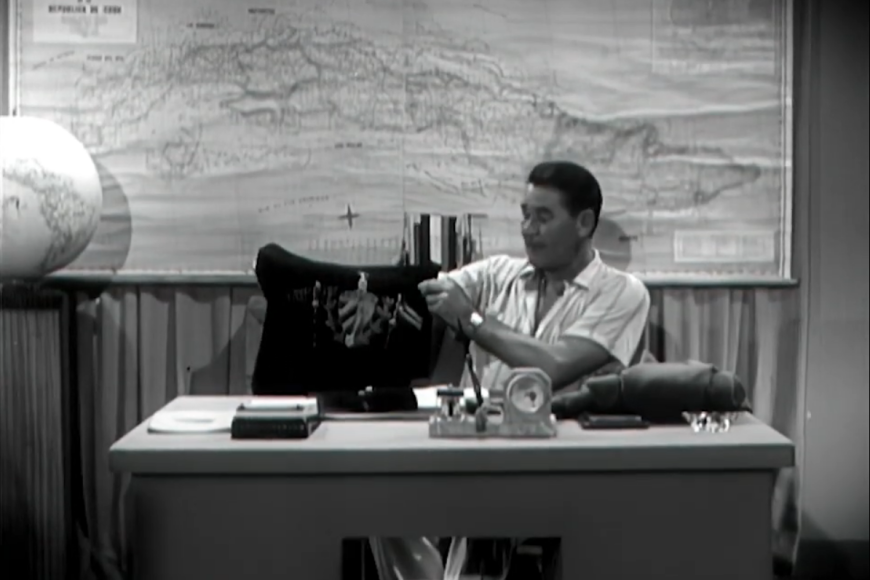
When Hollywood star Errol Flynn appeared on the Leipzig festival screen in 1960, he had been dead for a year. The audience saw him in his last role: as an aged lover – of Havana, casinos and cocktails, as the nemesis of the Cuban liberation movement, which had declared war on corrupt bon vivants like him. The movie swashbuckler rhapsodises about his Cuban counterpart Fidel Castro and nonchalantly moderates the history of the dictatorship and liberation of the island state, cigarette holder in hand. Did Hollywood call Leipzig to recommend this film? It was probably Moscow, because its world premiere is said to have taken place there in 1959. But how did the self-confessed anti-communist Errol Flynn come to make this declaration of love? Maybe his new friend Fidel did not tell him the whole truth?
Rectangular shapes in brilliant colours proliferate in a black void. The pioneer of computer animation uses 2D programming language to simulate strange fantastic galaxies.
Rectangular shapes in luminous colours proliferate in a black void. They resemble phosphenes, the subjective perceptions of lights that can appear when we rub our closed eyelids. Coloured round surfaces circle each other, even though they live in separate graphic worlds. Lillian Schwartz, pioneer of computer animation, uses the EXPLOR 2D programming language to simulate strange and fantastic galaxies.
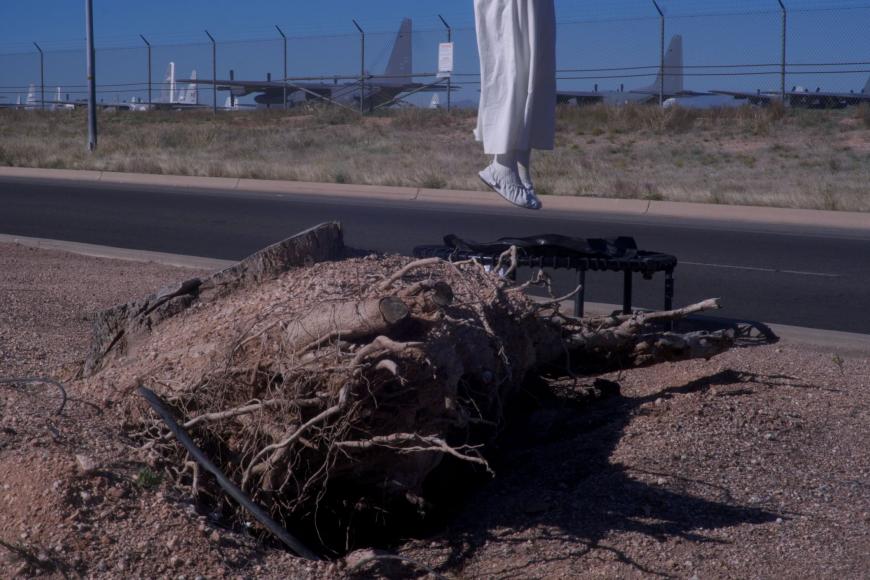
A Saudi artist is trampolining at a military airfield in Arizona. She would have to lift off to get home. A struggle not just with gravity, but with the patriarchy.
The aeroplanes are stationary, nothing moves, nothing takes off at the US military airbase in Arizona – until a young woman in a white dress begins to jump on a trampoline outside the fence, framed by an idyllic sunset. She conveys her story from the silent offscreen – only through subtitles. Having come from Saudi Arabia, she is stuck in the US because her father stole her identity papers. So homesick that she is considering drastic measures to get back home, she almost enlists in the military. But the US Army is suspicious and would not station her, a risk factor, anywhere near the Middle East. But there is a Baghdad in Arizona, too … Artist Samar Al Summary’s work is an investigation into systems of power. She does not only talk about herself, the prejudices and obstacles she faces as a Saudi woman, but also about the crash of two Iraqi air force pilots who were to be trained by the US Air Force but never made it home either. In her dramatically condensed film essay, she takes up the symbolic fight – both against gravity, which she can at least temporarily defy by using cinematic means, and against patriarchy. The latter, however, is not so easy to fight.
Borjana Gaković
Credits
Director
Samar Al Summary
Cinematographer
Samar Al Summary
Producer
Samar Al Summary
Nominated for:
Silver Dove
Winner of:
Silver Dove Short Film (International Competition Documentary Film)