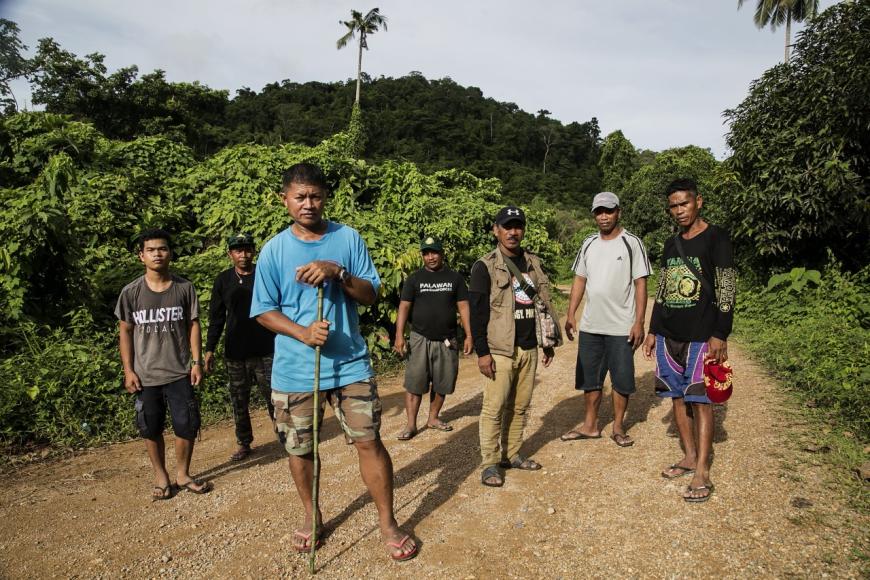
A gripping documentary thriller about a group of Filipino activists who prevent illegal clearances in the rainforest by stealing the loggers’ chainsaws.
On the island of Palawan in the Philippine archipelago, more and more rainforest is falling victim to the saws. The clearances have long been illegal but are protected and even initiated by President Duterte’s corrupt regime. Local resistance is forming. A group of courageous men around a determined human rights lawyer decide to react. They sneak into the forests to take away the logging teams’ chainsaws, cars and boats. This exciting film, constructed like a thriller, follows them on their dangerous missions, which they call “meta-legal”. But the price is high: Some of the activists pay for their resistance with their lives.
Luc-Carolin Ziemann
Credits
Director
Karl Malakunas
Cinematographer
Tom Bannigan
Editor
Michael Collins, Eric Daniel Metzgar
Producer
Marty Syjuco, Michael Collins, Kara Magsanoc-Alikpala
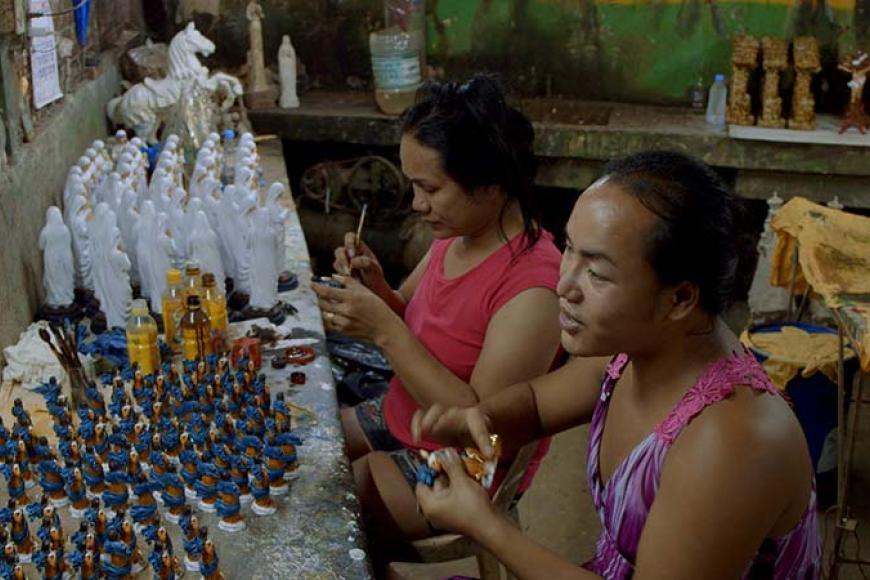
A factory for statues of Catholic saints in a city near Manila, portrayed as a microcosm of economic, social and religious conditions on the Philippines.
When the time “when St. Joseph came” is mentioned in this film, it doesn’t refer to a religious phenomenon, but to the most popular product of TML Holy Crafts Incorporated. In the factory on the Philippines, the country with the third-largest Catholic population in the world, the employees manufacture statues of saints under exploitative conditions. Joseph Mangat portrays this place with a focus on the workers, including some from the LGBTQI community.
In the first scene, a plaster bust is uncovered layer by layer. This image could also serve to describe the approach of “Divine Factory”: From the shop to the workshop, from the entrepreneur to the simple worker, from the production to the uses made of the religious articles, this film reveals the social and economic facets of this institution. The Filipino director not only observes precisely how people work and trade there, he also involves the participants in frank conversations about love, wages and living conditions. The employees’ profit-oriented payment model reveals how economical and religious ideas interlock. The success of the company in the city of Antipolo near Manila, desirable for all, thus appears as nothing short of a divine blessing.
Jan-Philipp Kohlmann
Credits
Director
Joseph Mangat
Cinematographer
Albert Banzon
Editor
Ilsa Malsi, Joseph Mangat
Producer
Alemberg Ang, Stefano Centini
Sound
Duu-Chih Tu
World Sales
Lya Li
Nominated for:
FIPRESCI Prize,
Prize of the Interreligious Jury
Where are the spaces for the LGBTQIA2S+ culture in Russia? This AR experience opens a digital safe space for the drag scene where they can perform without fear of violence.
The LGBTQIA2S+ community in Russia is facing an increasingly hostile social climate, is tabooed and criminalised. The AR experience opens a digital safe space for the local drag scene where they can perform without fear of violence. At the same time, this artistic occupation of heteronormatively dominated places is a political intervention.