A Prague food stall has run out of beer. Regular Hurikán takes matters into his own hands. An epic parkour in the drowsy but steep side streets of the city begins.
Beer is out in Prague … well, actually only at a food stall away from the touristy Old Town. But that doesn’t make the death rattle of the spigot less dramatic for Hurikán, a regular who spends his days and much of his nights at these haunts of lost souls. With a crush on the stall manager, Hurikán takes matters into his own hands. Things get rolling, just like the empty barrel he wants to have filled. An epic parkour begins, starting with small mocking gestures and rapidly expanding into a breakneck chase through the drowsy but steep side streets of Prague’s Žižkov neighbourhood. With brilliant timing and tongue-in-cheek humour, Jan Saska weaves typical genre elements from comics and action movies together, all revolving around a guy whose life is not easy. This time he needs luck if he does not want to die of thirst.
André Eckardt
Credits
Director
Jan Saska
Script
Jan Saska, Václav Hašek
Editor
Jan Saska
Producer
Kamila Dohnalová, Martin Vandas
Co-Producer
Antoine Lietout, Ivan Zuber, Juraj Krasnohorsky, Mladen Đukić, Alena Vandasová
Sound Design
Jiří Gráf
Animation
Marek Pokorný, Michaela Večerková, Jan Saska, Camille Chao, Hugo de Faucompret, David Štumpf, Jean-Christophe Lie, Félicia Gillibert, Delphine Grelet
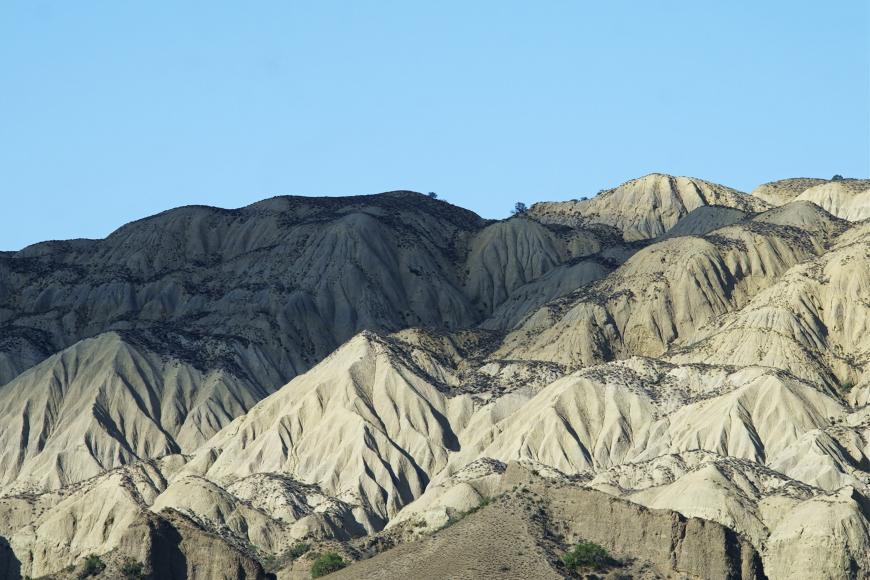
After the death of her grandparents, the director finds an expression for her grief in surreal rock and landscape formations. An associative, free-floating tour of inspection.
Surreal formations, stalactites, rocks moulded by water and poisonous bubbling. The images that turn into an exploration of her own soul for Paula Ďurinová seem like a dream landscape. Grief plays a key role – Ďurinová’s grandparents both died during the Covid pandemic. She looks for them between the gases and fumes, dives through a body of water that has ceased to exist but in whose cool freshness her grandfather once bathed his feet and across which she used to swim with her grandmother. “Lapilli” works in an associative and abstract way. At the same time, the minerals recovered by Ďurinová have something very concrete about them: compressed, buckled and broken, sharp-edged, corroded or gently polished. At one point, the director compares herself to a stone detached from its rock, questioning and without orientation, drifting around: “I don’t feel the ground anymore.” “Lapilli” leaves no doubt that feelings of pain and helplessness can harbour greater strength, but also a very special poetry and beauty. The interplay with an organic experimental soundscape opens up an intimate, almost universal experience.
Family obligations, her autistic sister’s needs and her own dream of studying psychology – 18-year-old Johanna must find the courage to take a life-changing decision
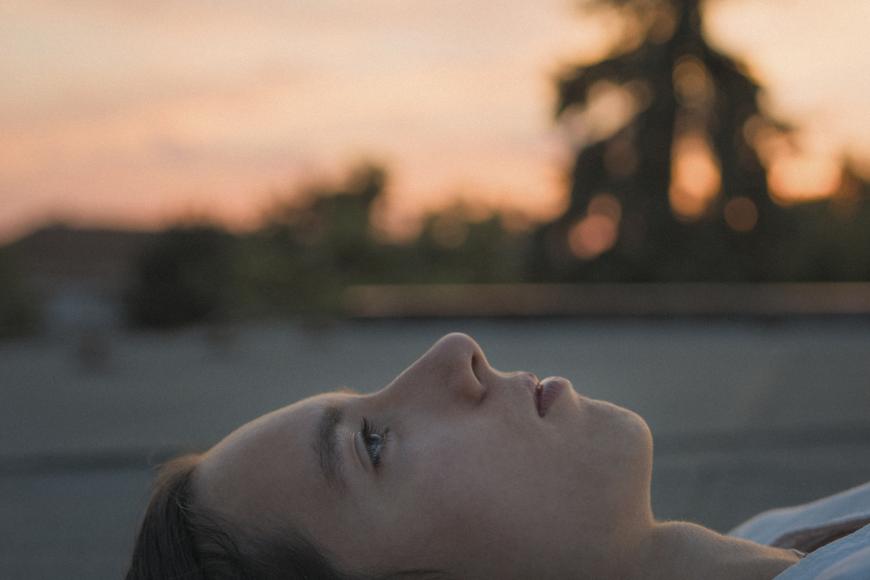
There is something very subtle about the moment when children become adults that it can hardly be put into words. In fact, hidden, almost imperceptible changes suddenly appear that act like tectonic shifts in the human psyche. In her documentary debut, Marie-Magdalena Kochová has managed to capture this subtle move. She documents the life of 18-year-old Johana, who lives with her parents and her younger sister in a small town in the Czech Republic. The sister has autism. Her health condition is severe and unpredictable. Her hysterical fits and aggressive outbursts dictate the life of the whole family. All the schedules are synchronised so that someone is always with the youngest. The well-practised routine is threatened when Johana decides to apply for a study programme in psychology at the university after her school exams. This means that she will soon have to move to another city, leaving the entire burden on the parents. Kochová shows us a transitional period in anticipation of massive changes, which requires everyone involved to have firm confidence in their own decisions. The mental tension is palpable, but the camera maintains an equalising distance. Step by step, the beauty of a challenged life unfolds, where courage becomes the only measure.
Vika Leshchenko
Credits
Director
Marie-Magdalena Kochová
Script
Marie-Magdalena Kochová
Cinematographer
Ludvík Otevřel, Kristina Kůlová, Marie-Magdalena Kochová
Editor
Simona Donovalová
Producer
Vít Poláček, Petr Kubica, Aleš Hudský, Barbora Drtílková
Co-Producer
Matej Sotník, Veronika Slámová, Tomáš Šimon, Lenka Medová
Those who confide their secret desires to astrologer Luciana and seek advice are unerringly sent to a place for a new beginning. Entertaining dramas and the big questions in life.
Luciana’s office is a place of miracles. This is where strangers confide in her, share their most profound desires and concerns. And Luciana? She circles her huge magnifying glass over the pages of old books to soon find the perfect coordinates for a spiritual new beginning. In his new film, Peter Kerekes becomes nothing less than a witness to psychomagical acts. The Neapolitan astrologer is not only able to calculate the perfect birthday spot for those who seek advice – in her blunt way, she aims right at the centre of personal dramas. A pair of identical twins, for example, argue whether one of the sisters should fulfil the other’s longing for a child, while an unhappy mother yearns to rekindle her relationship. Luciana sends the twins to Beirut, the mother to Alaska. Kerekes accompanies them on their journeys of salvation, even if Alaska turns into an air conditioner and a few buckets of ice cubes for reasons of practicality. He always brings out the comic potential of a story while pointing out complicated conflicts with astonishing poignancy: possessive mother figures and absent fathers, loneliness in a relationship and the fear of change. “Wishing on a Star” is a charming consultation that boldly confronts the big questions in life.
Carolin Weidner
Credits
Director
Peter Kerekes
Script
Peter Kerekes, Erica Barbiani
Cinematographer
Martin Kollar
Editor
Marek Sulik
Producer
Erica Barbiani, Lucia Candelpergher
Co-Producer
Peter Kerekes, Anna Mach Rumanová, Ralph Wieser, Vit Schmarc, Vanja Jambrovic, Tibor Keser