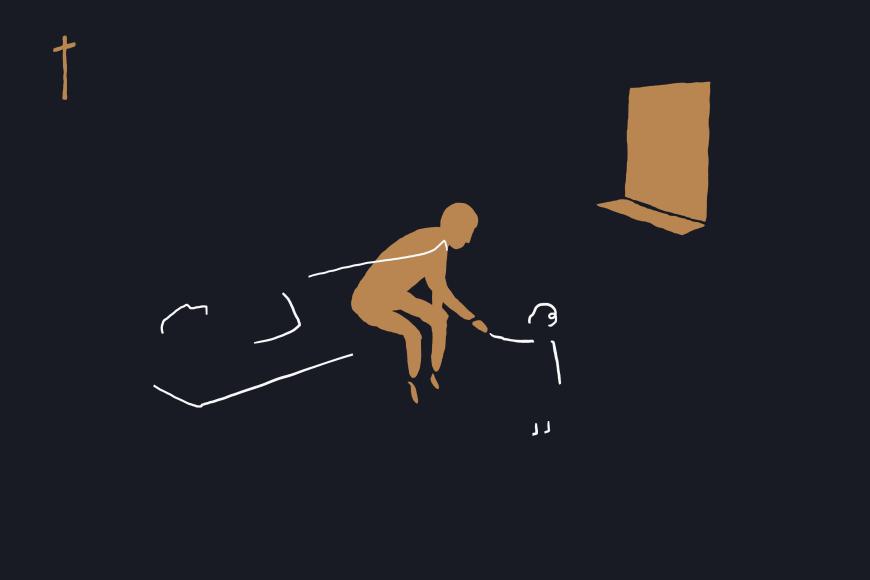
Children who are stillborn or die too young – not an uncommon fate. But society hardly ever talks about it. This film gives parents a space to grieve and break the silence.
“Apparently, it had to happen to me before I learned it was ‘normal’.” This statement by a protagonist sums up how our society deals with stillborn children or children who die young: Star children are omnipresent (one in four mothers has lost a child) and yet absent. We lack the vocabulary, the sensitivity, and the tranquillity to enable parents to mourn. Remo Rauscher’s animated documentary confronts us with this inability, letting twenty people in mourning or who deal with mourning speak: Thinking out loud, struggling for words, regarding the pain from different perspectives, discovering dignity and strength in it and helping us to overcome the taboo. They object to being an “error in the system”, to accepting the speechlessness. In Rauscher’s film, the darkness is ambivalent and palpable on all levels: It is absorbing and caring. It is generous and gives us moments of beauty, humility, and hope. The 2D animations in muted colours on a dark background are always abstract, sketchy, and restrained – an expression of tact and respect. They draw attention to themselves only once in a while, while the voices are given a lot of space and can unfold without fear. This film opens a space to mourn that society is unable to offer yet.
A storm of queer norm-busting archive images. The creative arrangement is as sensual as the material, including purple colour explosions and a jazz music leitmotif.
“Folks, I’m telling you, birthing is hard and dying is mean – so get yourself a little loving in between.” This advice of the African-American civil rights activist and jazz poet Langston Hughes precedes Jyoti Mistry’s found footage storm of images and runs like a guiding line through the archive material, a panopticon of revelries: parties, boxing matches, visits to the beach and above all, time and again, testimonies of lived queer sexuality. Sometimes clandestine, sometimes quite public.
Mistry mirrors the uninhibitedness of her sources in the way she arranges them – not neatly staggered but boldly mixed. The associative editing often virtually leaps into the images, linking them with purple colour explosions and three-dimensional animations of shoals of fish. On the soundtrack, a spoken word performance joins multi-channel dubbed noises and countless variations of the jazz standard “Diga Diga Doo.” This is how the film wrests its testimonies from the past and returns them to their inherent liveliness and transgressive explosive power.